Building a High-Conversion Digital Foundation
The best ways to market small business success come down to a focused set of tactics — not a hundred things at once. If you’re short on time, here’s what actually moves the needle:

Quick Answer: Best Ways to Market a Small Business
- Optimize your Google Business Profile — free, local, and high-intent
- Build a fast, mobile-friendly website with clear calls to action
- Use email marketing — it returns $36 for every $1 spent on average
- Post consistently on 1–2 social media platforms your customers actually use
- Publish SEO-focused content (blogs, videos) for long-term organic traffic
- Run targeted paid ads (Google or social) with retargeting for warm leads
- Ask for reviews — 82% of consumers read them before choosing a local business
- Build a referral or loyalty program to turn customers into advocates
Most small business owners don’t have a marketing budget problem. They have a focus problem.
They’re spread across six platforms, posting inconsistently, with a website that loads slowly on mobile and a Google Business Profile they set up in 2019 and never touched again.
Meanwhile, 46% of all Google searches have local intent — meaning nearly half the people searching right now are looking for something near them. And 88% of consumers who find a local business on mobile call or visit within 24 hours.
The opportunity is real. The question is whether your business shows up — and whether it makes a strong enough impression to convert.
This guide cuts through the noise. It covers the highest-impact marketing strategies for small businesses in 2025–2026: from building a digital foundation that actually converts, to content that compounds over time, to paid ads that scale without waste. No fluff, no growth hacks — just a clear system you can build and measure.
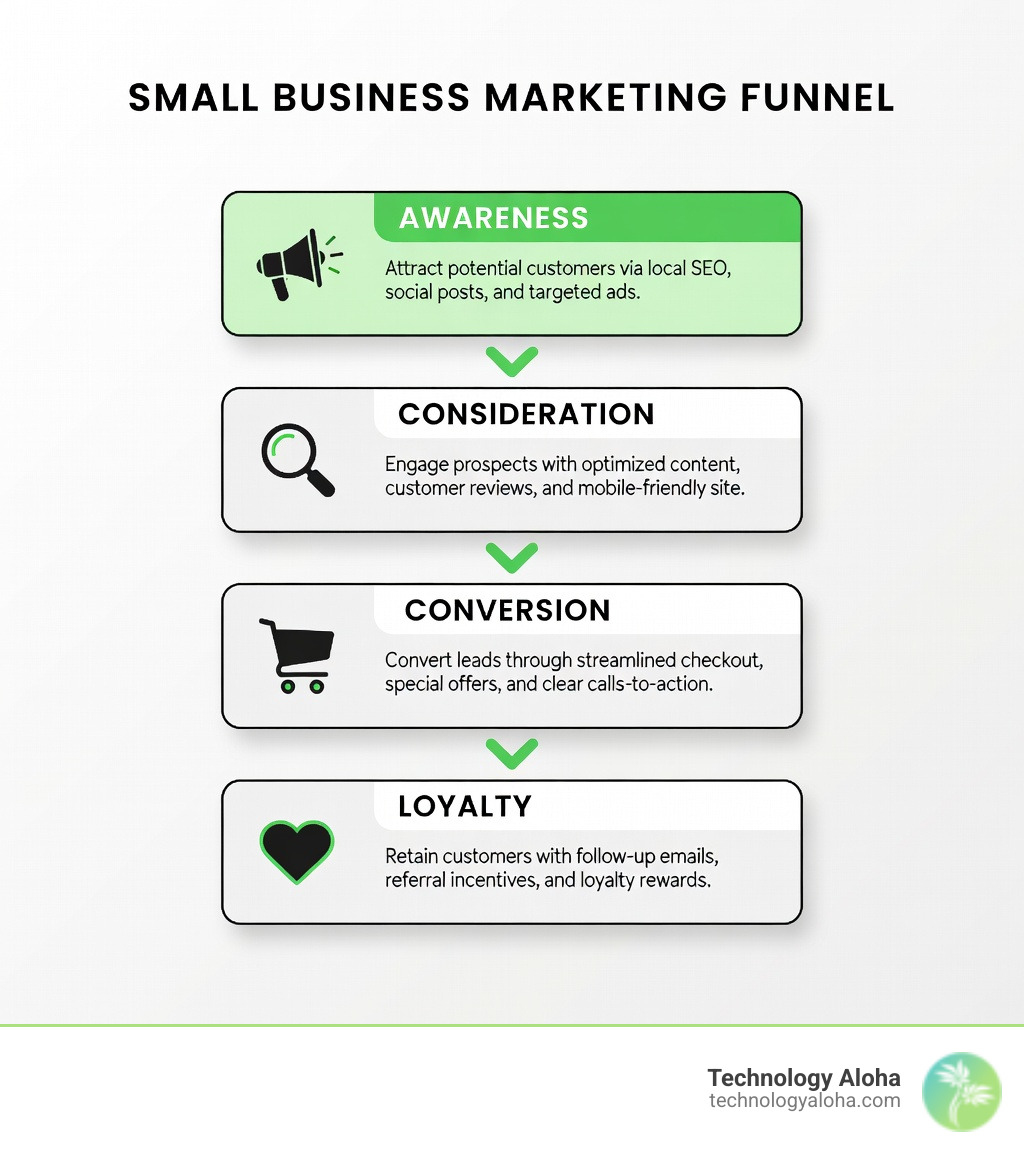

Your website is the digital headquarters of your business. If it isn’t optimized, every dollar you spend on marketing is being poured into a leaky bucket. Every additional second of website load time decreases conversions by 7%, meaning a slow site is literally costing you sales.
Because over 60% of searches happen on mobile devices, a mobile-first design is no longer optional. A high-converting site must have a clear value proposition visible within seconds of landing on the page. Visitors should immediately know who you help, how you help them, and what action they need to take next. Use clear headlines, professional imagery, and prominent “Call to Action” (CTA) buttons like “Book Now” or “Get a Quote.”
Best Ways to Market Small Business Local Visibility
For local businesses in Hawaii, visibility starts with the “Map Pack.” Setting up your Google Business Profile correctly is the most effective low-budget tactic available. Businesses with photos on their profile receive 42% more requests for directions than those without.
To dominate local search, you must maintain NAP consistency (Name, Address, Phone number) across the web. This includes your website, Yelp for business, and local directories. Google uses this consistency to verify your business’s legitimacy. Furthermore, Google Maps marketing relies heavily on social proof; 82% of consumers read online reviews for local businesses. Make it a standard practice to ask happy customers for reviews at the moment of peak satisfaction.
Essential Lead Capture and CRM Integration
Traffic is useless if you don’t capture it. Most visitors won’t buy on their first visit, so you need a way to stay in touch. Creating a marketing strategy that includes lead capture—such as a newsletter sign-up or a free downloadable guide—allows you to nurture prospects over time.
Integrate these forms with a Customer Relationship Management (CRM) system. A CRM helps you map the customer journey, ensuring no lead falls through the cracks. It allows you to track where your leads come from and how long it takes to convert them, which is essential for calculating your true marketing ROI.
The Best Ways to Market Small Business Growth Through Content
Content marketing is an investment in your business’s future. Unlike paid ads, which stop generating leads the moment you stop paying, blogging can help your business generate traffic for years. By answering the questions your customers are actually searching for, you build trust and authority before they ever speak to a salesperson.
Successful small business SEO requires a focus on local relevance and user intent. Use tools like AnswerThePublic or Google Search Console to find long-tail keywords specific to your niche. When you build a brand with SEO, you aren’t just chasing rankings; you are creating a library of resources that solve your customers’ problems.
Leveraging Short-Form Video and Social Media
Social media is no longer just for “brand awareness”—it is a powerful tool for engagement and conversion. There are over 4.48 billion active social media users, and the benefits for small businesses are significant if you choose the right platforms. Instead of trying to be everywhere, pick one or two platforms where your audience hangs out.
Short-form video content on Instagram Reels, TikTok, and YouTube Shorts is currently the most effective way to reach new audiences organically. Almost 70% of people prefer videos over other mediums when learning about new products. Use these platforms to show “behind-the-scenes” footage, customer testimonials, or quick tips. Remember to use captions; 80% of social videos are watched on mute. Consistent Facebook marketing and a strong social presence build a community that feels connected to your brand.
Building Authority with Educational Content
Thought leadership isn’t just for CEOs of massive corporations. As a small business owner, you are an expert in your field. A strategic guide to marketing should involve sharing that expertise freely. Whether it’s a video tutorial on how to maintain a tropical garden in Hawaii or a blog post on choosing the right roofing material, educational content positions you as the “go-to” expert.
Your brand story is the “why” behind your business. Branding tips for small business often emphasize that people buy from people they like. Share how your business came to be and the specific problems you are passionate about solving. This authenticity creates a competitive advantage that big-box retailers cannot replicate.
Driving Repeat Sales with Email and Loyalty Programs
Email marketing is the powerhouse of small business ROI, generating an average of $36 for every $1 spent. It is your direct line to your customers, free from the whims of social media algorithms. However, the key to success is list segmentation. Instead of sending the same “blast” to everyone, group your subscribers by their interests, purchase history, or location.
Personalized messaging is essential for reputation management. When you send relevant content to the right person at the right time, you strengthen the branding of your small business. This leads to higher open rates, fewer unsubscribes, and more repeat sales.
Best Ways to Market Small Business Loyalty
It is far cheaper to keep an existing customer than to acquire a new one. Finding your niche allows you to speak directly to a specific audience and build deep loyalty. Referral programs are a proven way to generate word-of-mouth growth. By offering a small incentive—like a discount or a free gift—to customers who refer their friends, you turn your best customers into a volunteer sales force.
Community involvement also drives foot traffic and trust. Sponsoring a local youth team or partnering with a neighboring business for a cross-promotion shows that you care about more than just the bottom line. These local marketing tactics create “customer energy” that digital ads simply can’t match.
Automated Nurture Sequences
You don’t need to spend all day sending emails. Free tools for small business allow you to set up automated “drip” sequences that work while you sleep. Essential sequences include:
- Welcome Series: Sent immediately after someone joins your list to introduce your brand.
- Abandoned Cart: A gentle reminder for e-commerce customers to complete their purchase.
- Re-engagement: A “we miss you” email sent to customers who haven’t purchased in a while.
Scaling with Paid Advertising and Data-Driven Insights
When you are ready to grow faster, paid advertising allows you to “buy” traffic. However, you must track your marketing ROI%20/%20Marketing%20Cost) meticulously to ensure profitability. For small businesses, Google Ads are excellent for capturing “high-intent” searches—people looking to buy now.
| Feature | PPC (Paid Search) | Organic SEO |
|---|---|---|
| Speed | Instant results | Takes 3–6 months |
| Cost | Pay per click | Investment in time/content |
| Sustainability | Stops when budget ends | Compounds over time |
| Intent | High (ready to buy) | Educational/Informational |
If managing these campaigns becomes overwhelming, you might consider outsourcing social media or ad management to experts who can optimize your spend. One advanced tactic is using “lookalike audiences,” where platforms like Facebook find new people who share characteristics with your current best customers.
Measuring ROI and Key Performance Metrics
You cannot manage what you do not measure. Every small business should track common marketing ROI metrics like Customer Acquisition Cost (CAC) and Cost Per Lead (CPL). If it costs you $50 to acquire a customer who only spends $30, your marketing is not sustainable.
Use Google Analytics (GA4) and Search Console to see which pages are driving traffic and conversions. If you use WordPress, there are essential plugins that can help you track these metrics directly from your dashboard. Aim for a Return on Ad Spend (ROAS) of at least 3:1 to ensure your campaigns are covering their own costs and contributing to profit.
Budgeting for Sustainable Growth
According to recent data, the average marketing budget for small businesses in 2025 ranges from $50 to $6,000 per month. Most established businesses allocate 5–10% of their total revenue to marketing. If you are in a high-growth phase, that number might climb to 20%.
The Small Business Marketing Playbook suggests starting small. Test one variable at a time—like a new ad headline or a different email subject line—and only increase the budget once you see a positive return. Cut the “waste” by stopping any campaigns that aren’t meeting your CPL targets and double down on the winners.
What are the key takeaways for small business marketing success?
The best ways to market small business success aren’t about chasing every new trend. They are about building a solid foundation of data-driven insights and cohesive branding. By focusing on compounding systems—like SEO, email automation, and a stellar Google Business Profile—you create a marketing engine that grows stronger over time. Smart, strategic marketing is the key to turning a small business into a local staple.
How much should a small business budget for marketing?
Most small businesses should aim to spend 5–10% of their gross revenue on marketing. If you are just starting or trying to expand rapidly, you may need to invest 10–20%. The actual dollar amount often ranges from $50 to $6,000 per month. The most important factor isn’t the total amount spent, but the ability to track ROI so you know every dollar is making an impact.
When should I hire a marketing agency versus doing it in-house?
You should consider hiring an agency when your marketing tasks are preventing you from running your business, or when you hit a growth plateau that you can’t break through on your own. Agencies provide advanced expertise in areas like SEO and paid ads that are difficult to master as a DIY-er. Outsourcing social media or web maintenance can often pay for itself by freeing up your time to focus on high-value sales and operations.
What are the most common marketing mistakes to avoid?
The biggest mistake is inconsistency—posting once a month or running an ad for three days and quitting. Other common pitfalls include trying to be on too many platforms at once, which spreads your focus too thin, and ignoring your data. Finally, poor branding and messaging can make even the most expensive ad campaigns fail. Keep your message clear, your visuals consistent, and your strategy rooted in what your customers actually want.