The Ultimate Guide to Marketing Plan
Why Every Business Needs a Marketing Plan Before Spending a Dollar
A marketing plan is a structured document that defines who you’re targeting, what you’ll say, where you’ll say it, how much you’ll spend, and how you’ll measure results — typically across a 12-month period.

Quick answer: What is a marketing plan?
- What it is — An operational roadmap that translates business goals into specific marketing actions
- What it covers — Target audience, channels, messaging, budget, timeline, and KPIs
- How long it takes — 4–8 weeks to write your first plan; a few weeks to update annually
- Who needs one — Every business, regardless of size or budget
- Key outcome — Businesses with a marketing plan are nearly seven times more likely to report success than those without one
Here’s the uncomfortable truth: most small businesses don’t fail at marketing because their product is wrong. They fail because they’re guessing — posting without a strategy, spending without a system, measuring without a baseline.
A marketing plan fixes that.
Think of it as a GPS for your business. You still drive. You still make decisions. But you’re not circling the same block wondering why you haven’t arrived yet.
The research is clear: businesses that set specific marketing goals and document their approach dramatically outperform those that don’t. That gap isn’t about budget. It’s about structure.
This guide walks you through every component of a marketing plan — from situation analysis and buyer personas to budget frameworks and KPIs — so you can build one that actually gets executed, not just filed away.
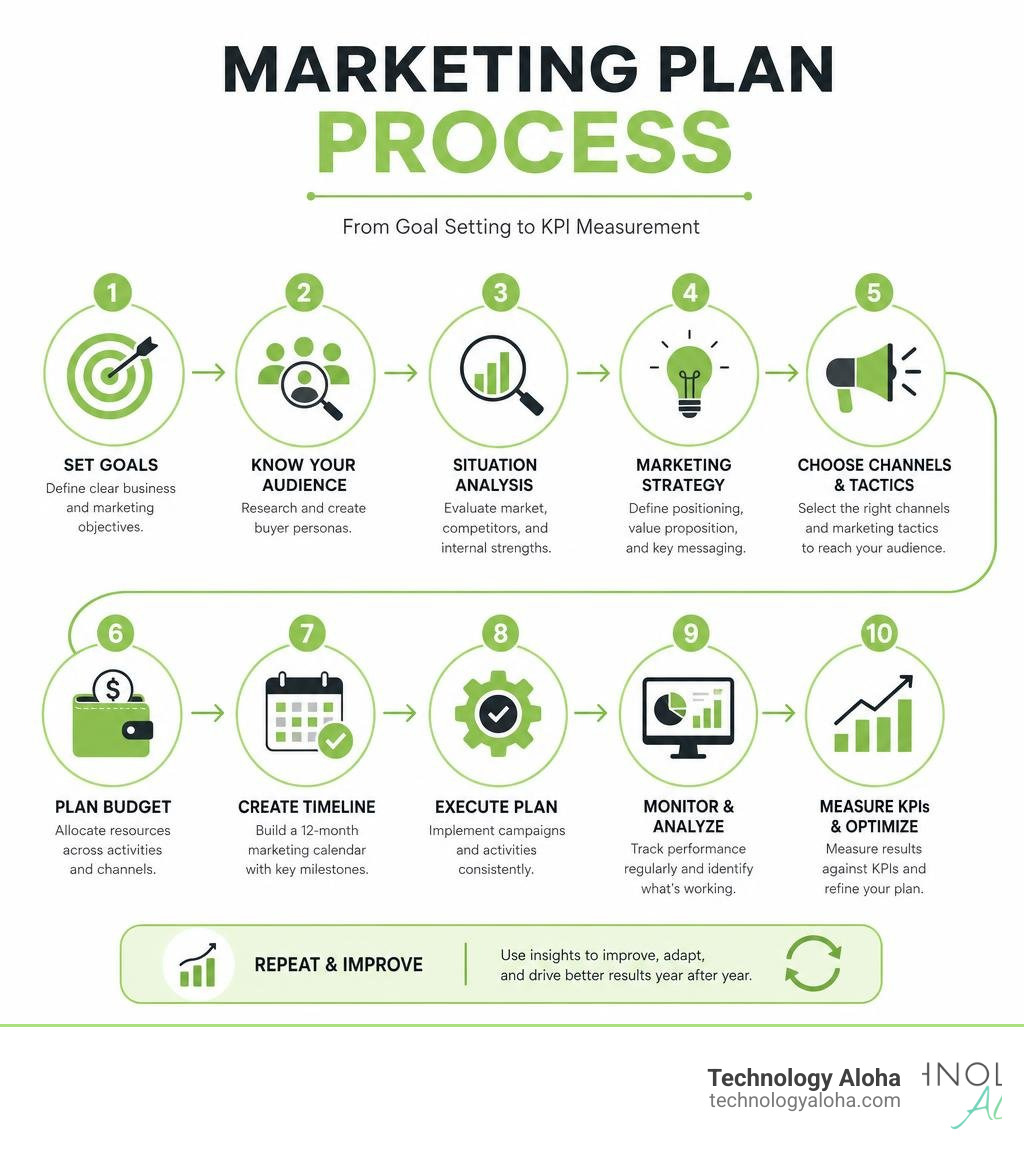
What is a Marketing Plan and How Does It Differ From Strategy?
To build an effective plan, we must first clear up a common source of confusion: the difference between a business plan, a marketing strategy, and a marketing plan. While these terms are often used interchangeably, they serve entirely different operational purposes.
A marketing plan is an operational roadmap. It is highly tactical, execution-focused, and typically mapped to a strict 12-month timeline. While your strategy determines the overall direction, the plan outlines the exact actions your team will take on Monday morning to generate leads and close sales.
To understand why this operational focus is so critical, read our guide on Marketing Basics: Importance of a Digital Marketing Strategy.
The easiest way to understand how these elements work together is to look at their scope, timeline, and primary questions answered:
| Document | Primary Focus | Timeline | Key Questions Answered |
|---|---|---|---|
| Business Plan | Whole-organization operations, finances, HR, and long-term viability | 3–5 years | What do we sell, how do we operate, and is this business financially viable? |
| Marketing Strategy | High-level market positioning, brand identity, and value proposition | Multi-year | What is our message, why does it matter, and who is our ideal customer? |
| Marketing Plan | Channel-specific tactics, budget allocations, content calendars, and campaign owners | 12 months | How will we reach our audience, when will we launch campaigns, and how much will we spend? |
Without a documented marketing plan, even the most brilliant marketing strategy remains a collection of high-level ideas. The plan is what bridges the gap between theory and revenue. For a deeper look at setting up your initial roadmap, check out How to Write a Marketing Plan.
Business Plan vs. Marketing Strategy
A business plan takes a macro view of your organization. It details your corporate mission, financial projections, operational requirements, and staffing needs. It is the document you present to banks or investors to prove your business can survive.
A marketing strategy sits beneath the business plan. It focuses entirely on your market positioning and long-term brand vision. It defines your unique value proposition — the reason customers should choose you over a competitor — and establishes your core brand messaging pillars. If you are launching a new venture, establishing this strategy is your first critical step. Learn how to outline yours in our guide on How to Create a Marketing Strategy for Your New Business.
How to Build a Strategic Roadmap Step-by-Step
Building a marketing plan is a systematic process. It requires moving from broad market observations to highly specific tactical execution. We begin this process with a situation analysis, which is an objective look at where your business stands in the market today.
The foundation of any situation analysis is a SWOT analysis. This framework forces you to evaluate internal factors (Strengths and Weaknesses) and external market realities (Opportunities and Threats):

Once your SWOT analysis is complete, you can apply the classic “5 Ps of Marketing” to refine your market positioning:
- Product — What are you selling, and how does it solve a specific customer pain point better than the alternatives?
- Price — What is your pricing strategy? Are you positioning as a premium service provider or a high-volume, cost-effective option?
- Place — Where can customers find and buy your product? (e.g., online, in-store, or via direct sales).
- Promotion — What channels and messaging will you use to attract attention and drive conversions?
- People — Who on your team is responsible for delivering the customer experience and executing the plan?
By combining your SWOT analysis with the 5 Ps, you gain a clear, objective picture of your current market position. This prevents you from building a plan based on assumptions. For a complete breakdown of how to structure this baseline, read An Essential Guide to Marketing Plan for Small Business.
Essential Components of a Comprehensive Marketing Plan
A comprehensive marketing plan must translate your high-level strategy into actionable daily tasks. To achieve this, your document should include these essential sections:
- Executive Summary — A one-page overview of your marketing goals, target audience, and key initiatives for the upcoming year. (Pro tip: Always write this section last).
- Situation Analysis — Your SWOT analysis, competitor audits, and current market trend data.
- Brand Positioning & Messaging — Your unique value proposition and the core messaging pillars that all marketing assets must reinforce.
- Target Audience & Buyer Personas — Detailed profiles of your ideal customer segments based on real data.
- Channel Strategy — A clear outline of the organic and paid marketing channels you will use to reach your audience.
- Action Plan & Content Calendar — A timeline of specific campaigns, content themes, and launch dates.
- Budget Allocation — A detailed breakdown of marketing spend by channel, campaign, and quarter.
- Accountability Matrix — A clear list of who owns which KPI to ensure execution doesn’t stall.
To kickstart your planning process with a structured framework, you can download a pre-built template such as the Marketing Plan Template.
Conducting Market Research and Competitive Analysis
You cannot market effectively in a vacuum. To win market share, you must understand exactly who you are competing against and where the market is heading.
Start by conducting a thorough competitor audit. Identify your direct competitors (those offering the same solution) and indirect competitors (those solving the same problem with a different product or service). Analyze their pricing, positioning, content strategy, and customer reviews. Where are they winning? Where are they failing to meet customer expectations?
Next, analyze broader market trends. Look at shift patterns in consumer behavior, emerging technologies, and search trends. For instance, in 2026, generative AI search visibility has fundamentally changed how consumers discover local services. Understanding these shifts allows you to adapt your strategy before your competitors do. For step-by-step guidance on analyzing your competitive landscape, see The No-Nonsense Guide to Creating Your Small Business Market Strategy.
Defining Target Audiences and Creating Buyer Personas
A common mistake is trying to appeal to everyone. When you speak to everyone, you connect with no one. An effective marketing plan relies on highly defined target audiences and detailed buyer personas.
Instead of relying on generic demographic assumptions, build your personas using real customer data, CRM insights, and direct interviews. A complete buyer persona should map out three core areas:

When building your personas, start with your highest-LTV (Lifetime Value) customer segment. Focus heavily on their emotional triggers: What keeps them up at night? What does success look like for them? What barriers prevent them from purchasing? By understanding these pain points, you can write copy that resonates deeply and choose the exact channels where your audience already spends their time.
Setting SMART Objectives, Budgets, and Channels
Once you have defined your audience and analyzed your market, you must establish clear goals, allocate your financial resources, and select your marketing channels.
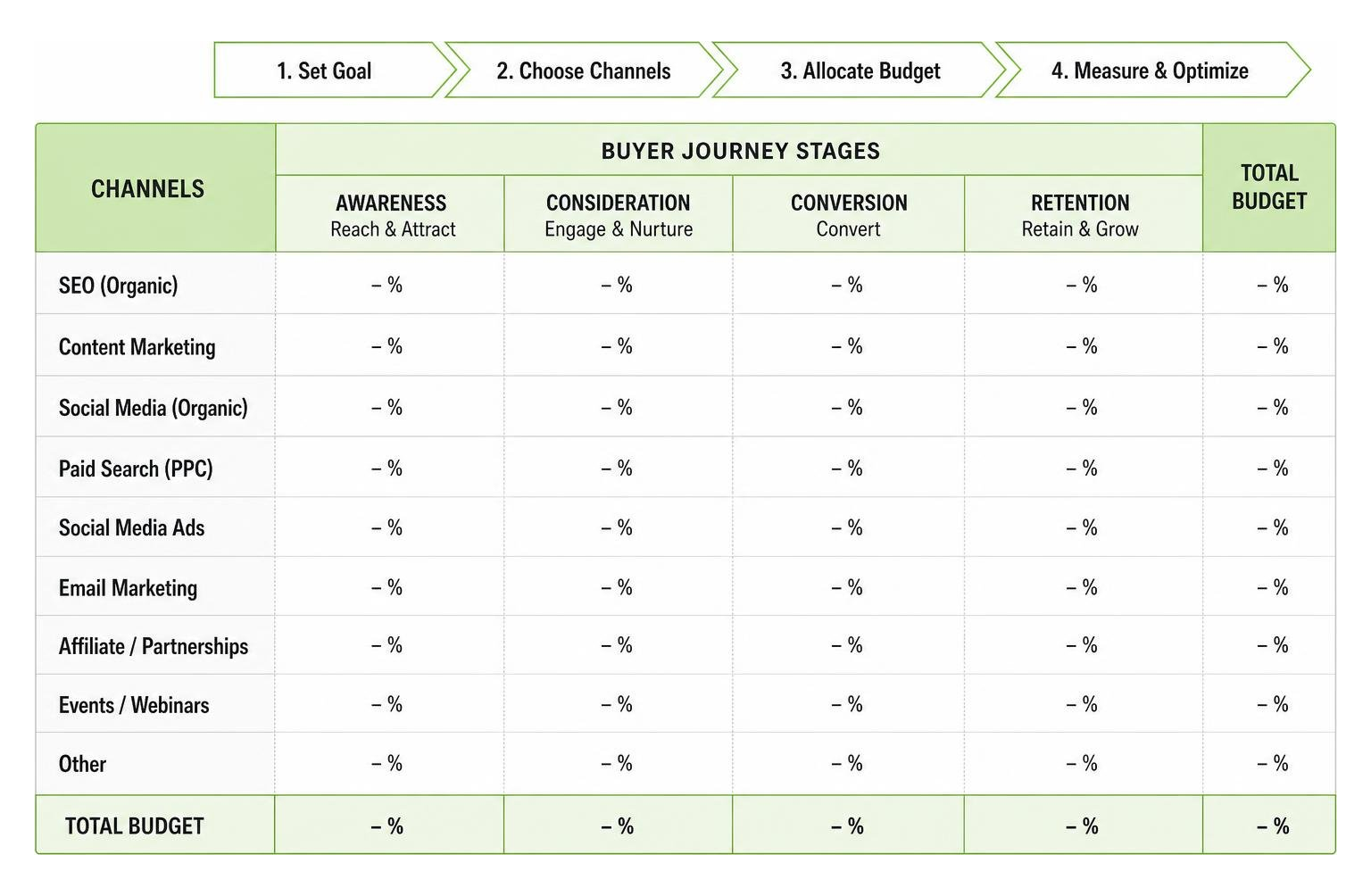
To ensure your marketing spend delivers a measurable return, you must align every tactical campaign with a specific business goal. If you are wondering how to integrate these elements into your broader strategy, read about 7 Advertising Strategies You Need to Add to Your Marketing Plan.
Aligning Marketing Objectives with Business Goals
Your marketing objectives should never exist in isolation. They must directly support your high-level business goals. If your business goal is to increase annual revenue by 20%, your marketing objectives must calculate exactly how many leads, conversions, and new customers are required to hit that revenue target.
To make these objectives actionable, they must be SMART:
- Specific — Define exactly what you want to achieve (e.g., “Increase organic website traffic”).
- Measurable — Attach a clear metric (e.g., “by 30%”).
- Achievable — Ensure the goal is realistic based on your baseline data and resources.
- Relevant — Align the goal directly with your business growth (e.g., “to generate 100 new qualified leads per month”).
- Time-bound — Set a firm deadline (e.g., “by December 31, 2026”).
A poor objective is: “We want to get more followers on social media.”
A SMART objective is: “We will increase organic website traffic by 30% by the end of Q4 2026 to generate an average of 150 inbound leads per month.”
Channel Allocation and Budgeting Frameworks
How much should you spend on marketing? While budgets vary by industry and company stage, standard operational benchmarks provide a reliable guide:
- B2B Companies — Typically allocate 6–12% of projected revenue to marketing.
- B2C Companies — Typically allocate 10–20% of projected revenue due to higher transactional volumes and direct-to-consumer competition.
- Early-Stage Startups & Product Launches — Often require 15–25% of projected revenue to build baseline brand awareness.
When allocating your budget across channels, avoid the trap of spreading your funds equally. Instead, focus your resources on the 2–3 channels that yield the highest conversion rates for your target audience. Always reserve a 5–10% contingency fund for opportunistic campaigns or unexpected competitive responses.
For a structured look at how to get your annual budget approved by leadership, consult the Annual Marketing Plan Template.
How to Choose the Right Channels for Your Marketing Plan
Choosing the right marketing channels is a matter of audience-to-channel matching. If your target audience is professional services buyers, paid B2B search ads and organic search optimization will yield better results than highly visual consumer-focused social platforms.
We recommend focusing on a balanced, multi-channel approach that spans the entire customer journey:
- Top of Funnel (Awareness) — Organic search (SEO), educational blog content, and targeted local advertising.
- Middle of Funnel (Consideration) — Case studies, email newsletters, and detailed product comparisons.
- Bottom of Funnel (Decision) — Personalized landing pages, direct outreach, and high-value offers.
To learn how to map your content directly to these channels and funnel stages, read our guide on How to Develop a Solid Content Marketing Plan.
KPIs and Metrics to Measure Success
To evaluate whether your marketing plan is working, you must track concrete performance metrics rather than vanity metrics. Focus your measurement plan on these four critical areas:
- Awareness Metrics — Organic search impressions, website sessions, and brand search volume.
- Consideration Metrics — Content download rates, email open rates, and session duration.
- Conversion Metrics — Marketing Qualified Leads (MQLs), Sales Qualified Leads (SQLs), and customer conversion rates.
- Efficiency Metrics — Customer Acquisition Cost (CAC), Return on Ad Spend (ROAS), and Customer Lifetime Value (LTV) to CAC ratio (aim for greater than 3:1).
Frequently Asked Questions about Strategic Planning
How often should a plan be updated?
A marketing plan is a living document, not a static binder. While you should revise your comprehensive plan annually, you must review your channel performance and budget allocations quarterly. We also recommend holding brief monthly checkpoints to review campaign metrics and adjust tactical execution.
If your digital presence hasn’t been evaluated recently, consider scheduling an Internet Marketing Strategy Tune-Up to identify quick wins.
What are the most common mistakes to avoid?
- Creating a 50-Page Plan Nobody Reads — Keep your plan to 5–10 actionable pages. If it is too long, your team will ignore it.
- Setting Goals Without Baselines — You cannot aim for a 20% increase if you do not know your current monthly traffic or conversion rates.
- Measuring Activity Instead of Outcomes — Tracking how many blog posts you published (activity) is useless if those posts did not generate traffic or leads (outcome).
- Sales and Marketing Misalignment — Ensure your marketing team and sales team agree on the exact definition of a qualified lead before launching campaigns.
Can a small business write a plan with no budget?
Yes. If you have more time than capital, focus your plan on organic, high-equity strategies. You can build a highly effective organic plan around search engine optimization, local community networking, and consistent email marketing.
To see how other small businesses have successfully structured low-budget plans, read A Practical Guide to Marketing Plan Examples for Small Business.
What are the key takeaways from this marketing plan guide?
A successful marketing plan does not require a massive budget or a massive team. It requires structure, consistency, and a commitment to data-driven decision-making. By taking the time to analyze your market, define your target audience, and set measurable SMART objectives, you protect your business from wasted ad spend and reactive marketing.
At Technology Aloha, we believe in blending cohesive branding with high-conversion, user-centric designs to drive sustainable business growth. Based in Hawaii, we use data-driven insights to help businesses build strategies that convert attention into revenue.
Ready to stop guessing and start growing? Read our An Essential Guide to Marketing Plan for Small Business to take control of your marketing roadmap today.