Why Most Small Businesses Skip the Plan—and Pay for It
Marketing plan examples for small business are one of the most searched topics among founders—and for good reason. Only 37% of small businesses have a documented marketing
 plan, yet those that do are 2.5 times more likely to see year-over-year revenue growth.
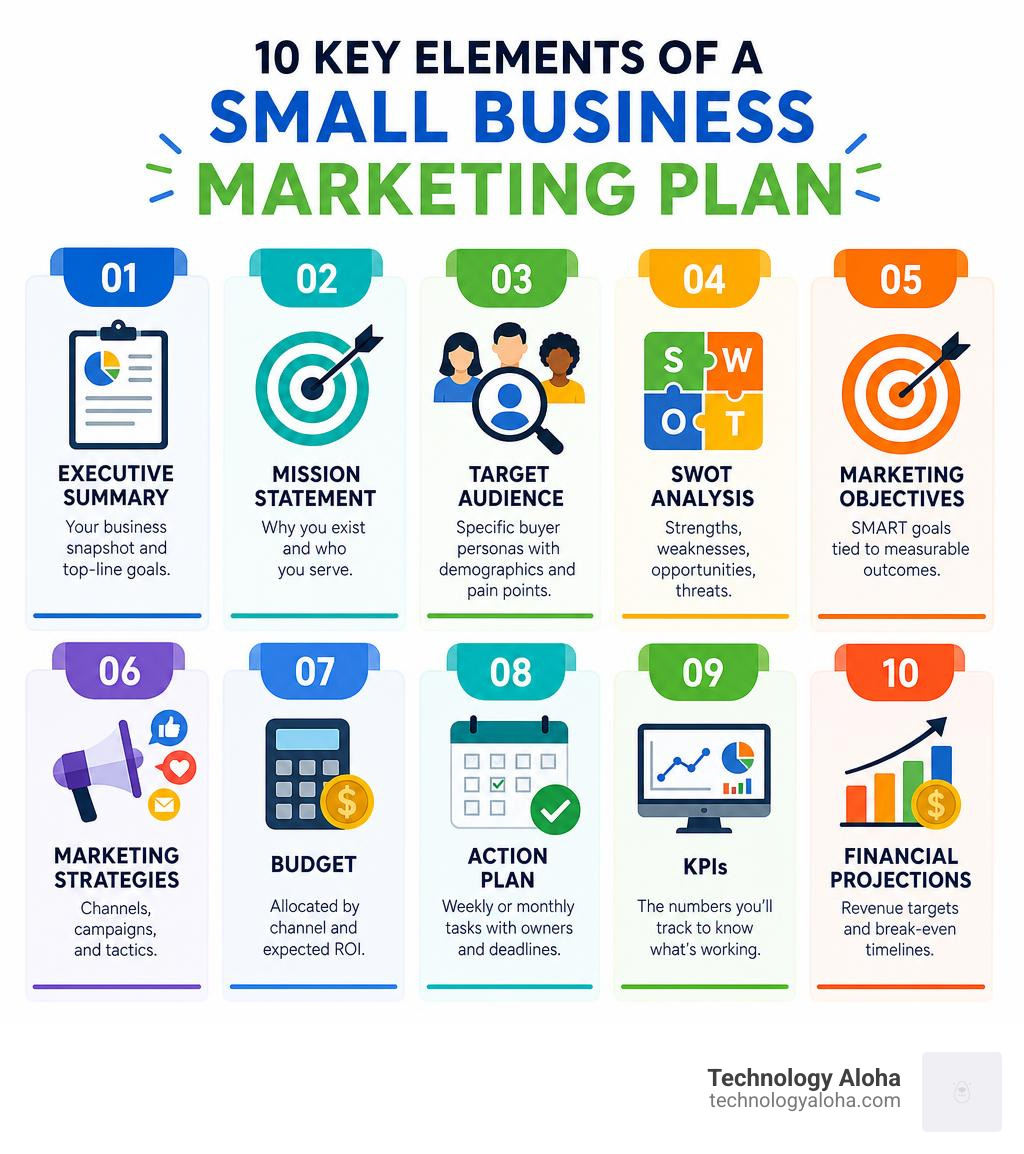
If you want a fast answer, here’s what a strong small business marketing plan includes:
- Executive summary — your business snapshot and top-line goals
- Mission statement — why you exist and who you serve
- Target audience — specific buyer personas with demographics and pain points
- SWOT analysis — strengths, weaknesses, opportunities, threats
- Marketing objectives — SMART goals tied to measurable outcomes
- Marketing strategies — channels, campaigns, and tactics
- Budget — allocated by channel and expected ROI
- Action plan — weekly or monthly tasks with owners and deadlines
- KPIs — the numbers you’ll track to know what’s working
- Financial projections — revenue targets and break-even timelines
Without this structure, marketing becomes reactive—expensive guessing with inconsistent results. With it, you have a repeatable system for attracting and converting customers.
The examples and frameworks in this guide are built for real small businesses with limited time, lean teams, and tight budgets.
Learn more about marketing plan examples for small business:
- The Best Ways to Market a Small Business for Success
- The No-Nonsense Guide to Creating Your Small Business Market Strategy
- The Small Business Guide to Digital Marketing Success
Why a Documented Marketing Plan is Essential and What It Includes
Many small business owners view a marketing plan as an academic exercise—a heavy binder designed to sit on a shelf. This is a mistake. A documented marketing plan is a living, breathing operational roadmap.
The data is clear: companies with a written marketing plan are 313% more likely to report success in achieving their marketing goals compared to those without one. Furthermore, structured planning leads to an average 20–30% increase in customer acquisition within the first year.
Without a written strategy, small businesses fall into the trap of “random acts of marketing.” You boost a Facebook post because a notification suggests it, or you buy a local ad because a salesperson called. This scattered approach is expensive and nearly impossible to measure.
To build a plan that actually drives revenue, you must understand your current position. This is why we recommend starting with a thorough evaluation of your existing assets. You can learn exactly how to analyze your current performance in our guide on Why You Need to Perform a Marketing Audit for Your Company.
Once you understand your starting point, your marketing plan must document these core elements:
- SMART Goals: Vague goals like “get more clients” lead to vague results. Your plan needs objectives that are Specific, Measurable, Achievable, Relevant, and Time-bound—such as increasing monthly qualified leads by 25% within the next 90 days.
- Target Audience & Buyer Personas: You cannot market to “everyone.” You must define your ideal customer’s demographics, purchasing behaviors, and primary pain points.
- SWOT Analysis: A clear-eyed look at your internal Strengths and Weaknesses, alongside external Opportunities and Threats.
- Marketing Channels: Rather than spreading yourself thin across every emerging platform, select two or three high-performing channels where your target audience is most active.
- Budget Allocation: Small businesses that allocate at least 6–10% of their revenue to marketing activities achieve twice the ROI of those spending less than 5%.
- Key Performance Indicators (KPIs): The specific metrics—such as cost per lead, click-through rate, or customer lifetime value—that indicate progress.
For local businesses, accessing regional resources can simplify this process. The UH SBDC Marketing Plan Template provides an excellent localized framework for structuring these components. For practical tips on applying these fundamentals to your business, check out this broadcast on Tips on how to market your small business | KHON2.
To tie all of these pieces together into a cohesive direction, read The No Nonsense Guide to Creating Your Small Business Market Strategy.
Real-World Marketing Plan Examples for Small Business

The best way to build your own plan is to study how other successful small businesses structure theirs. However, a local service business requires a completely different approach than an e-commerce brand.
Service-based companies must focus heavily on local search and reputation management, while product-based brands rely on visual content, email nurture sequences, and seamless digital checkouts.
The table below highlights the key differences in how these two business models should structure their marketing plans:
| Marketing Plan Component | Local Service Business (e.g., Plumbing, Salon) | E-commerce / Retail Business (e.g., Apparel, Specialty Foods) |
|---|---|---|
| Primary Goal | Lead generation and local phone calls | Direct online conversions and repeat purchases |
| Core Channels | Google Business Profile, Local SEO, Referral programs | Social media ads, Email marketing, Content marketing |
| Key Metrics (KPIs) | Cost per lead, Review acquisition rate, Quote close rate | Customer acquisition cost (CAC), Average order value (AOV) |
| Budget Focus | Local search visibility and review generation | Paid social ads, email automation tools, high-quality photography |
| Operational Rhythm | Weekly follow-ups on open quotes and review requests | Weekly email newsletters and daily social media publishing |
Local Service Marketing Plan Examples for Small Business
For a local service business, the marketing strategy must center on demand capture. When a pipe bursts or someone needs an emergency repair, they do not browse social media for inspiration; they search Google.
Therefore, your marketing plan should prioritize local SEO, your Google Business Profile, and rapid-response customer referral systems.
A highly effective local service plan does not focus on vanity metrics like follower counts. Instead, it defines exact, repeatable weekly actions. Let’s look at a practical example of a local service marketing plan:
- The Goal: Generate 20 more qualified quote requests per month within 60 days.
- The Target Audience: Local homeowners aged 35–65 who value speed and reliable customer service over the lowest price.
- The Core Offer: A complimentary 15-point home system inspection with any booked service.
- Primary Channels: Google Business Profile, local neighborhood search pages, and direct email follow-ups.
- Weekly Actions:
- Ask five happy customers from the current week to leave a Google review.
- Publish one localized service-area or neighborhood-specific page on the website.
- Follow up on every open, unaccepted quote within 24 business hours.
- Send one referral program reminder to past clients.
- KPIs to Track: Total quote requests, conversion rate of website visitors to leads, and average review rating.
By focusing on these specific, manageable tasks, a lean service business can build a highly predictable customer acquisition pipeline.
E-commerce and Retail Marketing Plan Examples for Small Business
Unlike service businesses, retail and e-commerce brands must focus heavily on demand creation and customer retention. Because you are competing in a crowded digital space, your plan must leverage multi-channel marketing—combining social media, content marketing, and email campaigns.
In fact, businesses utilizing multi-channel marketing strategies report 287% higher purchase rates than single-channel approaches.
An e-commerce marketing plan must guide prospects through a clear journey: attracting them with valuable content, converting them into email subscribers, closing the sale with targeted promotions, and delighting them to secure repeat business.
Here is an example of an e-commerce marketing plan structure:
- The Goal: Increase online preorder volume by 25% over the next 90 days.
- The Target Audience: Busy professionals looking for high-quality, artisanal products delivered directly to their door.
- The Core Offer: A “Subscribe & Save” discount of 10% on recurring monthly orders.
- Primary Channels: Instagram (visual storytelling), email marketing (nurture and automated abandoned cart sequences), and SEO-optimized blog content.
- Tactical Execution:
- Attract: Publish high-quality, educational blog posts that solve customer problems, then share snippets on social media.
- Convert: Offer a free, valuable digital download or a first-purchase discount in exchange for an email address.
- Close: Implement automated email sequences that trigger when a user leaves items in their shopping cart.
- Delight: Send personalized post-purchase emails with usage tips and exclusive loyalty discounts.
To see how global brands and successful small businesses alike scale these strategies, explore these 15 marketing plan examples to inspire your work – Adobe for Business.
To design a content program that feeds this funnel consistently without burning out your team, read our step-by-step guide on How to Develop a Solid Content Marketing Plan
How to Execute and Measure Your Marketing Strategy

The most common reason marketing plans fail is not a lack of creative ideas—it is a lack of execution. To prevent your plan from becoming a forgotten document, you must translate your high-level strategy into a structured 90-day action plan.
A 90-day execution framework breaks your annual goals into digestible, quarterly sprints. For each marketing initiative, assign a clear owner, a firm deadline, and the specific resources required.
This keeps your team focused on immediate priorities and prevents “scope creep”—the tendency to chase new marketing trends that do not align with your documented strategy.
Equally important is establishing a consistent rhythm for tracking your performance. You should review your marketing metrics on a set schedule:
- Weekly Reviews: Track leading indicators such as website traffic, social media engagement, and ad spend.
- Monthly Audits: Analyze lagging indicators like total leads generated, conversion rates, and customer acquisition cost (CAC).
- Quarterly Refreshes: Step back to evaluate your overall ROI. If a channel is consistently underperforming despite optimization efforts, reallocate that budget to your highest-performing strategies.
Marketing is not a static project; it is an ongoing process of testing, learning, and refining. For a comprehensive roadmap on managing this cycle of execution and optimization, read The Small Business Guide to Digital Marketing Success.
Frequently Asked Questions about Small Business Marketing Plans
How is a marketing plan different from a business plan?
A business plan is an all-encompassing document that details your entire operational structure. It covers financial projections, legal setups, hiring plans, and product development.
A marketing plan, on the other hand, is a highly focused subset of your business plan. It deals exclusively with customer acquisition, retention, and brand positioning—detailing exactly how you will find, convert, and keep your customers.
How often should a small business update its marketing plan?
Your marketing plan should be treated as a living document. We recommend conducting a brief review of your KPIs monthly to ensure your tactics are on track.
Every quarter, perform a deeper refresh to adjust your campaigns based on seasonal trends and market shifts. Finally, execute a complete annual overhaul to realign your marketing budget and strategies with your high-level business goals for the upcoming year.
Do I need a large budget to execute a marketing plan?
No. A structured marketing plan is actually more critical for businesses with small budgets because it prevents wasted spend.
If your budget is tight, focus your plan on high-ROI, low-cost organic tactics. Invest your time into local SEO, consistent email marketing to your existing list, and structured referral programs that turn your current customers into an active sales force.
Conclusion
Building an effective marketing plan does not require a massive corporate budget or a dedicated marketing department. By defining clear SMART goals, identifying your specific target audience, and committing to consistent weekly actions, you can build a reliable engine for business growth.
At Technology Aloha, we help small businesses eliminate the guesswork from their growth strategies. Based in Maui, Hawaii, we deliver data-driven insights that blend cohesive branding with high-conversion website designs.
We work with you to build a tailored strategy that maximizes your resources and delivers measurable results.
Ready to stop guessing and start growing? Explore our professional Marketing Strategy services today, and let’s build a roadmap that takes your business to the next level.