Why Every Small Business Needs a Written Marketing Plan
A marketing plan for small business is the single most practical document you can build to turn scattered effort into predictable revenue. Without one, you are reacting — spending time and money on whatever feels urgent instead of what actually works.
Quick answer: Here is what a small business marketing plan does and what goes into one:
| Element | What It Does |
|---|---|
| Situation Analysis + SWOT | Shows where you stand today |
| Target Audience Profiles | Defines exactly who you are selling to |
| SMART Goals | Ties marketing activity to revenue outcomes |
| Channel Strategy | Picks the right platforms for your audience |
| Budget Allocation | Decides how much goes where |
| Tactical Calendar | Assigns actions to specific weeks |
| KPI Tracking | Measures what is working and what is not |
Think of it like a GPS. You still do the driving — but the plan tells you the fastest route, flags the wrong turns, and recalculates when conditions change.
The numbers back this up. The U.S. Small Business Administration recommends spending 7–8% of gross revenue on marketing for businesses under $5 million annually. Gartner’s 2026 CMO Spend Survey found the cross-industry average sits at 7.7%. Yet most small business owners wing it — no written plan, no clear metrics, no way to know if the money is working.
That is an expensive way to grow.
This guide walks you through every step — from SWOT analysis and buyer personas to channel selection, budget allocation, and a 90-day execution calendar — so you can build a plan that connects daily marketing tasks to real business results.
Related content about marketing plan for small business:
- best ways to market small business
- best way to advertise small business online
- digital marketing plan for small business
The Strategic Foundation: Why a Marketing Plan is Essential
Operating without a marketing plan for small business is like sailing among the Hawaiian Islands without a compass. You might see land eventually, but you will waste a lot of fuel getting there. A plan provides a roadmap that identifies market needs and clarifies your competitive advantage.
In 2026, the marketplace is noisier than ever. A documented strategy ensures that every post, ad, and email serves a specific purpose. It moves you away from “hope-based marketing” and toward a system where you can actually predict growth. By understanding the importance of a digital marketing strategy, you align your team and your resources toward a single destination.
As noted in recent tips on how to market your small business, businesses that engage in formal planning are significantly more likely to succeed. The plan acts as a filter: if a new marketing “opportunity” doesn’t align with your documented goals, you can confidently say no, protecting your time and your budget.
Essential Sections of a Marketing Plan for Small Business
A professional marketing plan for small business doesn’t need to be a hundred pages long. In fact, the best plans for smaller teams are often under five pages. However, they must contain these core sections to be effective:
- Executive Summary: A high-level overview of your goals and how you intend to reach them.
- Mission Statement: Why your business exists and the value it provides to your community.
- SWOT Analysis: An honest look at your internal strengths and weaknesses, and external opportunities and threats.
- Competitive Profile: A breakdown of who else is vying for your customers’ attention and how you differ.
- Marketing Objectives: Clear, measurable targets tied to your revenue goals.
- Financial Projections: An estimate of the costs and the expected return on investment.
For those just starting, using small business marketing plan templates can help you organize these thoughts without getting overwhelmed by the formatting.
The Four Ps of Marketing for Small Business
The “Four Ps” framework has been around for decades because it works. It forces you to look at your business through the eyes of the customer. When we help clients with creating a small business market strategy, we always start here:
- Product: What problem are you solving? Your product or service should be defined by the benefits it provides, not just its features.
- Price: How does your pricing reflect your value? In 2026, pricing is a marketing differentiator. Being the “cheapest” is rarely a winning strategy for a small business; being the “best value” or “most specialized” often is.
- Place: Where can customers find you? This includes your physical location in Kahului or elsewhere in Hawaii, as well as your digital presence.
- Promotion: How do people find out about you? This is the tactical side—ads, social media, and email.
Defining Your Audience and Setting SMART Goals
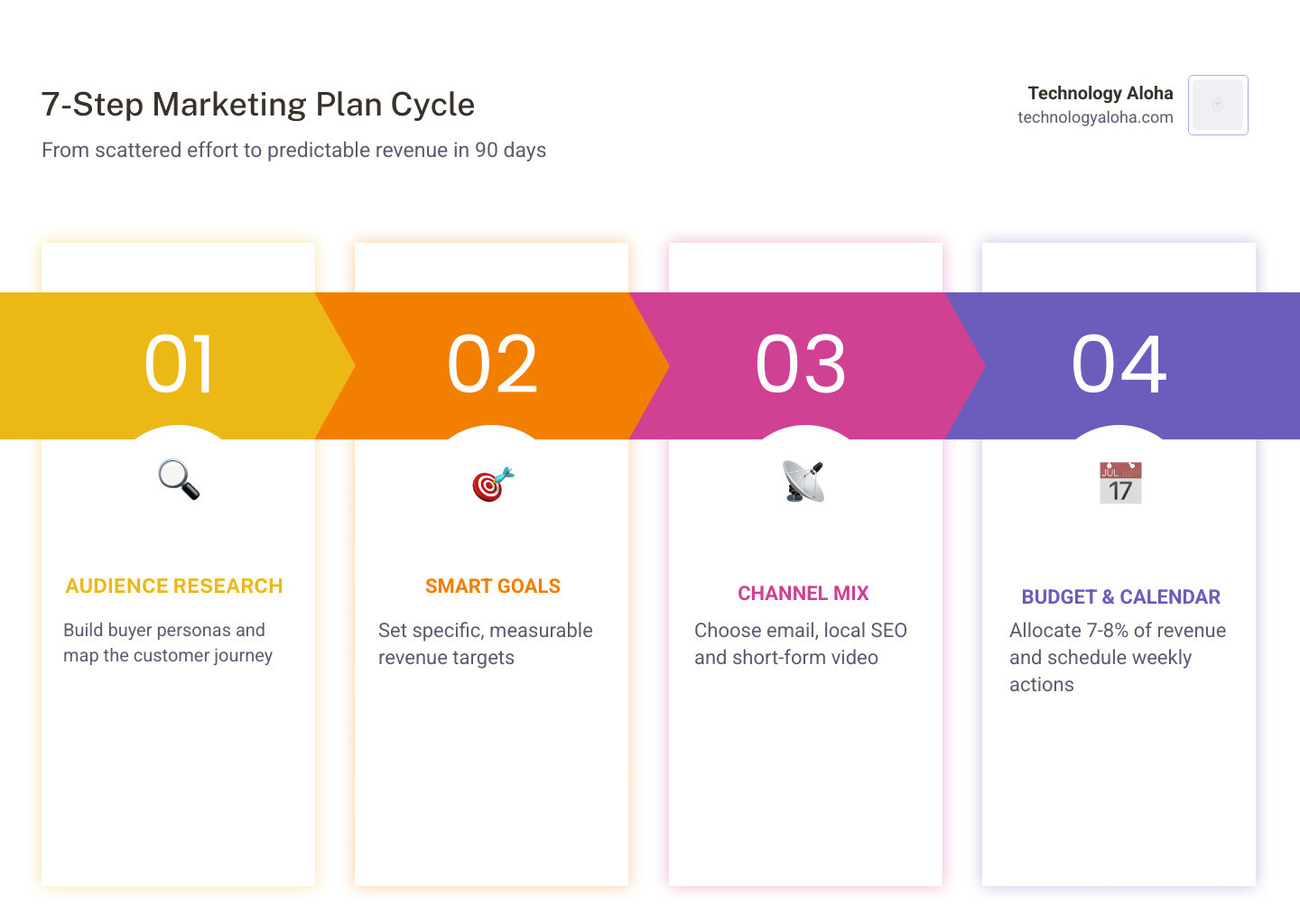
If you try to talk to everyone, you end up talking to no one. The most critical part of your marketing plan for small business is defining your target audience. We do this by creating buyer personas—fictional representations of your ideal customers based on data and interviews.
A persona should include:
- Demographics: Age, location, income, and job title.
- Psychographics: Values, interests, and pain points. What keeps them up at night?
- The Customer Journey: How do they go from realizing they have a problem to choosing your business?
When creating a marketing strategy for your new business, grounding your decisions in persona research prevents you from wasting money on channels your customers don’t even use.

Setting SMART Goals for Your Marketing Plan for Small Business
A goal without a number is just a wish. To make your marketing effective, every objective must be SMART:
- Specific: Instead of “get more leads,” try “increase website inquiries for our web design services.”
- Measurable: “Increase inquiries by 20%.”
- Achievable: Ensure you have the staff and budget to handle the growth.
- Relevant: Does this goal actually lead to more revenue?
- Time-bound: “By the end of Q3 2026.”
By building a successful marketing process, you ensure that these goals aren’t just written down and forgotten, but are tracked every single week.
Conducting SWOT and Competitive Research
To win in the Hawaii market, you need to know who you are up against. A SWOT analysis helps you identify where you have the upper hand.
- Strengths: Do you have deep local roots in Maui? A proprietary process?
- Weaknesses: Is your website outdated? Is your team stretched too thin?
- Opportunities: Are competitors failing to use video marketing? Is there a new neighborhood development?
- Threats: Are rising costs or new regulations impacting your industry?
Applying marketing principles for Hawaiʻi means understanding the “ohana” culture and how community reputation acts as a massive strength or a potential threat.
Budgeting and Channel Strategy for 2026
How much should you spend? As we mentioned, the 7–8% of gross revenue is a standard benchmark. However, if you are a new business or in a high-growth phase, you might need to invest closer to 12% to gain market share.
Gartner’s 2026 data shows that the average marketing budget is 7.7% of revenue. For a business earning $500,000 a year, that is roughly $3,200 per month. Spreading that $3,200 across ten different channels is a mistake—it dilutes your impact. Instead, focus on the digital marketing success channels that offer the highest return.
High-ROI Channels for Small Businesses in 2026
Not all channels are created equal. In 2026, we see the highest returns from these specific areas:
| Channel | Average ROI | 2026 Context |
|---|---|---|
| Email Marketing | $36 for every $1 spent | Highest ROI; you own the list. |
| Local SEO | High (Long-term) | Essential for Hawaii businesses to show up in “near me” searches. |
| Google Ads | $2 for every $1 spent | Average CPC is $5.26; requires at least $1,000/mo for data. |
| Short-form Video | Medium/High | Drives engagement on platforms like Instagram and TikTok. |
Implementing Hawaii marketing tips often involves prioritizing local search and community-based social proof over broad, national-style advertising.
Avoiding Common Pitfalls in Your Marketing Plan for Small Business
Many businesses fail because they fall victim to “Shiny Object Syndrome”—jumping on every new social media platform because it’s trendy. Here are the top marketing tips to avoid common errors:
- Budget Fragmentation: Trying to be everywhere with a small budget. Pick 2–3 channels and dominate them.
- Unmeasurable Goals: If you can’t track it, you can’t improve it.
- Ignoring Retention: It costs 5–10 times more to get a new customer than to keep an old one. Does your plan include a strategy for your existing clients?
- Static Planning: A plan that sits in a drawer is useless. It must be a living document.
Executing Your Marketing Plan for Small Business with a 90-Day Calendar
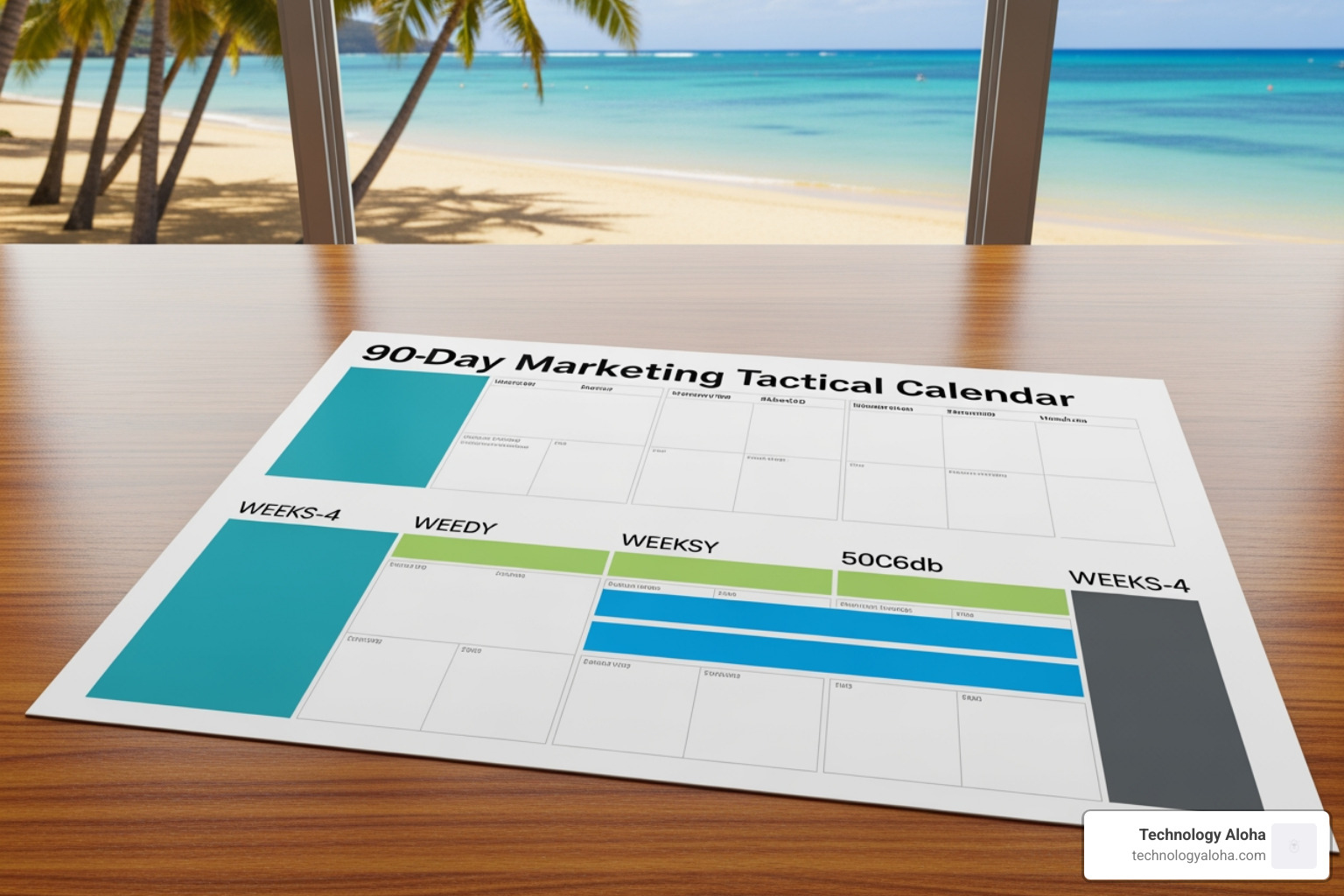
The difference between a successful business and a struggling one is execution. We recommend a 90-day tactical calendar. Why 90 days? Because a year is too long to stay focused, and a month is too short to see real results.
Your calendar should break down your goals into weekly actions. For example:
- Week 1: Finalize new lead magnet and set up email automation.
- Week 2: Launch Google Ads campaign targeting Kahului area.
- Week 3: Record four short-form videos for social media.
- Week 4: Review analytics and adjust ad spend.
Using marketing ideas that aren’t boring ensures your calendar stays full of content that actually engages your audience rather than just filling space.
Measuring Success with Key Performance Indicators (KPIs)
You need a dashboard. Whether it’s a simple spreadsheet or a professional tool, you must track your KPIs monthly. Key metrics for 2026 include:
- Conversion Rate: What percentage of website visitors actually contact you?
- Customer Acquisition Cost (CAC): Exactly how much does it cost in marketing spend to get one new customer?
- Lifetime Value (LTV): How much revenue does a customer bring in over their entire relationship with you?
- Email Open Rates: The industry average is 21.33%. If yours is lower, your subject lines or list quality need work.
Understanding social media benefits is also about tracking engagement and click-through rates, not just “likes.”
Tools and Templates for Plan Execution
You don’t need a massive tech stack to execute a marketing plan for small business. Start with these essentials:
- CRM: HubSpot offers a free version that is excellent for tracking leads.
- Analytics: Google Analytics 4 (GA4) is the standard for website traffic.
- Design: Canva allows you to create professional graphics without a degree in design.
- Email: Mailchimp or similar platforms for managing your highest-ROI channel.
As you build a big brand for your small business, these tools help you maintain a professional, cohesive appearance across all touchpoints.
Frequently Asked Questions about Marketing Plans
How much should a small business spend on marketing in 2026?
The standard SBA guideline remains 7–8% of gross revenue for businesses earning under $5 million. However, if you are in a highly competitive market like Maui’s tourism or real estate sectors, you may need to lean closer to 10–12% to maintain visibility.
How often should a marketing plan be updated?
We recommend a full review every quarter (90 days). The digital landscape—especially search algorithms and ad costs—shifts too quickly for an annual-only review. Use your quarterly meetings to pivot tactics while keeping your long-term goals the same.
What is the most effective marketing channel for small businesses?
Statistically, email marketing remains the king of ROI, returning an average of $36 for every $1 spent. It is one of the few channels where you “own” the audience rather than “renting” it from a social media platform.
Conclusion
A marketing plan for small business is not a luxury—it is a requirement for sustainable growth. By defining your audience, setting SMART goals, and executing with a disciplined 90-day calendar, you move from the stress of “not knowing” to the confidence of a data-driven strategy.
At Technology Aloha, we specialize in helping businesses in Kahului and throughout Hawaii find their strategic positioning. We blend cohesive branding with high-conversion designs to ensure your marketing plan doesn’t just look good on paper, but actually drives revenue. Whether you need a user-centric website or a full-scale digital strategy, we are here to help you navigate the 2026 marketplace.
Ready to turn your ideas into a pipeline? Explore the best ways to market small business success or contact us today to learn more about our marketing strategy services.