Step-by-Step Guide to Brand Strategy Plan
Why Every Small Business Needs a Brand Strategy Plan
A brand strategy plan is the foundational document that defines what your business stands for, who it serves, how it’s different from competitors, and how it communicates that consistently across every touchpoint.

If you want the short version:
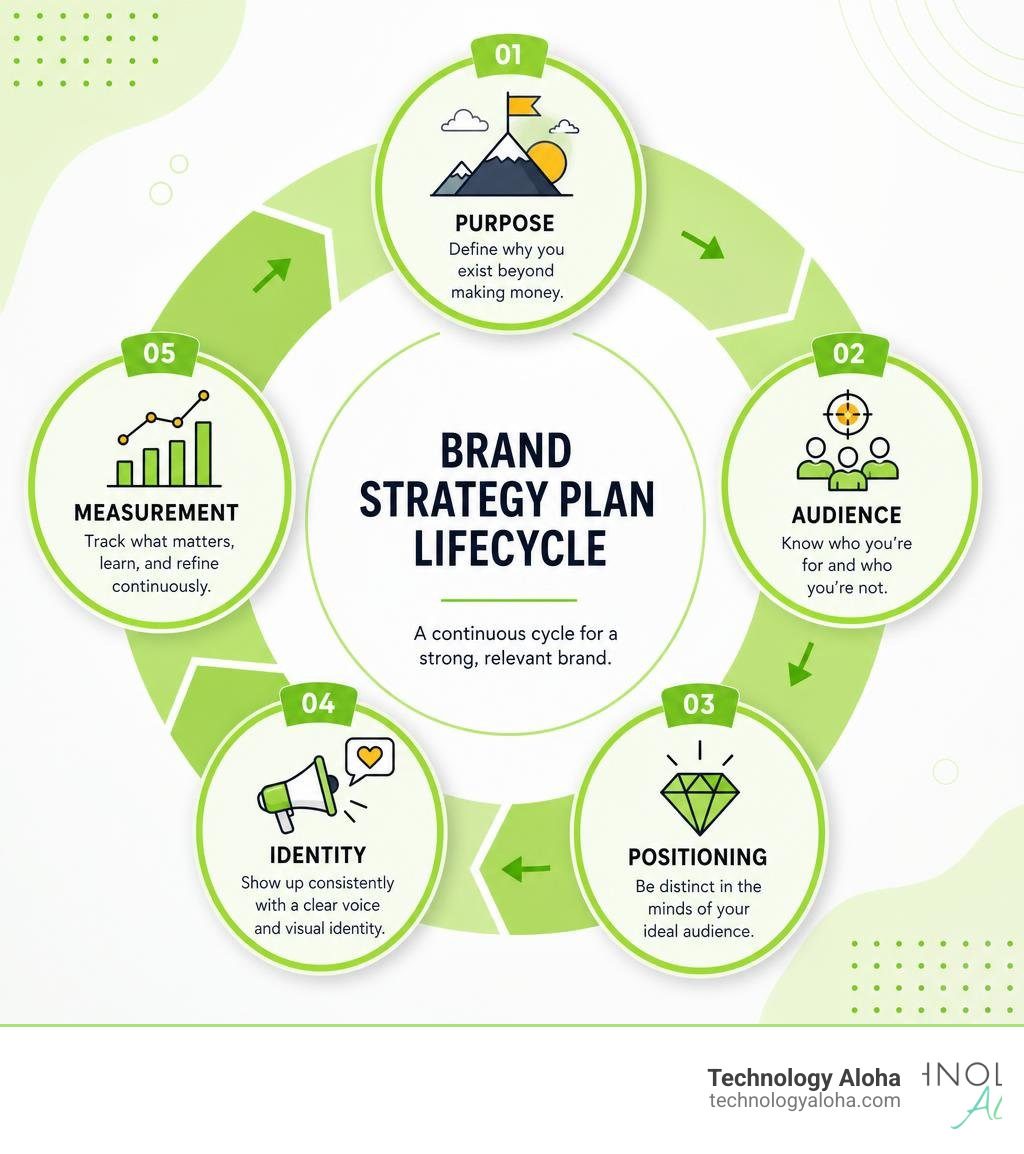
A brand strategy plan typically includes:
- Brand purpose — why your business exists beyond making money
- Target audience definition — who you’re for (and who you’re not)
- Positioning statement — how you’re different from alternatives
- Brand personality and voice — how you show up and communicate
- Messaging architecture — your core message, supporting pillars, and proof points
- Visual and verbal identity direction — how strategy translates into design and language
Here’s the uncomfortable truth: over 77% of consumers wouldn’t care if most brands simply disappeared. That stat isn’t a trivia point — it’s a warning.
Most small businesses skip the strategy and jump straight to a logo. The result? A brand that looks professional but communicates nothing distinctive. You blend in, compete on price, and wonder why the right clients aren’t finding you.
Brand strategy isn’t a marketing exercise. It’s a business decision framework.
It shapes your website copy, your pricing confidence, your hiring conversations, and your customer relationships — all at once. Without it, every marketing decision becomes a guess.
This guide walks you through building a brand strategy plan from the ground up — step by step, without the jargon.
Simple guide to brand strategy plan:
- Brand Building Strategies Demystified
- How to Win Friends and Influence Markets with Brand Positioning and Differentiation
- The Ultimate Guide to New Brand Development
What is a Brand Strategy Plan and Why Does It Matter?

A brand strategy plan is not a collection of aesthetic choices. It is a long-term blueprint designed to cultivate consumer identification, trust, and preference. In June 2026, where AI-driven discovery engines have flattened the playing field for visibility, ad spend alone no longer secures market share. Trust does.
Over 80% of consumers state they must trust a brand before considering a purchase. Building that trust requires a deliberate, structured approach to how your business is perceived. When you operate without a clear strategy, your marketing activities lack a compass, resulting in disjointed campaigns that confuse your audience and dilute your brand equity.
To understand how to build a durable brand, it is necessary to first separate the strategic foundation from its execution.
| Dimension | Brand Strategy | Brand Identity | Marketing Strategy |
|---|---|---|---|
| Core Focus | The “Why” and “Who” (Positioning, values, and purpose) | The “What” and “How” (Logo, typography, color palette, voice) | The “Where” and “When” (Channels, campaigns, budgets, and timelines) |
| Time Horizon | Multi-year foundation (3–5 years) | Static but evolving guidelines (2–3 years) | Short-term operations (Quarterly or annual) |
| Primary Metric | Brand equity, sentiment, and pricing power | Consistency and recognition across touchpoints | Customer acquisition cost (CAC), conversions, and ROI |
| Key Output | Brand strategy document or brief | Brand style guide and asset library | Campaign assets, media plans, and promotional schedules |
A successful strategy connects your internal business goals with external customer expectations. Without this alignment, organizations default to competing on price—a race to the bottom that small businesses rarely win. For a deeper look into the basics of this alignment, read the guide on Branding Strategy 101.
Brand Strategy vs. Brand Identity vs. Marketing Strategy
The confusion among these three terms is the single most expensive mistake small businesses make. They are not interchangeable; they exist in a strict, sequential dependency.
- Brand Strategy comes first. It defines your positioning, target audience, competitive differentiators, and personality. It is the intellectual layer of your brand.
- Brand Identity comes second. It translates the strategy into visual and verbal assets. It includes your logo, color system, typography, and tone of voice. Identity execution without strategy is merely aesthetic guesswork.
- Marketing Strategy comes third. It uses the brand identity to deliver specific messages to target audiences across selected channels—such as social media, search engine optimization, or email marketing.
If you build a marketing strategy before defining your brand strategy, you are driving a car without a destination. You might move fast, but you will likely end up in the wrong place. To map out your market position before launching campaigns, refer to The No-Nonsense Guide to Creating Your Small Business Market Strategy.
The Commercial Impact of Strategic Branding
Strategic branding is a commercial driver, not an overhead cost. A well-executed brand strategy plan directly impacts your bottom line by building brand equity and reducing customer acquisition costs (CAC). According to research by Bain & Company, established brands experience a 20–40% reduction in CAC over time.
Consider the real-world metrics of strategic rebranding:
- Pricing Power: Top-quartile awareness brands command up to a 13% price premium over generic competitors.
- Sales Velocity: Known, trusted brands close deals 24% faster because the customer is already pre-sold on the value proposition.
- Business Growth: In a notable industry case study, Heller Consulting achieved a 400% increase in website conversions and a 50% increase in organic search traffic after implementing a comprehensive, research-backed brand strategy.
- Resilience: Companies with above-average brand awareness maintain revenue two times better during economic downturns because customer loyalty acts as a financial buffer.
For a structured look at how to run this process for your business, you can consult the Brand Strategy Development Playbook | knowledgelib.io .
Defining Your Target Audience and Market Position

You cannot be everything to everyone. A brand position that is broad enough to include every potential buyer is too vague to attract anyone. To build a powerful brand, you must define your target audience with extreme specificity and identify a distinct space in the market that you can uniquely own. For small businesses, this focus is the ultimate competitive advantage. Learn more about this in the article on Positioning and Branding for Small Business.
Audience Prioritization and Segmentation
Lazy marketing relies on basic demographics: age, gender, and zip code. Effective brand strategy relies on psychographics and behavioral segmentation. Nearly 60% of consumers believe that businesses need to understand and address their specific needs better.
To segment your audience effectively in 2026, map them into three concentric circles:
- The Gravitational Customer: Your ideal, high-value client. They experience the exact problem you solve, value your unique approach, and are willing to pay a premium. They provide 80% of your referral value.
- The Reachable Next Customer: Audiences who share similar pain points but may require more education or a different trust-building approach to convert.
- Brand Spectators: The wider market. They may interact with your content or follow your brand, but they are not your primary commercial target.
Firms that conduct systematic, qualitative research on their target client groups grow faster and are significantly more profitable than those that rely on assumptions. By interviewing early customers and analyzing their motivations, you uncover the soft variables—such as personal values and cultural behaviors—that drive actual purchasing decisions. For practical steps on researching your market, read the breakdown of Brand Building Strategies Demystified.
Finding Your Competitive Wedge
Your competitive wedge is the single, distinctive idea that sets your business apart from direct competitors. It is not a list of features; it is your “onlyness” statement.
To find your wedge, perform a competitive positioning audit. Map out your top five competitors and analyze their core claims. You will likely find that most of them say the same things: “high quality,” “great service,” or “trusted experts.” These are table stakes, not differentiators.
Look for the white space—the valuable customer needs that competitors are ignoring. For example, in the local Hawaiian market, businesses often struggle to balance authentic cultural representation with modern digital delivery. Under the guidelines of the [PDF] A STUDY OF THE MADE IN HAWAI’I BRAND – Hawaii , presenting a credible, locally rooted value proposition is critical for standing out in both local and global markets. Your wedge must be defensible, authentic, and simple enough to explain in under thirty seconds.
Structuring Your Brand Strategy Document
A brand strategy is only useful if it is used. Most agency decks are beautiful but impractical—they get presented, archived, and forgotten. A working brand strategy document should be a concise, highly structured reference guide of 15 to 40 pages that your team uses to make daily business decisions. To start structuring your own, download the guide: Stop Guessing and Start Branding with This Strategy Framework PDF.
Core Components of a Brand Strategy Plan
Your document should flow logically, with each section constraining and informing the next. The core components of a professional strategy include:
- Brand Purpose: Your fundamental reason for existing beyond profitability. Why does your business matter to the world?
- Mission and Vision: Your mission is your immediate, operational commitment (what you do, for whom, and how). Your vision is your long-term aspirational destination. Keep these statements under 25 words to ensure they are memorable.
- Core Values: The 3 to 5 non-negotiable principles that guide your business conduct. Avoid generic words like “integrity” or “honesty.” Over 90% of organizations list integrity as a core value, yet few define the specific, difficult behaviors required to uphold it. Your values must have teeth—they should guide what you choose not to do, even when it costs you money.
- Brand Personality: The human characteristics of your brand. Using Aaker’s five dimensions of brand personality (Sincerity, Excitement, Competence, Sophistication, and Ruggedness), select one primary and one secondary trait to maintain a focused identity.
To build a brand that resonates internally and externally, explore resources such as Corporate Branding Strategy PDF: Building a Brand That Actually Sticks.
Messaging Architecture and Verbal Identity
Your verbal identity is how your brand speaks. It consists of your voice, tone, and messaging architecture. While your brand personality remains constant, your tone of voice must adapt contextually—just as a human speaks differently in a boardroom than at a family dinner.
A robust messaging architecture uses a strict top-down hierarchy:
- The Master Message (The Wedge): The core value proposition of your brand.
- Messaging Pillars: Three (and no more than four) supporting themes that address specific customer pain points.
- Proof Points: Verifiable facts, statistics, case studies, or proprietary methodologies that validate each messaging pillar.
For a deeper dive into crafting a consistent voice across digital platforms, read the guide on Mastering Brand Strategy and Development for Modern Marketing.
Translating Strategy into Brand Expression
Once your brand strategy is codified, you can safely transition to brand expression. This is where your strategy becomes visible and experiential. A beautiful website or a striking logo is useless if it does not communicate your strategic positioning. For an in-depth look at this integration, consult The Definitive Guide to Brand Identity Web Design.
Visual Identity and Design Systems
A visual identity is not just a logo; it is a cohesive design system built to perform under real-world constraints. Your visual system must include:
- Logo Design: A simple, memorable mark that works as well as a social media avatar as it does on a physical storefront.
- Color Palette: A strategic color system. For instance, Technology Aloha uses a balanced palette of deep teal (#208a9d), fresh lime (#abe080), bright sky blue (#50c6db), and charcoal (#4d4d4d) to evoke both professional competence and Hawaiian roots.
- Typography: A hierarchy of readable, accessible fonts that maintain brand character across print and digital media.
- Imagery Guidelines: Rules for photography, illustration, and generative AI use that ensure all visual content feels authentic and aligned with your brand personality.
When branding and web development are executed together under a unified strategy, they create a high-converting digital experience. This dynamic is explored in The Secret Sauce of Branding and Web Development.
Brand Experience and Touchpoint Consistency
Your brand is not what you say it is; it is the sum of every interaction a customer has with your business. Consistency across these touchpoints is what builds lasting trust. In the tourism and hospitality sectors of Hawaii, for example, organizations utilize cohesive digital assets and campaigns—such as those managed by the Hawaii Visitors and Convention Bureau—to ensure that the physical experience of visiting the islands matches the digital promise made in marketing materials.
Whether a customer reads a social media post, visits your office in Kahului, or navigates your website, the experience must feel unified. Discrepancies—such as a modern website paired with slow, outdated customer service—destroy trust instantly. Your brand guidelines must outline clear rules for customer service, email communication, and physical touchpoints to ensure your strategy is lived daily.
Execution: How to Build and Measure Your Strategy
Developing a brand strategy plan is a creative and analytical process that requires discipline. Whether you choose to build it internally or partner with a professional agency, following a structured execution roadmap is essential for success. For a comprehensive overview of your options, read the Buyer’s Guide: Best Brand Strategy Development Services for 2026.
Step-by-Step Process to Build Your Brand Strategy Plan
A professional brand strategy project typically takes 6 to 12 weeks and follows four distinct phases:
- Discovery & Diagnosis (Weeks 1–3): Conduct internal stakeholder interviews, run a competitive audit, and speak directly with your best customers. Do not skip this phase; starting with creative execution before diagnosing your market position is the single most common cause of brand failure.
- Strategy Definition (Weeks 3–5): Define your brand purpose, values, positioning statement, and messaging architecture. Test your positioning hypotheses with a small sample of your target audience to ensure they resonate.
- Identity Design (Weeks 5–8): Translate the approved strategy into visual and verbal identity assets. Develop your logo, color system, typography, and tone of voice guidelines.
- Implementation & Governance (Weeks 8–12): Compile the final brand strategy document, train your internal team, and launch your new brand assets across all digital and physical channels.
Measuring Brand Success and ROI
Because brand equity is intangible, many business owners believe it cannot be measured. This is false. To track the return on your brand investment, build a quarterly dashboard that tracks both leading and lagging indicators:
- Leading Indicators (Brand Health): Track metrics like brand search volume (how many people search for your business by name), social media sentiment, website engagement rates, and the gap between your intended brand personality and public perception.
- Lagging Indicators (Business Impact): Monitor long-term financial metrics, including customer acquisition cost (CAC) reduction, close rate improvements, customer lifetime value (LTV) increases, and employee referral rates.
A strong brand strategy is not static. It is a living framework that should be reviewed quarterly and adjusted as your business scales and market dynamics shift.
Frequently Asked Questions about Brand Strategy
How long does it take to develop a brand strategy?
A focused brand strategy project typically takes 6 to 12 weeks. This timeline depends heavily on stakeholder availability for interviews and workshops, as well as the depth of customer research required. Attempting to rush the process in under six weeks usually means skipping the critical diagnosis and customer research phases, leading to an ineffective strategy.
What is the difference between brand strategy and brand guidelines?
Brand strategy is the foundational thinking—the “why,” “who,” and “where” of your brand. It defines your target audience, market positioning, and core values. Brand guidelines (or a style guide) are the rules for executing that strategy visually and verbally. Brand strategy is the blueprint; brand guidelines are the construction manual.
How often should a brand strategy be updated?
A brand strategy should serve your business for 3 to 5 years. You should not change your strategy based on short-term market trends or quarterly sales cycles. However, you should review and refresh your strategy if you experience significant business milestones, such as a major pivot in your product offerings, a merger or acquisition, or a fundamental shift in your target audience’s behavior.
Conclusion
A successful brand strategy plan is not an aesthetic luxury—it is a vital business asset. It provides the clarity your team needs to make consistent decisions, the differentiation your business needs to escape price competition, and the emotional connection your customers need to build lasting trust.
Technology Aloha combines data-driven insights with cohesive branding and high-conversion web designs to help small businesses in Hawaii and beyond achieve sustainable growth. To stop guessing and start building a brand that actually drives revenue, explore Branding Services to find a competitive edge.