The Foundation: Why You Need a Branding Strategy PDF in 2026
A branding strategy PDF is a structured, documented plan that defines how your business presents itself to the world — covering everything from your core purpose and messaging to your visual identity and customer experience.
What a branding strategy PDF typically includes:
- Brand Heart — your purpose, vision, mission, and values
- Market analysis — competitive review and SWOT analysis
- Target audience — detailed customer personas with demographics and pain points
- Positioning statement — a single, precise statement of where you stand in the market
- Messaging and brand voice — what you say and how you say it
- Visual identity — logo, color palette, typography, and imagery guidelines
- Brand guidelines — rules for consistent application across every touchpoint
- Marketing and measurement plan — launch activities and KPIs to track progress
Most small businesses struggle not because their product is weak — but because their brand is unclear. Prospects can’t tell what you stand for, who you serve, or why you’re different. That confusion kills conversions before a single sales call happens.
Here’s the uncomfortable truth: a logo is not a brand. A brand is the full emotional and functional impression a business leaves on every person it touches — from a first Google search to a post-purchase email.
As Kevin Lane Keller’s foundational work on brand equity makes clear, strong brands reduce consumer risk, simplify decisions, and create loyalty that compounds over time. The top 100 global brands are collectively worth over a trillion dollars — not because of great products alone, but because of deliberate, consistent brand strategy.
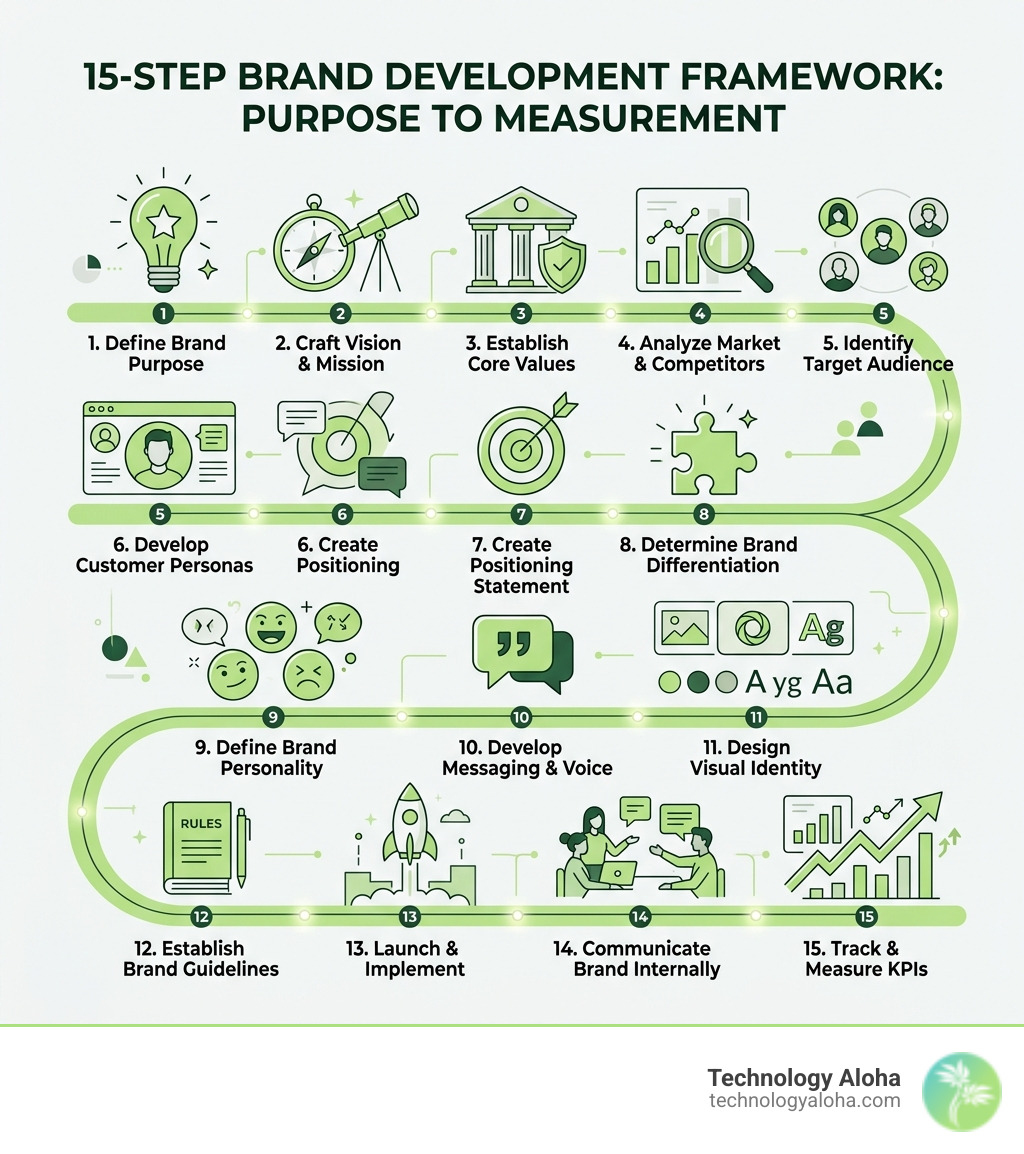
This guide walks you through a proven 15-step framework for building a brand that earns trust, drives revenue, and holds up under pressure.
Branding strategy pdf vocab explained:
- brand positioning and differentiation
- cohesive branding across platforms
- cohesive branding solutions Maui
In 2026, the marketplace is more crowded than ever. For SMEs and startups in Hawaii, the challenge isn’t just surviving; it’s standing out in a sea of “good enough” products. Technology has reached a point where functional differences between products are often negligible. When products become commoditized, the brand becomes the primary wealth creator.
A comprehensive branding strategy PDF serves as your business’s North Star. It ensures that every decision—from the colors on your website to the tone of your social media replies—aligns with your core objectives. Without this document, your marketing efforts will likely be fragmented, leading to wasted budget and confused customers.
Strategic brand management is not a luxury; it is a necessity for market value creation. As Alexander Chernev notes in Strategic Brand Management, 2nd Edition, a brand’s value is built through a combination of strategy (identifying target markets and value propositions) and tactics (designing and communicating that value). For a deeper look at why this matters for your growth, see our guide on 4 Hidden Benefits Of Having A Strong Branding Strategy For The New Year.
The Cost of Poor Reputation Management
Your brand’s reputation can be destroyed in hours. Statistics show that 93% of social media users believe companies should have a social media presence, and 85% expect those companies to interact with them. Neglecting this interaction—or worse, mishandling a crisis—can be fatal.
Consider the infamous Domino’s scandal: after an offensive video went viral, 65% of previous customers were less likely to order from them. YouGov confirmed that the perception of the brand’s quality flipped from positive to negative in just 48 hours. This highlights why Designing And Implementing Branding Strategies must include a plan for monitoring and rapid response.
Essential Elements of the Branding Strategy PDF
A “Brand Heart” is the core of your strategy. It consists of four pillars:
- Purpose: Why do you exist beyond making money?
- Vision: What future do you want to help create?
- Mission: What are you here to do every day to achieve that vision?
- Values: How will you conduct yourselves?
For organizations focused on impact, A Clear Branding Strategy Is What Every Nonprofit Needs to ensure their internal culture matches their external promise.
Phase 1: Market Intelligence and Positioning
Before you pick a font or a logo, you must understand the landscape. A competitive review isn’t just about seeing what others are doing—it’s about finding the gaps they’ve left behind. We use SWOT analysis (Strengths, Weaknesses, Opportunities, Threats) to identify where your business can truly win.
Your goal is to find your brand differentiators. These are the elements that make you “new,” “better,” or “elevated” compared to the status quo. Selecting the wrong differentiator can waste years of effort and thousands of dollars. Dive deeper into this process with our resources on Brand Positioning And Differentiation and Positioning And Branding For Small Business.
Defining Personas Within Your Branding Strategy PDF
You cannot speak to everyone. If you try, you’ll end up speaking to no one. Effective branding requires detailed customer personas—fictional representations of your ideal clients. These should include:
- Demographics: Age, location (e.g., Maui residents vs. tourists), and job title.
- Goals and Pain Points: What keeps them up at night, and what are they trying to achieve?
- Solution Messaging: How specifically does your brand solve their unique problems?
Building “customer-based brand equity” starts here. By understanding the audience’s psychological needs, you create a bridge between your past marketing investments and future performance. This is especially vital for mission-driven groups; learn more at The Importance Of Branding For Your Nonprofit.
Crafting the Positioning Statement
Once you know your audience and your differentiators, you must distill them into a Positioning Statement. This is a single, precise sentence that clarifies who you are, what you offer, and why you are the better choice.
This statement informs your brand voice. Is your brand authoritative and direct, or warm and humorous? Consistency is key. Your voice should be the same on your website, in your emails, and in your physical store. For help narrowing this down, check out 5 Tips For Choosing The Right Branding For Your Small Business.
Phase 2: Creative Execution and Visual Identity
Visual identity is the “clothes” your brand wears. It should be a direct reflection of your brand personality. A tech startup and a lifestyle brand require vastly different visual languages to be effective.
| Element | Tech Startup (B2B) | Lifestyle Brand (B2C) |
|---|---|---|
| Logo Style | Minimalist, geometric, sans-serif | Playful, organic, illustrative |
| Color Palette | Blues, grays, “trust” tones | Bright oranges, yellows, warm reds |
| Typography | Clean, high-readability sans-serif | Friendly serifs or custom scripts |
| Imagery | Modern, sleek, data-focused | Emotional, human-centric, scenic |
Choosing the right colors is a science, not just a preference. Different hues evoke different psychological responses. Learn how to select yours in Your Brand Colors Matter How To Choose And What They Say About Your Organization. Once you have a direction, Answer These Simple Logo Design Questions To Nail Your Branding.
Establishing Guidelines in Your Branding Strategy PDF
A branding strategy PDF is useless if it’s not followed. You must create a formal Brand Style Guide. This document includes rules for:
- Logo Usage: Minimum sizes and clear space.
- Color Codes: HEX, RGB, and CMYK values.
- Typography: Which fonts to use for headings vs. body text.
- Iconography and Photography: The “vibe” of your visual assets.
For a local example of comprehensive guidelines, see the University of Hawai’i Maui College Brand and Communications Toolkit. Consistency builds trust; a Brand Style Guide Your Key To A Consistent Brand Image ensures that trust isn’t broken by sloppy execution.
Building High-Performing Brand Collateral
Your website is your most important brand asset. In 2026, a website that “looks nice” isn’t enough—it must be a high-conversion tool. This involves user-centric design (UX) that guides the visitor toward a specific action.
Beyond the website, you need primary collateral: business cards, email templates, and perhaps a mobile app. These should all be developed with a clear marketing plan for launch. For a step-by-step approach, read How To Build Your Brand On Your Site and The Diy Guide To Creating A Brand Identity.
Phase 3: Protection, Extroversion, and Measurement
Building a brand is an “extroverted” activity. It requires an entrepreneurial attitude—networking, social media engagement, and visibility. You can’t build a brand in a vacuum. However, as you grow, you must protect your intellectual property.
Trademarks, copyrights, and patents are essential. Registering your trademark early prevents competitors from confusing your customers or stealing your hard-earned reputation. For more on professionalizing your presence, see 5 Tips On How To Create A Professional Brand As A Small Business Owner.
Monitoring Success and Brand Equity
How do you know if your branding strategy PDF is actually working? You must track Key Performance Indicators (KPIs). These include:
- Brand Awareness: Are people searching for your name?
- Sentiment Analysis: Is the online conversation about you positive?
- Customer Loyalty: What is your repeat purchase rate?
- Brand Equity: The added value your brand name brings to your products.
Regular brand audits and tracking studies help you stay on course. If you’re new to these metrics, start with Branding Strategy 101.
When to Consider Rebranding
Brands are not static. Market shifts, new competitors, or a change in business direction may necessitate a rebrand. Rebranding is a delicate process—you want to update your look and relevance without losing the equity you’ve already built.
Signs you might need a rebrand include:
- Your visual identity looks dated (2026 standards are high!).
- Your target audience has shifted.
- Your current brand no longer reflects your values or services.
Before you make the leap, read What You Need To Know When Rebranding.
Frequently Asked Questions about Branding Strategy
How long does it take to build a strong brand?
Building a brand is an ongoing process, not a one-time event. While you can develop the core elements of your branding strategy PDF in a few months, building significant brand recognition and loyalty typically takes years of consistent effort. It is a marathon, not a sprint.
What is the difference between brand identity and brand equity?
Brand identity is how the business wants to be perceived—it’s the visual and verbal expression (logo, voice, colors). Brand equity is the actual value of the brand in the mind of the consumer. It is a financial asset that results from consumer familiarity and positive associations. You build identity to create equity.
Can I handle branding myself or should I hire a professional?
While small business owners can certainly handle the initial “Brand Heart” work, a professional brings objective perspective and expert insights. Professionals help avoid common mistakes, such as choosing the wrong differentiators or creating a logo that doesn’t scale. Hiring an expert is often more time-efficient and leads to a higher ROI through better-performing designs.
Conclusion
At Technology Aloha, we believe that a brand is only as strong as the data behind it. We provide strategic positioning, branding, and user-centric websites designed for real business growth. Our USP is simple: we blend data-driven insights with cohesive branding and high-conversion designs to ensure your brand doesn’t just look good—it performs.
Whether you are a startup in Kahului or an established business elsewhere in Hawaii, your brand is your most valuable intangible asset. Don’t leave it to chance. Start building your foundation today.