Your Brand Identity Is the First Thing Customers Judge—Here’s How to Build It Right
How to create a brand identity starts with strategy, not design. Before you pick a color or sketch a logo, you need to know who you are, who you’re for, and what makes you different. Then the visuals follow—and they stick.

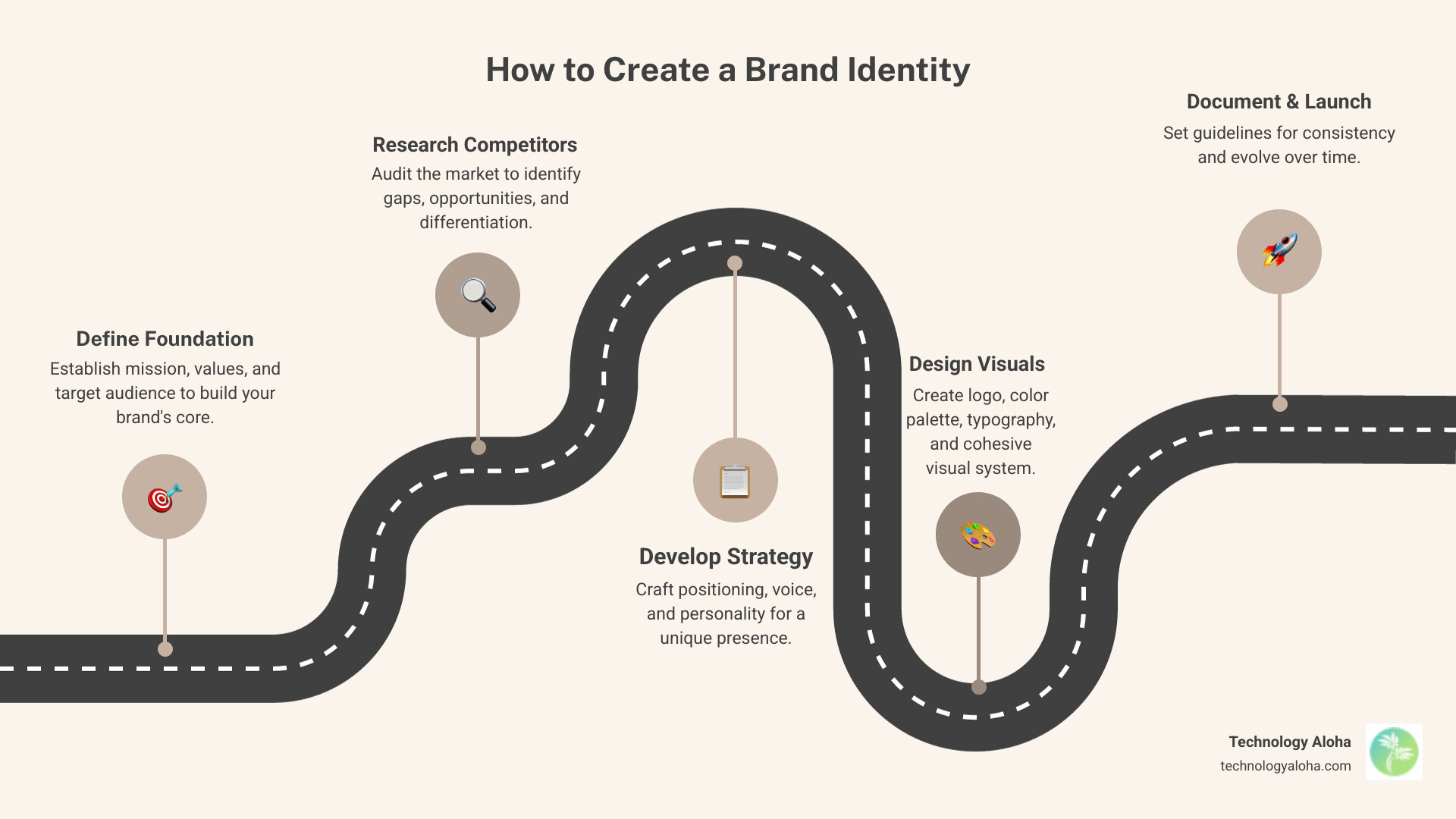
Here’s the short version:
- Define your foundation — mission, values, and target audience
- Research your competitors — find the gaps and opportunities
- Develop your brand strategy — positioning, voice, and personality
- Design your visual system — logo, color palette, and typography
- Document your guidelines — rules for consistent use across every touchpoint
- Launch and evolve — roll out your identity and refine it over time
Most small businesses skip straight to step four. That’s why their branding feels hollow—or forgettable.
Think about the last brand that stopped you mid-scroll. Chances are, it wasn’t just a pretty logo. It was recognition—a coherent look, feel, and message that made an immediate impression. Research shows 94% of first impressions are design-related. That’s not a small number.
And it’s not just about aesthetics. Consistent branding can increase revenue by 10–20%. A clear, cohesive identity builds trust—and trust drives decisions.
This guide walks you through every step of building a brand identity that works: one that’s strategic, scalable, and designed to attract the right clients in a competitive market.
Defining Brand Identity vs. Brand Image and Equity
To build a brand, we must first speak the same language. Many people use “brand,” “identity,” and “logo” interchangeably. They aren’t the same. Imagine your business is a person. The brand identity is how that person chooses to dress, speak, and behave. The brand image is what the neighbors actually think of them.
| Term | Perspective | Definition |
|---|---|---|
| Brand Identity | Internal (The Business) | The strategic vision and outward expression—name, logo, voice, and values. |
| Brand Image | External (The Customer) | The actual perception and reputation held by the public based on interactions. |
| Brand Equity | Financial/Market | The perceived value of the brand; the reason people pay more for a “name.” |
According to the American Marketing Association, brand identity refers to the “visual and symbolic elements that represent a brand.” This is the part we can control. We can choose our colors, our fonts, and our branding strategy.
However, a brand is more than just symbols. As entrepreneur and author Seth Godin defines it, “A brand is the set of expectations, memories, stories, and relationships that, taken together, account for a consumer’s decision to choose one product or service over another.”
When we discuss how to create a brand identity, we are building an internal asset. A strong identity improves employee engagement because it gives the team a clear purpose. It acts like a set of “tinted glasses” for your customers—it colors how they perceive every product or service you offer. If the identity is strong, it builds brand equity. This is why 52% of consumers are willing to pay more for products from companies that clearly communicate their values.
The Strategic Foundation: Steps Before You Design
Design without strategy is just art. For a business in Kahului or anywhere in Hawaii, your brand needs to solve a problem for a specific group of people. Before we open a single design tool, we must establish the “Brand Heart.”
1. Identify Your Audience and Create Buyer Personas
You cannot be everything to everyone. The most successful brands target a specific niche. We recommend creating “marketing personas”—hypothetical hybrids of your ideal customers. What are their demographics? What keeps them up at night? What are their “pain points”? If you are a local Maui business, your audience might value community and sustainability differently than a global corporation.
2. Conduct a Competitor Audit
Look at your top five competitors. What colors do they use? What is their tone of voice? A brand identity should differentiate you. If every competitor is using “ocean blue” and “sandy beige,” perhaps your identity needs a pop of #208a9d or #50c6db to stand out. Use a spreadsheet to track their strengths and weaknesses.
3. Define Your Mission and Values
Your brand purpose is why you exist beyond making a profit. The most important elements of your brand are your core values. Why does this matter? Because 82% of consumers make purchase decisions with purpose in mind. If you value sustainability, that should be reflected in your imagery and messaging.
4. Craft Your Value Proposition
What is your “special sauce”? This is the unique benefit you provide that no one else can. It should be the foundation of your branding strategy 101 efforts.
How to create a brand identity through audience research
Research is the “why” behind the “what.” To understand customer behavior, we look at how they interact with existing brands. An Akeneo study on consumer behavior showed that 82% of respondents are willing to spend up to 30% more on brands that align with their values.
Market segmentation allows us to speak directly to these motivators. For example, a premium egg brand might use packaging that shows a farmer feeding hens organic feed to appeal to health-conscious buyers. They aren’t just selling eggs; they are selling a “quality” identity.
When we research, we ask:
- What motivates our audience’s decisions?
- What frustrates them about our industry?
- Where do they spend their time online?
This data ensures that when we finally start designing, we aren’t just guessing. We are building a bridge between our business goals and our customers’ needs.
Building the Visual System: How to Create a Brand Identity
Now we move into the “outward expression” of the brand. This is the fun part, but it requires discipline. A cohesive visual identity includes your logo, color palette, typography, and imagery style.

Logo Design
The logo is the anchor. It should be simple, memorable, and timeless. Think of the world’s most recognizable logos—they often work just as well in black and white as they do in color. We start with sketches before moving to digital tools.
Color Psychology
Colors evoke emotion. Your brand colors matter because they tell a story before a customer reads a single word.
- #208a9d (Teal/Seafoam): Trust, clarity, and professionalism.
- #abe080 (Light Green): Growth, health, and sustainability.
- #50c6db (Cyan): Innovation and energy.
- #4d4d4d (Dark Grey): Stability and sophistication.
Typography Hierarchy
Limit yourself to two or three typefaces. You need a distinct font for headings and a highly legible font for body text. Typography should reflect your brand personality—a tech startup might use a clean sans-serif, while a luxury boutique might opt for a classic serif.
Iconography and Photography
Icons should be clear and consistent in weight and style. For more tips, see this iconography guide. Photography is equally vital. Are your images bright and airy? Or moody and dramatic? Consistent photo filters and styles help people recognize your brand instantly on platforms like Instagram.
Designing a logo that anchors your brand identity
A great logo must be versatile. It needs to look good on a giant billboard in Kahului and on a tiny favicon in a browser tab. To ensure your design hits the mark, you should answer these logo design questions during the process:
- Is it simple enough to be remembered after a three-second glance?
- Does it reflect the brand’s core values?
- Can it scale without losing detail?
Avoid “over-designing.” Complexity is the enemy of memorability. Some of the strongest brands, like Apple, have reached a point where they don’t even need their name next to their logo. That is the power of a simple, anchored shape.
How to create a brand identity that scales
Scalability means your brand identity can grow with you. A “responsive logo” is a modern necessity—it’s a version of your logo that changes based on the screen size. You might have a full logo for your website header and a simplified “lettermark” for your social media profile picture.
Digital-first assets are also crucial. Since 94% of first impressions are design-related, your website and social channels must feel like a natural extension of your brand. For small business owners in Hawaii, we offer 5 tips for small business branding that emphasize starting with the essentials (logo, colors, fonts) and expanding as you grow.
Documenting Consistency and Guidelines
A brand identity is only as good as its execution. If your Instagram looks like a party but your website looks like a funeral, you will lose customer trust. Consistency is the secret to a 10 to 20 percent revenue increase.
The Brand Style Guide
We create a “Brand Bible” or style guide to ensure everyone—from the founder to the summer intern—represents the brand correctly. This document should include:
- The Strategic Foundation: Mission, vision, and values.
- Logo Usage: Rules on spacing (clear space), minimum size, and what not to do (e.g., don’t stretch the logo).
- Color Palette: Exact hex codes (#208a9d, #abe080, etc.) for digital and CMYK for print.
- Typography: Which fonts to use for H1, H2, and body text.
- Tone of Voice: Are we funny and clever? Or authoritative and calm? Branding words build connection and engagement, so define your “do’s and don’ts” for copy.
Why Guidelines Matter
Brand style guide benefits go beyond just looking “neat.” They save you time and money. When you hire a new employee or a freelancer, you don’t have to explain your brand from scratch—you just hand them the guide.
Consistency breeds familiarity, and familiarity breeds trust. In a crowded marketplace, the brand that feels the most “reliable” is the one that wins. If your branding is consistent across your website, emails, and packaging, you are telling the customer that you are professional and attentive to detail.
Conclusion
Creating a brand identity is not a “one and done” task. It is a living process. As your business grows and the market in Hawaii evolves, your brand may need to adapt. However, the core values—your “Brand Heart”—should remain the anchor.
A strong brand identity is your most valuable silent salesman. It works 24/7 to tell your story, attract your ideal clients, and build long-term equity. Whether you are just starting or looking to refresh an existing look, strategy must always lead the way.
At Technology Aloha, we specialize in blending data-driven insights with cohesive branding to create high-conversion designs. If you’re ready to take the next step in your business journey, explore our strategic branding services. Let’s build something that lasts.