Why Brand Positioning and Differentiation Are the Difference Between Being Chosen and Being Ignored

Brand positioning and differentiation are two closely linked strategies that determine how your business is seen — and chosen — in a crowded market.
Here’s the short answer:
- Brand positioning is the place your brand occupies in your customer’s mind relative to competitors. It’s about perception.
- Brand differentiation is what makes your product or service actually stand apart from the competition. It’s about characteristics.
Together, they answer the question every potential customer is silently asking: “Why should I pick you?”
“Brands have never been more important,” says Harvard Business School Professor Jill Avery — because consumers don’t just buy products, they buy meaning.
For small business owners, this is especially high-stakes. Without a clear position in the market, you become invisible. You compete on price. You attract the wrong clients — or none at all.
The good news? Positioning and differentiation are learnable, repeatable disciplines. This guide walks you through both, step by step.
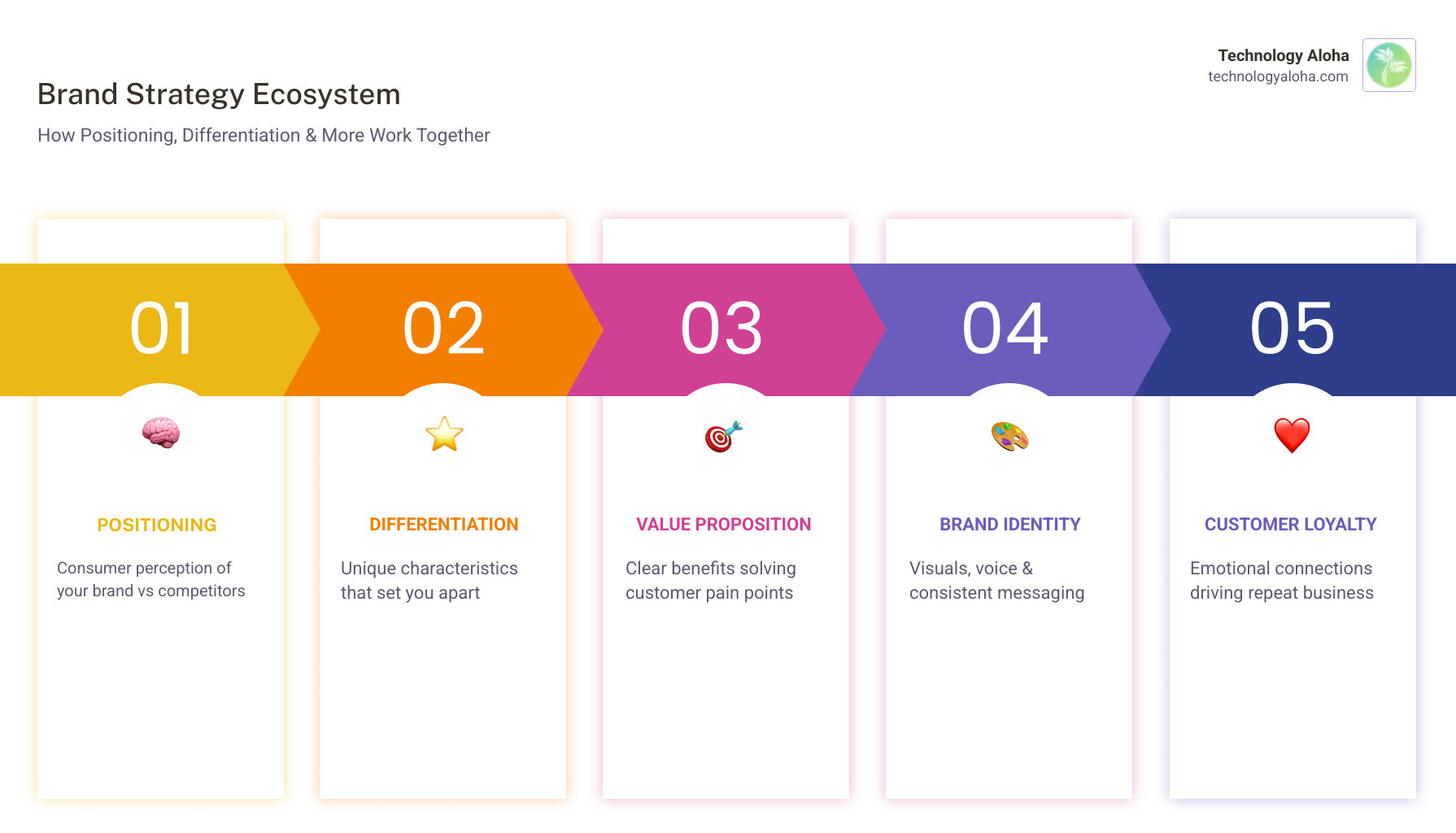
Infographic: The Brand Strategy Ecosystem — how positioning (consumer perception), differentiation (unique characteristics), value proposition, and brand identity work together. Designed in #208a9d, #abe080, #50c6db, and #4d4d4d.
Defining Brand Positioning and Differentiation: The Foundation of Market Authority

To win in any market, we must first understand the ground we stand on. While the terms are often used interchangeably, they represent two distinct sides of the same coin. Think of a chess board: differentiation is the unique move a knight can make compared to a pawn; positioning is where you place that knight on the board to dominate the game.
Product differentiation is the process of identifying and highlighting the specific characteristics that make your offering unique. It is product-specific and focuses on tangible or intangible attributes like quality, features, or price. On the other hand, brand positioning is about the audience. It is the strategic act of situating your brand in the consumer’s mind so that they perceive it favorably against alternatives.
As noted in scientific research on brand positioning impact, strategic positioning is a critical driver of business growth and competitive advantage. It aligns your brand identity with the consumer’s own identity, making your marketing efforts significantly more effective. At Technology Aloha, we believe that understanding the most important elements of your brand starts with this fundamental distinction.
| Feature | Brand Positioning | Brand Differentiation |
|---|---|---|
| Focus | Consumer Perception | Product/Service Characteristics |
| Goal | Occupy a “niche” in the mind | Stand out from the crowd |
| Execution | Messaging, Symbols, Emotions | Features, Quality, Innovation |
| Result | Brand Authority | Unique Value Proposition |
Why Brand Positioning and Differentiation Are Essential for Success
When AI has lowered the cost of content creation, markets have become noisier than ever. Without a clear strategy, your brand is just “another option.” Strong brand positioning and differentiation allow businesses to justify premium pricing. When customers perceive your brand as the only one that truly solves their specific problem, they become less price-sensitive.
Marketing pioneers Al Ries and Jack Trout famously emphasized the “one word” concept: brands succeed by owning a single word or concept in the consumer’s mind. If you try to occupy multiple positions at once (e.g., being the cheapest and the highest quality), customers struggle to categorize you, and you end up owning nothing.
The Relationship Between Positioning, Loyalty, and Growth
Effective positioning doesn’t just attract customers; it keeps them. By creating an emotional connection and a sense of shared values, you increase customer lifetime value. Loyal customers provide a higher ROI because they require lower acquisition costs over time.
There are 4 hidden benefits of having a strong branding strategy, including increased resilience during economic downturns. When people trust your brand’s position, they stay with you even when the market gets rocky. This trust acts as a “meaning-maker,” turning a simple purchase into a significant experience.
The Strategic Process: Developing Your Unique Value Proposition
Developing a strategy isn’t about guesswork; it’s about competitive intelligence and market dynamics. We must begin by auditing the current market reality to see where the gaps are. This involves segmenting your audience based on psychographics, pain points, and aspirations rather than just simple demographics.
To keep your team aligned, we recommend using a Marketing Terms Cheat Sheet to ensure everyone understands the nuances of the branding strategy 101 process.
Identifying Your Unique Value Proposition (UVP) and USP
Your Unique Selling Proposition (USP) typically refers to the specific, tangible benefit that makes your product superior (e.g., “15 minutes could save you 15%”). However, your Unique Value Proposition (UVP) is broader. It encompasses the functional and emotional payoff of choosing your brand.
To identify your UVP, ask:
- What specific problem do we solve better than anyone else?
- What are the “reasons to believe” (proof points) that we can deliver on this promise?
- How does our service make the customer the hero of their own story?
Even for small businesses, learning how to build a big brand for your small business involves moving away from generic claims like “we offer the best service” and toward specific, provable value.
Crafting Your Brand Positioning and Differentiation Statement
A brand positioning statement is your internal “North Star.” It isn’t a public-facing slogan; it’s a strategic tool that guides every marketing decision you make. A proven positioning statement template looks like this:
“For [target market], our brand is the only [category] that [unique value claim] because [reasons to believe].”
Once this statement is crafted, it must be documented. A brand style guide ensures that your visual and verbal identity consistently reflects this position across all touchpoints.
Visualizing the Competitive Landscape with Perceptual Mapping
How do you know if your positioning is actually unique? You map it. A perceptual map is a visual tool that plots your brand and your competitors along two axes—usually attributes like price, quality, innovation, or convenience.
Using a perceptual map guide, you can spot market white space fast: clusters where brands all feel the same, and gaps where a real customer need is underserved. The key takeaway isn’t about how the diagram is shared; it’s that positioning is always relative. Customers don’t judge you in a vacuum they compare you to the nearest alternatives on the attributes they care about most.
Real-World Brand Positioning and Differentiation Examples
Looking at successful companies can provide a blueprint for our own efforts:
- Inniskillin: Built clear icewine leadership by owning a specific category in buyers’ minds, turning a distinctive specialty into global recognition.
- 13th Street Winery: Differentiates through art integration, positioning the brand as a destination experience (wine plus gallery and bakery), not just a bottle on a shelf.
- CedarCreek Estate Winery: Positions around organic terroir, using sustainability and place-based winemaking to stand out for eco-minded, quality-seeking customers.
Common Types of Differentiation Strategies
There are several paths to standing out, but rarely if ever is lowering your price the right strategy. Price wars are a race to the bottom that erodes brand equity. Instead, consider these:
- Quality-Based: Being the “gold standard” in your industry (e.g., Voss water).
- Innovation-Led: Constantly introducing new features or proprietary technology.
- Service-Centric: Differentiating through the client experience or consultative selling.
- Horizontal vs. Vertical Segmentation: Vertical differentiation targets a specific industry (like accounting for construction), while horizontal targets a specific persona or specialty (like accounting for high-net-worth individuals).
Executing and Measuring Your Strategy in a Digital World
Your brand is no longer what you say it is—it’s what they say it is. Digital transformation has changed the game by providing real-time feedback through social media and data analytics. We must use branding words that build connection to engage with our audience where they already spend their time.
Overcoming Challenges in Cross-Channel Consistency
One of the biggest hurdles is “The Accidental Brand”—where a company’s messaging becomes fragmented across different platforms. Internal misalignment occurs when the sales team says one thing, but the website says another.
To fix this, we recommend learning how to build your brand on your site with a focus on cohesive storytelling. Regular brand audits are essential to ensure that your positioning isn’t becoming rigid or irrelevant as market trends shift.
Measuring Effectiveness and Adapting to Trends
How do we know if it’s working? We track Key Performance Indicators (KPIs) such as:
- Brand Awareness: Are people searching for you by name?
- Net Promoter Score (NPS): Would your customers recommend you?
- Sentiment Analysis: Is the online conversation about your brand positive?
You can also watch Professor Avery discuss brand portfolio strategy to see how giant companies like Marriott manage multiple brands without causing market confusion. Successful brands are “opinionated by design”—they make clear trade-offs to ensure they mean something specific to their target audience.
Frequently Asked Questions about Brand Positioning
What is the main difference between positioning and differentiation?
Differentiation is the set of “facts” about your product (it’s faster, organic, or has a specific feature). Positioning is the “feeling” or “place” those facts create in the customer’s mind (it’s the most reliable, the most eco-friendly, or the most prestigious).
How often should a business update its brand positioning?
While your core values should remain stable, you should audit your positioning every 1–2 years. If a new competitor enters the market or consumer preferences shift significantly (like the rise of sustainability), you may need to reposition to stay relevant.
Can a brand have more than one positioning statement?
Generally, no. A brand should have one primary positioning statement to serve as its North Star. However, you might have different value propositions for different market segments, as long as they all align with the overarching brand position.
Conclusion
At Technology Aloha, we understand that brand positioning and differentiation aren’t just marketing jargon—they are the engine of business growth. By blending data-driven insights with cohesive branding and high-conversion designs, we help businesses in Hawaii and beyond find their unique voice in a crowded digital landscape.
Whether you are a small business in Kahului or an organization looking to scale across the islands, a strong brand is a person’s “gut feeling.” By being intentional about your position and bold about your differences, you don’t just win market share—you win advocates.
Ready to define your place in the market? Explore our branding services and let’s start building your legacy today.