What Is New Brand Development — and Where Do You Start?

New brand development is the process of building a brand from scratch — defining who you are, what you stand for, and how customers will recognize and remember you.
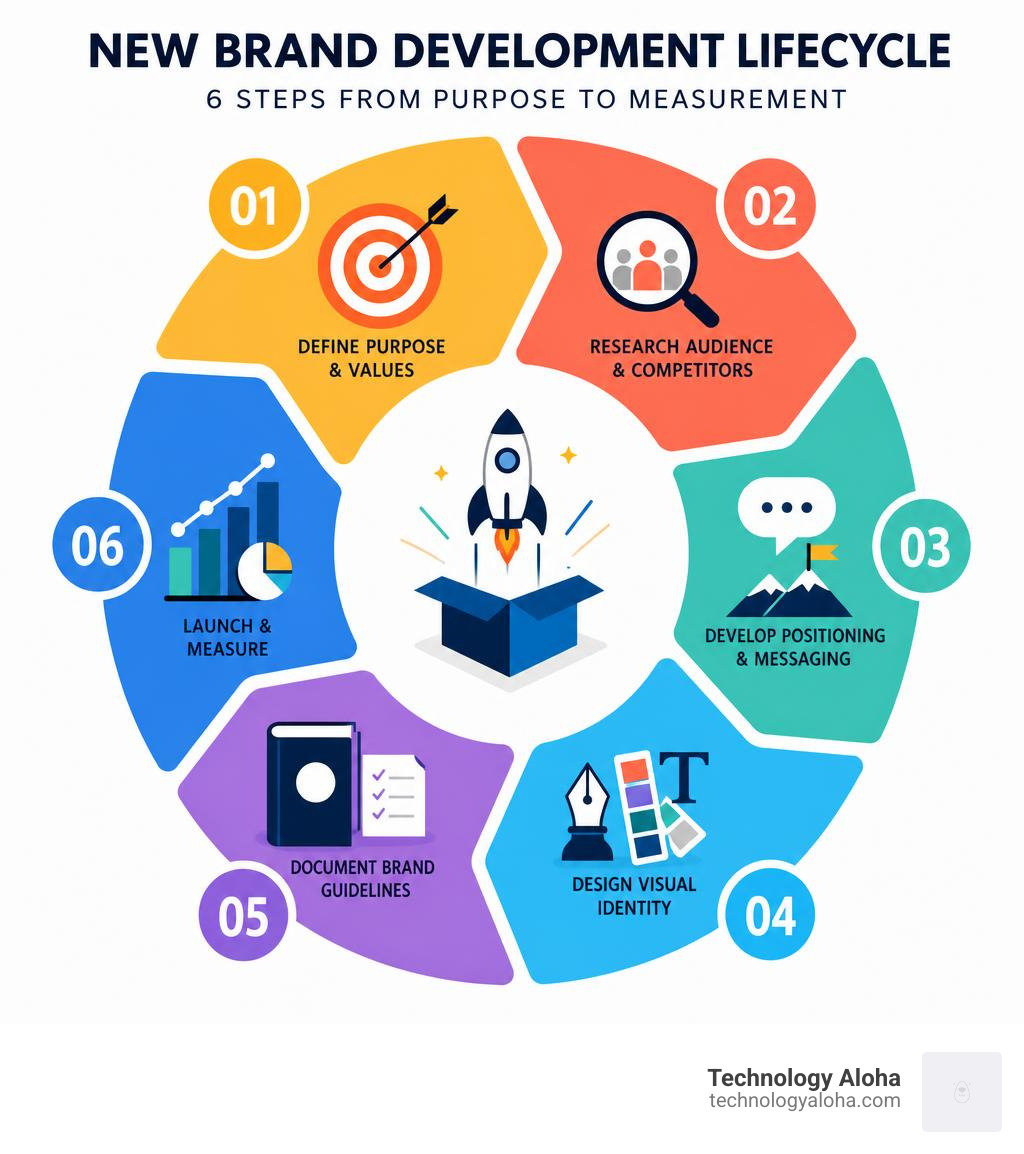
If you’re starting a business or launching a new product line, here’s the short version of what the process involves:
- Define your purpose and values — why does your brand exist?
- Research your audience and competitors — who are you serving, and what’s already out there?
- Develop your positioning and messaging — what makes you different and why should anyone care?
- Design your visual identity — logo, colors, typography, imagery
- Document brand guidelines — so your brand stays consistent as you grow
- Launch and measure — track what’s working and refine over time
That’s the skeleton. The rest of this guide puts meat on the bones.
Your brand is how people feel about your business — what they say about you when you’re not in the room. A strong brand doesn’t happen by accident. It’s built deliberately, on a strategic foundation, long before a logo is ever designed.
Here’s why this matters for small business owners specifically: according to research from Hinge Marketing, firms that conduct systematic research on their target audience grow faster and are more profitable than those that don’t. And companies with consistent brand identity see an average of 23% higher revenue — not because their logo is prettier, but because every touchpoint tells the same story.
The problem most small businesses face isn’t a lack of creativity. It’s starting with the visual before the strategy — designing a logo before they know who they’re talking to or what they actually stand for. That’s building a house without a foundation.
This guide walks you through every stage of new brand development — from first principles to launch — so you can build something that actually works.
New brand development terms to remember:
- Branding Strategy 101
- Brand Positioning and Differentiation
- Mastering Brand Strategy and Development for Modern Marketing
The Strategic Foundation of New Brand Development
A logo is a compressed memory device, not a strategy. True new brand development begins with a clear, documented brand strategy that aligns with your overarching business objectives. Without this roadmap, your marketing efforts will drift, your messaging will fragment, and your team will waste valuable resources on disjointed campaigns.
In 2026, the marketplace is too crowded and consumer attention is too fragmented for guesswork. A robust brand strategy acts as your filter for every future decision—from the features you build into your product to the tone of your customer service emails. It ensures your long-term planning is grounded in market realities and distinct positioning, rather than founder intuition alone.
To build a brand that endures, you must first master the intersection of market demand, operational capability, and distinct positioning. For a deeper look at this alignment, explore our guide on Mastering Brand Strategy and Development for Modern Marketing.
Defining Your Brand Purpose and Core Values
Every business exists to solve a problem, but great brands exist for a reason beyond what they sell. Your brand purpose is your “why”—the fundamental reason your business exists. Your mission statement outlines what you do today and who you do it for, while your vision paints a picture of the future you want to create.
Equally critical are your core values. These are not platitudes to print on a poster; they are the operating rules of your business. True values must be costly to uphold—if you have never killed a feature, walked away from a client, or delayed a launch to protect a standard, then that standard is not a value; it is merely marketing copy.
When we define these elements, we establish the internal compass that guides how your business behaves. To understand how these components work together to build trust, read about The Most Important Elements of Your Brand.
Audience Research and Competitor Analysis in New Brand Development
You cannot be everything to everyone. Trying to appeal to all buyers results in a diluted identity that appeals to no one. Successful brand development requires you to define who your brand is explicitly not for.
To identify your ideal target demographics, we must go beyond basic age and location brackets to build comprehensive buyer personas. This requires systematic research:
- Quantitative Data: Reviewing transaction records, search intent trends, and demographic analytics.
- Qualitative Data: Conducting direct customer interviews and staff surveys to understand the emotional friction points your product solves.
- Competitor Research: Evaluating your competitors’ positioning, share of voice, and market gaps.
According to professional services research, firms that conduct systematic audience research at least once per quarter grow faster and are more profitable than those that rely on assumptions. By analyzing where your competitors are playing safe, you can identify open spaces in the market to claim. For more insights on executing this research effectively, refer to the industry guide on The Importance Of Audience Research And Competitor Analysis In Brand Development.
The Step-by-Step Process to Build a Brand from Scratch
Building a brand is an iterative, structured process. It translates your strategic foundation into tangible visual, verbal, and experiential assets.
This process is generally divided into three major phases:
- Discovery & Strategy: Aligning on your audience, positioning, and core narrative.
- Design & Identity: Developing your visual and verbal assets.
- Activation & Rollout: Launching your brand consistently across all channels.
For those looking to understand the mechanics of this process, our resource on The DIY Guide to Creating a Brand Identity provides a highly practical starting point.
Crafting Your Brand Positioning and Messaging Strategy
Your positioning statement is the internal anchor of your brand. It defines your market category, your target audience, your unique selling proposition (USP), and the proof points that back up your claims. A typical positioning statement is four to six sentences long, grounded in reality, and highly specific.
From this positioning, we build your external messaging framework:
- The Slogan/Tagline: A brief, memorable phrase that captures your brand’s core benefit.
- Messaging Pillars: Three to four core themes that address specific customer pain points.
- Brand Voice: The consistent personality and tone of your copy—whether it is authoritative and direct or playful and accessible.
Your brand voice must reflect how your target audience actually speaks. Using social listening to analyze the vocabulary your customers use prevents your brand from sounding artificial or out of touch. Discover how to build this foundation in our article on Brand Positioning and Differentiation.
Designing a Cohesive Visual Identity System
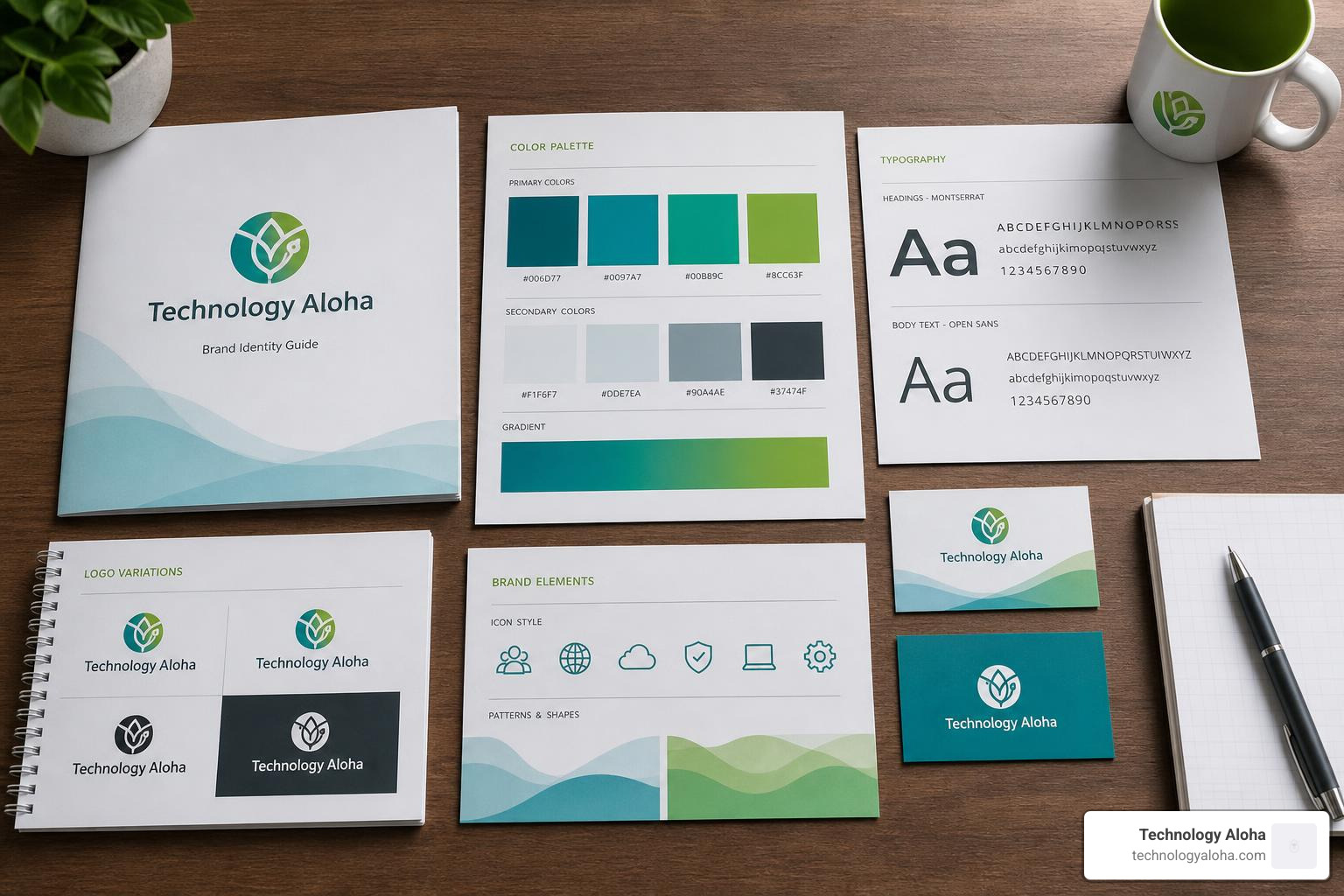
Once your strategy and messaging are locked in, we translate them into a visual system. Your visual identity includes your logo design, color palette, typography, and brand imagery.
Each element must work together to evoke the correct psychological response:
- Logo: A versatile, simple, and timeless mark that is legible at any scale—from a tiny mobile favicon to a large physical sign.
- Color Palette: A constrained set of colors (typically three to six) that establish immediate visual recognition.
- Typography: Limiting font selections to two or three cohesive typefaces to maintain hierarchy and readability across print and digital media.
- Imagery: Defining rules for photography and illustration styles (e.g., natural lighting, bold color-blocking, or minimalist line drawings).
We see modern examples of brands breaking out of wellness and corporate clichés by using bold, expressive color systems and playful typography to stand out in traditionally quiet categories. For instance, the recent launch of WAWA sparkling water shows how a brand can reject minimalist restraint in favor of vibrant, emotional storytelling. You can read about this design approach in the article Sparkling water gets a glow-up in WAWA, a playful new drink co-created with footballer Sam Kerr.
Documenting Guidelines for Scalable New Brand Development
A beautiful design system is useless if your team cannot apply it consistently. The final step of the creation phase is documenting your brand guidelines.
This comprehensive document serves as the operating manual for your business. It should include:
- Logo usage rules (clear space, unacceptable modifications).
- Exact color formulas (HEX, RGB, CMYK).
- Typography hierarchies (headings, body copy, line spacing).
- Tone of voice rules with explicit “write this, not that” examples.
- Design tokens and asset curation rules to keep digital developers and print vendors aligned.
Building a system that can scale without losing its core identity is the hallmark of great brand development. For an expert perspective on balancing scale with emotional resonance, read Built to Scale, Designed to Feel.
Brand Refresh vs. Full Rebrand: When to Pivot
As your business grows, your brand will inevitably face a crossroads. Market dynamics shift, competitors emerge, and target demographics evolve. When your current brand no longer aligns with your business reality, you must choose between a brand refresh and a full rebrand.
| Characteristic | Brand Refresh | Full Rebrand |
|---|---|---|
| Depth of Change | Tactical update; “polishing the surface” | Strategic overhaul; “gutting and rebuilding” |
| Core Strategy | Remains the same; minor positioning tweaks | Changes completely; new mission, values, or target market |
| Visual Identity | Modernized logo, updated colors, fresh typography | Entirely new name, logo, visual assets, and design system |
| Risk Level | Low; preserves existing brand equity | High; risks temporary loss of recognition |
| Average Frequency | Every 3–5 years | Rarely; only during major business pivots |
Key Signs Your Brand Needs an Update
How do you know when it is time to invest in your brand? Consumer brands need to refresh every six years on average to stay modern. Waiting too long risks making your business look outdated, which can lead to declining conversion rates and lost market share.
Look for these key signs that indicate your brand needs attention:
- Outdated Aesthetics: Your visual identity looks like a relic of a past decade, or your website is difficult to navigate on mobile devices.
- Audience Shifts: You are trying to reach a new demographic (such as transitioning to Gen Z buyers) whose values and visual codes differ from your original audience.
- Product or Service Expansion: Your business has grown beyond its original scope, and your current branding or name feels too restrictive.
- Competitor Changes: New, modern competitors have entered your market, making your brand look stagnant by comparison.
- Brand Fragmentation: Your sales decks, social media channels, and website look like they belong to three different companies because you lack centralized guidelines.
To understand why visual assets alone cannot solve these deeper alignment issues, read our article Small Business Branding and Positioning: Why Your Logo Is Not Your Brand.
Comparing Refresh and Rebrand Methodologies
A brand refresh acts like a home renovation—you keep the structural foundation but update the paint, lighting, and furniture. This approach preserves your existing brand equity while modernizing your visual codes.
For example, when Hellmann’s revived its historical blue ribbon heritage, it did not change what the brand stood for; it simply updated its visual elements to highlight real ingredients. Similarly, Heller Consulting achieved a 400% increase in website conversions and a 50% increase in organic search traffic over a two-year period following a strategic brand refresh.
A full rebrand is a complete demolition and rebuild. It is reserved for major strategic shifts—such as mergers, acquisitions, or complete changes in business direction. When Dunkin’ shortened its name from Dunkin’ Donuts in 2018, it was a strategic rebrand to position the company as a beverage-first brand. By the time the company was privately sold in 2020, its valuation had increased by roughly 50% in just two years.
To explore how modern brands navigate these transitions to connect with younger audiences, read the industry analysis on How to Build a Brand for Gen Z.
Measuring the ROI and Success of Your Brand Strategy
Branding is both a creative discipline and a business science. In 2026, with 59% of CMOs reporting that they do not have sufficient funds to deliver on their agendas, every dollar spent on new brand development must prove its utility. You cannot manage what you do not measure.

To prove the ROI of your branding efforts, we must move past vanity metrics (like social media likes) and focus on indicators that tie directly to business growth and marketing efficiency. For a structured approach to tracking these metrics, download our resource: Stop Guessing and Start Branding with This Strategy Framework PDF.
Key Performance Indicators for Brand Equity
We measure the strength of your brand using a mix of brand health and financial indicators:
- Net Promoter Score (NPS): Measures customer loyalty and their likelihood to recommend your business to others.
- Referral Rate: The percentage of new business that originates from existing customer recommendations. A rising referral rate indicates strong brand trust.
- Sales Win Rate: The percentage of proposals or sales pitches won against named competitors. A strong brand reduces sales friction and shortens the sales cycle.
- Unaided Brand Recall: The percentage of consumers who can name your brand without prompting when thinking of your product category.
- Customer Lifetime Value (CLV): Loyal customers buy more frequently and stay with your business longer, driving up overall profitability.
Data-Driven Optimization and Brand Lift Testing
Modern brand development relies on continuous optimization. By leveraging data-driven tools, we can track how your brand performs in real time:
- Brand Lift Testing: Running controlled advertising campaigns to measure changes in brand awareness and perception between an exposed group and a control group.
- Incrementality Testing: Determining the actual business growth driven by your branding efforts versus organic conversions that would have occurred anyway.
- Social Listening: Using sentiment analysis to track how consumers talk about your brand online, allowing you to catch shifting purchase intent or brand dissatisfaction early.
- AI Integration: Utilizing machine learning algorithms to analyze consumer behavior patterns and optimize your messaging across channels.
Frequently Asked Questions about Brand Strategy
Building a brand comes with many questions. Here are the answers to the most common questions businesses ask during the new brand development process. For a complete look at the basics, refer to our guide on Branding Strategy 101.
What is the difference between brand identity, branding, and brand strategy?
These terms are often used interchangeably, but they represent distinct parts of the development process:
- Brand Strategy is the why—your long-term plan, target audience, competitive positioning, and core values.
- Brand Identity is the what—the tangible visual and verbal assets you create to express that strategy (logo, typography, voice, guidelines).
- Branding is the how—the ongoing marketing activities, customer service practices, and campaigns that build your brand equity over time.
Without a strong brand strategy, your brand identity will lack direction, and your branding activities will produce inconsistent results. To build a cohesive system, read our guide on Corporate Branding Strategy PDF: Building a Brand That Actually Sticks.
How much does brand development cost in 2026?
The cost of brand development varies based on the size of your business and the depth of the project.
For growing businesses, branding is an investment in your business infrastructure rather than an expense. While DIY tools offer low-cost entry points, they often lead to generic designs and lack the strategic depth required to stand out. Working with a professional agency ensures your brand is built on deep market research, distinct positioning, and a scalable visual system. This upfront investment prevents the high cost of rebranding and correcting inconsistent marketing materials later on.
How long does the brand development process typically take?
A comprehensive brand development project typically takes between 6 to 12 weeks to complete. This timeline is split into clear phases:
- Weeks 1–3: Research, competitor audits, stakeholder interviews, and strategy formulation.
- Weeks 4–7: Messaging development, visual identity design, and logo concepts.
- Weeks 8–10: Asset refinement, brand guidelines documentation, and collateral design.
- Weeks 11–12: Asset handoff, website updates, and rollout planning.
Attempting to rush this process usually leads to shallow strategy and generic designs that fail to connect with your target market.
Conclusion
Building a successful brand requires a balance of strategic discipline and creative execution. In 2026, you cannot rely on intuition alone to stand out in a crowded market.
At Technology Aloha, we combine data-driven insights with cohesive branding and high-conversion web designs to help businesses grow. We understand how to build brands that connect with audiences while supporting long-term business goals.
Whether you are launching a new venture or updating an established business, we can help you build a brand that drives real results. Ready to start your new brand development journey? Contact us today to explore our Data-Driven Brand Strategy Services.