Is Transitioning from Graphic Design to UX Design Right for You?
Making the move from graphic design to UX design is one of the most strategic career pivots a designer can make in 2026. If you’re a graphic designer wondering whether it’s worth it — here’s the short answer:
Yes. And your existing skills give you a head start.
Here’s what the transition looks like at a glance:
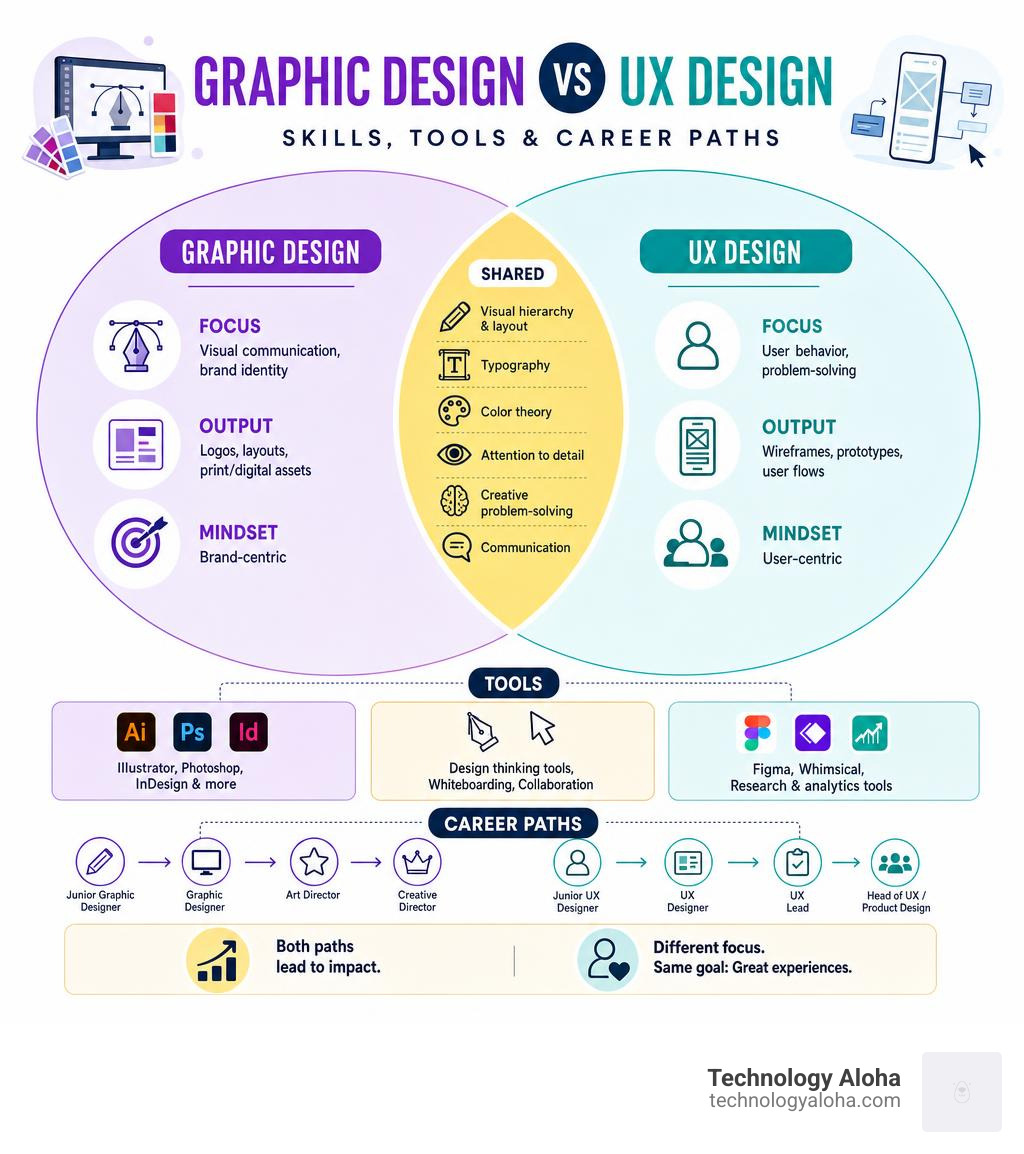
| Graphic Design | UX Design | |
|---|---|---|
| Focus | Visual communication, brand identity | User behavior, problem-solving |
| Output | Logos, layouts, print/digital assets | Wireframes, prototypes, user flows |
| Mindset | Brand-centric | User-centric |
| Avg. U.S. Salary | ~$41,000 | ~$74,000 |
| Key Tools | Illustrator, Photoshop, InDesign | Figma, Whimsical, research tools |
| Success Metric | Client approval | User task completion |
The gap between those two salary figures is real. And so is the demand.
Many graphic designers already have the visual foundation — typography, color theory, hierarchy — that UX designers rely on daily. What changes is the question you’re asking. Graphic design asks, “Does this look good?” UX design asks, “Can someone actually use this?”
That shift sounds simple. It isn’t. But it’s learnable — and this guide walks you through every step.
Relevant articles related to graphic design to ux design:
- Why Creative Graphic Design Is the Secret Sauce for Your Business
- The Graphic Design and Printing Guide for Non-Designers
- The Ultimate Guide to Motion Graphics for Social Media
Graphic Design vs. UX Design: Understanding the Core Differences
To make a successful transition from graphic design to UX design, you must first understand the structural differences between these two disciplines. While both reside under the broad umbrella of design, they serve entirely different masters and solve different classes of problems.
Graphic design is rooted in visual communication. Its primary objective is to convey a specific message, evoke an emotion, or establish a brand identity through static or dynamic visual elements. Graphic designers spend their days mastering composition, color palettes, and typography to capture attention and deliver information.
UX (User Experience) design, on the other hand, is a multidisciplinary field focused on the complete interaction between a user and a digital product. It is less about how a product looks and far more about how it works, how easily a user can complete their tasks, and how they feel during the process. For a deeper dive into the mechanics of digital experience, explore our guide on User Experience (UX): What It Is and Why It’s Important for Your Website’s Growth.
While a graphic designer’s work is often judged by its aesthetic impact and alignment with brand guidelines, a UX designer’s work is evaluated based on usability metrics, task success rates, and user friction points.
| Dimension | Graphic Design | UX/UI Design |
|---|---|---|
| Primary Goal | Visual storytelling, brand consistency, and aesthetic appeal. | Usability, accessibility, conversion, and seamless interactions. |
| Core Audience | Viewers, readers, and potential consumers. | Active users interacting with a digital interface. |
| Feedback Loop | Client feedback and brand alignment. | User testing, behavioral analytics, and iterative research. |
| Deliverables | Brand guidelines, packaging, marketing collateral, layouts. | User personas, wireframes, interactive prototypes, user flows. |
| Medium | Print, digital displays, static graphics. | Dynamic, interactive digital products (apps, websites, software). |
To design digital experiences that perform, we must balance visual storytelling with technical performance. This requires an understanding of how user-centric choices drive business outcomes. You can read more about this balance in The Ultimate Guide to User-Centric Website Design.
Shifting from Brand-Centric to User-Centric Design
The most significant hurdle when moving from graphic design to UX design is transitioning from a brand-centric approach to a user-centric one.
In traditional graphic design, the brand identity is the anchor. You design to project the brand’s personality, values, and messaging outward. To understand the strategic value of this visual positioning, see our article on Why Creative Graphic Design Is the Secret Sauce for Your Business.
In UX design, the user’s needs, limitations, and behaviors are the anchor. You are no longer designing for passive appreciation; you are designing a functional dialogue. As explained in Canvas to pixels: Transitioning from Artist to UX Designer, art is often about self-expression or open interpretation, whereas UX design demands absolute clarity, usability, and predictable behavior.
When you design a brand asset, you might prioritize a unique, asymmetrical layout to stand out. In UX design, unexpected layouts can confuse users, leading to high bounce rates and abandoned tasks. You must learn to design for the target audience’s mental models rather than your own aesthetic preferences.
Why Make the Career Move from Graphic Design to UX Design?
The decision to execute a career pivot into the digital product space is frequently driven by two primary factors: market demand and the desire for deeper project involvement.
In 2026, the digital landscape has matured to a point where companies of all sizes recognize that exceptional user experience directly correlates with customer retention and revenue. Consequently, the demand for skilled UX professionals continues to outpace traditional graphic design roles.
As pointed out in Moving From Graphic Design to UX Design: The Complete Guide to Career Change, transitioning to UX allows designers to work “under the hood” of products, providing a higher level of professional satisfaction as they solve systemic user problems rather than simply polishing the exterior.
For designers living in or looking to work with businesses in Hawaii, the local ecosystem is growing. Organizations across the islands—from Kahului, HI to Honolulu—are modernizing their digital presences. Local resources like UXHI | A UX design community for people in Hawaii and listings on Top UI/UX Design Agencies in Hawaii | 2026 – DesignRush indicate a robust, active market for product design talent.
Salary and Career Growth in the Transition from Graphic Design to UX Design
The financial benefits of transitioning from graphic design to UX design are substantial and well-documented.
- According to industry data, the average salary for a graphic designer in the United States is approximately $41,000, whereas the average salary for a UX designer is $74,000.
- Looking at broader design roles, graphic designers earn a median salary of $61,300 compared to web and digital interface designers who earn a median of $95,380 annually.
This salary differential reflects the multidisciplinary nature of UX design, which blends psychology, technology, business strategy, and visual design.
In addition to immediate financial gains, the career progression in UX design offers diverse pathways. You can specialize in areas such as:
- UX Researcher: Focusing entirely on user behavior, testing, and data analysis.
- Information Architect: Structuring content and navigation systems for complex platforms.
- Interaction Designer: Designing the micro-interactions, animations, and states of digital interfaces.
- Product Designer: A holistic role managing both the UX/UI and the overarching business strategy of a digital product.
The Mindset Shift: From Aesthetics to Problem-Solving
The core transformation when transitioning from graphic design to UX design is not learning new software—it is adopting a new mindset.
Graphic designers are accustomed to polished, pixel-perfect final deliverables. In UX, you must get comfortable with messy, low-fidelity wireframes, iterative testing, and the reality that your first design might fail when tested by real users.
As highlighted in From Graphic Design to UX: The Complete Transition Guide , good visuals will not save a bad user experience. A visually stunning app that takes five confusing steps to perform a simple action will always lose to a plain, highly intuitive app that completes the same action in one step.
This requires replacing design ego with deep empathy. You must base your design decisions on empirical evidence, user research, and behavioral patterns rather than your personal intuition or what “looks cool.” To master this structured methodology, read our guide on Mastering the User-Centric Design Process.
Transitioning Your Skills from Graphic Design to UX Design
You do not need to throw away your graphic design background. In fact, your visual skills are your “superpowers” in the UX/UI world. The key is understanding which skills transfer directly and which new ones you must build.
Directly Transferable Skills
- Typography & Readability: Knowing how to pair fonts, manage line heights, and set hierarchy is critical for interface legibility.
- Visual Hierarchy: Your ability to guide a viewer’s eye across a page translates directly to guiding a user through a digital checkout flow or dashboard.
- Color Theory: Using color to evoke emotion, establish brand identity, and create contrast for accessibility.
New Skills to Learn
- User Research & Testing: Learning how to conduct user interviews, run usability tests, and analyze quantitative behavioral data.
- Information Architecture (IA): Structuring and organizing complex digital content so users can find information intuitively.
- Wireframing & Prototyping: Creating low-fidelity blueprints (wireframes) and interactive models (prototypes) to test flows before writing code.
To ensure your digital products succeed, you must also understand how search engine optimization intersects with user flow. Learn more about this in Why You Need to Balance SEO and User Experience in Your Web Design.
Step-by-Step Roadmap to Transition Your Career
If you are ready to make the transition, follow this structured roadmap to build your skills, portfolio, and professional network.
Step 1: Learn the UX Fundamentals
Before opening any design software, study the foundational principles of user experience. Read classic texts such as Don Norman’s The Design of Everyday Things and Steve Krug’s Don’t Make Me Think. Learn Jakob Nielsen’s 10 usability heuristics, which serve as the industry standard for user interface design.
Step 2: Master Figma
Figma is the undisputed industry standard for digital product design and collaboration. Transitioning graphic designers should focus on mastering:
- Auto-Layout: To build responsive designs that adapt to different screen sizes.
- Component Libraries & Design Systems: To create reusable UI elements (buttons, inputs, navigation bars) that maintain design consistency.
- Interactive Prototyping: Connecting screens to show realistic user journeys, transitions, and hover states.
Step 3: Shift Your Focus to Case Studies
Hiring managers in the UX space do not hire based on beautiful UI shots alone; they want to see your thinking process. As outlined in From Graphic to UI/UX Design: A Guide on Career Transition – Supercharge Design , your portfolio must showcase your problem-solving journey.
Every case study should follow a clear narrative:
- The Problem: What user or business problem were you trying to solve?
- The Research: How did you validate this problem? (User interviews, competitive analysis, surveys).
- The Ideation: Show your messy sketches, user flows, and low-fidelity wireframes.
- The Testing: What did users struggle with during testing, and how did you iterate based on their feedback?
- The Solution: Show the final, polished UI, and explain why your design decisions solve the original problem.

Step 4: Reframe Your Graphic Design Projects
You do not have to start your portfolio from scratch. You can reframe your existing graphic design work through a UX lens. For example, if you designed a brand identity and marketing site for a local client, write a case study explaining how you structured the website’s information architecture to guide visitors toward booking a service.
If you want to read a first-hand account of this transition, check out Here’s the Story of How I Made the Switch from Graphic Design to UX.
Frequently Asked Questions about Transitioning to UX
Do I need a formal degree to transition to UX design?
No, you do not need a formal degree in human-computer interaction (HCI) to secure a UX role. While structured academic programs exist—such as the Creative Media – Graphic Design (AS) – Maui College program, which provides a strong foundational creative pathway—many successful UX professionals are self-taught.
Industry-recognized certifications like the Google UX Design Professional Certificate or courses from the Interaction Design Foundation are excellent for learning structured methodologies. Your portfolio and your ability to demonstrate a user-centric design process are what will win you the job.
What is the most important tool to learn during the transition?
Figma is the most critical tool to master in 2026. While Adobe Creative Suite remains useful for asset creation, Figma is where the actual product design, prototyping, and developer handoff occur. It is highly collaborative, allowing product managers, developers, and designers to work in the same file in real time.
How do I showcase UX skills if I only have graphic design work?
Create “playground” or self-initiated projects. Find a digital product or local website that suffers from poor usability—such as a confusing local booking portal—and document a complete redesign process.
Conduct informal user testing with friends, create wireframes that solve the identified friction points, and present the before-and-after as a comprehensive case study. This demonstrates initiative, practical application of UX principles, and your ability to solve real-world digital problems.
Conclusion
Transitioning from graphic design to UX design is not about abandoning your creative instincts—it is about focusing them on solving human problems. By combining your visual design skills with user research, empathy, and systems thinking, you can build a highly rewarding, future-proof career in digital product design.
At Technology Aloha, we believe that great design is always rooted in strategy and user behavior. From our base in Kahului, HI, we leverage data-driven insights to blend cohesive branding with high-conversion, user-centric digital experiences.
If you are a business owner looking to elevate your digital presence, or if you want to learn how our strategic design process drives growth, explore our Technology Aloha Web Design Services. To learn more about how we build websites that convert, read our guide on how to Master the 7 Principles of Conversion-Centered Design Today.