The Definitive Guide to Audience Analysis
What Audience Analysis Actually Is — and Why It Drives Growth
Audience analysis is the process of gathering and interpreting data about the people you want to reach — so you can understand what they need, what they believe, and what drives their decisions.

Here’s a quick breakdown:
| Question | What Audience Analysis Answers |
|---|---|
| Who are they? | Age, location, income, occupation |
| What do they value? | Beliefs, attitudes, lifestyle priorities |
| What do they do? | Purchase behavior, content habits, brand interactions |
| Where do they gather? | Communities, platforms, trusted media |
| What moves them? | Motivations, barriers, cultural context |
It’s not a one-time research project. It’s an ongoing discipline — and in 2026, it’s the difference between marketing that converts and marketing that gets ignored.
The numbers back this up. 77% of consumers choose, recommend, or pay more for brands that deliver a personalized experience. Companies using advanced audience segmentation achieve 3x higher conversion rates than those relying on demographics alone.
For small businesses competing against bigger brands, this matters enormously. You can’t out-spend the competition — but you can out-understand them.
Most marketing underperforms not because of poor design or low budget, but because it’s aimed at the wrong version of the audience — a statistical average that doesn’t correspond to any real person.
Audience analysis fixes that.
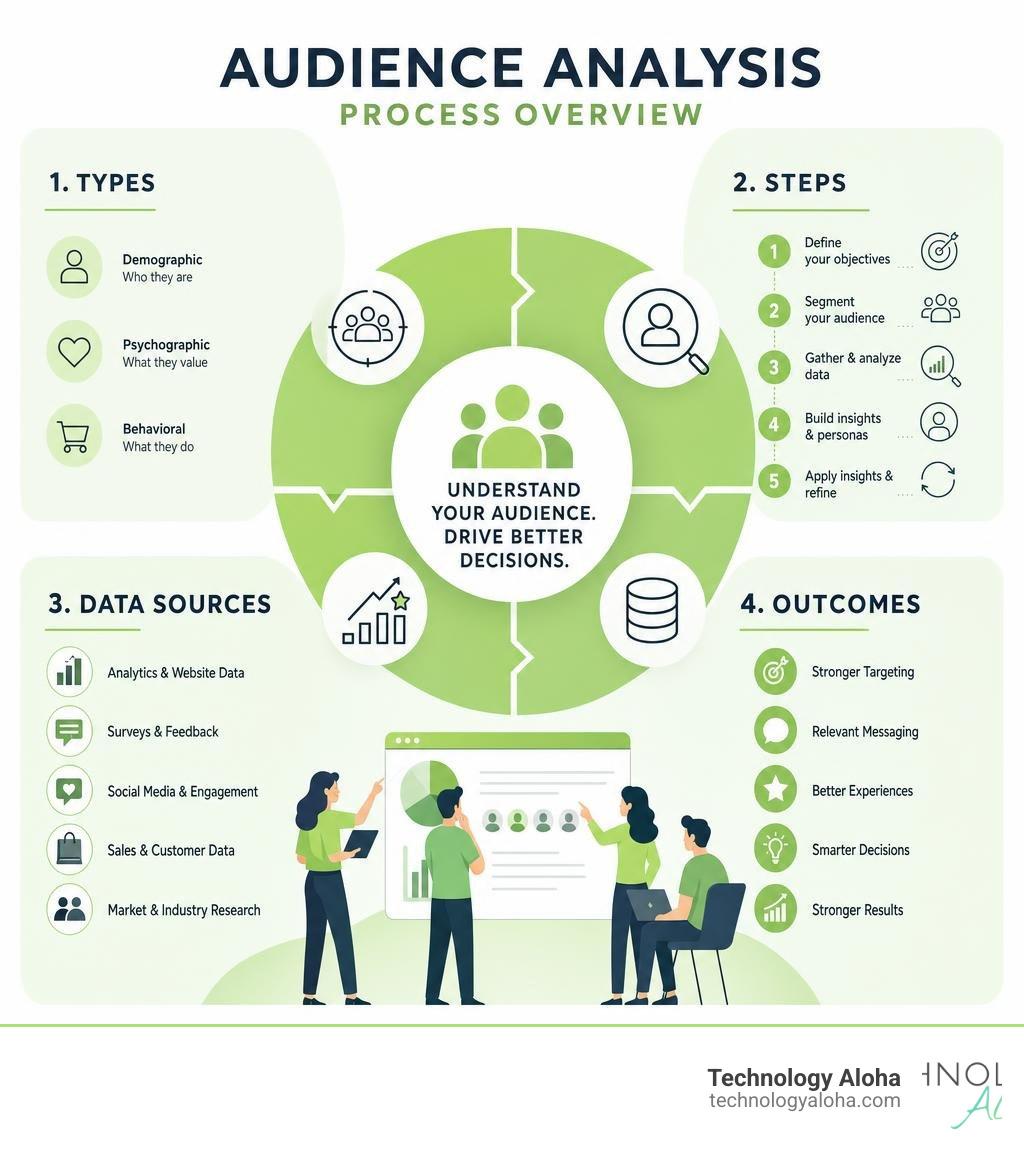
What is Audience Analysis and Why It Matters in 2026
To market effectively in 2026, we have to let go of the comforting fiction that our audience is a single, homogeneous block of people waiting to hear from us. The digital landscape is highly fragmented. People do not consume media in the same room, let alone on the same platforms.
If you rely on outdated demographic proxies, your marketing will fail. A 35-year-old remote software developer living in Kahului, Hawaii, and a 35-year-old retail manager in the same town might share an age bracket and a ZIP code, but their media consumption, daily frustrations, and purchasing drivers are worlds apart. One might spend their free time on Reddit researching local surf conditions; the other might be on Instagram looking for quick weeknight dinner recipes.
This is why understanding your audience requires a deeper look. If you are new to this concept, our Beginners Guide to Background Audience Analysis is an excellent place to start.
At its core, audience analysis is the strategic foundation of all successful positioning, web design, and brand development. When you understand your audience, you no longer have to guess what colors, messaging, or website layouts will convert. You build your digital presence on evidence.
According to classic communication frameworks outlined in Analyzing Your Audience, failing to adapt to your listeners leads to immediate disengagement. In a business context, that disengagement looks like high bounce rates, abandoned shopping carts, and flatlining ad campaigns. When you align your brand strategy with the precise expectations of your market, your conversion rates rise because your audience feels seen, heard, and understood.
The Five Core Types of Audience Analysis
To build a complete, multi-dimensional view of your target market, we look at five distinct layers of data. Relying on just one or two of these layers creates a flat, inaccurate picture.
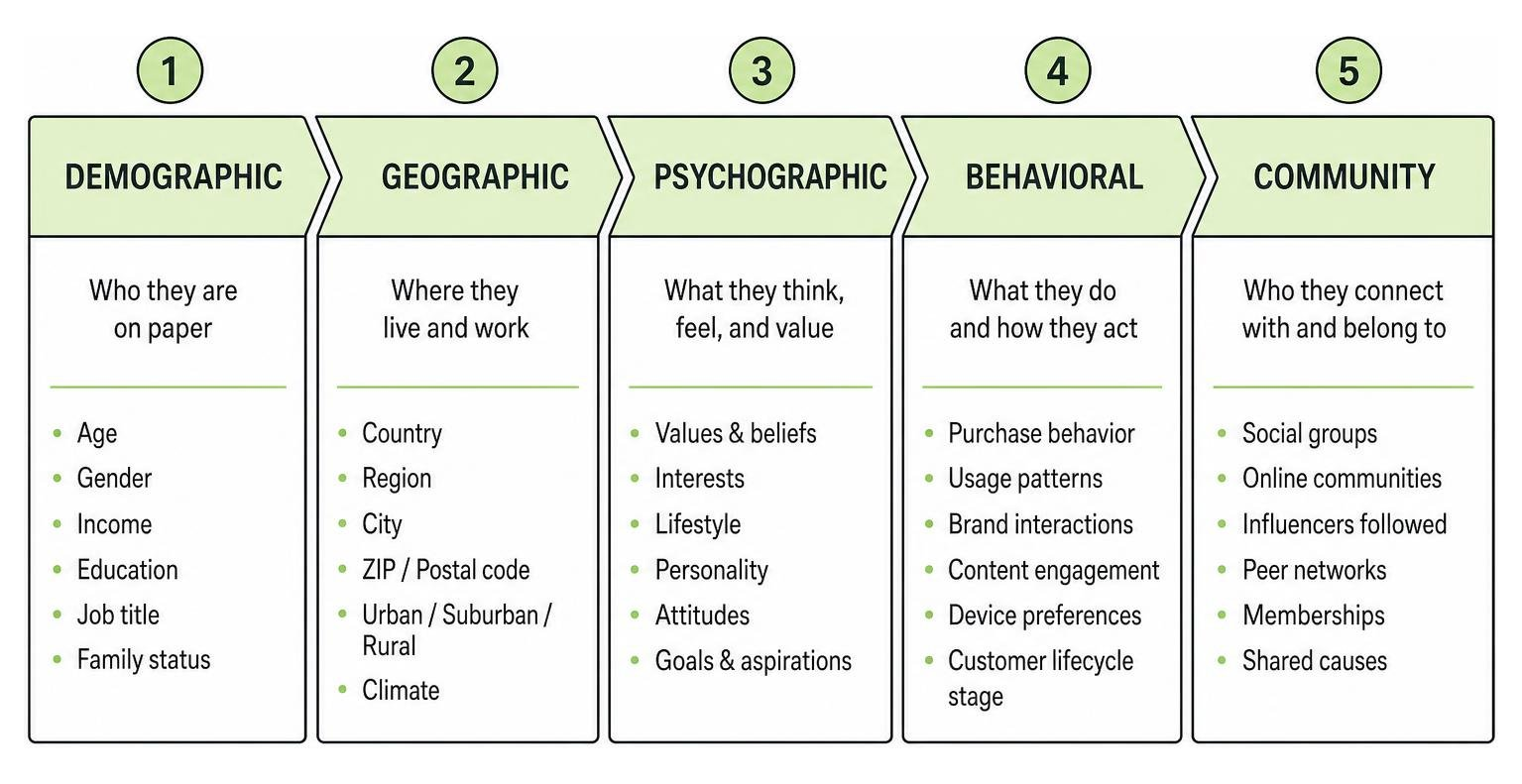
Here is how these five types of analysis compare:
| Analysis Type | Focus | Primary Data Source | Key Metric |
|---|---|---|---|
| Demographic | Who they are on paper | Census data, CRM profiles | Age, income, job title |
| Geographic | Where they live and work | IP addresses, shipping data | ZIP code, climate, region |
| Psychographic | Why they make decisions | Surveys, interviews, reviews | Values, attitudes, fears |
| Behavioral | What they actually do | Web analytics, purchase logs | Click patterns, cart value |
| Community-Based | With whom they cluster | Social graph analysis | Shared accounts, vocabulary |
Let us dive deeper into how these types function in practice.
Demographic and Geographic Audience Analysis
Demographics and geography are the starting points of any research initiative. They provide the structural boundaries of your audience. Demographic analysis looks at measurable statistics: age, gender identity, household income, education level, and occupation. Geographic analysis looks at physical location, climate, and local cultural influences.
For example, if you are a business operating in Hawaii, geographic factors dictate everything from your shipping expectations to your seasonal messaging. A winter campaign targeting residents in Kahului requires a completely different visual and emotional tone than one targeting tourists visiting the islands.
However, demographics alone can lead to dangerous over-simplifications. If you only target “women aged 30 to 45,” you are grouping people with wildly different life experiences, budgets, and needs into a single bucket. To avoid this trap, you must learn how to segment these groups intelligently. You can read more about how to refine your approach in our guide on Social Media 101: Know Your Target Market.
Psychographic and Behavioral Audience Analysis
If demographics tell you who is buying, psychographics and behavior tell you why they buy and how they do it.
Psychographics study the psychological drivers of your audience:
- Values: What do they care about? (e.g., environmental sustainability, family time, financial independence)
- Attitudes: How do they view the world and your industry? (e.g., skeptical of corporate marketing, enthusiastic about DIY solutions)
- Interests: What do they do in their spare time? (e.g., hiking, local community volunteering, reading business biographies)
Behavioral data focuses on real, observable actions. This is incredibly valuable because, quite frankly, people often misreport their own habits in surveys. A customer might tell you they read The Wall Street Journal every morning, but their web history shows they actually get their news from quick email newsletters and TikTok. Behavioral tracking looks at:
- Website interactions: Which pages do they visit first? Where do they click, and where do they drop off?
- Transactional history: What is their average order value? How often do they abandon their carts?
- Engagement patterns: Do they open your emails immediately, or do they only click when you offer a discount?
Analyzing this data does not require a massive enterprise budget. By using The Best Free Tools to Analyze Your Audience, you can uncover rich behavioral patterns directly from your existing website traffic and social channels. For a broader perspective on modern audience research frameworks, you can also check out What Is Audience Analysis? A Practical Guide for Marketers (2026) • Pulsar Platform.
How to Conduct a Modern Audience Analysis Step-by-Step
Understanding your audience is a structured process. It requires setting aside your assumptions and letting data guide your strategy. Here is our step-by-step framework to help you execute a thorough, actionable analysis.
Step 1: Define Your Strategic Scope
Do not start by pulling random reports. Start with a specific business question. If you ask a vague question like, “Who is our customer?” you will get a vague, useless answer.
Instead, define a precise scope:
- “Why is our software-as-a-service conversion rate dropping among local business owners in Hawaii?”
- “What content topics resonate most with our highest-value, repeat customers?”
- “Which platforms should we prioritize for our new product launch this fall?”
A clear scope ensures you only collect data that directly answers your business goals, saving you hours of aimless spreadsheet scrolling.
Step 2: Gather Multi-Source Data
To build a reliable profile, you must combine multiple data sources. Never rely on a single channel. We recommend grouping your data collection into three categories:
- First-Party Data: This is the most accurate data you own. Pull reports from your CRM, analyze your website traffic patterns, look at your customer support chat transcripts, and review your payment history records.
- Revealed Preferences (Social Listening and Search Intent): Use social listening tools to monitor unfiltered conversations on platforms like Reddit, Instagram, and specialized forums. Analyze search intent to see the exact phrases your audience types into search engines. This tells you what problems they are actively trying to solve.
- Stated Preferences (Surveys and Interviews): Ask your customers directly. Run a short, 10-minute survey or conduct five to ten qualitative interviews with your best clients. Ask about their daily frustrations, what almost stopped them from buying from you, and what they love most about your service.
For more details on balancing these sources, explore Audience Research: The Complete Guide for Marketers.
Step 3: Map Communities and Cultural Signals
People do not make decisions in isolation; they are influenced by the digital communities they belong to. Community mapping involves looking at where your target audience clusters online and who they trust.
Instead of looking at broad industry influencers with millions of followers, look for micro-influencers and local advocates who hold real sway within specific niches. Pay close attention to:
- The language they use: What industry jargon or casual slang do they use naturally?
- Their trusted media: Which blogs, podcasts, or newsletters do they share most often?
- Their collective pain points: What common complaints keep popping up in their community discussions?
By identifying these cultural signals, you can craft messaging that feels native and authentic to those specific groups, instantly building trust. To understand how to leverage these social signals effectively, read How to Use Social Data to Conduct Target Audience Analysis.
Step 4: Build Dynamic Buyer Personas
Once you have gathered and analyzed your data, you need to package it into a format your team can actually use. This is where buyer personas come in.
A great persona is not a fictional story about “Marketing Mary” who likes long walks on the beach. It is a highly practical, data-backed profile of a key segment of your market. It should outline their core business goals, their daily frustrations, their preferred communication channels, and the specific barriers that prevent them from buying from you.

To help you get started with this process, we have put together several resources:
- Learn the basics with Everything You Need to Get Started with Marketing Personas.
- See real-world layouts in The Ultimate Target Persona Example Gallery.
- Dive into practical, industry-specific templates with Meet Your Customers: A Deep Dive into Buyer Persona Samples and Persona Examples: How Can They Help Your Marketing Strategy?.
For a complete look at how to run this entire process from scratch, refer to the comprehensive guide on How to Conduct Audience Analysis: A 5-Step Guide for 2026 or explore the structured methodologies in How to Do an Audience Analysis.
How AI and Network Science Have Transformed Audience Research
In 2026, artificial intelligence and network science have fundamentally changed how we understand target markets. We no longer have to rely on slow, manual data aggregation or guess what our customers think based on small focus groups.
AI-driven audience intelligence platforms can process millions of data points in real-time, allowing us to:
- Solve the “False-Average” Problem: Traditional research often averages audience data, creating a profile that represents everyone in theory but no one in reality. AI avoids this by automatically grouping your audience into highly distinct, organic clusters based on real-time behavior.
- Map Semantic Clusters: AI can analyze thousands of social media posts, forum discussions, and customer reviews to find recurring themes, emotions, and sentiment trends. This goes far beyond basic keyword matching to reveal how people feel about your brand or your competitors.
- Predict Future Trends: By tracking predictive media signals, machine learning models can identify topics, challenges, and cultural shifts that are gaining velocity before they peak, giving you a massive first-mover advantage.

This evolution means that audience research is no longer a static document that sits in a drawer. It is a dynamic, living stream of intelligence that informs your ongoing web design, branding, and content creation. To learn more about how to set up these modern tracking systems, you can explore the insights in Audience Analysis: What It Is And How To Do It.
Frequently Asked Questions about Audience Research
What is the difference between audience analysis and market research?
While they are closely related, they have different focuses:
- Market research is landscape-centric. It looks at macro-level trends, industry growth, competitor market share, and overall product viability. It answers the question: “Is there a profitable market for our product?”
- Audience analysis is people-centric. It looks at the micro-level behaviors, values, motivations, and communication preferences of the actual humans within that market. It answers the question: “How do we connect with and convert the individuals we want to serve?”
How long does a comprehensive audience analysis take?
The timeline depends on the depth of your research:
- Basic Analysis (2 to 4 hours): An experienced analyst can pull quick, highly useful insights using existing social listening data and website analytics.
- Mid-Level Analysis (1 to 2 days): This involves mapping community structures, reviewing competitor audiences, and building basic buyer personas.
- Deep-Dive Research (3 to 4 weeks): A comprehensive program that includes qualitative customer interviews, custom brand surveys, cross-functional team workshops, and fully validated persona development.
How often should audience profiles be updated?
Audience profiles are not permanent. Markets shift, new social platforms emerge, and customer expectations evolve.
We recommend reviewing your high-level audience metrics monthly to spot quick behavioral changes. For your core buyer personas, a thorough review and update should happen annually, or whenever your business undergoes a major shift in leadership, core services, or strategic direction.
Conclusion
At Technology Aloha, we believe that successful marketing is never built on guesswork. It is built on deep, data-driven insights that blend cohesive, beautiful branding with high-conversion web designs.
Whether you are looking to refine your positioning, launch a user-centric website, or build a scalable brand strategy that resonates with your local community here in Hawaii, everything we do starts with understanding your unique audience.
Ready to stop guessing and start growing with evidence-backed marketing? Let us help you find the clarity you need to connect with your ideal customers. Explore our marketing strategy services today, and let us build something remarkable together.