Email Campaign Copywriting That Earns Opens, Clicks, and Action
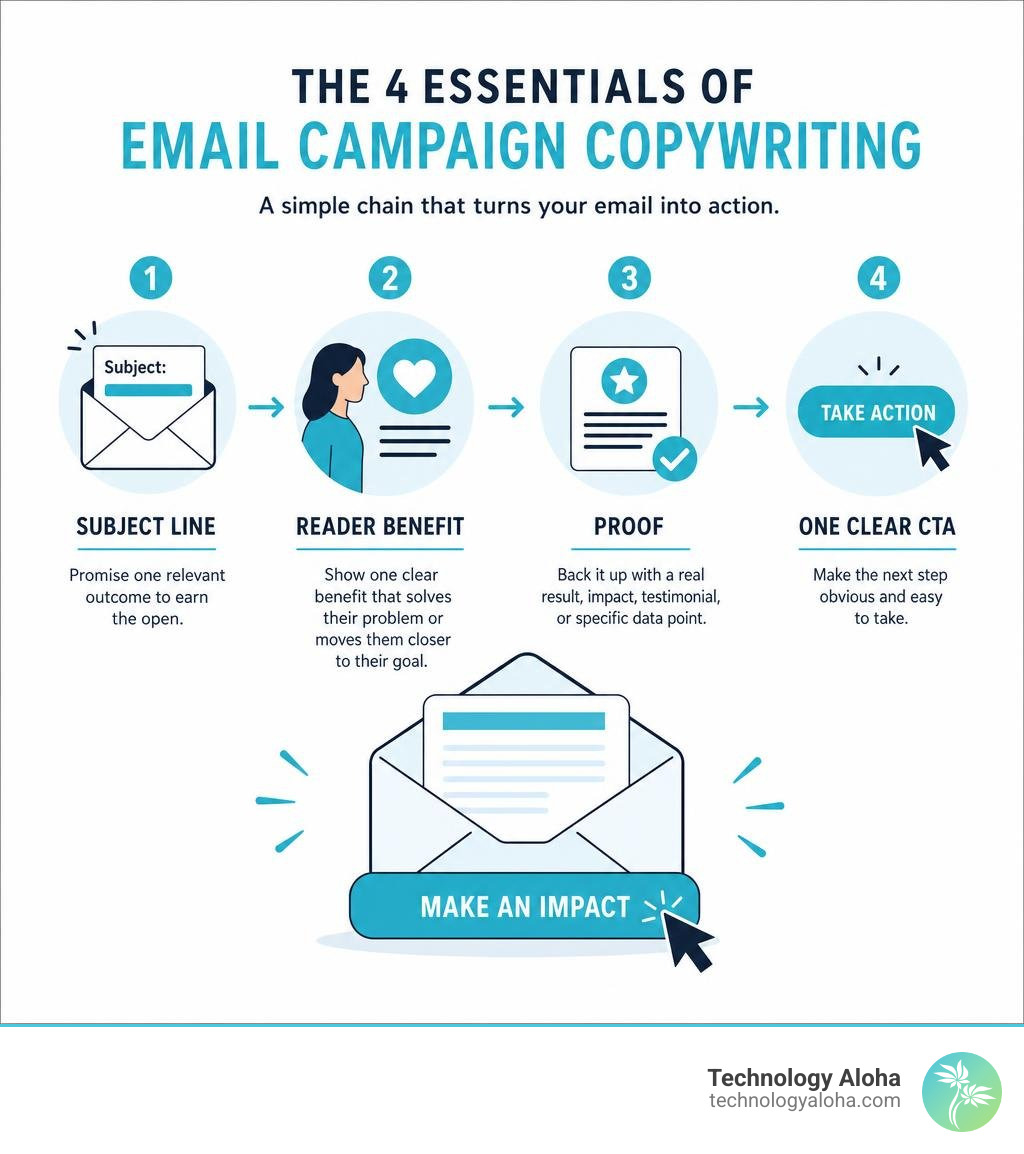
Effective email campaign copywriting is a simple chain: write an honest subject line that earns the open, use the body to show one clear reader benefit, and finish with one direct call to action.

Use this quick checklist before sending:
- Promise one relevant outcome in the subject line and preview text.
- Open with the reader’s problem, goal, or impact – not a long update about your organization.
- Keep the body easy to scan with short paragraphs, plain language, and one central message.
- Support the ask with proof such as a real result, donor impact, testimonial, or specific data point.
- Give one clear next step – for example, “Make my gift,” “Read the update,” or “Register now.”
This matters because the inbox is a harsh place to ask for attention. Many recipients decide whether to open based on the subject line alone, while typical click-through rates remain modest. That means vague updates, crowded layouts, and clever-but-unclear asks can waste an email before its message has a chance.
For food banks and other nonprofits, the strongest emails make the supporter the active part of the story. Show a specific need, explain the practical outcome their action can create, and make the next step obvious. Clear, relevant copy is not less human. It is how busy people understand where they can help.
Explore more about email campaign copywriting:
- In-Depth Guide to Comparing Email Copywriting Services
- Stop Getting Ghosted with Better Sales Email Copywriting
- A-Z Guide to Copywriting for Digital Marketing
Core Foundations of Email Campaign Copywriting
Email marketing continues to generate an average return of $42 for every $1 spent according to research highlighted in the Email Copywriting: The Complete Guide For Beginners [2026], outpacing virtually every other digital marketing channel. Capturing that return requires mastering the core structure of message delivery.
Every high-performing email relies on an inverted pyramid structure. You place the most essential, attention-grabbing information at the top, support it with context and proof in the middle, and narrow the message down to a single conversion point at the base.
An email body does not need to close a complex transaction on its own. Instead, it earns a micro-conversion: the single click that brings the reader to your dedicated page. When writing with reader-centric framing, discard throat-clearing pleasantries and focus entirely on the subscriber’s needs, as outlined in our Step-by-Step Guide to Marketing Copywriting.
Subject Lines and Preview Text Synergy
Your subject line and preview text operate as an editorial partnership within an 85–115 character window. Across modern mobile clients, subject lines begin truncating between 30 and 50 characters.
To maximize opens, avoid trickery. Industry data compiled by the Email Marketing Bible indicates that over half of consumers report feeling tricked by deceptive subject lines, which increases unsubscribes and spam complaints.
- Curiosity Gaps: Pique interest without withholding the underlying point (e.g., “The missing step in your volunteer onboarding”).
- Direct Benefit: State the exact payoff upfront (e.g., “3 meal prep routines that save 2 hours”).
- Inbox Preview Alignment: Ensure the preview text extends the subject line rather than repeating it word for word.
Engaging Body Copy and Storytelling
Once a subscriber opens the message, you have seconds to hold their attention. Structuring your message around a three-part narrative arc provides emotional momentum without bloating the word count:
- The Situation (Before): Establish the relatable pain point or operational challenge.
- The Turning Point: Introduce the realization, methodology, or community intervention.
- The Result (After): Detail the measurable outcome and tie it directly to the reader’s action.
Keep body paragraphs restricted to micro-paragraphs of 20–25 words (1–3 lines max). This formatting accommodates mobile skimmers and creates natural visual momentum down the page.
To evaluate whether your draft maintains tension, analyze it using The 6 U’s framework for email copywriting, confirming that your copy is Useful, Urgent, Unique, Ultra-specific, Unbelievable, and User-focused.
High-Conversion Call-to-Action Design
A single, focused call to action (CTA) eliminates decision fatigue. Focusing on one clear CTA dramatically lifts engagement compared to emails cluttered with competing links.
Frame your CTA button copy in the first person (e.g., “Start my trial” or “Fund a family meal”) rather than second-person commands. First-person phrasing mentally transfers ownership of the action to the reader, consistently lifting conversion rates.
Ensure the primary button uses high-contrast styling—such as vibrant brand accents (#208a9d or #50c6db)—and review the messaging against our The Definitive Guide to Evaluating Persuasive Copywriting Quality before deploying the campaign.
Proven Frameworks and Psychology for Email Conversion
High-converting email copy leverages cognitive ease. When readers process text effortlessly, their trust in the underlying message naturally increases.
Applying psychological principles helps guide reader action ethically:
- Loss Aversion: Highlight what the reader stands to lose by delaying action, which often motivates behavior more effectively than potential gains alone.
- Illusory Truth Effect: Naturally reinforce the core value proposition 1–2 times every 60–80 words using fresh vocabulary to deepen retention.
- Social Proof: Embed verified metrics, volunteer testimonials, or community impact data to validate your claims without relying on empty hype, a technique detailed in our guide, Stop Getting Ghosted with Better Sales Email Copywriting.
Execution Frameworks for Email Campaign Copywriting
Selecting a proven structural framework prevents writer’s block and ensures your email copy moves logically from problem to resolution.
| Framework | Structure | Ideal Campaign Use Case | Primary Objective |
|---|---|---|---|
| PAS | Problem $rightarrow$ Agitate $rightarrow$ Solution | Urgent donation appeals, software upgrades | Validates pain points and presents immediate relief |
| BAB | Before $rightarrow$ After $rightarrow$ Bridge | Case studies, client success stories | Shows a desirable transformation and provides the path |
| 4 Ps | Promise $rightarrow$ Picture $rightarrow$ Proof $rightarrow$ Push | Product launches, event registrations | Builds emotional resonance supported by concrete proof |
| Soap Opera | Narrative Open Loops $rightarrow$ Climax $rightarrow$ Resolution | Multi-part onboarding, welcome nurture series | Maximizes sequence open rates using cliffhangers |
For extended multi-email campaigns, the Soap Opera sequence uses open loops across consecutive days. Resolving one story element while introducing a fresh question keeps subscribers eager to open subsequent messages.
Ethical Urgency and Persuasive Data
Urgency accelerates decisions, but artificial scarcity destroys long-term trust. If an email claims an offer expires at 5:00 PM, the system must enforce that deadline. Resetting countdown timers or fabricating limited inventory triggers sales resistance and harms sender reputation.
When applying deadlines, rely on authentic operational limits: matching gift windows, grant distribution dates, or event seating caps. Incorporate concrete, defensible numbers (e.g., “142 meals provided” instead of “lots of food”) to build credibility. For structured copy formulas, consult the email-writing Skill guidelines to balance persuasive urgency with messaging clarity.
Audience Segmentation and Strategic Personalization
Blasting an entire list with a generic message is the fastest way to drive unsubscribes. Many email users mark messages as spam when content feels irrelevant to their needs. Effective personalization looks beyond basic merge tags like {{First_Name}} and aligns copy with actual subscriber behavior.
Segment your audience across four foundational pillars:
- Geographic: Localized messaging, regional updates, and venue-specific announcements for communities like Kahului, HI.
- Demographic: Organizational roles, giving capacities, or lifecycle designations.
- Psychographic: Core motivations, values, and program interests.
- Behavioral: Past purchase history, link-clicking habits, and engagement recency.
For additional segmentation strategies, review our guide on How to Write Marketing Emails That Convert.
Structuring Email Campaign Copywriting for Different Funnel Goals
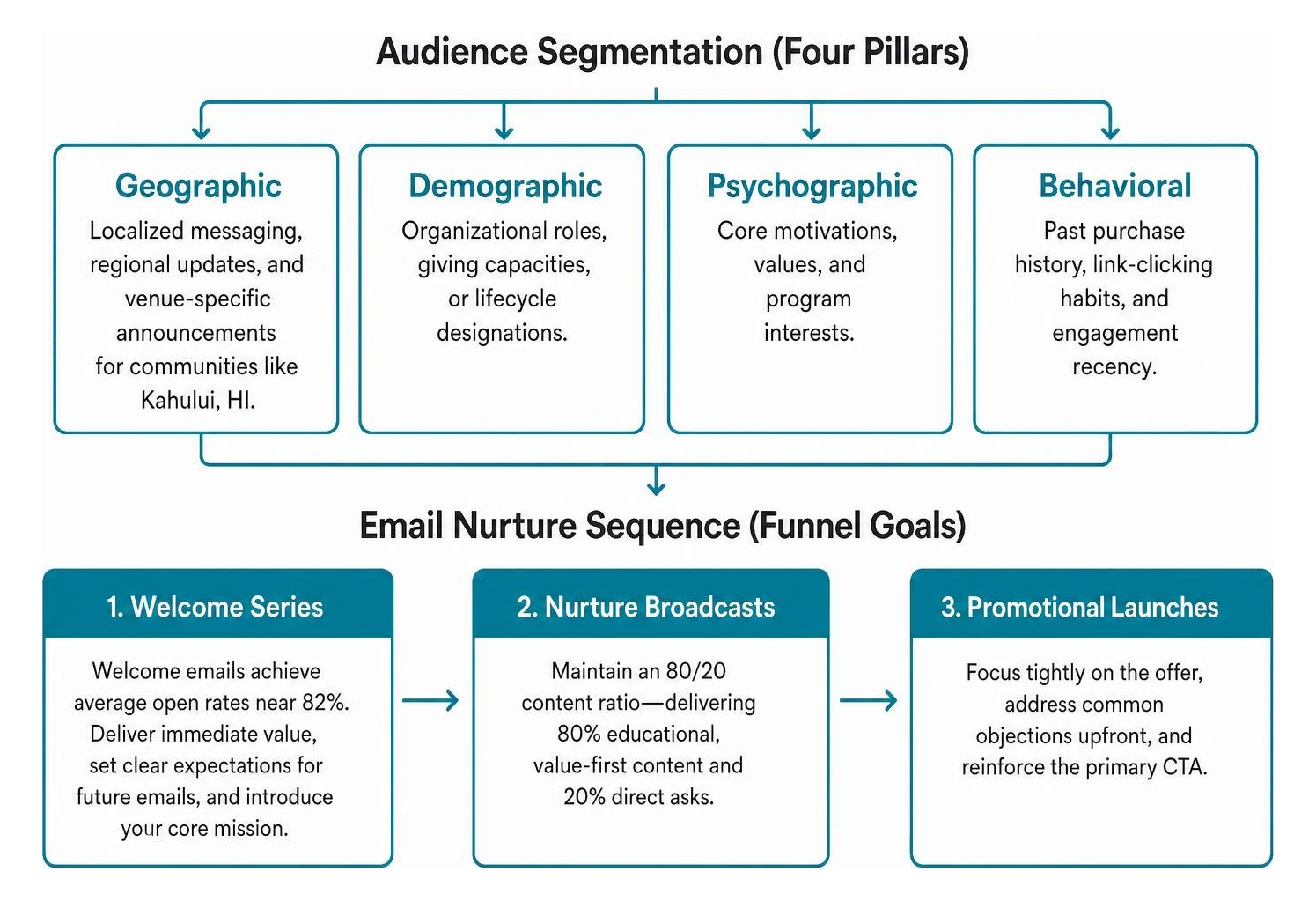
Copy must adapt to where the reader sits within your funnel:
- Welcome Series: Welcome emails achieve substantially higher open rates than standard broadcasts. Deliver immediate value, set clear expectations for future emails, and introduce your core mission.
- Nurture Broadcasts: Maintain an 80/20 content ratio—delivering 80% educational, value-first content and 20% direct asks.
- Promotional Launches: Focus tightly on the offer, address common objections upfront, and reinforce the primary CTA.
- Re-Engagement Sequences: Check in with inactive subscribers using honest, low-pressure framing to determine if they wish to stay on the list.
- Nonprofit Appeals: Center copy around the supporter’s direct role in solving community challenges rather than internal organizational milestones.
Tailoring Messages Across Lifecycle Stages
A prospective lead requires different framing than a five-year recurring supporter. Tailor your copy to their level of familiarity:
- Prospective Leads: Emphasize trust, introduce organizational credentials, and provide low-friction entry points.
- Active Supporters & Customers: Acknowledge ongoing involvement, suggest relevant expansions, and share regular impact reports.
- Lapsed Contacts: Acknowledge the communication gap directly, highlight what has changed, and ask a single question to prompt a reply.
Technical Optimization, Deliverability, and Testing
Brilliant copy cannot perform if it lands in the spam folder or gets lost in the Promotions tab. Across industries, deliverability challenges and secondary inbox tabs keep many non-spam commercial emails from reaching the primary view.
Deliverability is not solely an IT responsibility; your sentence structure, punctuation, and link choices directly influence automated spam filters.

- Spam Trigger Words: Avoid aggressive hype terms like “100% FREE,” “ACT NOW,” or excessive currency symbols.
- Formatting Hygiene: Eliminate erratic capitalization, excessive exclamation marks, and mismatched font colors.
- Link Hygiene: Limit hyperlinks to 2–3 per message. Overloading body copy with links triggers mailbox safety flags.
Explore foundational copywriting rules further in our A-Z Guide to Copywriting for Digital Marketing.
A/B Split Testing Methodologies
A/B testing removes guesswork from email optimization. To generate reliable data, test only a single variable at a time across a representative sample of your list before deploying the winner to your remaining subscribers.
- Subject Line Tests: Compare direct statements against open-ended questions to optimize open rates.
- CTA Copy Tests: Test first-person phrasing against direct benefit descriptions to improve click-through rates.
- Body Copy Length: Evaluate concise bulleted layouts against long-form narrative storytelling.
Mobile Readability and Layout Hygiene
With a majority of emails opened on mobile devices, responsive formatting is essential. A layout that breaks on smaller screens harms engagement immediately.
Maintain at least a 14px font size for body text and 22–28px for headers. Use single-column layouts, generous white space, and touch-friendly CTA buttons with minimum dimensions of 44×44 pixels to ensure effortless reading on any screen.
Frequently Asked Questions About Email Campaign Copywriting
How many links should be included in marketing email copy?
Keep hyperlinks to 2–3 per email. Distribute these naturally across the body copy, the primary CTA button, and an optional P.S. line. Including too many links increases spam filter scrutiny and distracts readers from your primary conversion goal.
What is the ideal subject line length for mobile devices?
Aim for 30 to 50 characters (roughly 6 to 10 words). This range prevents mobile email clients from truncating your message. Front-load your most compelling keywords in the first 30 characters and use the preview text to provide supporting context.
How do you balance promotional selling with educational value?
Follow an 80/20 ratio: provide 80% valuable, educational, or story-driven content and dedicate 20% to direct promotional pitches. Alternatively, use a 3:1 cadence—sending three high-value educational emails for every direct sales or fundraising appeal. This cadence builds authority while preserving subscriber goodwill.
Conclusion
High-converting email campaign copywriting relies on clarity, structure, and respect for the reader’s time. By pairing honest subject lines with scannable body copy, proven storytelling frameworks, and a single first-person call to action, you turn everyday inbox messages into dependable drivers of engagement and support. Treat every campaign as a continuous learning process: segment thoughtfully, test isolated variables, optimize for mobile reading, and ensure every word serves a clear purpose for your audience.