Why Persuasive Copywriting Services Matter for Nonprofit Growth
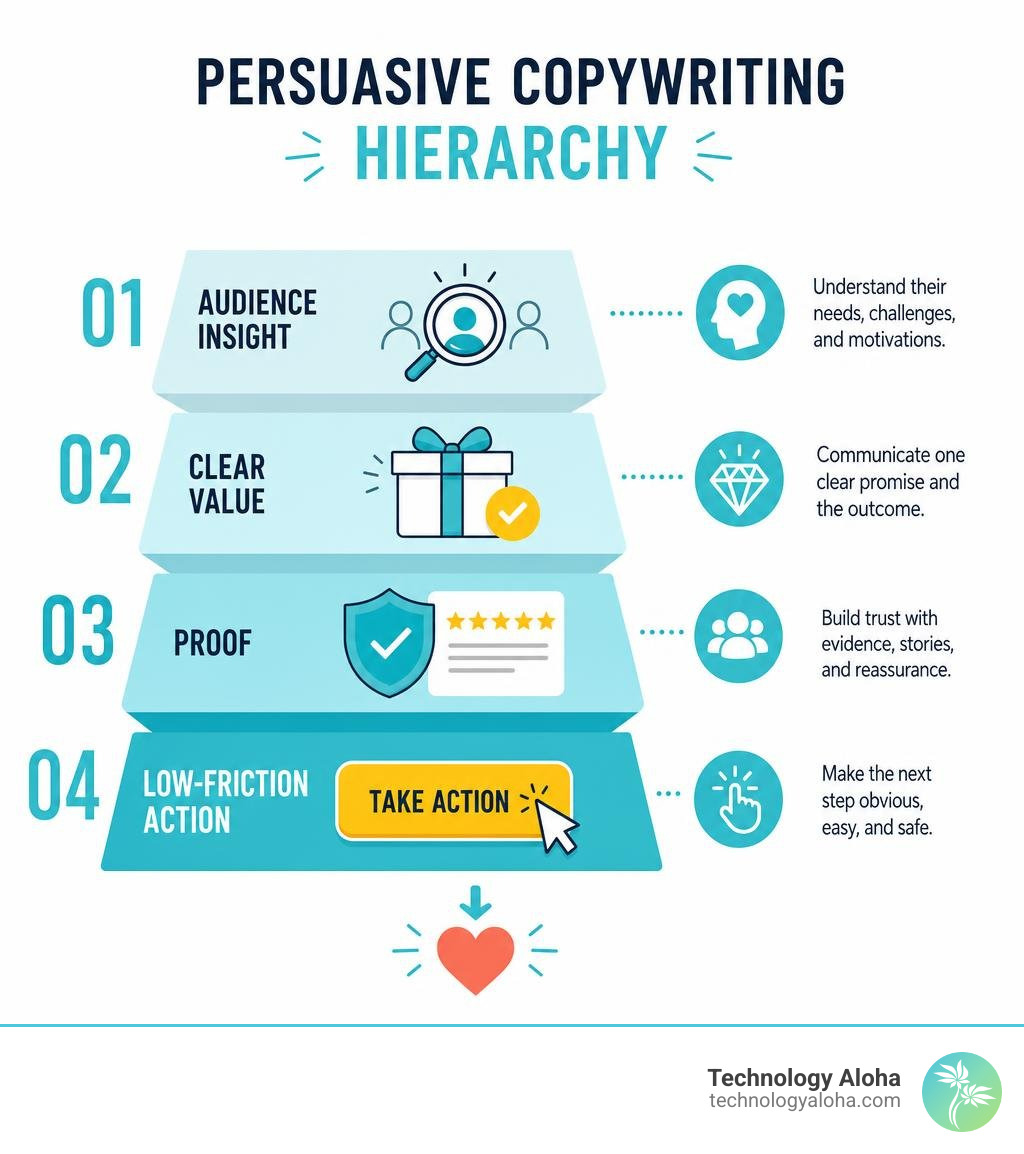
Persuasive copywriting services turn interest into action. They research what supporters need, fear, and value, then use clear language to help people donate, request help, subscribe, register, or contact your organization.

For a food bank or nonprofit, quality copy should do three things:
- State the outcome quickly—such as helping a neighbor find food or showing a donor what their gift makes possible.
- Reduce doubt with specific proof, plain language, and answers to real concerns.
- Make the next step obvious with a focused call to action.
This is different from general content writing. Content can earn attention through useful guides, news, and search visibility. Persuasive copy is built to convert that attention at key moments: a donation page, service-intake form, email appeal, paid ad, or landing page.
The best copy is not a collection of clever phrases. It is a tested argument shaped by audience research, search intent, brand voice, and the barriers that stop people from acting. A strong page makes one clear promise, supports it with credible evidence, and asks for one meaningful next step.
For nonprofit leaders, that distinction matters. An outdated website or vague donation message can add friction when a supporter is ready to help—or when a family needs services now.
Persuasive copywriting services resources:
- Hire a Sales Copywriter to Do the Heavy Lifting
- A-Z Guide to Copywriting for Digital Marketing
- A Comprehensive Guide to Copywriting Services
The Anatomy of High-Converting Copy: Psychology, Formulas, and Voice
High-performing copy is engineered from behavioral science, neurological triggers, and voice-of-customer research. When someone visits a website or opens an email, their brain makes snap judgments in milliseconds. The limbic system—the brain’s emotional and survival center—processes inputs and triggers instincts before the analytical neocortex steps in to justify a decision.
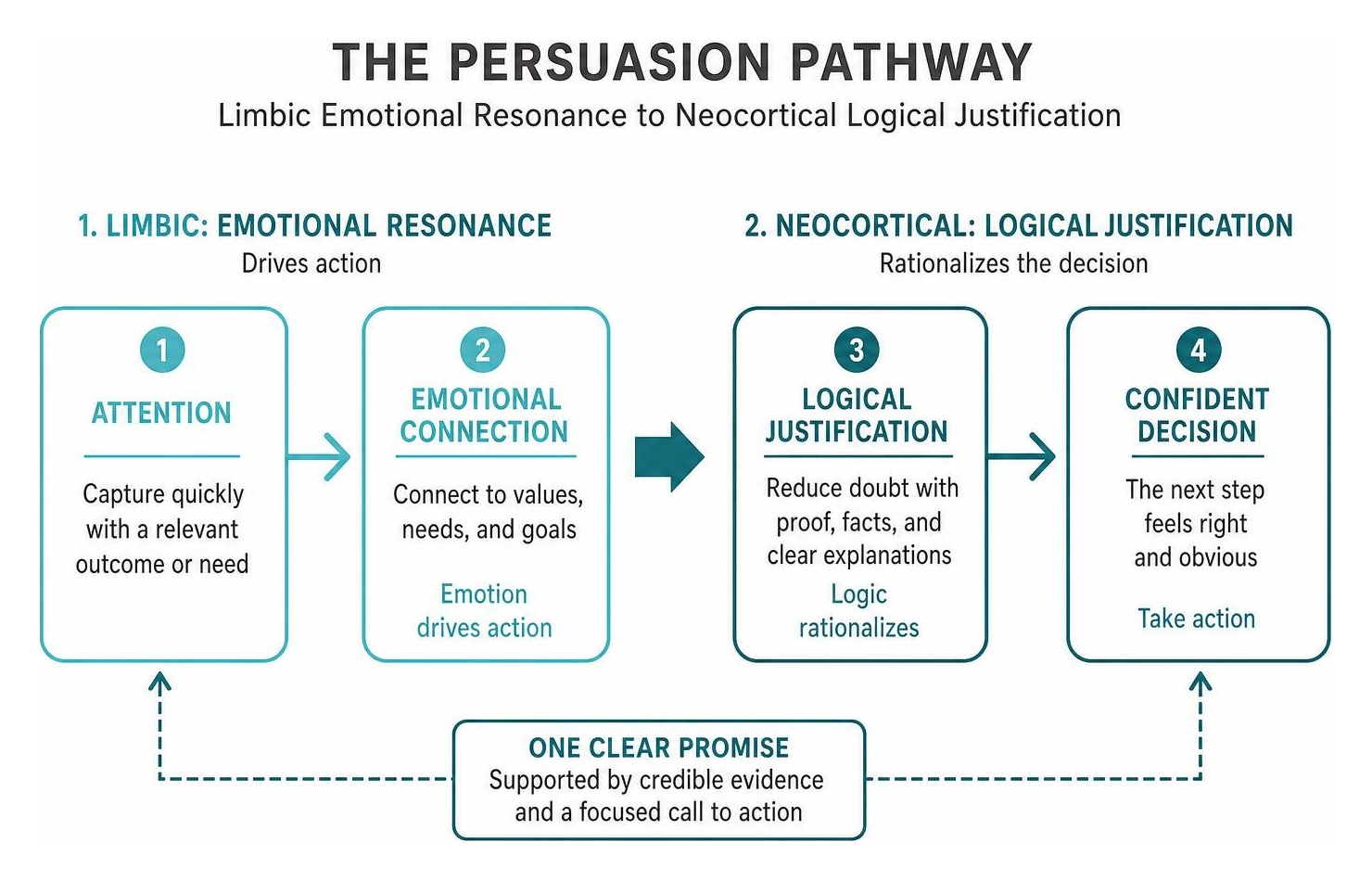
Because emotion drives action while logic merely rationalizes it, persuasive copy connects with the reader’s internal reality before presenting practical details. This principle was codified in behavioral research through Robert Cialdini’s six universal principles of influence:
- Reciprocity: Delivering unearned value or helpful clarity upfront builds goodwill.
- Commitment and Consistency: Asking for small, natural micro-actions makes larger commitments feel organic.
- Social Proof: Demonstrating that peers or community members trust the organization lowers risk.
- Authority: Establishing verified credentials, clear data, and operational track records builds credibility.
- Scarcity: Highlighting urgent community needs or deadlines clarifies why immediate action is necessary.
- Liking (Sympathy): Using relatable storytelling and conversational warmth aligns the organization with the reader’s identity.
To dive deeper into tactical deployment across campaigns, explore our A-Z Guide to Copywriting for Digital Marketing.
Proven Behavioral Frameworks: AIDA, PAS, and BAB
Professional conversion copywriters rely on time-tested frameworks to organize arguments logically. Rather than guessing sentence by sentence, these structures systematically guide a prospect through an emotional and logical journey.
Many professionals earn industry-standard credentials, such as becoming a Certified Persuasive Copywriter, to master these structures:
- AIDA (Attention, Interest, Desire, Action): Grabs the reader with a relevant hook, builds interest with pertinent facts, creates desire by detailing the positive outcome, and delivers a singular call to action (CTA).
- PAS (Problem, Agitate, Solution): Identifies a specific pain point, explores the emotional or operational cost of leaving it unresolved, and presents the solution as the logical remedy.
- BAB (Before, After, Bridge): Paints the current reality (Before), illustrates the ideal future state (After), and positions the service as the bridge that gets the reader there.
- PASTOR (Problem, Amplify, Story, Transformation, Offer, Response): Expands on PAS by weaving a detailed transformation narrative, ideal for long-form sales or major fundraising campaigns.
- 4Ps (Promise, Picture, Proof, Push): Makes an early claim, helps the reader visualize the result, substantiates the claim with hard proof, and urges immediate follow-through.
| Framework | Core Mechanism | Best Used For |
|---|---|---|
| AIDA | Linear progression from curiosity to commitment | Landing pages, promotional emails, print collateral |
| PAS | Emphasizes problem severity to spur action | Short-form landing pages, problem-aware paid ads |
| BAB | Focuses on positive future transformation | Program enrollment, SaaS onboarding, volunteer recruitment |
| PASTOR | Comprehensive narrative objection handling | Long-form sales pages, major gift donor proposals |
| 4Ps | Direct proof stacking and outcome visualization | High-intent product pages, corporate sponsorship appeals |
How Persuasive Copywriting Services Drive High-Intent Conversions
When users arrive on a page with high commercial or civic intent, vague text introduces friction. Quality copy aligns with explicit search intent by answering three questions:
- Am I in the right place?
- Can this organization solve my specific problem?
- What exact step must I take next?
Clear value propositions state what an organization delivers, who it serves, and why it is unique—without fluff. When evaluating whether messaging sounds genuine or pushy, review our guide on How to Write Sales Pages That Sell Without Being Sleazy.
Core Offerings in Modern Persuasive Copywriting Services

Persuasive copy touches every point in the digital user journey. To get a comprehensive view of how these disciplines interact, read A Comprehensive Guide to Copywriting Services.
High-Impact Digital Assets: Landing Pages, Sales Pages, and VSLs
Landing pages, sales pages, and Video Sales Letter (VSL) scripts require deliberate structure:
- Landing Pages: Built for paid ads or focused organic traffic. They rely on concise headlines, scannable visual hierarchy, contextual objection handling, and a single conversion goal.
- Sales Pages: Provide long-form messaging to address every buyer hesitation, comparison, and technical question for complex or high-commitment offers.
- VSLs: Combine spoken dialogue with visual cues. A compelling script hooks viewers within the first 10 to 30 seconds, introduces the core mechanism, presents verifiable proof, and guides viewers to act.
Direct-Response Sequences: Email Funnels and Paid Advertising
Direct-response messaging guides leads through sequential touchpoints:
- Email Funnels: Onboarding sequences, nurture campaigns, and re-engagement workflows build trust over time. Rather than relying on repetitive promotions, narrative-driven sequences use empathy and clear calls to action. For email campaigns that convert, review our tips to Stop Getting Ghosted with Better Sales Email Copywriting.
- Paid Advertising: Ad copy on search engines and social platforms captures fleeting attention, disrupts passive scrolling, and creates a seamless message transition from the ad to the destination page.
Strategic Research and Voice-of-Customer Mining Methodologies
The most effective copy is discovered through structured research rather than manufactured out of thin air. Professional writers spend substantial project time researching customer behavior, analyzing search trends, and evaluating competitor messaging before writing a word.
To understand how technical optimization and messaging work together, review SEO Copy Writing 101 Crafting Content That Ranks.
Extracting Unfiltered Prospect Insights and Overcoming Objections

Voice-of-customer (VOC) research captures the exact language, phrasing, and emotions prospects express. This qualitative data is gathered through:
- Review Mining: Analyzing reviews on public platforms, including competitor reviews, to uncover common frustrations and missed expectations.
- Support Transcripts and Intake Notes: Reviewing chat logs, email inquiries, and intake records to identify the questions people ask before committing.
- Customer and Stakeholder Interviews: Speaking directly with active clients, donors, or recipients to document their motivations, hesitations, and milestones.
This research produces an objection map addressing the five core reasons people hesitate:
- Price/Cost: Is the financial or time investment justified?
- Trust/Credibility: Can this team deliver on its promises?
- Fit/Relevance: Does this solution apply to my unique circumstances?
- Timing/Urgency: Why must I take action today instead of next month?
- Switching Friction: How difficult is it to change from my current setup?
Integrating Technical SEO With Direct-Response Messaging
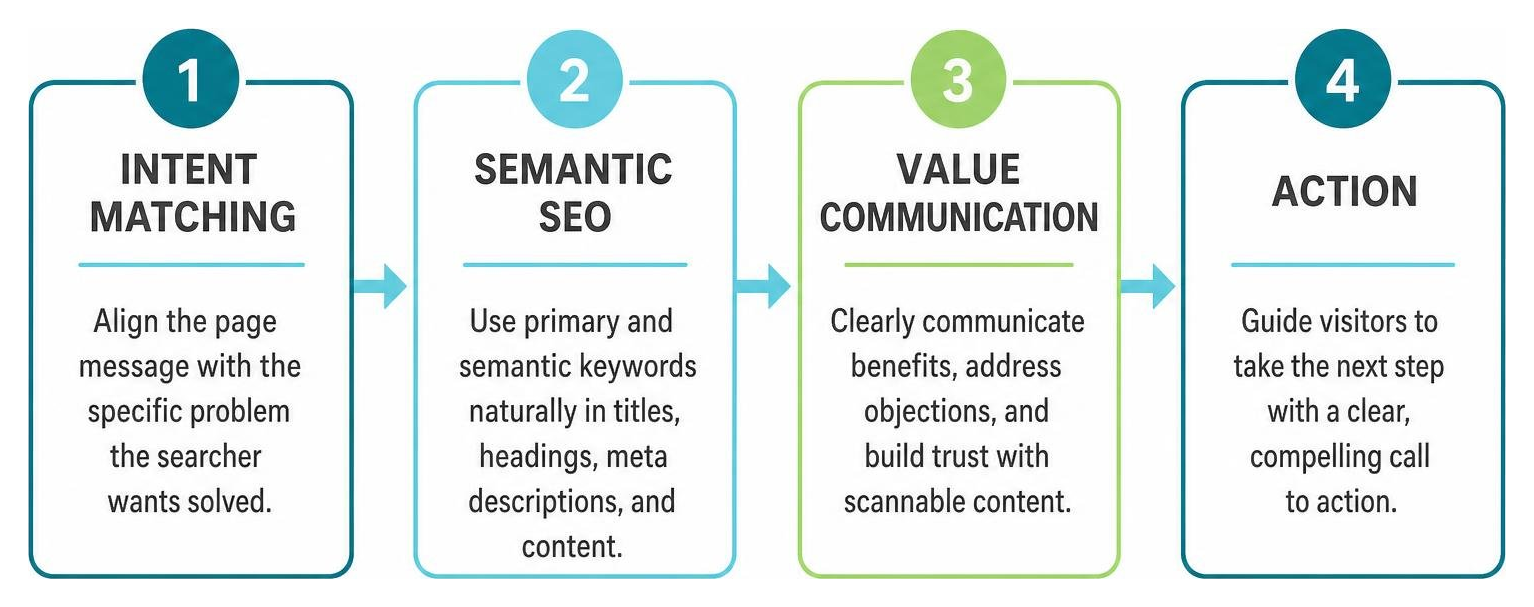
SEO and conversion copywriting work hand in hand. SEO brings qualified searchers to the page; conversion copy guides them to take action.
Balancing both disciplines requires:
- Matching Search Intent: Aligning the page’s core message with the specific problem the user typed into the search bar.
- Strategic Keyword Placement: Placing primary and semantic keywords naturally in H1s, subheadings, meta descriptions, and body paragraphs without compromising readability.
- Scannable Layouts: Using 5 to 10-word subheadings, short paragraphs (30–60 words), and bulleted lists so visitors can quickly scan the value proposition.
For a structured approach to writing for search and conversions, consult our Step-by-Step Guide to Marketing Copywriting.
Evaluating ROI: Professional Agencies, Freelancers, and AI Tools
Evaluating copy quality requires measuring real-world performance rather than subjective artistic taste. Clear key performance indicators (KPIs) include:
- Conversion Rate (CR): The percentage of page visitors who complete the target action.
- Cost Per Acquisition (CPA): The advertising or marketing spend needed to secure a lead, donor, or customer.
- Email Engagement: Open rates, click-through rates (CTR), and reply metrics.
- Return on Ad Spend (ROAS): The revenue generated for every marketing dollar spent.
Before deciding how to source your copy, explore The Definitive Guide to Compare Copywriting Service Providers.
Evaluating Persuasive Copywriting Services Against AI Tools and General Freelancers
Organizations typically choose between three copywriting models:
- AI Generation Tools: Fast and cost-effective for outlining and research synthesis. However, raw AI output often relies on generic phrases, misses brand nuances, hallucinates facts, and cannot conduct primary voice-of-customer research.
- General Freelancers: Suitable for general content generation and broad blog writing. However, generalists may lack direct-response training, structured testing methodologies, and conversion optimization experience.
- Specialized Persuasive Copywriting Services: Focus exclusively on research-backed conversion architectures. They conduct voice-of-customer discovery, build objection maps, write distinct testing variants, and optimize copy against conversion analytics.
Avoiding Common Conversion Pitfalls and Diagnostic Copy Audits
When auditing underperforming pages, look for these common messaging mistakes:
- Feature Dumping: Listing operational mechanics instead of explaining the personal, emotional, or financial outcome for the reader.
- Writing ‘Inside-Out’: Relying on internal acronyms, organizational jargon, and corporate phrasing that alienates external audiences.
- Weak or Passive CTAs: Using generic commands like Submit or Click Here instead of value-focused phrasing like Claim Your Resource or Provide Meals Today.
- Burying the Value Proposition: Forcing readers to scroll through background context before explaining what the organization does.
- Isolating Proof: Tucking testimonials into a disconnected footer widget instead of placing them next to friction points, like donation forms or checkout fields.
Frequently Asked Questions About Persuasive Copywriting
How does persuasive copywriting differ from general content writing?
Content writing educates, entertains, or informs to build organic search visibility, brand affinity, and topical authority over time. Persuasive copywriting is conversion-focused, using psychological frameworks, research-backed objection handling, and clear value propositions to drive immediate action.
How long does a standard professional copywriting engagement take?
A thorough copywriting project for key web pages or an email sequence typically takes 2 to 4 weeks. This includes the initial briefing, voice-of-customer research, competitor audits, wireframe outlining, drafting, client revisions, and delivery of testing variants.
Can AI tools effectively replace human conversion copywriters in 2026?
While AI tools assist with early ideation and research acceleration, they cannot conduct primary customer interviews, unearth authentic brand nuances, or verify emotional resonance. High-converting copy requires real-world empathy, strategic positioning, and accountability that automated tools cannot provide alone.
Conclusion
Persuasive copywriting bridges your operational investments—such as web design, software tools, and paid traffic—and your real-world goals. Whether you run a mission-driven nonprofit expanding community support or a growing enterprise launching a new initiative, your words determine whether visitors scroll past or commit.
By grounding your messaging in voice-of-customer research, using proven persuasion frameworks, and testing page variants, you can build a reliable digital path that turns interest into measurable action.