What Marketing and Copywriting Actually Mean (And Why It Matters)
Marketing and copywriting are two of the most misused terms in business. People blur them together, then wonder why their websites inform but do not convert.
Here is the short answer:
| Term | What It Does | Primary Goal |
|---|---|---|
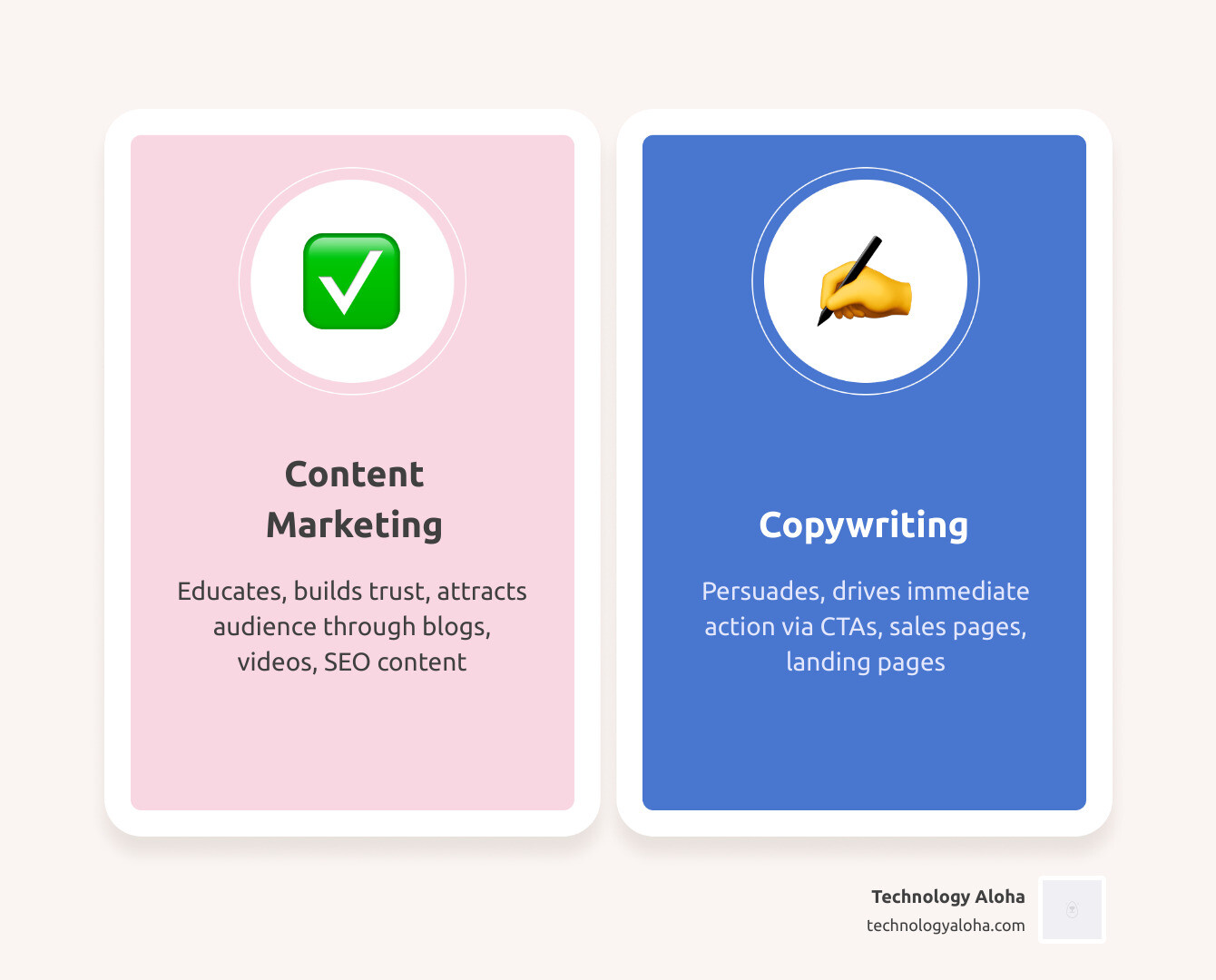
| Content Marketing | Educates and builds trust over time | Attract and retain an audience |
| Copywriting | Persuades and drives immediate action | Convert readers into leads or buyers |
| Together | Guides prospects from first click to final sale | Sustainable growth + conversions |
They are not the same. They depend on each other.
Content marketing without copywriting lacks pull, direction, and calls to action. Copywriting without content marketing lacks context, trust, and a warm audience.
For small businesses in crowded markets, that distinction matters. A site that explains is useful. A site that explains and converts is an asset.
Clear, persuasive writing keeps gaining value as more brands compete for the same attention. That is exactly why businesses need both strategy and language working together.
This guide explains both disciplines, shows where they differ, and lays out how to use them together to build a stronger brand and win more clients.
Marketing and copywriting helpful reading:
- Hire a Sales Copywriter to Do the Heavy Lifting
- How to Write Sales Pages That Sell Without Being Sleazy
What Marketing and Copywriting Mean in 2026
In 2026, the difference is clearer than ever.
Marketing is the full system. It defines the audience, the offer, the positioning, the channels, and the path from stranger to customer.
Copywriting is the language inside that system. It turns strategy into words people can understand, trust, and act on.
Content marketing sits slightly differently. It uses useful, relevant material to earn attention over time. Think blog posts, videos, guides, white papers, podcasts, and email newsletters. Its job is to build familiarity and authority before the sale.
Copywriting is more direct. It appears on landing pages, ads, emails, service pages, forms, and calls to action. Its job is to move the reader one step forward now.
What content marketing does
Content marketing educates first. It answers questions, solves small problems, and helps buyers make sense of bigger ones.
Common content marketing assets include:
- Blog posts
- Case studies
- Videos
- Podcasts
- Guides and ebooks
- White papers
- Email newsletters
Its long-term goals usually include:
- Organic traffic
- Brand visibility
- Search rankings
- Audience trust
- Lead nurturing
- Customer retention
This is the part of marketing that says, “Let us help before we ask.”
What copywriting does
Copywriting persuades. Good copy makes the offer clear, shows why it matters, lowers resistance, and asks for action.
Typical copywriting assets include:
- Homepage copy
- Service pages
- Landing pages
- Sales pages
- Paid ads
- Email campaigns
- Product descriptions
- CTA buttons
- Lead forms
Its direct goals are usually:
- Clicks
- Replies
- Demo requests
- Form submissions
- Purchases
- Booked calls
- Revenue
This is the part that says, “Here is the next step. Take it.”
Why people confuse content marketing and copywriting
They overlap everywhere.
A blog post needs copywriting in the headline, opening hook, subheads, CTA, and internal links. A landing page often needs content elements like proof, FAQs, and education. Both use SEO. Both require brand voice. Both support the customer journey.
That overlap causes confusion, but the distinction still matters:
- Content marketing builds attention and trust
- Copywriting converts that trust into action
Think of content as the conversation and copy as the invitation.
Content Marketing vs Copywriting: The Real Difference
Here is the clean comparison.
| Area | Content Marketing | Copywriting |
|---|---|---|
| Primary purpose | Educate and build trust | Persuade and convert |
| Typical formats | Blogs, videos, guides, case studies | Ads, landing pages, emails, sales pages |
| Time horizon | Long-term growth | Short to medium-term action |
| Funnel role | Awareness and consideration | Consideration, decision, action |
| Main KPIs | Traffic, rankings, engagement, assisted leads | CTR, conversion rate, inquiries, sales |
| Tone | Helpful, informative, trust-building | Clear, specific, action-oriented |
Different goals, roles, and success metrics
Content marketers usually care about reach and engagement. Copywriters usually care about action and conversion.
Content marketing metrics often include:
- Impressions
- Organic sessions
- Keyword rankings
- Time on page
- Scroll depth
- Newsletter signups
- Assisted conversions
Copywriting metrics often include:
- Click-through rate
- Form completion rate
- Email reply rate
- Demo bookings
- Sales
- Revenue per visitor
- Conversion rate
Neither set of metrics is better. They answer different questions.
A blog post that ranks but never leads anywhere is a scenic route to nowhere. A sales page that pushes hard without educating the buyer is like proposing on the first date. Timing matters.
Different writing styles, tools, and workflows
Content marketing tends to be broader and editorial. Copywriting is tighter and more directional.
Content marketing workflows often use:
- Editorial calendars
- Topic clusters
- SEO research tools
- Content briefs
- Publishing schedules
- Analytics dashboards
Copywriting workflows often use:
- Voice-of-customer research
- Offer messaging docs
- CRM data
- Heatmaps
- Funnel reports
- A-B tests
The writing style shifts too:
- Content marketing explains
- Copywriting emphasizes
- Content marketing explores
- Copywriting decides
- Content marketing earns attention
- Copywriting channels it
Both need strong brand voice, simple language, and collaboration. One survey in the research noted that 18.77% of copywriter roles required collaboration with other teams, 11.88% required idea research, and 7.47% required understanding a company marketing plan. None of that is surprising. Good copy does not happen in isolation.
How content marketing and copywriting work together
The best strategy combines both.
A practical example:
- A prospect searches for an answer
- They find your educational blog post
- The headline pulls them in
- The article builds trust
- The CTA offers a next step
- The landing page makes the offer clear
- The email follow-up keeps momentum going
That is not content or copy alone. That is both doing their jobs.
If you want a stronger foundation for web messaging, read How to Write the Best Copy for Your Website.
How Marketing and Copywriting Support Every Funnel Stage
Every stage of the funnel needs different words, different offers, and different expectations.
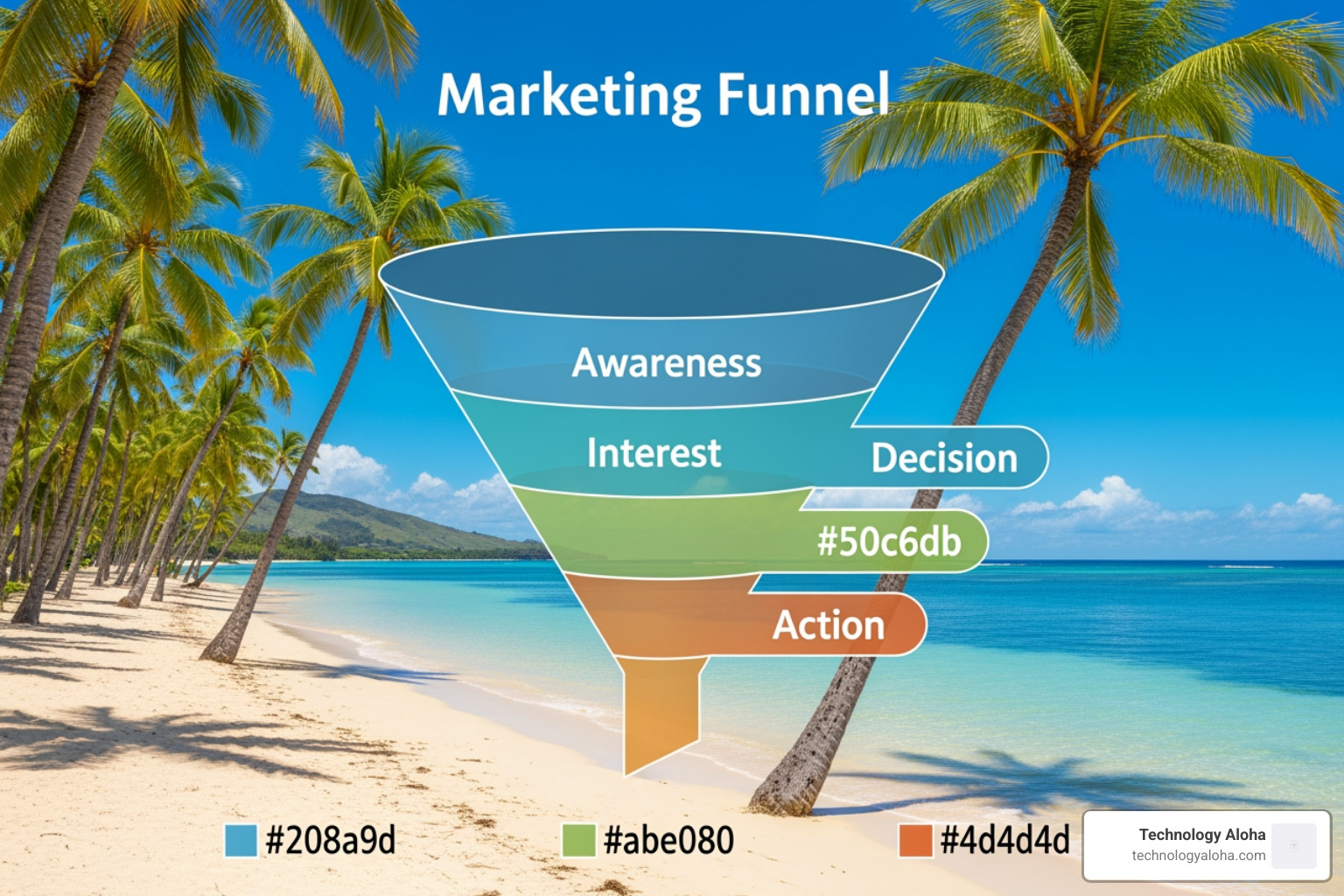
Awareness: attract attention without selling too soon
At the top of the funnel, buyers are problem-aware, not solution-ready. They need clarity before they need a pitch.
Best assets here include:
- SEO blog posts
- Educational videos
- Social posts
- Guides
- Search-optimized service explainers
The copywriting job at this stage is not to close. It is to hook attention, frame the problem, and earn the next click.
Use:
- Strong headlines
- Specific pain points
- Clear introductions
- Search-intent alignment
For more on balancing ranking and readability, see SEO Copy Writing 101: Crafting Content that Ranks.
Interest and consideration: build trust and reduce friction
Now the buyer is evaluating options. This is where trust earns its keep.
Useful assets include:
- Case studies
- Comparison pages
- FAQ pages
- Email nurture sequences
- Webinar pages
- Service pages with proof
This is also where B2B and B2C begin to diverge.
In B2B, buyers often need more clarity, more proof, and more internal justification. Longer sales cycles mean the copy has to support multiple stakeholders, not just one interested reader.
In B2C, the path is often faster and more emotional, though still grounded in trust.
At this stage, effective copy should:
- Show outcomes, not just features
- Answer objections
- Demonstrate authority
- Reduce risk
- Make the next step feel easy
Decision and action: convert with clear next steps
At the bottom of the funnel, confusion is expensive.
This is where landing pages, proposal pages, sales emails, and form copy matter most. Your copy should make the next action obvious and low-friction.
Use:
- One primary CTA
- Clear benefit-led headlines
- Specific proof
- Concise form fields
- Reasonable urgency
- Strong follow-up emails
Urgency is useful. Manufactured panic is not. We want momentum, not melodrama.
For bottom-funnel messaging that converts without sounding pushy, read How to Write Sales Pages that Sell Without Being Sleazy.
Step-by-Step Framework for Effective Marketing and Copywriting
Here is the process we recommend when building messaging that performs.

Step 1: Start with audience, problem, and market position
Do not start by writing. Start by listening.
Gather:
- Customer interviews
- Sales call notes
- Reviews
- Search queries
- CRM data
- Competitor positioning
- Common objections
You are looking for voice-of-customer language, recurring problems, desired outcomes, and market gaps.
Ask:
- What problem are buyers trying to solve?
- What words do they use to describe it?
- What have they already tried?
- Why have they not acted yet?
- How is our offer different?
This step matters because weak messaging usually comes from weak positioning, not weak grammar.
Step 2: Build the message before you draft
Before you write a page, build a message hierarchy.
That usually includes:
- Core value proposition
- Top 3-5 benefits
- Proof points
- Key objections and responses
- Primary CTA
- Supporting CTA
- Elevator pitch
If you cannot explain the offer simply, the copy will wobble. In many cases, businesses lose opportunities because the message is unclear, not because the service is poor.
A good message answers:
- What is it?
- Who is it for?
- Why does it matter?
- Why trust us?
- What should happen next?
Step 3: Write persuasive copy that sounds human
Persuasive does not mean loud. It means clear, specific, and credible.
Core copywriting principles include:
- Clarity over cleverness
- Benefits before features
- Specifics over vague claims
- Active voice over passive voice
- Proof over puffery
- One main idea per section
Classic persuasion principles still hold up in 2026:
- Reciprocity – give value first
- Commitment and consistency – ask for small next steps
- Social proof – show evidence that others trust you
- Authority – demonstrate expertise
- Scarcity – show limits honestly
- Sympathy – sound like a real human
Storytelling also helps, when used with restraint. A tiny before-and-after narrative often works better than a wall of adjectives.
Read your draft out loud. If it sounds like a robot trying to impress a committee, revise.
Step 4: Optimize for channel, SEO, and action
Copy changes by channel. What works on a landing page often fails in an email. What works in email may flop on social.
Still, a few rules travel well:
- Focus on one primary keyword where SEO matters
- Make pages scannable with strong headings and short paragraphs
- Keep mobile readability in mind
- Align metadata with page intent
- Use one dominant CTA per page
- Add internal links where helpful
For email-specific guidance, see How to Write Marketing Emails that Convert.
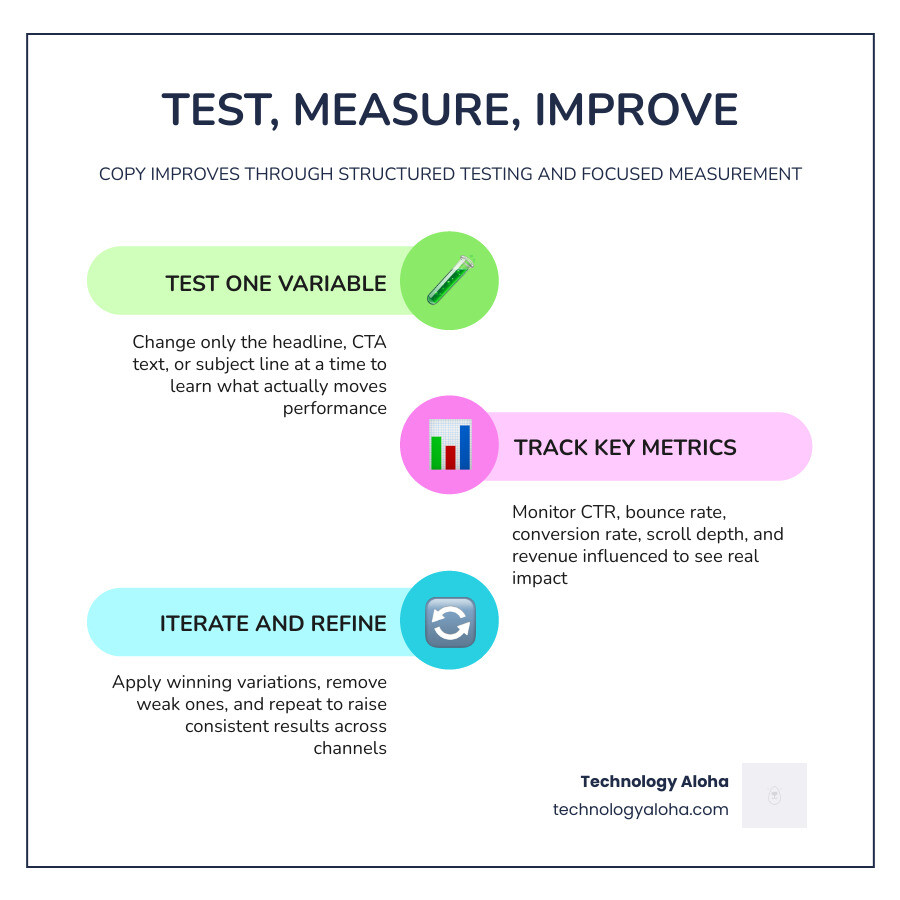
Step 5: Test, measure, and improve
Copy is not finished when it is published. It is finished when it performs consistently.
Test elements like:
- Headlines
- CTA text
- Page layout
- Offer framing
- Subject lines
- Form length
- Proof placement
Measure:
- CTR
- Bounce rate
- Scroll depth
- Conversion rate
- Assisted conversions
- Sales-qualified leads
- Revenue influenced
A-B testing helps, but only if you test one meaningful variable at a time. Otherwise, you are not learning. You are just redecorating.
Types of Copywriting and When to Use Each
Different channels need different copy muscles.
SEO, website, and landing page copy
SEO copywriting targets search intent while staying readable. Website copy clarifies your brand and offer. Landing-page copy narrows focus around one action.
Use SEO and website copy for:
- Homepages
- Service pages
- Blog articles
- Location pages
- Resource libraries
Use landing-page copy for:
- Campaigns
- Lead magnets
- Paid traffic
- Webinar registrations
- Consult requests
Best practices include clear internal linking, strong headings, search-intent match, and visible CTAs. For a broader writing tune-up, read 9 Proven Writing Tips to Improve Your Digital Marketing Strategy.
Email and social media copy
Email is one of the strongest channels for nurturing and conversion because you are speaking to an audience that already knows you, at least a little.
Use email copy for:
- Welcome sequences
- Nurture campaigns
- Sales outreach
- Cart recovery
- Re-engagement
- Launches
Use social copy for:
- Awareness
- Engagement
- Traffic generation
- Offer reminders
- Community building
Email rewards specificity and sequencing. Social rewards speed, clarity, and a strong opening line. Both punish fluff fast.
For sharper outreach, read Stop Getting Ghosted with Better Sales Email Copywriting.
B2B vs B2C copywriting
The difference is not just tone. It is buying context.
B2B copywriting usually needs:
- More clarity
- More proof
- More stakeholder alignment
- More case-study support
- More objection handling
B2C copywriting usually leans more on:
- Emotion
- Identity
- Speed
- Simplicity
- Immediate payoff
That does not mean B2B has no emotion or B2C has no logic. It means the weighting changes.
In both cases, the job stays the same: make the offer clear, credible, and easy to act on.
Common Mistakes, Hiring Choices, and Future Trends
Common mistakes that weaken copy or content
Most underperforming content fails in predictable ways.
Common mistakes include:
- Weak or generic CTAs
- Keyword stuffing
- Vague claims like “best-in-class”
- Inconsistent tone
- Feature dumping without benefits
- Writing for everyone
- Selling too early
- No funnel match
- No proof
- No testing
A page can be beautifully written and still fail if it asks for the wrong action at the wrong time.
Should you hire in-house, freelancers, or an agency?
Each model has strengths.
In-house works well when you need deep brand knowledge and ongoing output.
Freelancers work well when you need specialist help, flexibility, or extra capacity.
Agencies work well when you need strategy, systems, design, implementation, and measurement working together.
Many businesses benefit from a hybrid model:
- In-house for institutional knowledge
- Freelancers for specialty projects
- Agency support for strategy and execution
If you are evaluating local talent trends, Copywriting Jobs in Hawaii – Remote, Work From Home & Online offers a useful snapshot of the role landscape.
AI, authenticity, and what changes next
AI is now part of the workflow. It is not the strategy.
In 2026, the strongest teams use AI for:
- Research synthesis
- Draft support
- Variations
- Summaries
- Pattern spotting
- Data organization
But human judgment is still what makes messaging good.
AI can speed up production. It cannot decide what your market actually values. It cannot replace customer empathy, positioning clarity, or brand taste. It also tends to produce average-sounding copy unless it is grounded in real customer data.
The future belongs to businesses that combine:
- AI-assisted efficiency
- Human strategic direction
- Clear brand voice
- Trust signals
- Real proof
- Strong E-E-A-T cues
How to measure ROI for both content and copywriting
Measure content marketing and copywriting differently, then connect them.
For content marketing, track:
- Organic traffic growth
- Rankings
- Email signups
- Assisted conversions
- Lead quality from content paths
For copywriting, track:
- Landing page conversion rate
- Email CTR and replies
- Form submissions
- Sales opportunities created
- Revenue per campaign
- Customer acquisition cost
- Lifetime value by source
The key is attribution. Some assets close the sale. Others influence it. Both matter.
A useful rule:
- Content marketing often earns the first yes
- Copywriting often earns the next yes
Frequently Asked Questions about Marketing and Copywriting
Is copywriting part of content marketing?
Yes, but it is not the whole thing.
Copywriting supports content marketing through headlines, introductions, CTAs, email promotion, and conversion paths. Content marketing is the broader strategy for attracting and nurturing an audience.
Are content writing and copywriting the same?
No.
Content writing is usually more educational and traffic-oriented. Copywriting is more persuasive and action-oriented. A blog post can contain both, but the intent is different.
Is email marketing the same as copywriting?
No.
Email marketing is a channel and strategy. Copywriting is the skill used inside that channel. You can run email marketing badly with weak copy, or run it well with clear, timely, persuasive messaging.
Conclusion
If you remember one thing, let it be this: marketing and copywriting are separate disciplines, but they work best as one system.
Content builds trust. Copy drives action. Strategy connects the two.
That is how Technology Aloha approaches growth – through positioning, branding, user-focused web design, and conversion-minded messaging that helps businesses communicate clearly and move people to act.
If you want help turning strategy into sharper messaging, stronger pages, and better conversion paths, explore Technology Aloha Copywriting and Editing Services.