Why SEO Copy Writing Determines Who Gets Found—and Who Gets Ignored
SEO copy writing is the practice of crafting web content that ranks well in search engines and persuades real people to take action. It sits at the intersection of keyword strategy, user psychology, and clear writing.
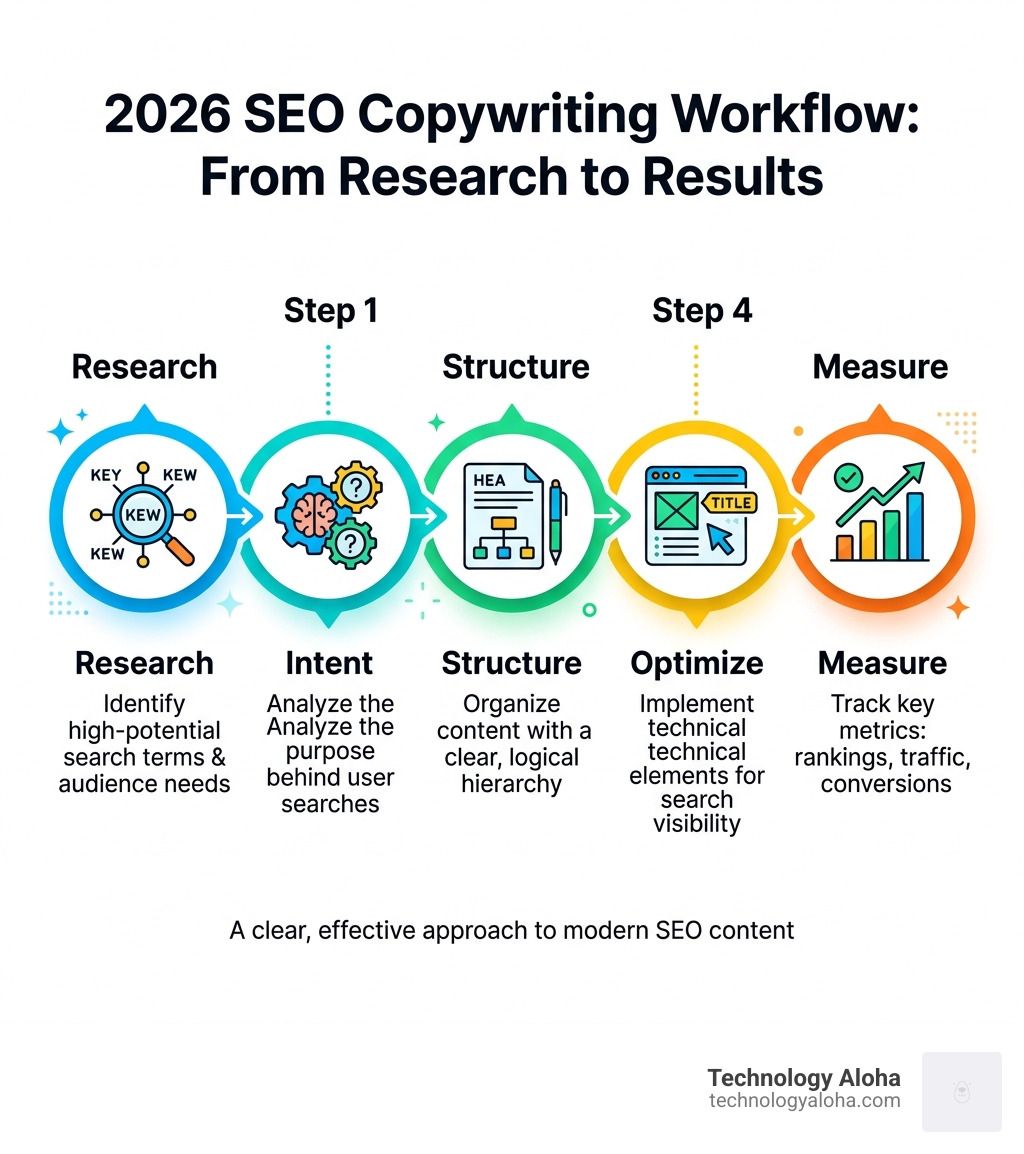
Here’s what SEO copywriting covers, fast:
- Research — find the keywords your audience actually searches
- Intent matching — write content that answers what they’re looking for
- Structure — use headings, short paragraphs, and clear hierarchy
- On-page optimization — title tags, meta descriptions, URLs, internal links
- Engagement — keep readers on the page long enough to convert
- Measurement — track rankings, traffic, bounce rate, and conversions
Most content on the web fails at one of two things: it ranks but nobody acts on it, or it reads beautifully but nobody finds it. The goal of SEO copy writing is to solve both problems at once.
Organic search drives more than half of all website traffic. That means the words on your pages are either working for you around the clock—or they’re not working at all.
For small business owners competing in crowded markets, this gap is costly. A well-optimized competitor with average writing will consistently outrank a beautifully written site that ignores search fundamentals.
This guide walks you through the full process—from keyword research to on-page optimization to measuring what’s actually working—so your content earns its place in search results and converts the visitors it attracts.
Quick seo copy writing definitions:
Defining Modern SEO Copy Writing
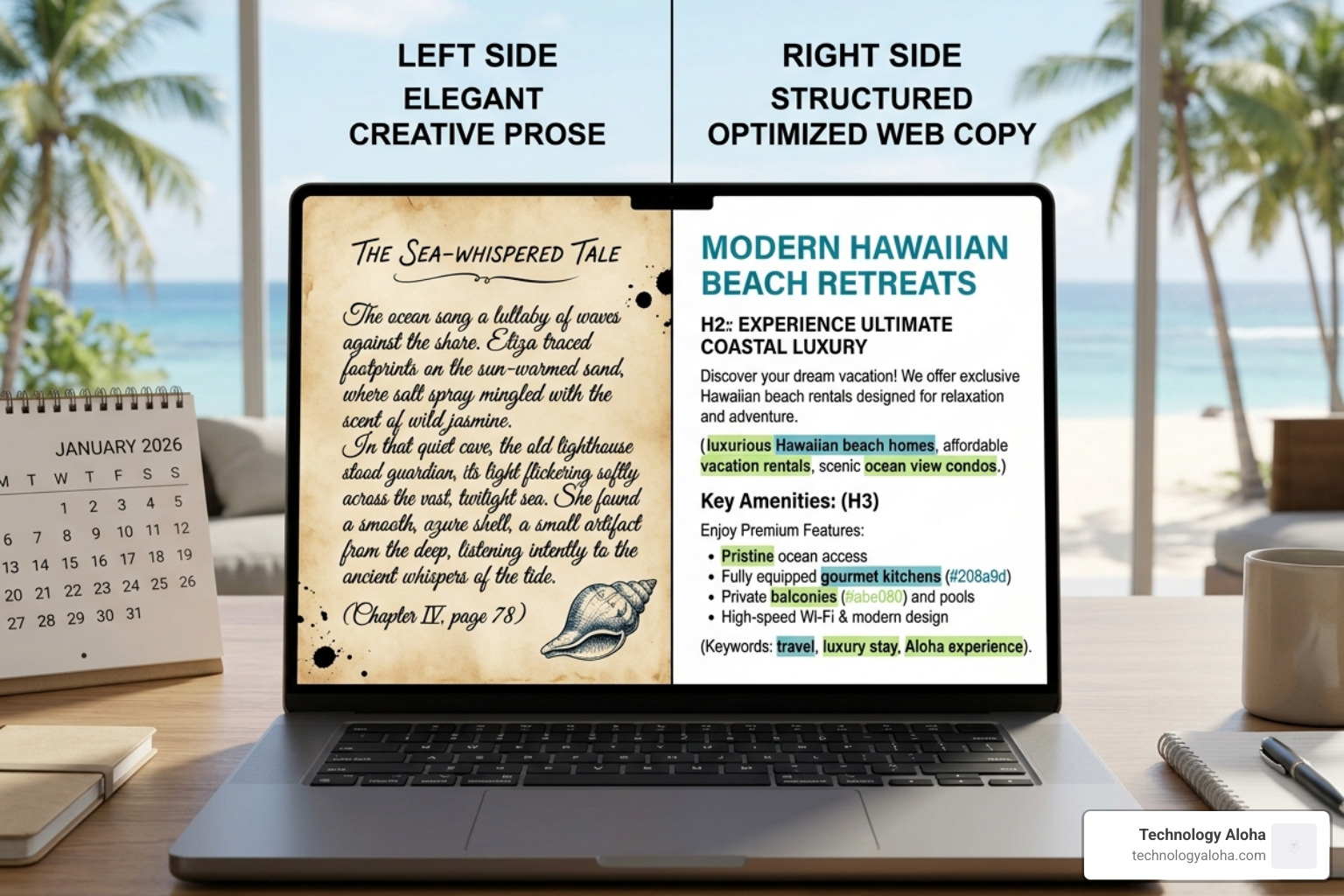
In April 2026, seo copy writing is no longer just about placing keywords in the right spots. It is a sophisticated discipline that balances the demands of search algorithms with the needs of human readers. While standard copywriting focuses on persuasion and standard SEO writing focuses on visibility, seo copy writing merges these goals to create assets that rank and sell simultaneously.
The foundation of modern search success is E-E-A-T: Experience, Expertise, Authoritativeness, and Trustworthiness. Google’s algorithms are now designed to prioritize content that feels like it was written by a human who actually knows the subject. In 2026, the “Experience” component is particularly critical; search engines look for first-hand accounts and unique insights that AI cannot replicate. To understand the groundwork of these concepts, you can start with SEO: the basics.
How SEO Copy Writing Differs from Standard Content
The primary difference lies in the technical constraints and sales psychology. Standard content writing might aim to entertain or inform without a specific search goal. SEO copy writing, however, uses data-driven keyword integration to ensure the content is discoverable.
We don’t just write; we architect. Every sentence is designed to satisfy a searcher’s query while moving them closer to a conversion. This involves a deep understanding of what SEO means and how it can benefit your company. Unlike standard copy, SEO copy must also account for:
- Keyword Placement: High-impact areas like title tags and first paragraphs.
- Dwell Time: Keeping users on the page to signal quality to Google.
- Conversion Optimization: Guiding the reader toward a CTA without sacrificing ranking power.
The Evolution of Search in 2026
Search has changed. We are now firmly in the era of AI Overviews and zero-click searches. When a user asks a question, Google often provides the answer directly on the Search Engine Results Page (SERP). This means that for seo copy writing to be effective, our content must be structured to be the source of those AI answers.
Authority is the 2026 currency. Semantic search—understanding the meaning and context behind a query rather than just the words—is the standard. We no longer write for “strings”; we write for “things” (entities). If your content doesn’t demonstrate deep topical relevance, it won’t matter how many keywords you use.
The Strategic Framework for Content That Ranks
Successful seo copy writing starts long before we type the first word. It begins with a framework that aligns our business goals with user needs.
| Search Intent Type | User Goal | Content Example |
|---|---|---|
| Informational | Seeking an answer or guide | “How to optimize a blog post” |
| Navigational | Finding a specific brand/site | “Technology Aloha contact page” |
| Commercial | Comparing options | “Best SEO agencies in Hawaii” |
| Transactional | Ready to buy | “Buy SEO copywriting services” |
Effective keyword research involves identifying “parent keyphrases”—the broad terms that capture 80% of search traffic—and then branching out into long-tail variations. While 70% of all searches are long-tail, these specific, niche queries are where you find the highest intent. To see how this fits into your broader plan, you should apply content marketing to your SEO strategy.
Mastering Search Intent for SEO Copy Writing
Matching search intent is the single most important factor in ranking. If a user searches for “best running shoes” (Commercial Investigation) and you give them a page that only lets them “Buy Now” (Transactional), they will bounce. We map content to the user’s stage in the journey:
- Informational: Use guides, lists, and “how-to” articles.
- Navigational: Ensure brand and service pages are clear.
- Commercial: Provide comparisons, reviews, and case studies.
- Transactional: Use clear CTAs and streamlined product descriptions.
Analyzing the Competitive Landscape
Before writing, we perform a SERP analysis. We look at the top 3 results for our target keyword. If the average word count is 2,000 words and the content includes video, we know that is the benchmark for entry. We look for content gaps—questions the competitors didn’t answer or data they missed. This is a core part of the importance of content marketing in SEO.
Proven Techniques to Increase Dwell Time and CTR
Once we have the strategy, we use specific techniques to keep readers engaged. Dwell time (how long someone stays on your page) and CTR (click-through rate) are massive ranking signals in 2026.
Structuring for Scannability and Retention
People don’t read on the web; they scan. We use the Inverted Pyramid style—putting the most important information at the top. This is supported by:
- Bucket Brigades: These are short sentences ending in a colon to keep people reading. (e.g., “But here’s the kicker:”)
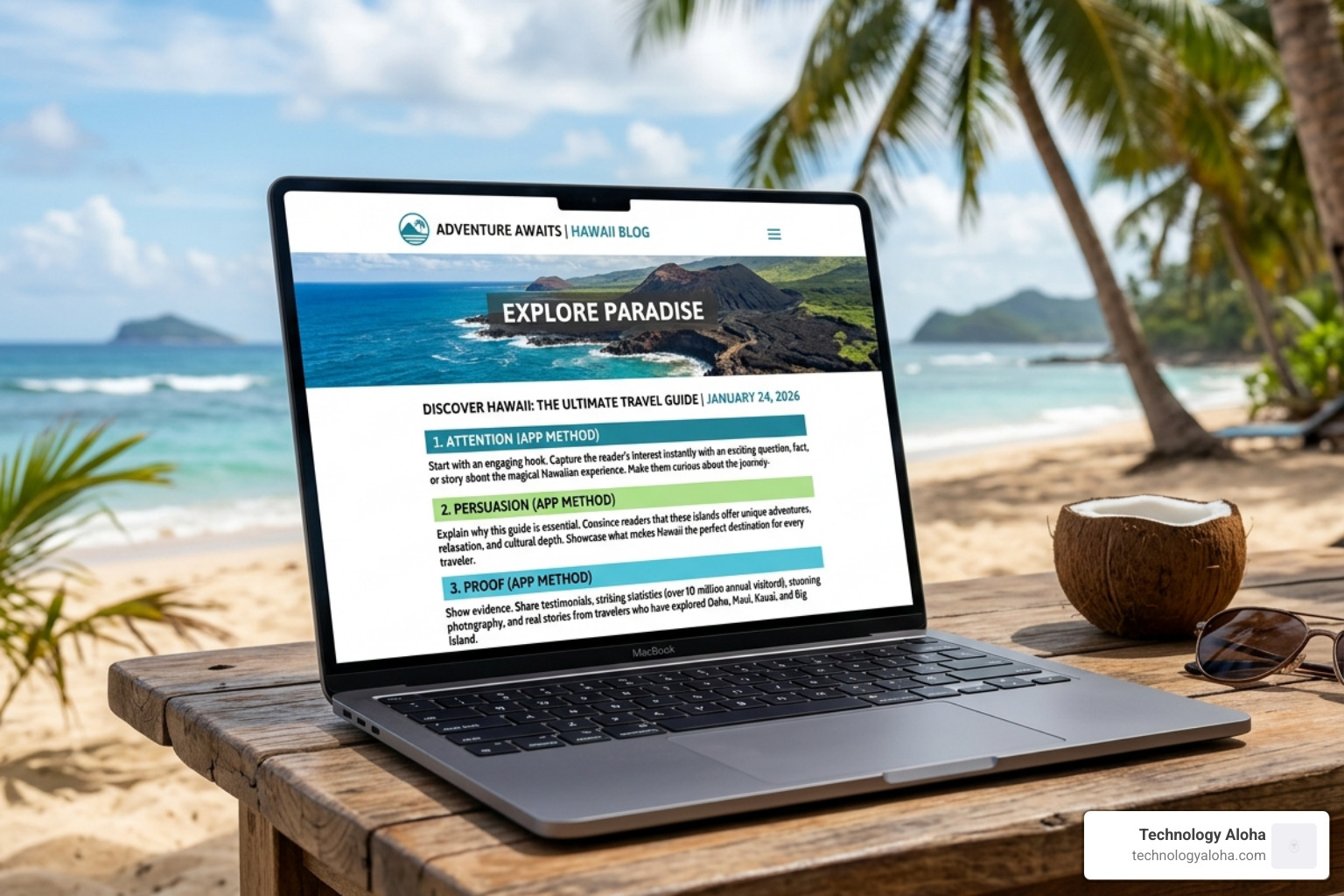
- APP Method: Agree, Promise, Preview. We agree with the reader’s problem, promise a solution, and preview what the article covers.
- Heading Hierarchy: Use H1, H2, and H3 tags correctly. Never skip levels. This helps search engines understand your structure and helps readers find what they need. Learn more about how to format a blog post for SEO.
Advanced Engagement Strategies
To further boost engagement, we use Snippet Bait. These are 40–60 word blocks of text designed to be pulled into Google’s Featured Snippets. We also incorporate LSI (Latent Semantic Indexing) keywords—terms related to your primary keyword that help search engines understand the context. For example, if you’re writing about “Apple,” LSI keywords like “iPhone,” “orchard,” or “MacBook” tell Google exactly which “Apple” you mean.
For those looking to go deeper into the psychology of persuasion, The Copywriter’s Handbook by Robert Bly remains an essential resource for blending classic sales tactics with digital needs.
Additionally, adding a video near the top of a post can increase Time on Page by a full minute. This is a simple but powerful way to improve your click-through rate in the search results.
On-Page Optimization and Technical Precision
Technical precision is the “SEO” in seo copy writing. Even the best writing won’t rank if the technical elements are missing.
- Title Tags: Keep them under 60 characters and include your primary keyword near the beginning. Question-based titles have a 14% higher CTR.
- Meta Descriptions: These should be under 155 characters and “sell” the click. They don’t directly impact rankings, but they impact CTR, which does.
- URL Slugs: Keep them short and keyword-rich. Avoid dates or strings of numbers.
- Internal Linking: Link to at least 3–5 other relevant pages on your site. This helps Google crawl your site and keeps users engaged. For a deeper dive, see our guide on blog post SEO: how to write blog post that ranks.
Optimizing for Local and Niche Markets
For businesses in Hawaii, local SEO is paramount. We focus on local intent—keywords like “near me” or “in Kahului.” This involves optimizing your Google Business Profile and ensuring your NAP (Name, Address, Phone) data is consistent across the web. Small businesses have a unique advantage here; you can dominate a local niche by being the most relevant local authority. This is why small business SEO: why you need to rank locally is a critical strategy. We even see this in specialized fields, such as how medical SEO works for your healthcare website.
The Role of Human Expertise in the Age of AI
Generative AI tools are everywhere in 2026, but they are not a replacement for human seo copy writing. AI is excellent for ideation and structuring, but it lacks brand voice, real-world experience, and the ability to verify facts accurately.
We use a “Human-in-the-loop” strategy. AI might generate a draft, but a human expert must provide the strategic oversight, the specific Hawaii-based context, and the final polish that ensures the content resonates with real people. Google does not penalize AI content, but it does penalize “unhelpful” content. Humans ensure helpfulness.
Measuring Performance and ROI
You cannot manage what you do not measure. We track the success of our seo copy writing through several key metrics:
- Organic Traffic: Are more people finding you through search?
- Keyword Rankings: Are you moving up the SERPs for your target terms?
- Bounce Rate: Are people leaving immediately, or are they staying to read?
- Time on Page: Does the content engage them?
- Conversions: Is the traffic actually doing what you want them to do (signing up, buying, calling)?
For small businesses, seeing a 138% increase in organic traffic and a 96% increase in lead conversions in a single year is possible when these elements are aligned. Review these 10 simple SEO copywriting tips for your small business to start your own tracking.
Frequently Asked Questions about SEO Copywriting
What is the ideal keyword density in 2026?
The concept of “keyword density” is largely outdated. Instead of aiming for a percentage (like 2%), focus on natural integration. If you write comprehensively about a topic, your keywords will naturally appear at a healthy frequency. In 2026, search engines prioritize topical authority over keyword counting. Most experts suggest a density of 0.5% to 1.5% is more than enough.
How often should I update my SEO content?
We recommend reviewing your top-performing content every 3 to 6 months. Search intent can shift, and new competitors can emerge. Updating statistics, adding new internal links, and refreshing the “current year” in your titles can provide a quick ranking boost.
Can AI-generated content rank as well as human-written copy?
Yes, it can rank, but it often struggles to stay ranked. AI content tends to be derivative. In 2026, Google’s “Helpful Content” signals favor original research, unique perspectives, and high E-E-A-T. AI can help you get started, but human refinement is what secures the top spot and converts the reader.
Conclusion
At Technology Aloha, we know that seo copy writing is the engine of digital growth. By blending data-driven insights with cohesive branding and high-conversion designs, we help Hawaii businesses transition from being ignored to being found. Whether you are in Kahului or anywhere across the islands, your online presence depends on the quality of your words and the strategy behind them.
Ready to turn your website into a lead-generating machine? Elevate your brand with professional copywriting and editing services and let us help you craft content that truly ranks.