Beginner’s Guide to Background Audience Analysis
What Background Audience Analysis Actually Is (And Why It Changes Everything)
Background audience analysis is the process of researching who your audience is — their demographics, values, behaviors, and cultural context — before you craft a single message or campaign.
Here’s a quick breakdown of what it covers:
- Who they are — age, gender, education, occupation, religion, cultural background
- What they believe — values, attitudes, and preexisting opinions about your topic
- How they behave — content habits, purchase patterns, platform preferences
- Why they’re listening — voluntary interest vs. obligation, occasion context, prior knowledge
This isn’t just a public speaking concept. It’s the foundation of every effective marketing decision.
One marketing director’s story captures it perfectly: a campaign was built, launched, and flopped — not because the creative was weak, but because the team skipped audience research entirely and had to pivot after the damage was done.
That’s the cost of guessing.
Most communication fails not from poor execution, but from poor audience understanding. You can have a clear message, a strong offer, and a solid budget — and still miss completely if you don’t know who you’re talking to, what they already believe, and what they actually care about.
The good news: background audience analysis is learnable, repeatable, and — when done right — one of the highest-leverage investments you can make in your marketing.
The Core Pillars of Background Audience Analysis
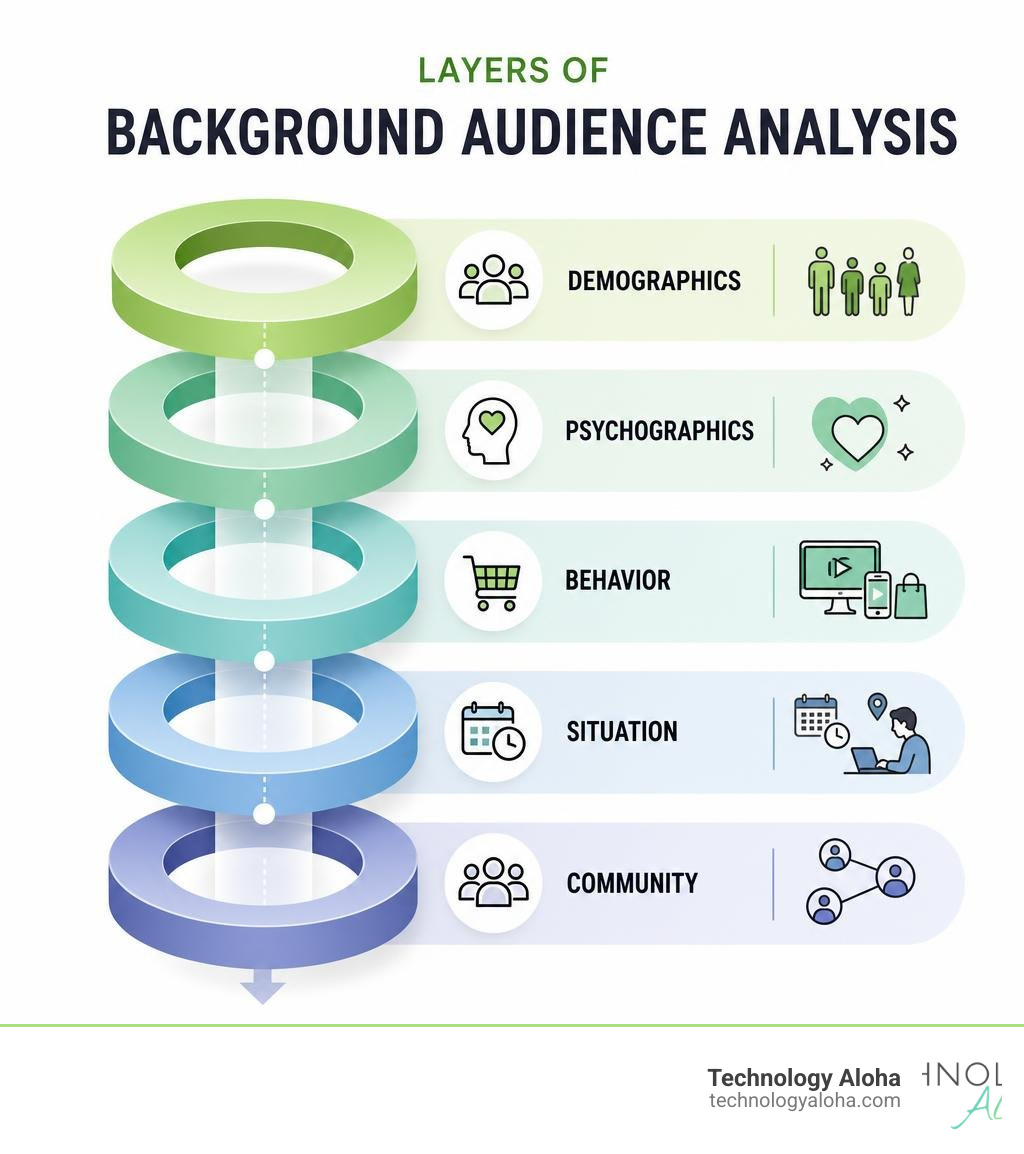
To build a message that resonates, we must look beyond basic customer profiles. Traditional marketing often relies on flat, demographic proxies. In 2026, we know that true audience intelligence requires a multidimensional approach.
According to What Is Audience Analysis? A Practical Guide for Marketers (2026) • Pulsar Platform, audience analysis is an ongoing program designed to maintain a continuously updated understanding of how target audiences organize, what they believe, and how those beliefs are changing.
To achieve this, we rely on four core pillars:
- Demographic Data — The baseline facts of who your audience is on paper.
- Psychographic Profiling — The internal drivers of why they make decisions.
- Behavioral Signals — The digital breadcrumbs of what they actually do.
- Community Mapping — The social structures of with whom they cluster and around what.
When we combine these four lenses, we solve the “false-average problem”—the common mistake of aggregating audience data into a single, generic profile that actually represents no one in the real world. Instead of marketing to a statistical ghost, we target real, self-organizing communities.
Demographic Factors in Background Audience Analysis
Demographics are the starting point of any background audience analysis. They provide the structural guardrails for your message. If you do not understand the basic makeup of your audience, you risk using tone, references, and channels that completely miss the mark.
Key demographic factors include:
- Age Cohorts: Age dictates cultural touchstones, technological comfort, and media habits. For instance, Gen Z spends nearly 18 hours per week on social and short-form video in 2026, whereas older generations may prioritize email or editorial content.
- Gender Identity: Gender influences communication styles and purchasing priorities, though we must avoid lazy stereotyping.
- Education and Occupation: These factors dictate the complexity of your vocabulary and the specific pain points your audience faces. A nurse has different daily operational stresses than a hospital administrator; your copy must reflect that reality.
- Cultural and Religious Affiliation: Culture shapes how people perceive symbols, stories, and ethical arguments. Religion is a massive element of this framework. Statistically, 84 percent of Americans identify with at least one of a dozen major religions, and another 6 percent identify as unaffiliated but religious. This means only one in ten Americans is atheist, agnostic, or “nothing in particular.” Ignoring the role of faith and values in your audience’s worldview is a major strategic blind spot.
From our office in Kahului, Maui, we see this cultural mosaic in action every day. Hawaii’s unique demographic landscape—where there is no single ethnic majority and cultural preservation is highly valued—proves that local context matters. You can read more about how localized demographics shape communication in the Demographic, Social, Economic, and Housing Characteristics of Selected Racial Groups in Hawaii Report and explore specific regional interests via Hawaii Audience in United States – Rascasse.
To ensure your campaigns hit the mark, review our guide on Social Media 101: Know Your Target Market to align your demographics with your platform strategy.
Psychographic and Behavioral Layers
If demographics tell us who is buying, psychographics and behaviors tell us why and how.
Psychographics dive into your audience’s internal world:
- Core Values: What do they prioritize? Stability or experimentation? Individual autonomy or community care?
- Belief Systems: What pre-existing notions do they hold about your industry?
- Motivations and Pain Points: What keeps them up at night?
To organize these insights into a functional strategy, we use marketing personas. If you are new to this process, explore Everything You Need to Get Started with Marketing Personas to build a solid foundation.
Behavioral signals ground these psychographic theories in reality. People are notoriously bad at reporting their own behavior in surveys—they tell us what they think we want to hear, or who they wish they were. Behavioral data tracks what they actually do:
- Search Intent: Are they looking for quick answers (informational) or ready to buy (transactional)?
- Content Consumption: Do they read long-form guides, listen to podcasts, or scroll through short-form videos?
- Dark Social Sharing: A massive portion of modern audience behavior happens in untrackable spaces. In 2026, 100% of traffic from platforms like TikTok, Slack, Discord, and WhatsApp is marked as “direct” in standard analytics, meaning we must look beyond basic referral links to map true community engagement.
Situational Factors That Shape Audience Reception
An audience does not consume your message in a vacuum. The physical, emotional, and situational context of the moment matters just as much as their demographic background.

According to the Audience Analysis – Communication – University of Pittsburgh guidelines, situational analysis involves looking at the concrete environment in which your communication takes place.
Managing Audience Size and Setting
The physical and logistical setup of your presentation or digital touchpoint changes how you must deliver your message:
- Audience Size: The size of your audience dictates your delivery style. A small group of 20–30 people allows for an informal, highly interactive, and conversational approach. A large crowd of hundreds requires structured delivery, clear visual aids, and a formal tone to maintain authority and attention.
- Physical Setting: If you are speaking in person, you must account for room layout, temperature, acoustics, and potential distractions (such as external street noise or internal tech glitches).
- Technical Aids: Ensure your slides, microphones, and video elements are optimized for the room.
For a deeper look at managing these physical logistics, see the resources provided by the Analyzing Your Audience – University of Hawaii System speech lab.
Navigating Voluntariness and Occasion
One of the most critical situational factors is whether your audience is there by choice:
- Voluntary Audiences: These listeners are highly motivated. They chose to click your link, download your guide, or attend your talk. Your job is to deliver on their high expectations and maintain their interest.
- Captive (Involuntary) Audiences: These individuals are there because they have to be—think of employees attending a mandatory safety training or students in a required course. Captive audiences are naturally more skeptical and easily distracted. You must address their inherent egocentrism immediately by answering: Why does this matter to me right now?
Additionally, you must align with the occasion expectations. Every event comes with unwritten rules. If a speaker uses a solemn community memorial service to pitch a political platform, they violate the audience’s expectations and destroy their credibility. Your message must match the emotional gravity and purpose of the moment.
Executing Your Audience Research Strategy
Now that we understand the pillars and situational factors, let’s look at how to build and execute a practical research workflow.
A successful strategy moves systematically from broad questions to highly precise, actionable data. You can follow the structured framework outlined in How to Conduct Audience Analysis: A 5-Step Guide for 2026 to guide your implementation.
Step 1: Define Your Strategic Objectives
Never start researching without a clear goal. “Knowing our audience better” is not an objective. A real objective is tied to a specific business decision:
- Are we trying to find a niche market for our new software tool?
- Do we need to understand why our donor retention dropped last quarter?
- Which messaging angle will resonate best with local business owners in Kahului?
Defining your scope keeps you from drowning in data. For guidance on narrowing your focus, read our Expert Guidance on How to Find a Niche for Your Business.
Step 2: Gather and Triangulate Data Sources
To get an accurate picture, you must combine multiple research methods. Relying on a single data source is the fastest way to build a flawed strategy.
We recommend triangulating your data using three primary methods:
- Revealed Preferences (Social Listening & Analytics): Use tools to monitor what your audience talks about, shares, and searches for online when they don’t know they are being observed.
- Stated Preferences (Surveys & Polls): Ask targeted questions to gather quantitative data at scale. Keep surveys under 10–15 minutes to prevent abandonment.
- Qualitative Depth (Interviews & Focus Groups): Conduct 6–10 deep-dive interviews with representative audience members. This is often enough to reveal consistent patterns, struggles, and language choices.
For a detailed breakdown of social and behavioral research methodologies, consult How to Do an Audience Analysis – The Compass for SBC. If you are building a specialized business model, you will also find highly relevant tips in Uncover What Is a Audience Analysis: Your 2026 SaaS Guide | Proven SaaS. To round out your toolkit, review Audience Research: The Complete Guide for Marketers in 2026 – SparkToro to future-proof your data collection methods.
Step 3: Segment and Build Actionable Personas
Once your data is collected, group your audience into distinct communities based on shared behaviors, values, and cultural codes—not just basic demographic buckets.
To turn these segments into practical tools, translate them into lean, functional personas. Avoid decorative details (like their fictional favorite food or pet’s name) and focus on:
- The Job to Be Done: What progress are they trying to make?
- Key Triggers: What events push them to seek a solution?
- Primary Objections: Why would they say “no” to your offer?
- Preferred Channels: Where do they actively spend their attention?
To jumpstart this step, you can Steal These Marketing Buyer Persona Templates and customize them for your brand.
How to Conduct a Background Audience Analysis Step-by-Step
To bring this all together, follow this repeatable six-step execution loop:
- Inventory Existing Insights: Gather what your team already knows (or thinks they know) from customer support tickets, sales calls, and website analytics.
- Map the Communities: Identify the self-organizing groups within your market. Look at who they follow, what vocabulary they use, and which media outlets they trust.
- Execute Targeted Surveys and Interviews: Fill in the gaps in your knowledge by speaking directly to representatives from those communities. For inspiration, take a look at our Meet Your Customers: A Deep Dive into Buyer Persona Samples.
- Draft Lean Personas: Create 2 to 4 highly focused persona profiles using real verbatims and behavioral data.
- A/B Test and Validate: Run small-scale campaigns, change landing page headlines, or adjust email subject lines to see if your new audience insights actually improve conversions. You can read about this process in Target Audience Analysis Explained: Examples & How to Step by Step | fusepoint.
- Iterate Quarterly: Treat your audience profiles as living documents. Reevaluate them regularly to keep up with shifting cultural trends and market dynamics.
Frequently Asked Questions about Audience Backgrounds
What is the difference between audience analysis and market research?
While they are closely related, they serve different strategic purposes. Market research is landscape-centric; it looks at the macro environment, including market size, competitor pricing, and supply chains. Audience analysis is people-centric; it focuses on the micro-level behaviors, beliefs, and needs of the specific human beings you want to reach.
| Feature | Traditional Market Research | AI-Native Audience Intelligence |
|---|---|---|
| Primary Focus | Market size, competitors, and pricing | Human communities, beliefs, and behaviors |
| Data Types | Industry reports, macro economics, broad surveys | Social listening, network science, conversational data |
| Cadence | Project-based (often annual or bi-annual) | Continuous, real-time monitoring and updates |
| Segmentation | Broad demographic buckets (e.g., age 25–45) | Behavioral and self-organizing community clusters |
How often should we update our audience profiles?
Archived profiles lead to archived strategies. We recommend a light review of your audience data quarterly and a comprehensive rebuild once a year. If you operate in a fast-moving industry, you should monitor your key community channels weekly to spot emerging narratives and cultural shifts before they peak.
Why are demographics alone insufficient for modern marketing?
Demographics only describe the surface. Two people can share the exact same age, gender, income bracket, and zip code, yet hold completely opposite political views, buy different products, and hang out in entirely different online communities. If you build a campaign based purely on demographic averages, you risk falling into the “false-average problem” and creating a message that speaks to everyone on paper but resonates with no one in reality.
Conclusion
A successful marketing strategy is built on deep, evidence-based audience understanding, not guesswork. By executing a thorough background audience analysis, you replace assumptions with data-driven insights, ensuring your message lands with precision.
At Technology Aloha, we help businesses grow by blending cohesive branding with high-conversion, user-centric web design. Based in Kahului, Maui, we use data-driven insights to help you identify your best target segments and build digital experiences that drive real results.
Ready to stop guessing and start connecting? Explore our strategic audience analysis services or contact us at Technology Aloha to elevate your brand strategy today.