The Complete Guide to Static Web Pages
What Is a Static Web Page — and Why It Matters for Your Business
A static web page is a web page delivered to your browser exactly as it was stored — no database, no server-side processing, no on-the-fly generation.

Here’s the short version:
| Feature | Static Web Page |
|---|---|
| How content is served | Pre-built HTML files sent directly to the browser |
| Same content for all users? | Yes |
| Requires a database? | No |
| Server-side processing? | No |
| Typical load speed | Under 100 milliseconds via CDN |
| Common use cases | Portfolios, landing pages, blogs, documentation |
The first pages ever published on the World Wide Web were static. Simple, fast, and reliable. Then the internet got complex — databases, user logins, personalized feeds — and dynamic sites took over.
But something shifted. As of 2026, static sites are back in a big way.
Why? Because most small businesses don’t need real-time user data. They need a site that loads fast, ranks well on Google, and doesn’t break.
Static sites deliver exactly that — and modern tools have closed the gap on nearly every limitation they once had.
This guide explains how static web pages work, when they’re the right choice, and how to get the most out of them without sacrificing the features your business actually needs.
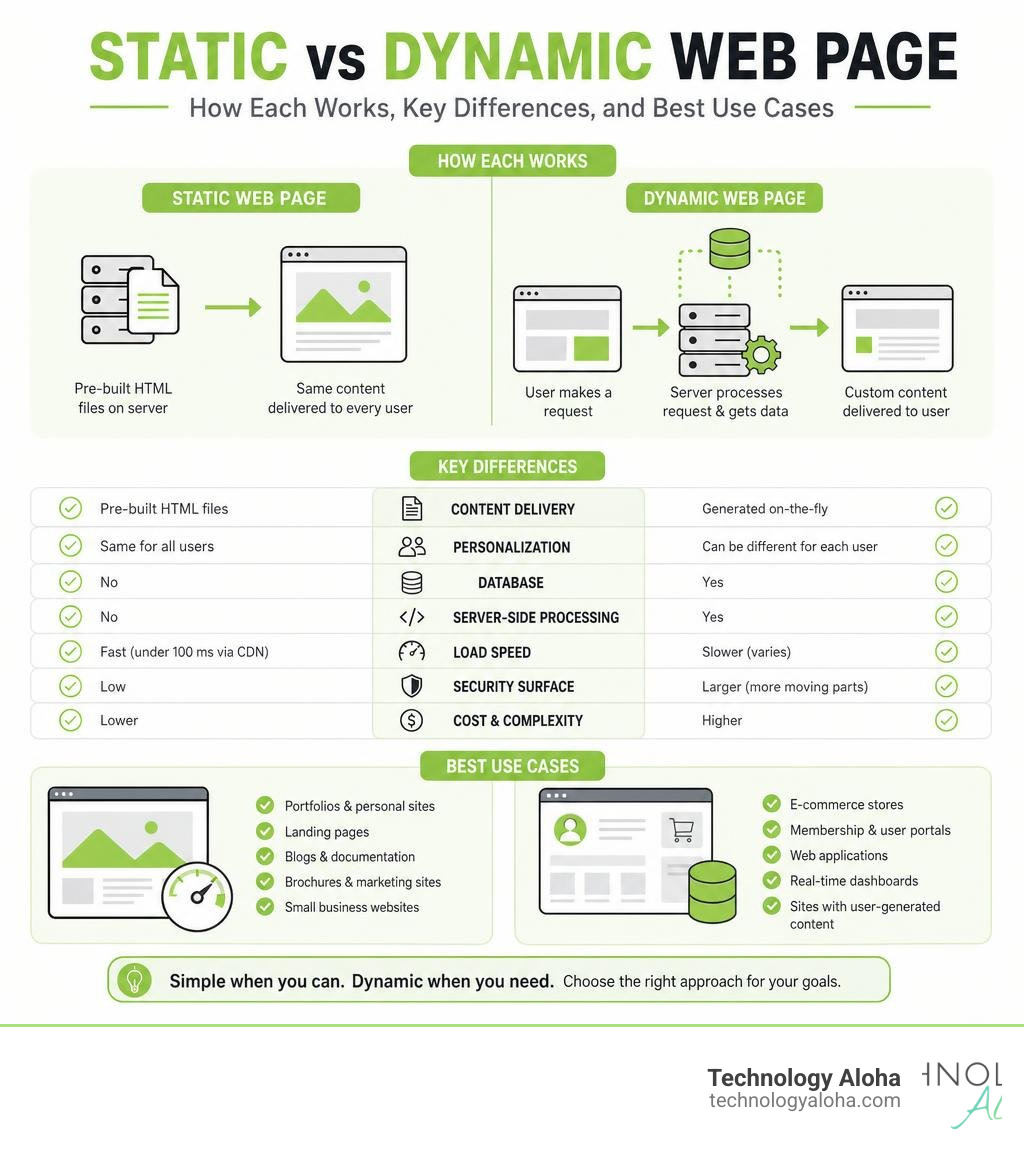
Terms related to static web page:
What is a Static Web Page and How Does It Work?
To understand why a static web page is so efficient, you must look at what happens behind the scenes when a user clicks a link. In traditional dynamic setups, a web server acts like a busy chef cooking every meal from scratch. When a visitor requests a page, the server queries a database, fetches content, injects it into a template, builds the HTML page on the fly, and finally sends it to the browser.
A static website operates like a high-efficiency vending machine. The pages are already built, packaged, and waiting. The moment a user makes a request, the server hands over the pre-built file. There is no cooking, no waiting, and no delay.
Defining the Core Mechanics of a Static Web Page
At its core, a static web page consists of flat files written in HTML, styled with CSS, and enhanced with client-side JavaScript. Because these files are pre-rendered, they display the exact same content to every visitor under all contexts. You can learn the fundamentals of how these files are structured in our guide on How to Create a Basic HTML Page in 5 Steps.
Historically, the very first web pages on the internet were entirely static. While the technology has matured, the fundamental definition remains identical: a file stored on a server that is delivered to a web browser exactly as it is written. For a deeper dive into the historical and technical definitions, you can explore the Wikipedia page on Static web page.
Importantly, “static” does not mean “boring” or “non-interactive.” Modern static sites use client-side JavaScript to run animations, interactive calculators, and responsive menus directly inside the user’s browser without ever needing to contact a backend database.
How Dynamic Web Pages Differ
Dynamic web pages rely heavily on server-side processing. Every time a user visits a dynamic page, a web application runs scripts (written in languages like PHP, Python, or Ruby) to assemble the page.
This on-the-fly generation introduces several points of failure:
- Database Queries: If your database is slow or experiences high traffic, your pages will lag.
- Server Latency: The physical time it takes for the server to run scripts and assemble the HTML adds valuable seconds to your page load time.
- Complexity: Dynamic sites require constant security patches, database optimizations, and server maintenance to prevent crashes.
If your content changes multiple times per hour based on specific user profiles—such as an Amazon dashboard or a personalized social media feed—dynamic architecture is necessary. However, for standard business sites, service descriptions, and portfolios, dynamic generation is often an over-engineered solution that slows down the user experience.
How a Static Web Page Impacts SEO and Core Web Vitals
Google prioritizes speed, stability, and user experience. Under the Core Web Vitals framework, search engine algorithms measure exactly how fast your site loads and how quickly it becomes interactive.
Because static web pages bypass database queries and server-side script execution, they can load up to 5x faster than dynamic websites. This speed directly translates to superior Core Web Vitals scores:
- Largest Contentful Paint (LCP): Static pages achieve near-instant content delivery, often loading the main visual elements in under 100 milliseconds when served via a Content Delivery Network (CDN).
- Cumulative Layout Shift (CLS): Because static pages are pre-rendered, the layout is locked in before delivery, preventing the annoying visual shifts common on dynamic sites as slow elements load.
- First Input Delay (FID) / Interaction to Next Paint (INP): With no heavy backend scripts blocking the browser’s main thread, static pages respond to user clicks instantly.
By optimizing these technical performance metrics, static sites earn a natural ranking advantage in search results. To see how these performance optimizations fit into a broader digital strategy, read The Ultimate Guide to User-Centric Website Design.
The Strategic Advantages of Static Websites
For businesses operating in highly competitive markets—whether local service providers in Kahului, HI, or national enterprise brands—website performance is a business metric. A slow website is a leaky sales funnel. Choosing a static architecture is a strategic decision that directly protects your bottom line.

How Do Static Websites Offer Unmatched Speed and Performance?
Page speed is the single most important factor in keeping visitors on your site. Studies show that websites loading in under 100 milliseconds provide a near-instant experience that keeps users engaged. Static sites achieve this by delivering raw HTML and CSS directly to the browser.
With no database to query and no templates to compile, server load is virtually non-existent. This rapid delivery keeps bounce rates low and conversions high. If you are currently struggling with slow load times on a dynamic platform, you can compare performance strategies in The Ultimate Checklist to Speed Up Page Load Time WordPress.
How Do Static Websites Offer Inherent Security and Reduced Vulnerability?
Static websites offer inherent security and reduced vulnerability because, unlike dynamic websites, they do not rely on databases or active backend code, which are prime targets for hackers. This eliminates common attack vectors like SQL injections, cross-site scripting (XSS), and web shell exploits.
Static websites have no database to hack and no server-side code to exploit. There is simply nothing for an attacker to inject malicious code into. This drastically reduced attack surface makes static sites incredibly secure. For businesses, this means fewer security alerts, no emergency patching, and absolute peace of mind.
How Do Static Websites Offer Cost Efficiency and Scalability?
Static websites offer significant cost efficiency and scalability because they do not require robust servers or complex database processing, unlike traditional dynamic hosting. This means static sites can easily handle traffic spikes without crashing, reducing infrastructure costs and ensuring consistent performance even during successful marketing campaigns.
Static websites are hosted on lightweight cloud storage services and distributed globally via CDNs. This serverless architecture is incredibly cheap to maintain. Instead of paying for expensive database servers, businesses can host static sites for pennies using basic cloud storage.
Furthermore, static sites are infinitely scalable. A sudden spike of 100,000 visitors will not crash a static site; the CDN simply serves the pre-cached HTML files from the nearest edge server without breaking a sweat.
Limitations and Modern Workflows for Static Sites
While the benefits of static web pages are clear, businesses often wonder how to handle interactive elements like contact forms, search bars, or e-commerce checkouts without a traditional database. Fortunately, modern web development workflows have solved these challenges.
Managing Dynamic Functionality Without a Backend
You do not need a heavy backend server to make a website interactive. By leveraging client-side JavaScript and API-driven microservices, static sites can easily handle complex user interactions:
- Contact Forms: Instead of a database-driven form handler, static sites use serverless form services to securely collect and route customer inquiries.
- Interactivity: Interactive maps, calculators, and filters run entirely in the user’s browser using lightweight JavaScript.
- Accessibility: Standardized HTML structures make it simple to ensure your site is usable for everyone. To learn more about these standards, read How to Make Your Website Accessible.
- Responsive Layouts: Static files adapt beautifully to any screen size. See our breakdown on What is Responsive Web Design for best practices.
How Static Site Generators (SSGs) Work
Writing raw HTML for hundreds of pages manually is inefficient. That is where Static Site Generators (SSGs) come in. SSGs allow developers to write content in simple Markdown files, apply cohesive design templates, and compile those files into a complete static website locally or during a deployment pipeline.
Popular SSGs include:
- Hugo: Known for extreme build speeds, capable of rendering thousands of pages in less than a second.
- Astro: A modern framework optimized for content-rich websites that keeps JavaScript to an absolute minimum.
- Jekyll: The classic generator that integrates seamlessly with version control systems.
- Publican: A streamlined, HTML-first static site generator designed for fast builds using standard JavaScript template literals. To explore this tool, visit Publican – a simpler HTML-first static site generator for Node.js.
By using an SSG, businesses get the ease of templated content management during development, while their customers get the lightning-fast speed of flat HTML files on the live web.
Hosting and Content Delivery Networks (CDNs)
Hosting a static website is fundamentally different from hosting a dynamic one. Because there is no software runtime or database required, you can host static files on ultra-reliable cloud storage systems.
A common setup involves hosting the source files in an Amazon Web Services (AWS) S3 bucket. To ensure the server knows which file to display when a user visits your domain, you must configure a default landing page. You can follow the official guide on Configuring an index document – Amazon Simple Storage Service to set this up correctly.
For developer-focused projects or simple portfolio sites, you can also host files directly from a code repository using GitHub Pages.
Once hosted, these files are paired with a CDN. The CDN copies your static files to hundreds of edge servers around the globe. When a user in Hawaii visits your site, the files are delivered from a server physically located in Hawaii, reducing latency to near zero.
Frequently Asked Questions
When is a static website the best choice for a business?
A static website is the ideal choice for any business whose primary goal is to share information, build brand authority, and capture leads. This includes professional portfolios, marketing landing pages, local service business sites, and technical documentation hubs.
If your site does not require real-time personalization or complex user accounts, a static site will save you money, load faster, and require almost zero ongoing maintenance. To plan your initial site structure, check out Where to Start When Building a Website for Your Business.
How do you update and maintain a static website?
Updating a static site is simple and highly automated in 2026. Instead of logging into a clunky database backend, content editors can use a “headless CMS.” This provides a friendly, visual editor similar to WordPress.
When you click “Save,” the headless CMS automatically triggers your static site generator to rebuild the changed pages and push the updated files to your CDN. This workflow keeps your editing process simple while preserving all the performance and security benefits of a static frontend.
Can a static website handle e-commerce or user accounts?
Yes. Through a design pattern known as JAMstack (JavaScript, APIs, and Markup), static sites can easily connect to third-party services. You can embed secure Stripe checkout buttons directly onto a static page to sell products, or use tools like Auth0 to manage user logins.
The core informational pages remain static and lightning-fast, while specific dynamic actions are handled securely by specialized external APIs.
Conclusion
The web has come full circle. The demand for speed, security, and cost efficiency has made the static web page the gold standard for modern business websites in 2026. By removing the database and pre-rendering content, you eliminate the latency, security vulnerabilities, and maintenance headaches that plague traditional dynamic platforms.
At Technology Aloha, we blend data-driven insights with high-conversion designs to build websites that grow your business. Whether you are looking to launch a new project or optimize your current site’s performance, we are here to help you navigate the best technical architecture for your goals.
Ready to build a faster, more secure online presence? Let’s discuss your project and explore our custom Web Design services today.