What Is Branding for the Hospitality Industry — and Why It Matters
Branding for the hospitality industry is the strategic process of shaping how guests perceive, feel about, and choose your property — before, during, and after their stay.

It goes far beyond a logo. It covers every touchpoint: your website, your lobby scent, the font on your menu, the tone of your check-in email, and the story your staff tells without saying a word.
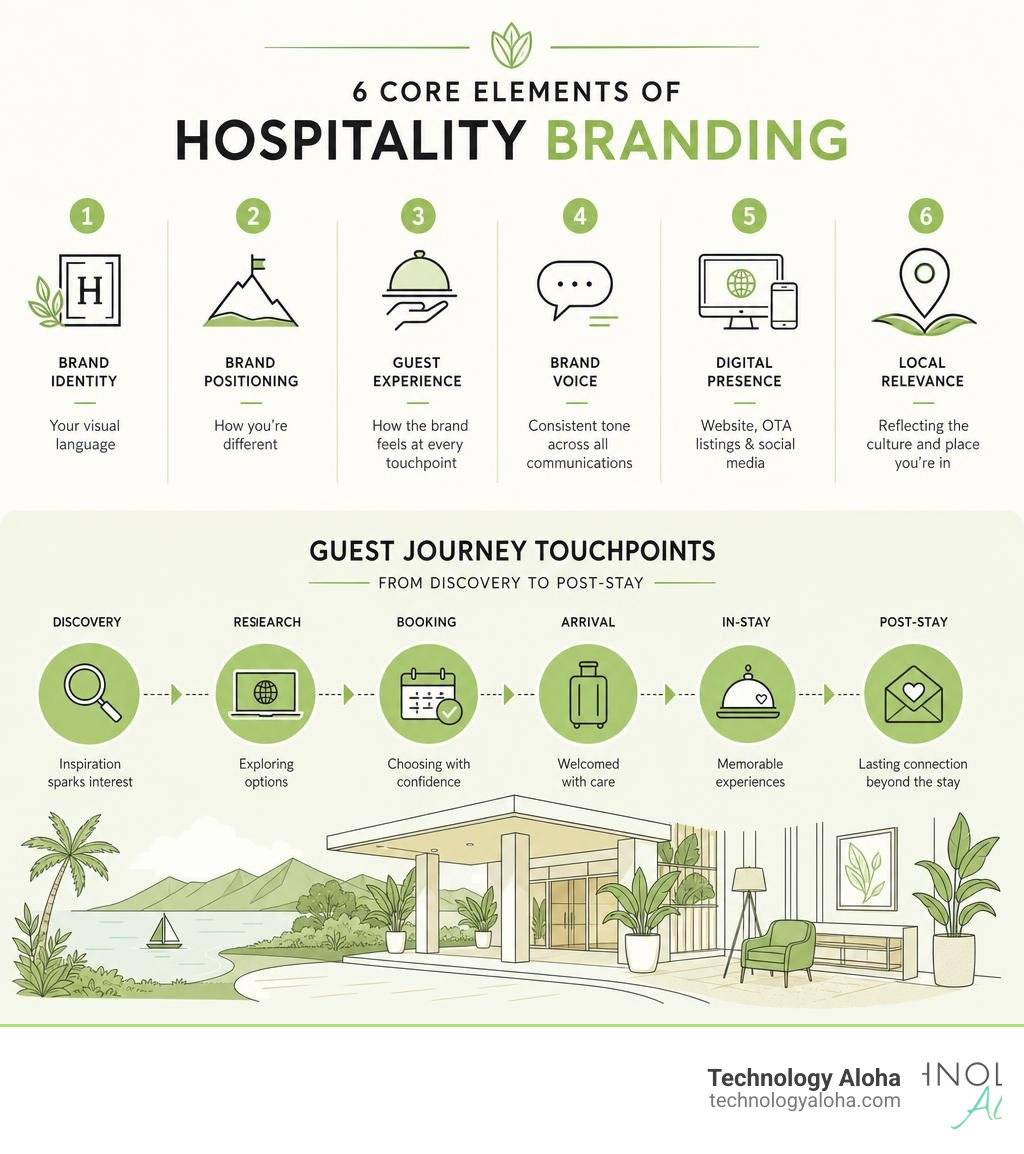
Here is a quick breakdown of what hospitality branding actually involves:
- Brand identity — your visual language (logo, colors, typography)
- Brand positioning — how you’re different from every other option
- Guest experience — how the brand feels at every physical and digital touchpoint
- Brand voice — the consistent tone across all communications
- Digital presence — your website, OTA listings, and social media
- Local relevance — how your brand reflects the culture and place it lives in
Why does this matter right now? The hotel market is increasingly commoditized. Properties offer similar amenities at similar price points. When everything looks the same, guests default to price — and that is a race no one wins.
Consider this: 60% of travelers begin their research online. That means your brand’s digital first impression is often your only first impression. And with 93% of perceived communication coming from non-verbal cues, your visual identity is doing most of the talking before a guest ever reads a word.
Strong branding is not a luxury reserved for five-star resorts. For small hospitality businesses competing in saturated markets, it is the difference between being remembered and being overlooked.
Why Branding for Hospitality Industry Dictates Market Survival
In a hyper-saturated market like Hawaii, survival requires distinct positioning. Without a clear brand, your property is just a commodity—a bed, a pool, a roof. Commodity businesses compete solely on price, which erodes profit margins and invites operational instability.
Effective branding acts as an insurance policy for your reputation. It builds customer trust, establishes competitive advantage, and drives direct bookings. When guests understand what you stand for, they bypass third-party booking channels to book directly with you. To understand how this fits into a broader business model, explore our guide on Branding Strategy 101.
A strong brand allows you to command premium pricing. Guests do not pay premium rates for real estate; they pay for how that real estate makes them feel. For a deeper look at this dynamic, read about The Power of Branding in the Hospitality Industry.
What is the difference between intangible experiences and tangible goods in branding?
Consumer branding sells physical products—a shoe, a beverage, a smartphone. Hospitality branding sells an experience. You are selling memories, emotional investment, and relationship intimacy. Because the product is intangible, the brand must work twice as hard to establish trust.
When a guest books a room, they are buying a promise of comfort, safety, and belonging. The delivery of that promise relies entirely on service delivery and human interaction. This is why a logo is never enough; your brand must live in the behavior of your staff. Learn more about this distinction in Small Business Branding and Positioning: Why Your Logo Is Not Your Brand.
| Brand Dimension | General Consumer Branding | Hospitality Branding |
|---|---|---|
| Product Type | Tangible goods (shoes, electronics) | Intangible experiences (stays, memories) |
| Purchase Driver | Utility, features, status | Emotional connection, trust, location |
| Key Touchpoint | The physical product itself | The guest journey and staff interactions |
| Loyalty Metric | Repeat purchases, product upgrades | Customer lifetime value, direct return bookings |
The Cost of Price Wars and Commoditization
When properties fail to differentiate, they enter a race to the bottom. Under-cutting competitor rates might fill rooms in the short term, but it destroys your Average Daily Rate (ADR) and Revenue Per Available Room (RevPAR) over time.
Once you train customers to buy from you based on discounts, you lose the ability to sell based on value. Branding breaks this cycle. By focusing on customer lifetime value rather than transactional volume, you build a loyal base that remains insulated from market price fluctuations.
Building Blocks of a Strong Hospitality Brand Identity
A cohesive brand requires structured development. You cannot build a memorable identity on guesswork. It requires brand architecture, clear brand guidelines, and an authentic brand narrative. If you are starting from scratch, consult The Ultimate Guide to New Brand Development.
Core Visual Elements of Branding for Hospitality Industry
Your visual elements are the sensory shorthand for your brand. They must communicate your positioning instantly.
- Typography: Fonts carry psychological weight. Elegant serifs suggest heritage and luxury, while clean sans-serifs communicate modern efficiency.
- Logo Design: A hotel logo must be scalable and versatile. It needs to look as striking on a tiny smartphone screen as it does embossed on a leather room key.
- Color Palette: Your colors dictate the mood. Ocean-front properties often leverage soft sand tones and deep blues to mirror their environment, while urban boutique hotels might use high-contrast monochrome palettes. Learn how to select your palette in Your Brand Colors Matter: How to Choose and What They Say About Your Organization.
Consistency across these elements is non-negotiable. To keep your team and vendors aligned, you must document these rules in a cohesive Brand Style Guide: Your Key to a Consistent Brand Image.
Sensory and Immersive Spatial Design
In hospitality, the brand must occupy physical space. The transition from your digital presence to your lobby must feel seamless.
This is achieved through immersive interior design, curated lighting, ambient soundscapes, and custom scents. Wayfinding and physical signage must also reflect your brand guidelines. When signage is cohesive, it guides guests effortlessly while subtly reinforcing your visual identity. For insights on how physical spaces bring brands to life, read how immersive brand identities power hotel design – Hotel Dive. To execute this in your physical layout, consider collaborating with experienced hospitality design and branding experts who understand how to translate brand values into physical environments.
Strategies for Differentiation and Emotional Connection
True differentiation lives in the emotional territory your brand claims. To uncover this, you must map the guest journey and design moments that surprise and delight.
Balancing Global Consistency with Local Relevance
For hospitality brands operating in culturally rich regions like Hawaii, localization is critical. Modern travelers reject generic, cookie-cutter experiences. They want to experience the authentic destination.
However, you must balance local cultural integration with global consistency. Your brand standards must remain intact while honorably showcasing local heritage. This means avoiding superficial clichés and instead focusing on deep cultural partnerships, local art, and indigenous design elements.

To understand how to build an authentic local brand identity, review the strategic frameworks outlined in the [PDF] A STUDY OF THE MADE IN HAWAI’I BRAND – Hawaii. You can also study resources from the Hawaii Tourism Authority: Hawaiʻi Tourism Authority and analyze how heritage properties like The Kahala Hotel & Resort: Luxury Hotel in Honolulu, Hawaii maintain luxury standards while celebrating host culture.
Crafting the Brand Voice and Narrative
Your narrative is the emotional glue of your brand. It defines your brand promise and tells guests why you exist. Your brand voice must remain consistent across your website, social media, confirmation emails, and in-room collateral. To refine your written identity, check out Branding Words: Build Connection and Engagement Into Your Brand.
For example, a boutique surf-lodge brand voice should feel warm, casual, and adventurous. A high-end luxury resort voice must remain polished, refined, and anticipatory.
The Digital Front Door: Websites and Mobile Presence
Your website is your digital lobby. If it is clunky, slow, or difficult to navigate, guests will assume your physical property is equally neglected.
With 60% of research starting online and mobile bookings dominating the landscape, mobile optimization is no longer optional. Your site must load instantly, display beautifully on mobile screens, and offer an intuitive user experience. For design best practices, refer to The Definitive Guide to Brand Identity Web Design.
Designing High-Conversion Digital Destinations
A high-performing hospitality website serves two masters: brand storytelling and conversion optimization.
- Direct Booking Engines: Your booking engine must be integrated seamlessly. If a guest is redirected to a generic, third-party-looking booking page, trust is broken, and abandon rates spike.
- OTA Optimization: While you want direct bookings, Online Travel Agencies (OTAs) are necessary for visibility. Optimize your OTA profiles with high-quality, brand-aligned imagery and consistent descriptions that drive users back to your main site.
- Digital Marketing: Coordinate your SEO, paid search, and social media to drive qualified traffic to your high-converting design. Discover how to align these elements in Mastering Brand Strategy and Development for Modern Marketing.
Real-World Success: Hospitality Rebranding Case Studies
Analyzing successful transformations reveals the direct correlation between strategic design and financial performance.

Sofitel’s Strategic Rebrand and Commercial Impact
In 2024, the global luxury brand Sofitel underwent a comprehensive brand refresh to reclaim its market position. The brand shifted its focus away from clichéd cultural stereotypes, reframing its heritage through modern, authentic human connections.
The results, documented in The Sofitel Rebrand case study, demonstrate the power of design:
- Revenue Growth: Achieved a 3.3% increase in total room revenue and a 3.1% increase in RevPAR.
- Pipeline Expansion: Experienced a 129% increase in its development pipeline (from 14 to 32 hotels).
- Digital Traffic: Gained a 612% increase in organic website traffic and added 700,000 new social media followers.
Cromlix Hotel’s Nature-Led Culinary Branding
When the luxury Cromlix Hotel sought to elevate its dining experience, they bypassed traditional heritage tropes. Instead, they built a curated brand ecosystem for their culinary spaces.
As detailed in the Cromlix Hotel’s Nature-Led Branding by Thissaway – Design Week, the agency used nature as a metaphor for growth and transformation. By creating distinct yet cohesive visual identities for each venue—using custom typography and organic color palettes—they strengthened the overall estate brand while giving each restaurant a unique voice.
Measuring Performance and Avoiding Common Pitfalls
Branding is a financial investment, and like any investment, it must be measured.
Measuring the ROI of Branding for Hospitality Industry
Track these key metrics to evaluate your branding efforts:
- Net Promoter Score (NPS): Measures guest loyalty and advocacy.
- Direct Booking Ratio: The percentage of bookings coming through your website versus OTAs.
- RevPAR & ADR: Financial indicators of your brand’s pricing power.
- Customer Lifetime Value (CLV): The total revenue generated by a guest over their relationship with your brand.
- Digital Analytics: Organic search growth, website conversion rates, and social media engagement.
Common Mistakes in Hospitality Brand Refreshes
Avoid these critical errors when updating your brand:
- Clichéd Visuals: Using generic local imagery (like generic palm tree silhouettes in Hawaii) that makes you blend in rather than stand out.
- Ignoring Staff Alignment: Failing to train your team on the new brand values. If your staff does not live the brand, the guest experience fails.
- Overcomplicating Brand Architecture: Creating too many sub-brands or venue identities that confuse the guest. Keep your portfolio clean and logical.
Frequently Asked Questions about Hospitality Branding
What is the difference between hotel branding and general consumer branding?
Consumer branding focuses on tangible product attributes and transactional loyalty. Hospitality branding focuses on intangible assets, relationship intimacy, and emotional investment. The “product” is an experience delivered by people, making service consistency a core brand component.
How often should a hospitality brand undergo a refresh?
Typically, a hospitality brand should undergo a minor refresh every 3–5 years to keep visual assets and digital experiences modern. A comprehensive brand repositioning is usually required every 7–10 years to adapt to shifting guest demographics and market trends.
How does local culture impact international hospitality branding?
Local culture provides the authenticity that modern travelers crave. International brands must practice localization—integrating local design, storytelling, and partnerships—while maintaining the operational consistency and quality standards of the global parent brand.
Conclusion
In the hospitality industry, your brand is your most valuable asset. It is the promise you make to your guests, the culture you build for your staff, and the shield that protects your business from price wars.
At Technology Aloha, we blend data-driven insights with cohesive branding and high-conversion web design to help hospitality businesses stand out and grow. Whether you are launching a new property or refreshing an established heritage brand, we can help you build an identity that connects with guests and drives direct bookings.
Ready to elevate your property’s presence? Get started with our branding services.