A – Z Guide to Keyword Advertising Plan for Small Business
Why Every Small Business Needs an Advertising Plan in 2026
An advertising plan for small business is a structured document that defines who you’re targeting, what channels you’ll use, how much you’ll spend, and how you’ll measure results — all tied directly to revenue goals.
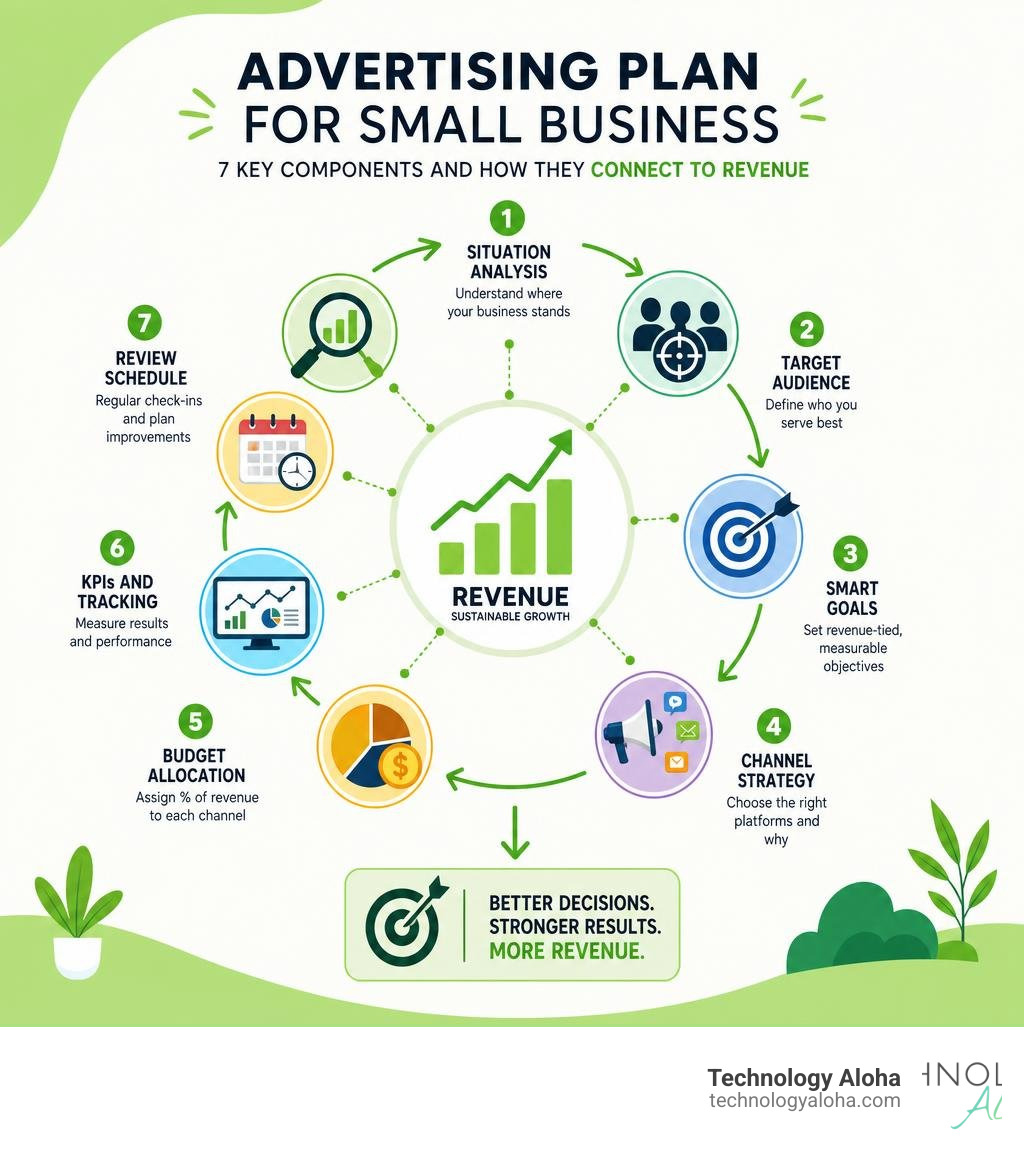
Here’s what a solid small business advertising plan covers:
- Situation analysis — where your business stands today (SWOT)
- Target audience — specific demographics and buyer personas
- SMART goals — revenue-tied, measurable objectives
- Channel strategy — which platforms get your budget and why
- Budget allocation — percentage of revenue assigned to each channel
- KPIs and tracking — how you’ll know if it’s working
- Review schedule — monthly check-ins, quarterly revisions
Most small businesses skip the plan entirely and guess where to spend their next dollar. That guessing is expensive.
The U.S. Small Business Administration recommends spending 7–8% of gross revenue on marketing for businesses earning under $5 million per year. Yet without a written plan, that budget tends to scatter across disconnected tactics — a few social posts here, a boosted ad there — with no clear way to measure what worked.
The result? Weak brand positioning, inconsistent messaging, and no real data to improve from.
This guide walks you through building an advertising plan from scratch — channels, budgets, goals, and measurement — using what actually works in 2026.
Advertising plan for small business basics:
- The Best Ways to Market Your Small Business for Success
- An Essential Guide to a Marketing Plan for Small Business
- The No-Nonsense Guide to Creating Your Small Business Market Strategy
Strategy vs. Plan: Defining the Roadmap
To build a high-performing advertising plan for small business, we must first clarify the difference between a marketing strategy and an advertising plan. Many business owners use these terms interchangeably, but doing so leads to operational confusion.
A marketing strategy is your long-term vision. It defines your brand’s identity, your unique value proposition, and your target market. It answers the why and the who.
An advertising plan is your tactical roadmap. It outlines the specific campaigns, budgets, platforms, timelines, and creative assets you will use to execute that strategy. It answers the how, when, and how much.
Without a clear strategy, your advertising plan has no direction. Without an advertising plan, your strategy is just wishful thinking. To build a solid foundation first, refer to The No-Nonsense Guide to Creating Your Small Business Market Strategy.
Why You Need a Structured Advertising Plan for Small Business
Running campaigns without a written plan is the fastest way to waste your marketing dollars. When we work with small businesses in Hawaii, we often see owners fall victim to “shiny object syndrome”—jumping onto every new social media platform or running ad-hoc promotions because a competitor did. This disjointed approach confuses your target audience and dilutes your brand consistency.
A structured plan protects your business in three specific ways:
- Prevents Scope Creep: It acts as a reference point to evaluate new opportunities. If a new ad platform doesn’t align with the goals in your plan, you don’t spend money on it.
- Ensures Consistent Messaging: Your audience needs multiple touchpoints before making a purchase. A plan ensures your message remains identical across search engines, social media, and email.
- Simplifies Resource Allocation: When you know exactly what assets you need weeks in advance, you can plan your creative production without last-minute panic.
For a deeper dive into organizing these assets, check out An Essential Guide to Marketing Plan for Small Business.
Essential Components of an Advertising Plan for Small Business
An effective plan does not need to be a hundred pages long. In fact, a lean, actionable document is far more valuable for a busy small business owner.

Every successful plan must include these core elements:
- Situation Analysis (SWOT): Honestly assess your Strengths, Weaknesses, Opportunities, and Threats. For local Hawaii businesses, look at geographic constraints, shipping costs, and local tourism trends.
- Target Market Demographics & Personas: Define exactly who buys from you. Don’t just list “people aged 25–54.” Define their specific pain points, location, and online behaviors.
- Competitive Profile: Identify your top 3–5 direct competitors. What are they offering? Where are they advertising? You can use public ad libraries to study their active campaigns.
- Unique Selling Proposition (USP): Why should a customer choose you over a competitor? Your USP must be clear, compelling, and easy to communicate in a two-second ad headline.
To ensure your plan aligns with federal guidelines and local business standards, review the official resources on Marketing and sales | U.S. Small Business Administration – SBA .
Setting SMART Goals Tied to Revenue
Vague goals like “get more exposure” or “increase brand awareness” are impossible to measure. Your advertising plan must rely on SMART (Specific, Measurable, Achievable, Relevant, Time-bound) objectives that connect directly to your financial targets.
To set these goals, you must work backward from your revenue targets using lead generation math.
Let’s look at a concrete example:
- Your Revenue Goal: $100,000 in new sales over the next quarter.
- Average Deal Value: $10,000. This means you need 10 closed sales.
- Sales Close Rate: If your sales team closes 10% of qualified leads, you need 100 qualified leads to secure those 10 sales.
- Lead Conversion Rate: If your landing page converts 5% of visitors into leads, you need 2,000 website visitors directed to that page from your ads.
By breaking your revenue goals down into specific traffic and lead targets, you can determine exactly how much ad spend is required to achieve your business outcomes.
High-ROI Channels and Budget Allocation in 2026
The most competitive small businesses in 2026 do not rely on a single marketing channel. According to recent industry data, multi-channel marketing campaigns report significantly better outcomes than single-channel efforts. However, this does not mean you should spread your budget across every platform.
The goal is to build a highly targeted digital roadmap. To see how these channels fit together, read Where to Advertise Your Small Business Online: A Digital Roadmap and explore 7 Advertising Strategies You Need to Add to Your Marketing Plan.
How to Fund Your Advertising Plan for Small Business
To build your budget, start with the percentage-of-revenue method. Gartner’s 2026 CMO Spend Survey reports that the average marketing budget across businesses is 7.7% of gross revenue. The SBA similarly recommends 7–8% for small businesses earning under $5 million.
If you are launching a new product or entering a highly competitive local market, you may need to increase this percentage temporarily. However, if you are working with a tight budget, you can still achieve measurable results.
For a step-by-step guide on starting small, read How to Advertise Your Business with a $500 Budget .
When launching new campaigns, we recommend establishing a minimum viable test budget to gather baseline data before scaling. For Google Search Ads, a practical minimum is $500–$800 per month. For Meta Ads, aim for $300–$500 per month. This ensures the platform algorithms have enough conversion data to optimize your campaigns.
Selecting the Right Digital Platforms
Different platforms serve different stages of the customer buying journey. To maximize your ROI, you must match your campaign goals to the correct platform mechanics.
| Platform | Primary Intent | Best For | Average CPC (2026) |
|---|---|---|---|
| Google Search Ads | High Intent (Active Search) | Direct conversions, local services, immediate needs | $5.26 |
| Meta Ads (FB/IG) | Discovery & Demographics | Brand awareness, visual products, audience building | $0.80 – $2.50 |
| Google Local Service Ads | Hyper-Local Verification | Plumbers, HVAC, local professional services | Pay-per-lead (varies) |
For a comprehensive breakdown of digital ad strategies, check out the Online Advertising for Small Business: 2026 Playbook .
If you want to start with social media advertising, make sure you understand the core mechanics first. Read Considering Advertising on Social Media? Learn the Basics Today and utilize our Facebook Ads: Helpful Tips and Tricks to avoid common setup mistakes.
The Rise of AI-Powered Advertising
In 2026, artificial intelligence has completely transformed how small businesses advertise. The federal AI for Main Street Act has made AI literacy training highly accessible through local Small Business Development Centers (SBDCs). This legislation provides tax incentives for small businesses adopting AI-powered tools, allowing local shops to compete directly with national brands.
One of the biggest shifts in 2026 is the introduction of conversational ads, such as ChatGPT ads. Unlike traditional Google keyword targeting, conversational advertising relies on contextual targeting. Your business is surfaced naturally inside a user’s conversation when they ask for recommendations or research solutions.
To succeed with AI-driven ad platforms, your focus must shift toward input asset quality. AI systems amplify what you feed them. If you provide generic headlines and poor imagery, the AI will generate low-performing campaigns at high speeds.
To stand out, you must feed the algorithms high-impact, creative inputs. Learn how to do this by reading Stop Being Boring with High-Impact Digital Ads.
Measuring Campaign Success and ROI
You cannot manage what you do not measure. To keep your advertising plan for small business profitable, you must move away from vanity metrics—like social media impressions, views, or clicks—and focus on metrics that impact your bottom line.

Set up a tracking dashboard that monitors these key performance indicators (KPIs) weekly:
- Return on Ad Spend (ROAS): Your total ad revenue divided by your total ad spend. If you spend $1,000 and generate $5,000 in sales, your ROAS is 5:1.
- Cost Per Acquisition (CPA): How much it costs to acquire a single paying customer.
- Cost Per Lead (CPL): The total cost of your campaign divided by the number of leads generated.
- Conversion Rate: The percentage of ad clickers who complete your target action (e.g., filling out a contact form or making a purchase).
Before spending a single dollar on ads, make sure you have conversion tracking properly installed on your website using Google Analytics 4 and the Meta Pixel. Without this infrastructure, you are flying blind. For a complete guide to setting up these tracking systems, read The Small Business Guide to Digital Marketing Success.
Common Mistakes That Waste Your Budget
Over our years of helping Hawaii businesses grow, we have identified several recurring mistakes that can quickly drain your ad budget:
- Spreading Your Budget Too Thin: Many business owners try to advertise on five different platforms with a small budget. This results in insufficient data on every platform. It is far better to dominate one or two channels before expanding.
- Setting Unmeasurable Goals: Running ads to “get your name out there” makes it impossible to calculate your return on investment. Every campaign must have a single, trackable conversion goal.
- Ignoring Email Marketing: Paid ads are excellent for acquiring traffic, but email marketing is where you nurture those leads into lifelong customers. In 2026, email marketing remains the highest-ROI channel available, returning an average of $36 for every $1 spent.
- “Set It and Forget It” Campaigns: Ad platforms are not set-and-forget systems. Creative ad copy decays over time, search terms change, and competitor bids shift. You must monitor your search term reports weekly to add negative keywords and pause underperforming creatives.
For fresh, engaging ways to keep your campaigns active and profitable, read New Marketing Ideas for Small Business Owners Who Hate Boring Ads.
Frequently Asked Questions About Small Business Advertising
What is the highest-ROI marketing channel for small businesses?
Consistently, email marketing delivers the highest return on investment for small businesses, averaging a $36 return for every $1 spent. While paid advertising is essential for bringing new visitors into your funnel, email marketing allows you to retain those customers and drive repeat purchases at almost zero additional cost. Direct customer engagement through an opt-in newsletter is one of the most valuable assets a small business can own.
How much should a small business spend on marketing?
The general industry benchmark is to allocate 7% to 8% of your gross revenue to marketing, as supported by the SBA and Gartner’s 2026 CMO Spend Survey. However, this budget must remain flexible. If you are a brand-new business in Kahului or Maui looking to establish your presence, you may need to invest a higher percentage initially. If you are an established business with strong organic search traffic, you can focus your budget on highly targeted retargeting campaigns to maximize efficiency.
How often should a small business review and update its marketing plan?
We recommend a three-tiered review schedule to keep your plan aligned with market changes:
- Weekly: Review campaign-level metrics (CTR, CPL, search terms) to pause underperforming ads and adjust keyword bids.
- Monthly: Review overall KPIs (ROAS, CPA, conversion rates) against your quarterly revenue targets.
- Quarterly: Revise your tactical calendar, reallocate budgets between channels based on performance, and adjust your messaging to account for seasonal trends.
If you are looking for local business development support and educational programs in Hawaii to help build your plan, explore the Business Resources – Patsy T. Mink Center for Business & Leadership or check out the Small Business Suite | University of Hawaii, Maui College … – Ed2Go . For general local business tips, see Tips on how to market your small business | KHON2 .
Take Action on Your Advertising Plan Today
Building a successful advertising plan for small business requires a careful blend of strategic positioning, cohesive branding, and data-driven insights. In 2026, you cannot rely on guesswork or boring, generic ads to grow your business. You need a system that targets the right audience, tracks every dollar, and optimizes for real revenue.
At Technology Aloha, based in Kahului, Maui, HI, we specialize in helping small businesses build high-conversion digital marketing systems that drive measurable growth. We combine data-driven insights with beautiful, user-centric web designs to ensure your paid traffic turns into paying loyal customers.
If you are ready to stop guessing and start scaling your business with a custom, high-ROI advertising plan, explore our marketing strategy services today. Let’s build a clear roadmap to your business success together.