What a Digital Marketing Plan for Small Business Actually Is (And Why You Need One)
A digital marketing plan for small business is a documented strategy that defines your goals, identifies your audience, selects your channels, and sets the metrics you’ll use to measure success.

Here’s the short version of what a solid plan covers:
- Goals — What you’re trying to achieve (e.g., grow leads by 50%, increase online sales 30% year-over-year)
- Audience — Who you’re targeting and where they spend time online
- Channels — SEO, content, social media, email, and/or paid ads
- Budget — How much you’re allocating and to what
- Metrics — How you’ll know if it’s working (traffic, conversions, ROI)
Most small business owners are running marketing on instinct — scattered posts, a website that isn’t converting, and no clear picture of what’s actually driving revenue. That’s not a plan. That’s guesswork with a logo.
The gap between businesses that grow predictably and those that plateau is almost always strategic. Not budget. Not team size.
Digital marketing levels the playing field. A small business with a clear plan can outmaneuver a larger competitor through precise targeting, smarter content, and channels chosen for the right reasons — not just because everyone else is on them.
This guide walks you through every step: from setting goals and defining your audience, to choosing channels, measuring results, and optimizing for ROI.
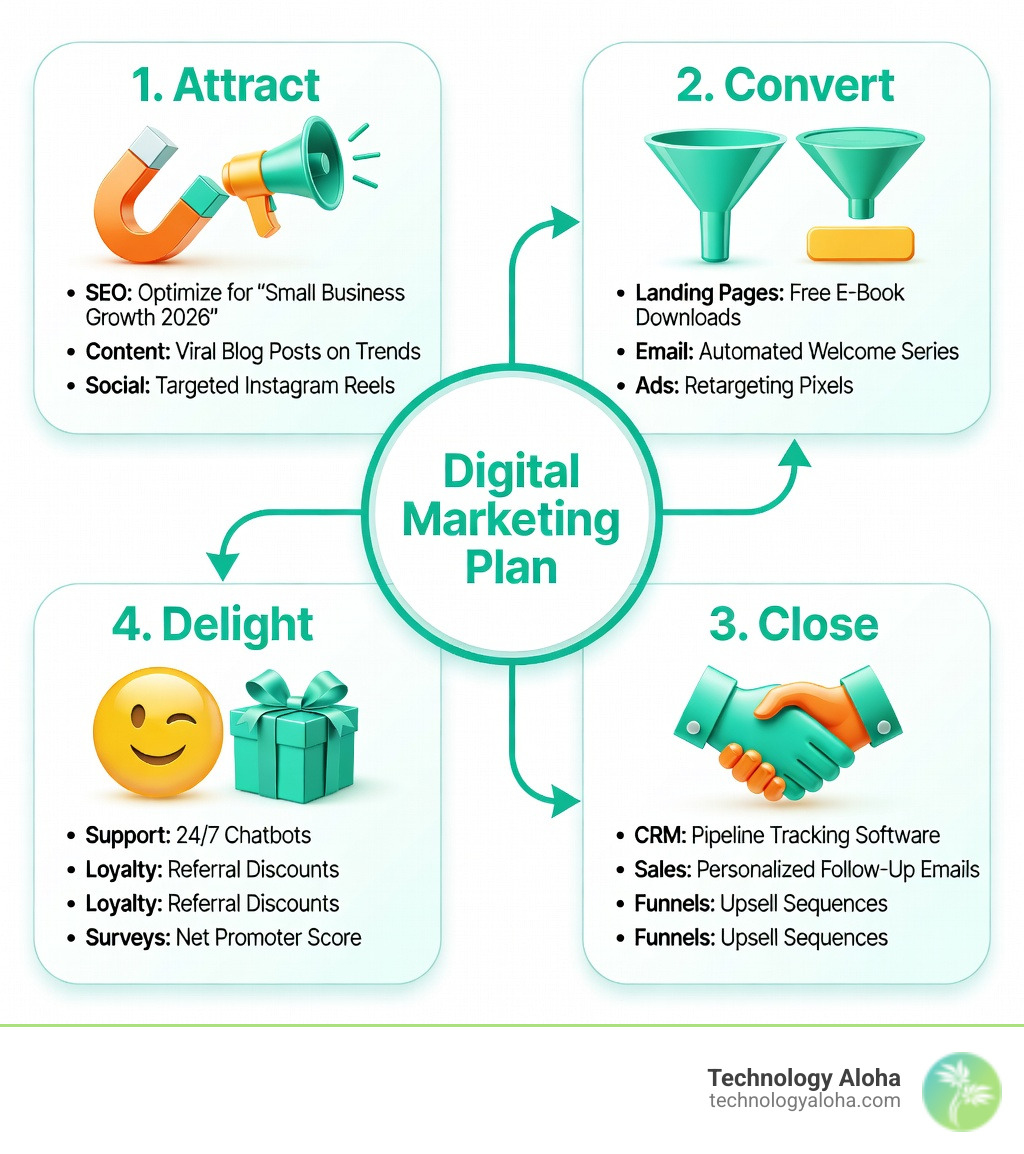
Why Your Small Business Needs a Digital Marketing Plan

The most common reason marketing fails isn’t a lack of effort—it’s a lack of alignment. Without a plan, you are effectively throwing spaghetti at a digital wall and hoping something sticks.
Strategy vs. Tactics
A tactic is a blog post. A strategy is knowing why you are writing that post, who needs to read it to solve a specific problem, and how that reader eventually becomes a client. Tactics without strategy are just noise. A digital marketing plan for small business ensures that every dollar spent and every hour worked moves the needle toward your primary business objectives.
Brand Engagement and Competitive Advantage
Digital marketing allows you to connect personally with your community. While giant corporations have massive budgets, they often lack the agility and local touch of a small business. By leveraging strategic positioning and branding, you can differentiate yourself in a crowded market.
The Math of Marketing: CAC and LTV
To run a sustainable business, you must understand two numbers:
- Customer Acquisition Cost (CAC): The total marketing spend divided by the number of new customers acquired.
- Lifetime Value (LTV): The total revenue a customer generates for your business over the duration of your relationship.
If your CAC is higher than your LTV, you don’t have a marketing problem; you have a math problem. A solid plan helps you build a successful marketing process that keeps these numbers in balance, ensuring your growth is profitable, not just busy.
Building the Foundation: Goals, Audience, and Analysis
Before you open a social media app or buy an ad, you need a foundation built on data, not assumptions. This requires a cold, hard look at where your business stands and where you want it to go.
| Metric | Business Impact | How to Measure |
|---|---|---|
| Conversion Rate | High: Directly impacts revenue and ROI | Google Analytics 4 (GA4) |
| Cost Per Lead | Medium: Determines efficiency of ad spend | Ad platform dashboards |
| Organic Traffic | High: Long-term sustainability and brand authority | Google Search Console |
| Email Open Rate | Medium: Measures audience engagement and trust | ESP (Mailchimp, Klaviyo, etc.) |
Setting SMART Goals for Your Digital Marketing Plan for Small Business
Vague goals like “get more customers” are impossible to track. Instead, use the SMART framework. Your goals must be:
- Specific: Targeted at a specific area for improvement.
- Measurable: Quantifiable (e.g., “increase leads by 20%”).
- Achievable: Realistic based on your current resources.
- Relevant: Aligned with your overall business objectives.
- Timely: Tied to a deadline.
SMART goals allow you to break a 12-month roadmap into manageable 90-day sprints. For example, a local service provider might aim to “increase website inquiries by 15% by the end of Q2 through local SEO and Google Business Profile optimization.”
Defining Your Target Audience and Buyer Personas
You cannot market to “everyone.” If you try, you’ll end up marketing to no one. You need to create 2–3 buyer personas—fictional representations of your ideal customers based on real data.
Look at your current customer list. What are their demographics (age, location, income)? More importantly, what are their psychographics? What are their pain points? What keeps them up at night? For a homeowner in Maui, the pain point might be finding a reliable contractor who actually shows up on time. By mapping the customer journey, you can identify the exact moment they start looking for a solution and ensure you are there to meet them.
Conducting a SWOT Analysis and Competitor Audit
A SWOT analysis (Strengths, Weaknesses, Opportunities, Threats) provides a clear picture of your market position.
- Strengths: What do you do better than anyone else? (e.g., “Our 24-hour response time.”)
- Weaknesses: Where do you struggle? (e.g., “Our website takes 6 seconds to load.”)
- Opportunities: Are there gaps in the local market? (e.g., “A new housing development in Kahului needs our services.”)
- Threats: What external factors could hurt you? (e.g., “A large national chain just opened a branch nearby.”)
Pair this with a competitor analysis. Analyze at least four rivals. Look at their price points, their reputation, and their USPs. This helps you define your own Unique Selling Proposition (USP)—the specific reason a customer should choose you over the person down the street.
Executing the Digital Marketing Plan for Small Business: Key Levers
Once the foundation is set, it’s time to pull the “levers” that drive growth. These levers must work together to create a cohesive brand experience. The most important aspects of digital marketing are consistency and relevance.
Search Engine Optimization (SEO) and Content Strategy
SEO is your long-term growth engine. It’s about building authority so that when someone searches for your services, you appear at the top.
- Long-tail Keywords: Instead of trying to rank for “marketing,” aim for “digital marketing plan for small business in Hawaii.” These have lower competition and higher intent.
- Technical SEO: If your site takes longer than 3 seconds to load, you are losing leads. Google penalizes slow sites, and users won’t wait. Use tools like PageSpeed Insights to check your speed.
- Mobile Optimization: Over 50% of website traffic is now mobile. If your site looks terrible on a phone, your marketing plan is already failing.
- Content Marketing: Don’t just blog for the sake of blogging. Develop a solid content marketing plan that uses a “pillar and cluster” strategy to build topical authority.
Social Media, Email Marketing, and Paid Advertising
- Social Media: Treat social media as a community engagement tool, not a billboard. Pick 1–2 platforms where your audience actually hangs out (e.g., Facebook for local services, Instagram for visual brands) and post 3–5 times a week.
- Email Marketing: Your email list is one of your most valuable assets because you own it. Use lead magnets like a “Small Business SEO Checklist” to grow your list, then use automation to nurture those leads.
- Paid Advertising (PPC): Paid ads are like a faucet—you can turn them on for immediate traffic. However, without a strategy, you’ll burn through your budget. Start with small tests to find “winning” ad creative before scaling.
Common Mistakes in a Digital Marketing Plan for Small Business
These errors occur frequently:
- Targeting broad keywords: You can’t outspend the giants on generic terms.
- Thin content: Writing 300-word fluff pieces that don’t answer customer questions.
- Ignoring mobile users: Not testing your site on multiple devices.
- Fragmented messaging: Having a different “voice” on Facebook than you do on your website.
- Lack of tracking: Not knowing where your leads are coming from.
Measuring Success and Optimizing for ROI
You cannot manage what you do not measure. A digital marketing plan for small business is a living document that must be adjusted based on performance data.
Google Analytics 4 and UTM Tracking
Install Google Analytics 4 immediately. It’s free and tells you exactly who is visiting your site and what they are doing there. To get even more granular, use UTM tracking codes for your email and social media links. This allows you to see exactly which specific email or post generated a sale.
Conversion Rate Optimization (CRO) and A/B Testing
If you have high traffic but low sales, you have a conversion problem. This usually signals friction in the checkout process or a lack of trust signals on your site. Use Hotjar or Microsoft Clarity to see where users are getting stuck. Run A/B tests on your headlines and CTAs (Call to Action) to see what resonates best with your audience.
Calculating ROI
To calculate your ROI, use this simple formula: ROI = (Revenue – Marketing Cost) / Marketing Cost.
If you spend $1,000 on ads and generate $5,000 in revenue, your ROI is 400%. Regularly reviewing these numbers allows you to cut the underperforming channels and double down on the ones that work.
Frequently Asked Questions about Digital Marketing Plans
How long does it take to see results from a digital marketing plan?
For SEO and content marketing, expect to see meaningful results in 3–6 months. Paid advertising (PPC) can show results in days, but it takes a few weeks of testing to optimize for the best ROI. Marketing is a marathon, not a sprint.
What is a realistic budget for a small business marketing strategy?
While there is no one-size-fits-all answer, many small businesses allocate 7–10% of their gross revenue to marketing. However, if you are in a high-growth phase, you may need to invest more. The key is to start with what you can afford and scale based on proven ROI.
How do I track ROI if I have a limited budget for tools?
You don’t need expensive software to start. Google Analytics 4 and Google Search Console are free. Most social media platforms and email service providers (like Mailchimp) have built-in analytics that provide excellent insights into engagement and click-through rates.
Conclusion
A digital marketing plan for small business isn’t a luxury; it’s a necessity for survival and growth. By setting SMART goals, deeply understanding your audience, and choosing the right levers, you move from reactive “guesswork” to proactive, data-driven growth.
A digital presence should be a small business’s hardest-working employee, blending cohesive branding with high-conversion designs. Small businesses deserve insights tailored to their unique needs, whether located in Kahului or anywhere else in Hawaii.
Ready to stop guessing and start growing? Build a professional marketing strategy today. Turn your vision into a measurable roadmap for success.