The Complete Guide to Understanding the 4 Stages of Marketing Planning
Why Strategic Discipline Matters in Business Growth
Running a business or nonprofit without a structured marketing plan creates chaotic decision making. Teams jump directly to tactical execution—launching social media campaigns, designing flyers, or buying ad space—without confirming whether those activities align with business realities or financial goals. Strategic discipline transforms isolated promotional efforts into a predictable growth engine.

Data shows that organizational success hinges on systematic planning and tracking. According to research from Hinge Marketing, firms that track marketing key performance indicators (KPIs) and return on investment (ROI) are far more likely to experience high top-line growth (20% or greater) and maintain high profitability (25% or greater). Furthermore, organizations that conduct systematic audience research at least once per year grow faster and achieve higher profit margins than those relying on internal assumptions.
Establishing a formal roadmap through An Essential Guide to Marketing Plan for Small Business ensures that financial and human resources go toward verified market opportunities. A disciplined process prevents resource waste, establishes operational accountability across teams, and provides clear benchmarks for measuring commercial performance.
The 4 Stages of Marketing Planning Process Breakdown
The 4 stages of marketing planning process break high-level business goals into manageable operational steps. By moving sequentially from diagnosis to evaluation, organizations prevent premature strategy choices and misaligned spending.
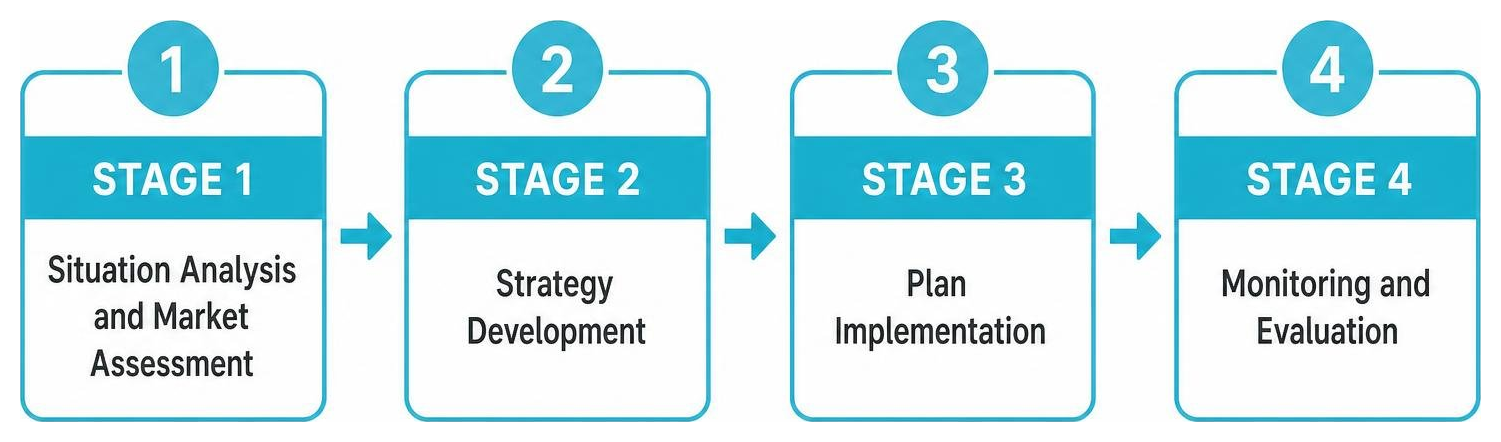
This framework operates as a continuous planning hierarchy. Each stage directly informs the next, creating a clear strategic roadmap that guides daily operations and long-term expansion.
Stage 1: Situation Analysis and Market Assessment
Before deciding where an organization should go, leaders must conduct an honest evaluation of where it currently stands. Stage 1 examines internal capabilities, audience behaviors, competitor actions, and macro-environmental forces. Skipping this stage leads to misdiagnosed problems—such as treating a conversion drop as an awareness issue when the true cause is product pricing or friction on a donation page.

A thorough situation analysis includes several key frameworks:
- Internal Audit: Evaluate past campaign performance, team bandwidth, technological stack, budget constraints, and current customer retention metrics.
- External Market Assessment: Map demographic trends, economic conditions, and shifting consumer behaviors using primary and secondary sources, such as Marketing Planning Research.
- SWOT Framework: Synthesize internal Strengths and Weaknesses against external Opportunities and Threats to uncover immediate strategic focus areas.
- Competitor Profiling: Analyze direct and indirect competitors within your target market segment to identify messaging gaps, pricing differences, and market opportunities.
- Customer Persona Mapping: Document target audience pain points, buying triggers, media consumption habits, and decision timelines.
Stage 2: Setting Objectives and Target Audience Selection in the 4 Stages of Marketing Planning Process
With situational data established, Stage 2 defines specific outcomes and identifies the exact audience segments required to achieve them. Vague goals like “build brand awareness” fail to provide execution clarity. Instead, use the SMART framework to set specific, measurable, achievable, relevant, and time-bound goals.
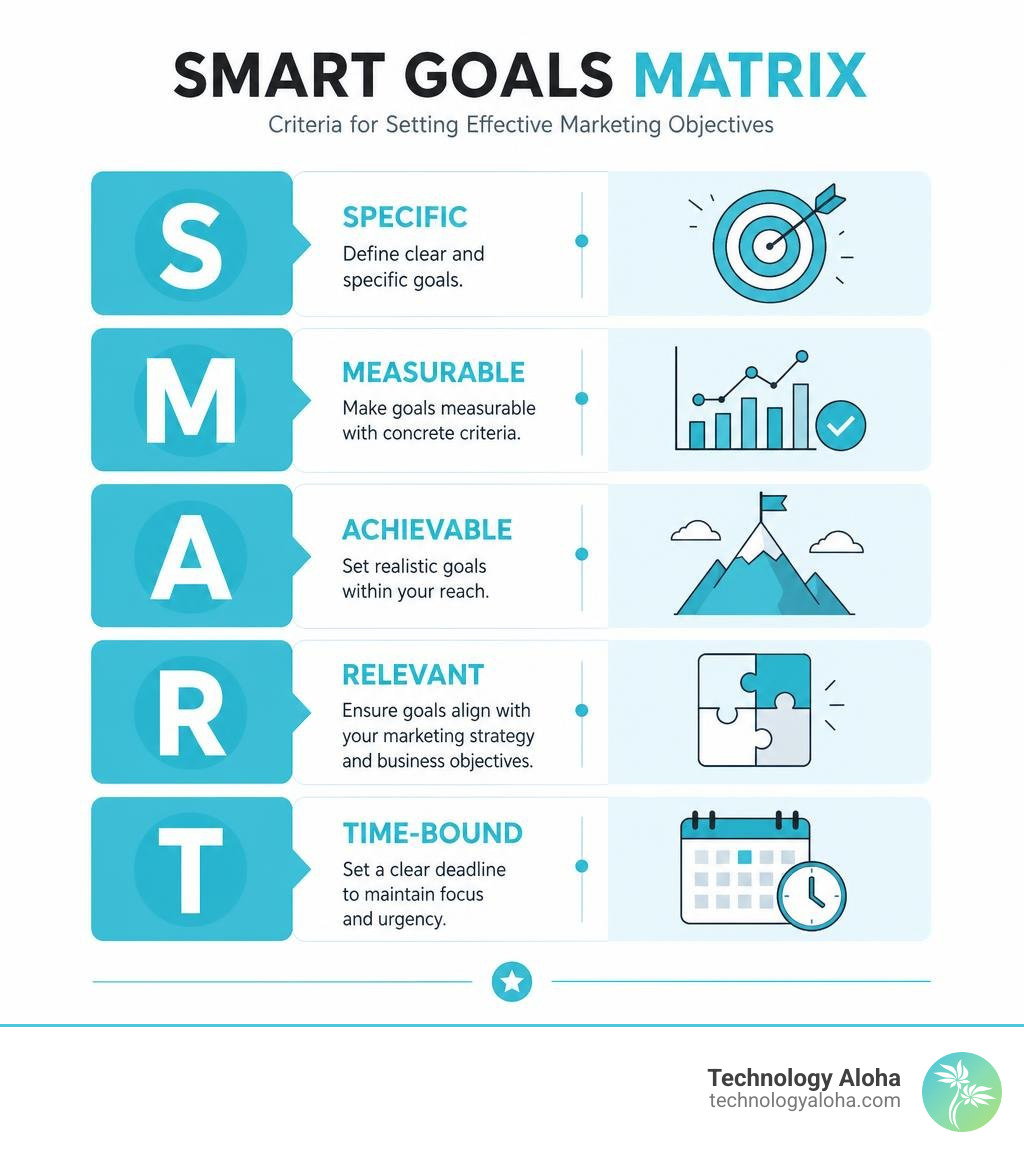
SMART objectives establish explicit operational targets, such as increasing qualified website lead volume by 35% within six months or growing recurring donor registrations by 20% by Q4. These objectives direct target market selection and segmentation.
Attempting to appeal to everyone dilutes brand messaging and wastes budget. Market segmentation categorizes broad audiences into specific groups based on geographic, demographic, psychographic, and behavioral criteria. Once segmented, teams select primary target audiences based on commercial value, accessibility, and strategic fit. Defining these parameters early lays a strong foundation for operational execution, as detailed in How to Build a Successful Marketing Process.
Stage 3: Developing Strategy and the Marketing Mix
Stage 3 translates target audience insights and strategic goals into action. Strategy formulation establishes brand positioning—how the business intends to differentiate its offerings in the target audience’s mind relative to alternative options.
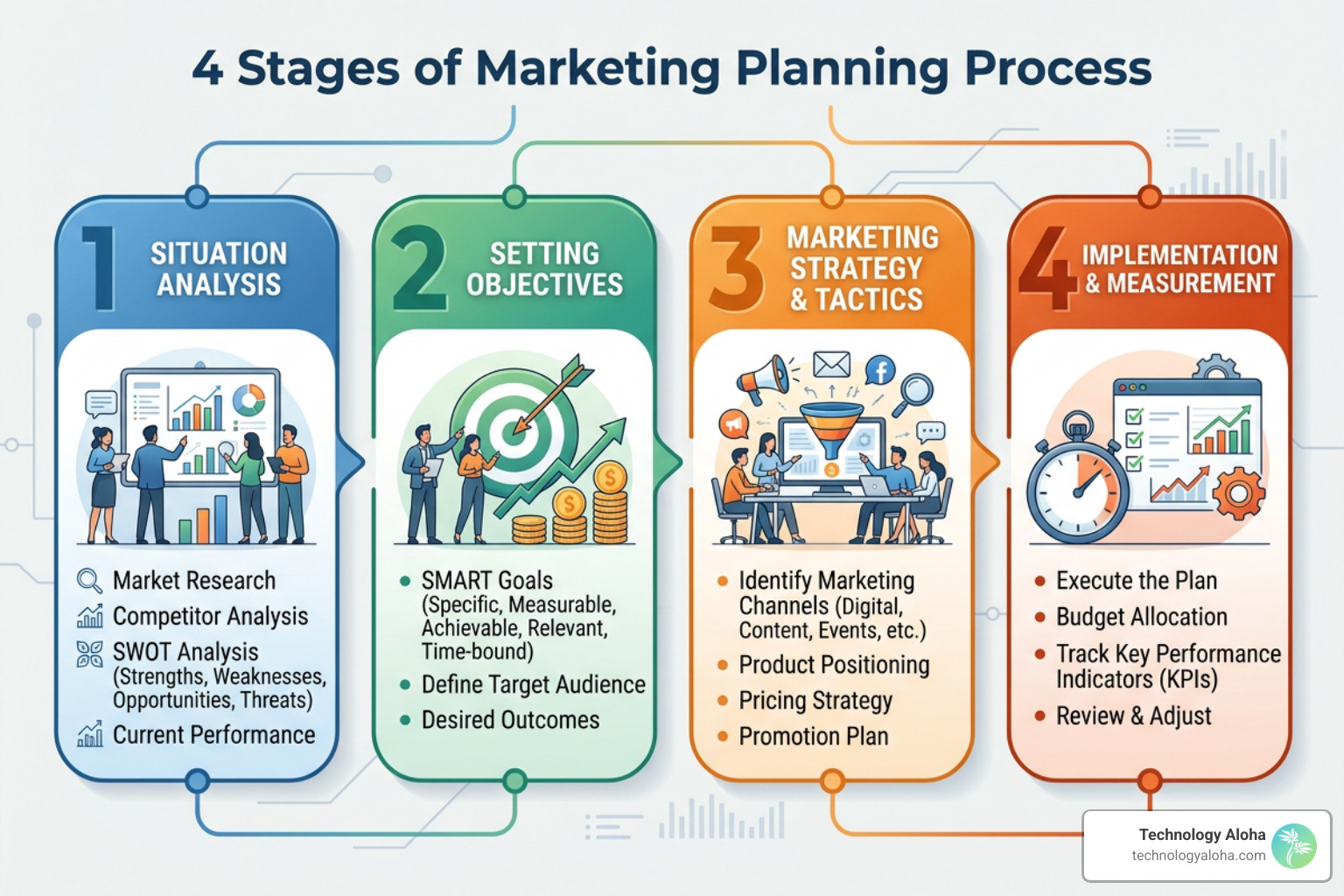
The tactical engine of this stage is the classic marketing mix (the 4 Ps):
- Product: Define the specific core offering, service structure, packaging, and unique value proposition that solves target audience problems.
- Price: Set pricing or donation capture models based on market positioning, customer willingness to pay, competitor benchmarks, and margin targets.
- Place (Distribution): Determine the online and offline channels where target customers purchase offerings or engage with content.
- Promotion: Build an integrated communications strategy across paid, earned, and owned channels to guide audiences through the sales or donation funnel.
During this stage, teams allocate marketing budgets using task-related budgeting methods, linking every line-item cost back to specific sub-objectives. Frameworks like The Five Levels of Marketing emphasize documenting these elements in detail to align sales pipelines with operational capabilities.
Stage 4: Execution, Monitoring, and Evaluation in the 4 Stages of Marketing Planning Process
A marketing strategy remains purely theoretical until executed, monitored, and refined. Stage 4 puts the plan into production while creating continuous operational feedback loops to monitor execution quality and spend burn rates.
Successful execution requires establishing clear project timelines, assigning clear task owners across teams, and setting up centralized analytics dashboards. Teams monitor leading performance indicators—such as website traffic, click-through rates, and landing page conversion rates—to make timely optimizations.
Tracking requires multi-channel marketing attribution models to understand how various customer touchpoints contribute to ultimate conversions. When performance metrics fall short of strategic benchmarks, teams pivot tactics rather than abandoning the core strategy prematurely. Step-by-step launch guidance can be reviewed in How to Create a Marketing Strategy for Your New Business.
Comparing the 4-Stage Model to Multi-Step Frameworks
While the 4-stage marketing planning process offers a clean, foundational lifecycle, other methodologies break planning down into 7-step, 8-step, or 9-step sequences. Expanded models do not replace the 4-stage process; instead, they break down its primary stages into granular steps for larger teams or highly complex operational environments.
| Framework | Core Focus Areas | Best Suitable For | Operational Pros & Cons |
|---|---|---|---|
| 4-Stage Process | Situation Analysis, Objectives/Segmentation, Strategy/Marketing Mix, Execution/Evaluation | Small businesses, nonprofits, agile marketing departments | Pros: Clear, adaptable, simple to govern. Cons: Requires internal definition of sub-steps. |
| 7-Step Model | Audit, Personas, Positioning, Offerings, Channel Selection, Infrastructure, Calendar/Budget | B2B professional services, complex client offerings | Pros: Direct alignment with service sales cycles. Cons: Heavy operational overhead. |
| 9-Step Model | Audit, Research, Personas, Messaging, Goals, Agile Budgeting, Campaigns, Timeline, Review | Enterprise corporations, large cross-functional teams | Pros: Advanced financial spend controls. Cons: Extended planning timelines (4–8 weeks). |
Smaller organizations often find that multi-step models introduce unnecessary administrative overhead without adding strategic value. The classic 4-stage process delivers an ideal balance of strategic discipline and execution speed.
Common Pitfalls to Avoid in Marketing Planning
Even structured marketing plans fail when teams make execution and sequencing errors. Identifying common planning traps allows leadership teams to build safeguards into their operational processes.

Watch out for these planning mistakes:
- Premature Budget Allocation: Setting channel budgets before defining strategic goals forces teams to build plans around arbitrary financial constraints rather than market opportunities.
- Vague, Non-Measurable Goals: Objectives like “increase brand visibility” lack clear benchmarks, making campaign evaluation and accountability impossible.
- Channel Bias and Tactical Rush: Selecting tactics (e.g., launching short-form video campaigns) based on personal preference rather than target audience channel habits.
- Audience Over-Generalization: Attempting to reach all market segments with generic messaging dilutes campaign relevance and inflates acquisition costs.
- Ignoring Marketing Infrastructure: Launching demand generation campaigns without functional CRM systems, tracking tags, or conversion-optimized landing pages leads to lost opportunities.
Frequently Asked Questions about Marketing Planning
How long does it take to see ROI from a marketing plan?
Realizing a measurable return on investment from a marketing strategy typically takes between 6 and 12 months. Early campaign phases focus on audience research, infrastructure setup, channel testing, and content indexing.
While short-term performance tactics (such as paid search) can generate immediate conversions, sustainable top-line revenue growth and brand equity require sustained campaign execution over multiple quarters.
What is the difference between a marketing plan and a marketing strategy?
A marketing strategy defines the long-term strategic choices that drive brand growth—including target customer profiles, brand positioning, and unique value propositions.
A marketing plan is the operational roadmap that translates that strategy into action. It documents specific campaign tactics, channel selection, execution timelines, resource allocations, line-item budgets, and performance measurement frameworks.
How often should a business update its marketing plan?
Organizations should maintain a living planning cycle using a structured review cadence:
- Quarterly Reviews: Evaluate campaign KPIs, track budget burn rates, test tactical messaging, and adjust channel allocations based on performance data.
- Annual Plan Updates: Conduct comprehensive situational audits, re-examine target buyer personas, update strategic objectives, and build operational plans for the upcoming fiscal year.
- Real-Time Pivots: Adjust plans immediately when external disruptions occur—such as sudden shifts in customer demand, economic volatility, or new competitive threats.
Conclusion
Mastering the 4 stages of marketing planning process equips organizations with a strategic roadmap for sustainable commercial growth. Moving sequentially through situation analysis, goal setting, strategy development, and performance evaluation prevents misaligned tactics and optimizes capital allocation. Organizations that combine continuous execution monitoring with clear audience positioning consistently outpace competitors in revenue growth and operational performance.