Why Every Business Needs a Conversion Checklist Before Launch
A conversion checklist is a structured, step-by-step audit that verifies every element of your website, process, or business system is ready to turn visitors into customers—before you go live or scale.
Here’s the fast answer if you need it now:
A conversion checklist covers:
- Technical foundation — page speed (LCP under 2.5 seconds), mobile usability, Core Web Vitals
- Design and copy — headline clarity, value proposition, CTA placement, message match
- Trust signals — testimonials, social proof, security badges
- Forms — minimal fields, inline validation, multi-step structure
- Analytics — conversion tracking, heatmaps, baseline metrics
- Testing — A/B test setup, statistical significance (95% minimum), prioritization frameworks
Most small business owners launch first and fix problems later. That’s expensive. Every week your site runs with a broken CTA, a slow load time, or a vague headline is a week of wasted traffic.
The research is clear: above-the-fold and form checks alone account for 60–70% of conversion lift in real audits. Fixing the right things—in the right order—compounds fast.
This checklist is built for business owners who want to get it right the first time.
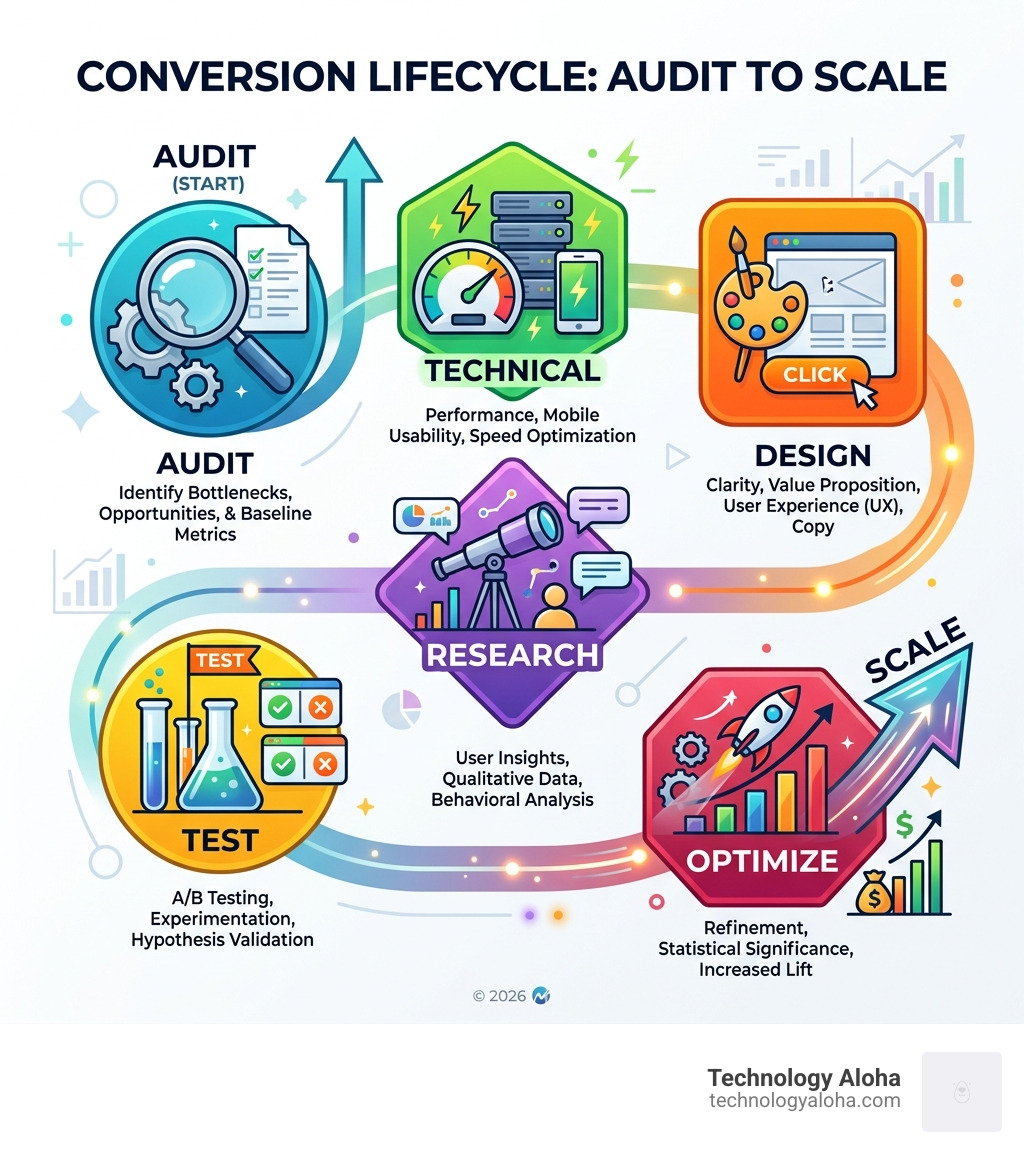
Simple conversion checklist word guide:
- The Complete Guide To High Conversion Websites
- The Art Of High Converting Lead Capture Page Design
- How To Build A Conversion Focused Web Design That Actually Works
The Strategic Power of a Conversion Checklist

In 2026, digital competition is fiercer than ever. A conversion checklist isn’t just a “to-do” list; it is a strategic asset that mitigates risk and drives operational efficiency. Without a system, optimization is random. We see businesses spend weeks debating button colors while their primary headline fails to communicate any value. This is the digital equivalent of rearranging deck chairs on the Titanic.
By implementing a structured audit, we identify “conversion leaks” before they drain your marketing budget. This process applies across industries—whether you are optimizing a landing page for lead generation or managing a complex legal entity conversion. A well-executed checklist ensures that every department, from design to development, is aligned with the ultimate goal: moving the needle on revenue.
For those looking to scale, understanding the landscape is vital. You can explore The Insider Guide To Conversion Rate Optimization Agencies to see how professional teams approach these audits.
Technical Foundations: Speed, Mobile, and SEO
Before you worry about the “pretty” parts of your website, you must secure the foundation. In 2026, technical performance is a core marketing function. If your site is slow, you are telling potential customers you do not value their time.
- Largest Contentful Paint (LCP): This should be under 2.5 seconds. Google’s Core Web Vitals are not just “SEO suggestions”—they are direct indicators of user frustration.
- Mobile-First Indexing: Over 60% of web traffic now comes from mobile devices. Your site must be more than “responsive”; it must be mobile-optimized.
- Tap Targets: Ensure buttons and links are at least 44×44 pixels. This prevents “fat-finger” errors that lead to bounces.
- Typography: Use a minimum font size of 16px for body text on mobile to ensure readability without zooming.
Technical issues often go unnoticed because they don’t “break” the site visually, but they quietly suppress your rankings and conversions. To dive deeper into how speed impacts your bottom line, visit our Website Speed Optimization guide.
High-Impact Design and Copywriting Elements

Once the technical foundation is solid, we turn our attention to what actually converts visitors: the message. Copy changes routinely outperform design changes by 5–10x. A broken headline matters more than a slightly slow page.
Your conversion checklist must prioritize the “above-the-fold” experience. Visitors decide whether to stay or leave within five seconds. If your H1 headline doesn’t match the ad or search intent that brought the user there, they will bounce immediately.
Key elements to verify:
- Value Proposition: Is it clear within five seconds what you offer and why it matters?
- Message Match: Does the landing page headline mirror the promise made in your traffic source?
- Social Proof: Are testimonials, client logos, or specific results visible near your primary conversion points?
For a detailed look at building these pages, refer to The Art Of High Converting Lead Capture Page Design and ensure you have the 4 Things You Need To Include On Your Product Pages. For those looking to master the psychology of clarity in their writing, we highly recommend The Happiness Project by Gretchen Rubin as a study in clear, impactful communication.
Essential Steps for a Website Conversion Checklist
Clarity converts; complexity kills. When auditing your copy, use these specific checks:
- Headline Specificity: Replace vague phrases like “Welcome to Our Platform” with benefit-driven statements like “Generate 47% More Leads Without Increasing Ad Spend.”
- Benefit Stacking: List benefits in order of importance to the user, not the business.
- Objection Handling: Address the top three fears (e.g., “No long-term contracts,” “Setup takes 5 minutes”) directly before the Call to Action (CTA).
These steps are particularly critical for How To Achieve High Conversion E-Commerce Success, where friction at the point of sale results in immediate revenue loss.
Optimizing Forms within Your Conversion Checklist
Forms are often where the conversion journey ends prematurely. Every extra field you add can reduce completion rates by 5–10%.
- Multi-step Forms: Research shows that breaking a long form into smaller steps can increase completion by 15–25%.
- Inline Validation: Show users they’ve made an error (or a success) in real-time, rather than making them wait until they hit “Submit.”
- CTA Copy: Avoid “Submit.” Use action-oriented language like “Get My Free Checklist” or “Start My Trial.”
For more on the psychology of button text, see our guide on Website Call To Action Buttons The Best And Worst Words To Use.
Data Diagnostics and Prioritization Frameworks
We don’t guess; we measure. A conversion checklist is only as good as the data backing it. We use qualitative research—like heatmaps, session recordings, and micro-interviews with 5–10 users—to uncover why users are dropping off.
To manage your optimization efforts, use a prioritization framework to ensure you are working on high-leverage tasks first.
| Framework | Meaning | Best For |
|---|---|---|
| ICE | Impact, Confidence, Ease | Fast-moving teams needing quick wins. |
| PIE | Potential, Importance, Ease | Strategic planning for high-traffic sites. |
When running A/B tests, aim for a minimum statistical significance threshold of 95% confidence. Never stop a test early just because one version looks like it’s winning; run it for at least one full business cycle to avoid false positives. Learn more about this in our article on How To Build Pages That Convert Using Real Data and Increase Your Websites Conversions With These 5 Tips.
Specialized Industry Conversions: Legal, Finance, and Software
Not all conversions happen on a website. Many involve complex business processes that require their own specialized conversion checklist.
- Legal Entity Conversions: If you are converting an entity under Delaware law (DGCL), you must ensure board and stockholder consents are documented and certificates of conversion are filed precisely with the Secretary of State.
- Finance (Roth IRA): A successful Roth IRA conversion requires navigating the 5-year rule for tax-free earnings. You must also ensure RMDs are taken before the conversion and that you have cash outside the IRA to cover the tax liability.
- QuickBooks Online Migration: Before moving from Desktop to Online, verify that your “target count” is below 350,000. Be aware that inventory costing will change to FIFO, which may require filing IRS Form 3115.
- Enterprise Software: For Oracle Cloud Infrastructure, pre-conversion steps include updating network allow-lists and verifying console access, while post-conversion requires re-importing “Bring Your Own Key” (BYOK) settings.
- Healthcare (Dental PMS): When migrating dental practice management software (like Dentrix or Eaglesoft) to a cloud system like Archy, verify which fields convert. While patient demographics and perio charts usually migrate well, custom templates and specific provider SSNs often require manual re-entry.
Frequently Asked Questions about Conversion Audits
How long should an A/B test run?
Tests should run until they reach both the required sample size and a 95% confidence level. Crucially, they must cover at least one full business cycle (usually 2–4 weeks) to account for variations in traffic patterns between weekdays and weekends.
What are the common pitfalls in a conversion checklist?
The biggest mistake is testing without research—fixing things that aren’t actually broken while ignoring major friction points. Other pitfalls include broken analytics tracking (meaning you can’t trust your results) and ignoring mobile usability in favor of desktop aesthetics.
How do I prioritize conversion hypotheses?
We recommend the ICE framework (Impact, Confidence, Ease). Rate each idea from 1–10 on how much it will move the needle, how sure you are it will work, and how easy it is to implement. Average the scores and start with the highest numbers. For high-revenue pages, also consider “revenue-at-risk” models.
Conclusion
At Technology Aloha, we believe that high-performance design is rooted in data. Whether you are a Maui-based business or operating globally, your digital presence should be your hardest-working employee. A conversion checklist is the tool that ensures that employee is trained, ready, and optimized for success.
By blending cohesive branding with user-centric strategy, we help you move beyond guesswork. Don’t leave your launch to chance. Review our Marketing Strategy and let us help you build a system that converts.