Why Sales Page Copywriting Is the Difference Between Browsers and Buyers
Sales page copywriting is the craft of writing persuasive, structured text that moves a reader from “I’m interested” to “I’m buying.” Done right, it works like a tireless salesperson—addressing doubts, building trust, and guiding a visitor to click that purchase button.
Here’s what effective sales page copywriting covers:
- Headline – Grabs attention and makes a clear promise
- Problem + empathy – Shows you understand the reader’s pain
- Solution reveal – Positions your offer as the logical next step
- Credibility – Builds trust through proof, testimonials, and guarantees
- Offer details – Explains what’s included and why it’s worth it
- Call to action – Tells the reader exactly what to do next
Get these right, and your sales page does the heavy lifting—24 hours a day.
Most small business owners treat their sales page like a product description. That’s the mistake. A sales page isn’t a brochure. It’s a conversation—one that meets a reader at their frustration, earns their trust, and walks them to a decision.
The difference is real and measurable. One sales page built around a structured copywriting process generated $284,000 in revenue. Another simple, repeatable formula has driven over $8 million in sales—without paid ads or complex funnels.
That’s not magic. That’s method.
People buy emotionally first, then justify the decision logically. Your copy needs to do both: connect on a human level, then give the rational mind a reason to say yes.
This guide walks you through exactly how to do that—without being pushy, vague, or boring.
The Psychology of Sales Page Copywriting
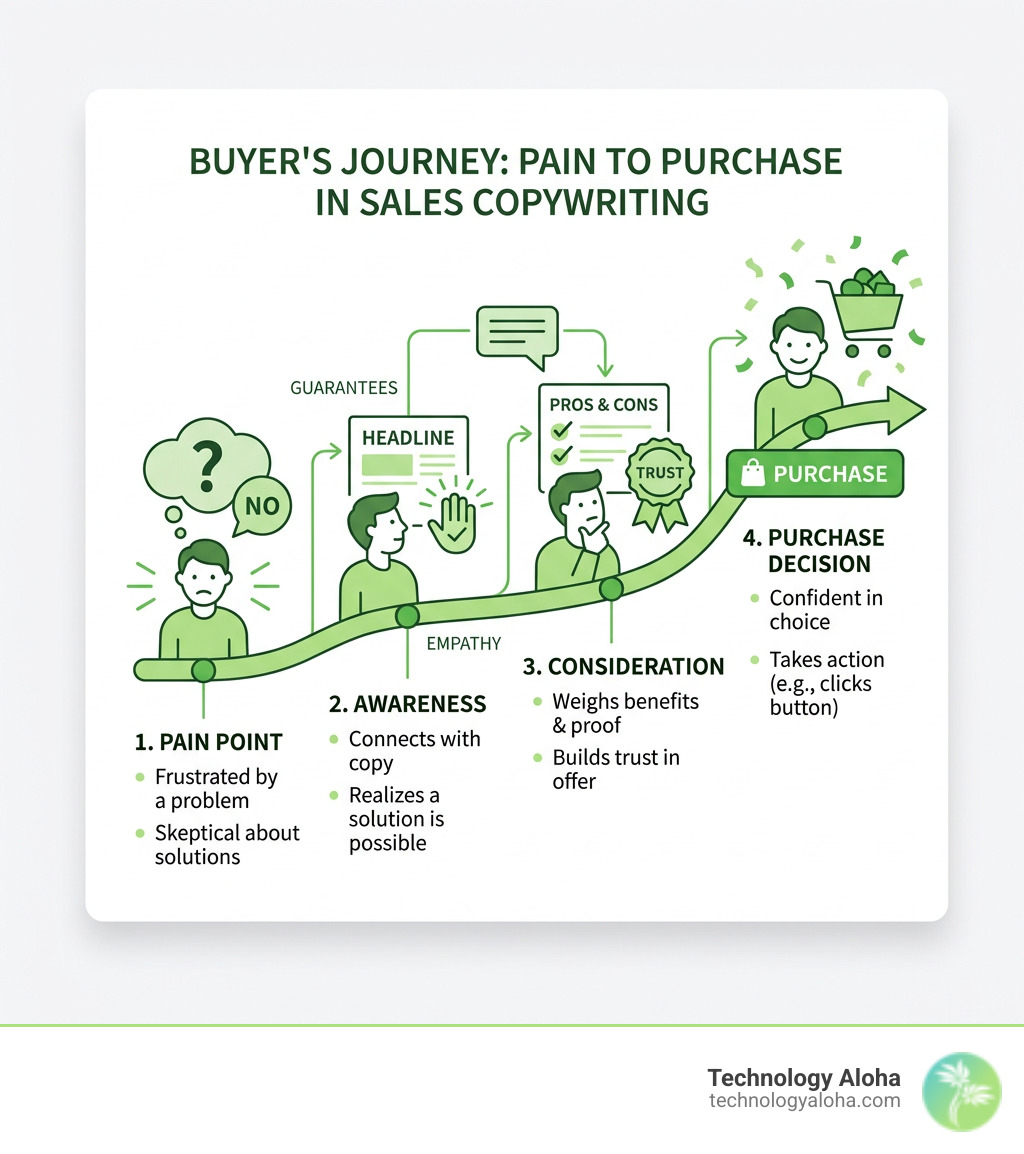
Effective sales page copywriting is less about “selling” and more about psychological alignment. We must understand that a visitor arrives at a page burdened by a specific problem. They are skeptical, tired of being marketed to, and likely suffering from decision fatigue.
To move them, we must bridge the gap between their current “pain” and their desired “dream” state. This requires a deep understanding of how to write for your website in 5 simple steps, starting with the realization that the customer is your MVP.

The human brain processes a purchase in two stages. First, the emotional centers (the limbic system) react to the promise of relief or gain. Only after the “gut feeling” says yes does the logical neocortex look for facts—like price, features, and specs—to justify the spend. If your copy leads with dry facts, you lose the emotional hook. If it’s all hype, the logical brain flags it as a scam.
A reliable way to balance this is the PAS framework:
- Problem: Clearly state the frustration they are feeling right now.
- Agitate: Explain why that problem is actually worse than they think (the “ouch” factor).
- Solution: Introduce your offer as the specific bridge to their better future.
Mastering Persuasion in Sales Page Copywriting
Persuasion isn’t about trickery; it’s about momentum. Successful copywriters often use the AIDA model: Attention, Interest, Desire, and Action.
We grab Attention with a bold headline, build Interest by using proven writing tips like storytelling, create Desire by showing the transformation, and trigger Action with a clear directive.
Storytelling is particularly potent because it bypasses the reader’s natural “marketing defenses.” Instead of being lectured, the reader sees themselves as the hero of the story, with your product serving as the tool that helps them win.
What is the Difference Between a Landing Page and a Sales Page?
A common point of confusion is the difference between a landing page and a sales page. While all sales pages are landing pages, not all landing pages are sales pages.
| Feature | Landing Page | Sales Page |
|---|---|---|
| Primary Goal | Lead generation (emails, sign-ups) | Transaction (sales, credit card entry) |
| Length | Typically short and focused | Often long-form to address objections |
| Audience Intent | Curiosity or top-of-funnel interest | Intent to buy or bottom-of-funnel |
| Complexity | Simple offer (e.g., a free PDF) | Complex offer (e.g., a $2,000 course) |
A sales page is the “closer.” It is designed for the person who is informed and ready to make a financial commitment.
A Proven Framework for High-Converting Sales Copy
We don’t recommend staring at a blank screen. High-converting sales page copywriting follows a sequence of content blocks designed to lower resistance and build value.
- The Headline: This is your bold promise. It must answer the reader’s internal question: “What’s in it for me?”
- The Subheadline: This adds clarity to the promise and keeps them reading.
- Set the Stage: Briefly describe the current reality the reader is facing.
- Highlight the Problem: Use the reader’s exact words to describe their frustration.
- Show Empathy: Share a personal story or observation that proves you “get it.”
- Reveal the Solution: Introduce your product or service as the logical fix.
- Introduce Yourself: Build authority by explaining why you are the right person to solve this.
- Explain What’s Included: List the features, but always tie them to benefits.
- Provide Bonuses: Add extra value that helps the customer achieve results faster.
- Define the Ideal Customer: Be honest about who this is (and isn’t) for.
- Handle Objections: Address the “but what about…” questions head-on.
- The Guarantee: Offer a risk reversal to make the decision safe.
- Recap: Summarize the value one last time.
- Call to Action: Give a direct instruction to buy.
When writing the best copy for your website, formatting is just as important as the words. Use short sentences, bulleted lists, and plenty of white space.
Building Credibility and Handling Objections
Objections are not “no’s”—they are unanswered questions. If you don’t address them, the reader will leave. The best way to do this is through a robust FAQ section or by weaving “objection-busting” copy throughout the page.
Common objections include:
- “It’s too expensive.” (Counter with value stacking and ROI).
- “I don’t have time.” (Counter by showing how much time they’ll save later).
- “Will this work for me?” (Counter with testimonials and social proof).
Risk reversal is also critical. A “Golden Guarantee”—like a 30-day money-back promise—removes the fear of making a mistake. As we often note when discussing call to action buttons, the words you use at the moment of decision can make or break the conversion.
Structuring the Offer and Bonuses
Your offer is not your product; it’s the transformation the product provides. For example, you aren’t selling a “waffle iron”; you’re selling “fast, stress-free Sunday mornings with your kids.”
In your “What’s Included” section, list the features but immediately follow them with the benefit.
- Feature: 10-video module library.
- Benefit: So you can learn at your own pace without feeling overwhelmed.
To boost perceived value, include bonuses. The best bonuses are “pulled” from the main offer or solve the next problem the customer will have after using your product. This creates a “value stack” that makes the price feel like a bargain. If you need help refining this, professional copywriting and editing can ensure your value proposition is crystal clear.
Modern Techniques and the Role of AI
The landscape of sales page copywriting has shifted. With over 50% of web traffic coming from mobile devices, your copy must be skimmable. Long paragraphs are “walls of text” that mobile users will ignore.
Then there is the question of Artificial Intelligence. AI is a fantastic “brainstorm buddy.” It can help you generate headlines, find synonyms, or outline a PAS framework. However, beware of the “uncanny valley” effect. AI-generated copy often feels “off”—it lacks the human quirks, empathy, and specific brand voice that build trust.
Use AI to get 60% of the way there, then edit it to add your personality. People buy from people, not algorithms. This same principle applies to marketing emails that convert; the human touch is what drives the click.
Frequently Asked Questions about Sales Page Copywriting
We often hear from business owners who are worried about the “sleaze” factor. The truth is, if you have a product that truly helps people, you have an obligation to sell it effectively. Persuasion is only sleazy if you’re lying. If you’re solving a real problem, you’re doing a service.
How long should a sales page be?
The “Starbucks Test” is a good rule of thumb: your page should be long enough to answer all the questions a customer would ask you over a cup of coffee.
Generally, the more expensive or complex the product, the more copy you need. A $20 ebook might only need a short page. A $5,000 consulting package requires a long-form page to build enough trust for that level of investment. For more on content length, see our guide on how to write a great blog post.
Can anyone learn to write effective sales copy?
Yes. It is a skill, not a gift. It requires research, an understanding of customer psychology, and practice. You don’t need a formal degree; you need to listen to your customers. Use their exact words—their specific complaints and “dream” outcomes—and your copy will naturally resonate. Learning how to write a good-looking blog post is a great starting point for mastering the visual flow of persuasive text.
What are the most common copywriting mistakes?
- Leading with features: Customers don’t care how it works until they know what it does for them.
- Corporate jargon: Words like “synergy” and “optimized” kill trust. Write like a human.
- Lack of a clear CTA: Don’t make the reader guess. Tell them exactly what to do next.
- Appealing to everyone: If you try to talk to everyone, you’ll end up talking to no one. Pick a specific “ideal customer” and write directly to them.
Conclusion
At Technology Aloha, we believe that your website should be more than a digital brochure—it should be a guided journey that builds confidence. By combining strategic positioning with data-driven sales page copywriting, we help businesses in Hawaii and beyond turn browsers into loyal customers.
Growth doesn’t come from doing more; it comes from doing a few things better. Tightening your sales copy is one of the most effective ways to see immediate results in your revenue.
If you’re ready to stop guessing and start converting, we’re here to help. Learn more about our copywriting and editing services and let’s build a sales page that works as hard as you do.