Why Brand Strategy Development Services Determine Whether Your Business Gets Chosen
Brand strategy development services are the professional process of defining how your business is positioned, who it serves, how it communicates, and why customers should choose it over competitors.
If you’re evaluating options right now, here is what matters:
- What they include: positioning, audience research, messaging frameworks, brand voice, competitive analysis, and brand guidelines
- Who needs them: startups building from scratch, small businesses losing ground to competitors, and established companies whose messaging has drifted
- How long they take: most engagements run 4–10 weeks depending on scope and complexity
- What they cost: focused projects start in the low thousands; comprehensive engagements run into the tens of thousands
- What you get: a documented strategy that guides every marketing, sales, and design decision going forward
Most businesses skip strategy and go straight to a logo. That is the wrong order.
Strategy determines whether buyers understand you, trust you, and remember you. Without it, design and marketing work harder than they should.
This guide explains what brand strategy development services include, how the process works, what affects cost, and how to evaluate the right partner in 2026.
Explore more about brand strategy development services:
- Branding Strategy 101
- Brand Positioning and Differentiation
- Building a Cohesive Brand Presence from Web to Mobile
What Brand Strategy Development Services Actually Include
At a minimum, professional brand strategy development services should answer six questions:
- Who are you?
- Who are you for?
- What makes you different?
- Why should anyone trust that claim?
- How should you sound?
- How should that strategy show up across your website, sales materials, and marketing?
That means the work usually includes positioning, audience research, messaging, differentiation, voice and tone, visual direction, and brand guidelines. Good strategy connects to business goals. If the work cannot improve sales, marketing, recruiting, partnerships, or growth, it is decoration.
Brand strategy development services vs. branding vs. visual identity
These terms get mixed together constantly, so make the distinction clean.
- Brand strategy is the thinking
- Branding is the expression
- Visual identity is one part of that expression
A logo is not a brand. It is a symbol for a brand. Useful, yes. Sufficient, no. For the longer version, start with Branding Strategy 101 and Small Business Branding and Positioning: Why Your Logo Is Not Your Brand.
A solid strategy engagement creates the foundation before design begins. That foundation often includes:
- Positioning platform
- Audience definition
- Category framing
- Value proposition
- Messaging hierarchy
- Verbal identity
- Proof points
- Strategic direction for visual identity
Then design turns that thinking into a visual system – logo, colors, typography, imagery, layout principles, and assets.
If a provider starts with “What colors do you like?” before asking “Why do customers choose you?” keep looking.
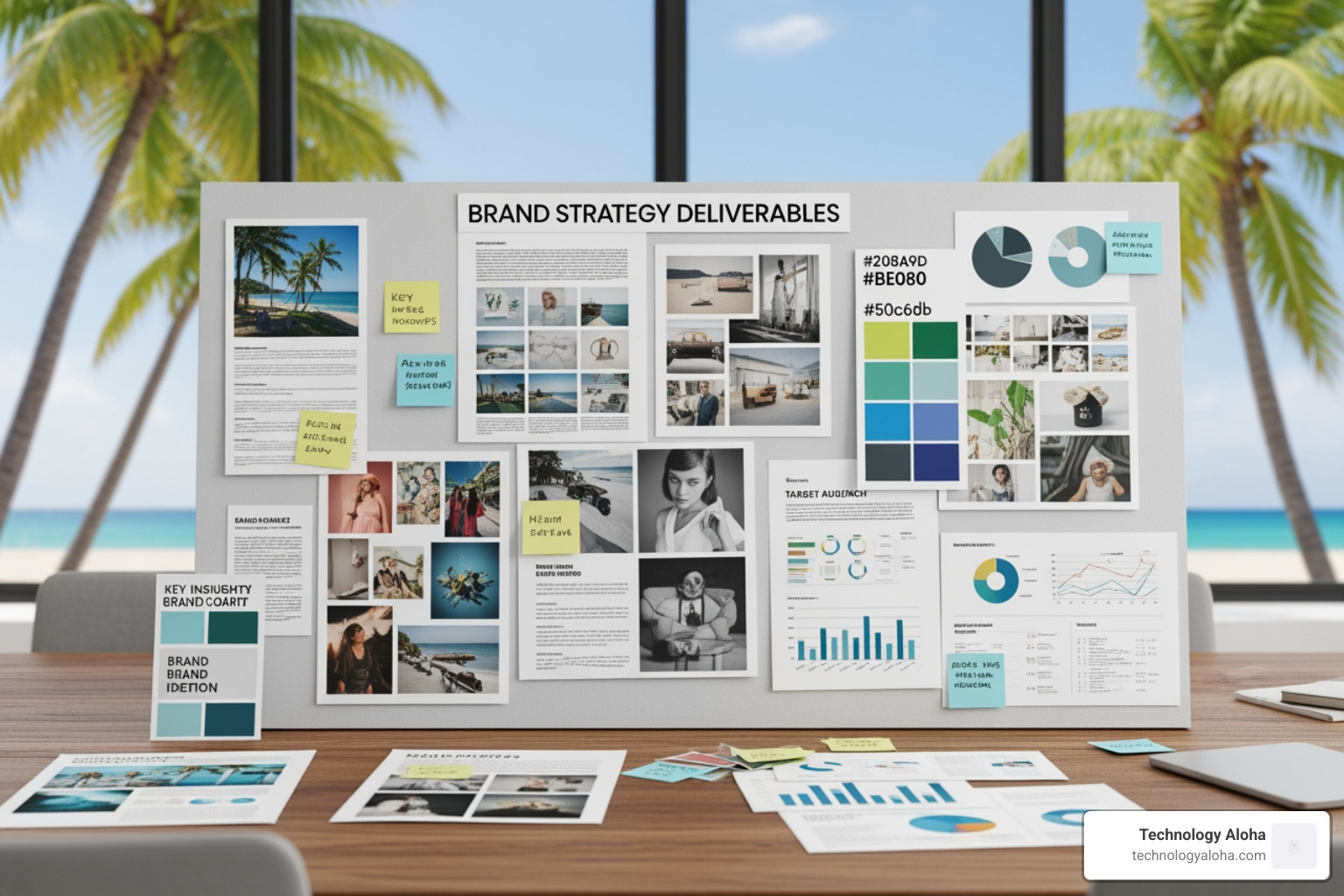
The standard deliverables in a professional engagement
Deliverables vary by scope, but a professional engagement commonly includes:
- Stakeholder interviews
- Customer or audience personas
- Competitive audit
- Brand positioning statement
- Value proposition framework
- Messaging hierarchy by audience
- Brand story or narrative
- Voice and tone guide
- Proof points and differentiators
- Naming or tagline support if needed
- Rollout priorities and governance guidance
The best engagements also create practical tools teams can use – not a strategy deck that gets admired once and ignored forever.
For a useful framework view, see Stop Guessing and Start Branding with This Strategy Framework PDF.
Why Businesses Invest in Brand Strategy Development Services
Businesses invest in strategy because confusion is expensive.
A strong brand strategy solves practical problems:
- Unclear positioning that makes sales conversations harder
- Price pressure because buyers see you as interchangeable
- Inconsistent messaging across website, social, sales, and ads
- Audience confusion about what you actually do
- Internal misalignment between leadership, sales, and marketing
- Brand drift during growth, expansion, or service changes
- Weak launches when entering new markets or adding offers
Here is the contrast:
| Unclear branding | Strategic branding |
|---|---|
| Generic claims | Specific market position |
| Inconsistent messaging | Clear messaging framework |
| Competes on price | Competes on value |
| Internal disagreement | Cross-team alignment |
| Random marketing tactics | Coordinated brand system |
| Harder to trust | Easier to understand and choose |
How strategy creates differentiation and long-term value
Differentiation is not being louder. It is being clearer.
Strong strategy finds the overlap between three things:
- What your audience needs
- What the market is claiming
- What your business can credibly own
That is where competitive whitespace lives.
Once that clarity is in place, you get real business benefits:
- Stronger trust
- Higher relevance
- Better retention
- Greater consistency
- Improved conversion
- More pricing power
- Long-term brand equity
For more on this, see Brand Positioning and Differentiation and Positioning and Branding for Small Business.
How the Brand Strategy Development Process Works
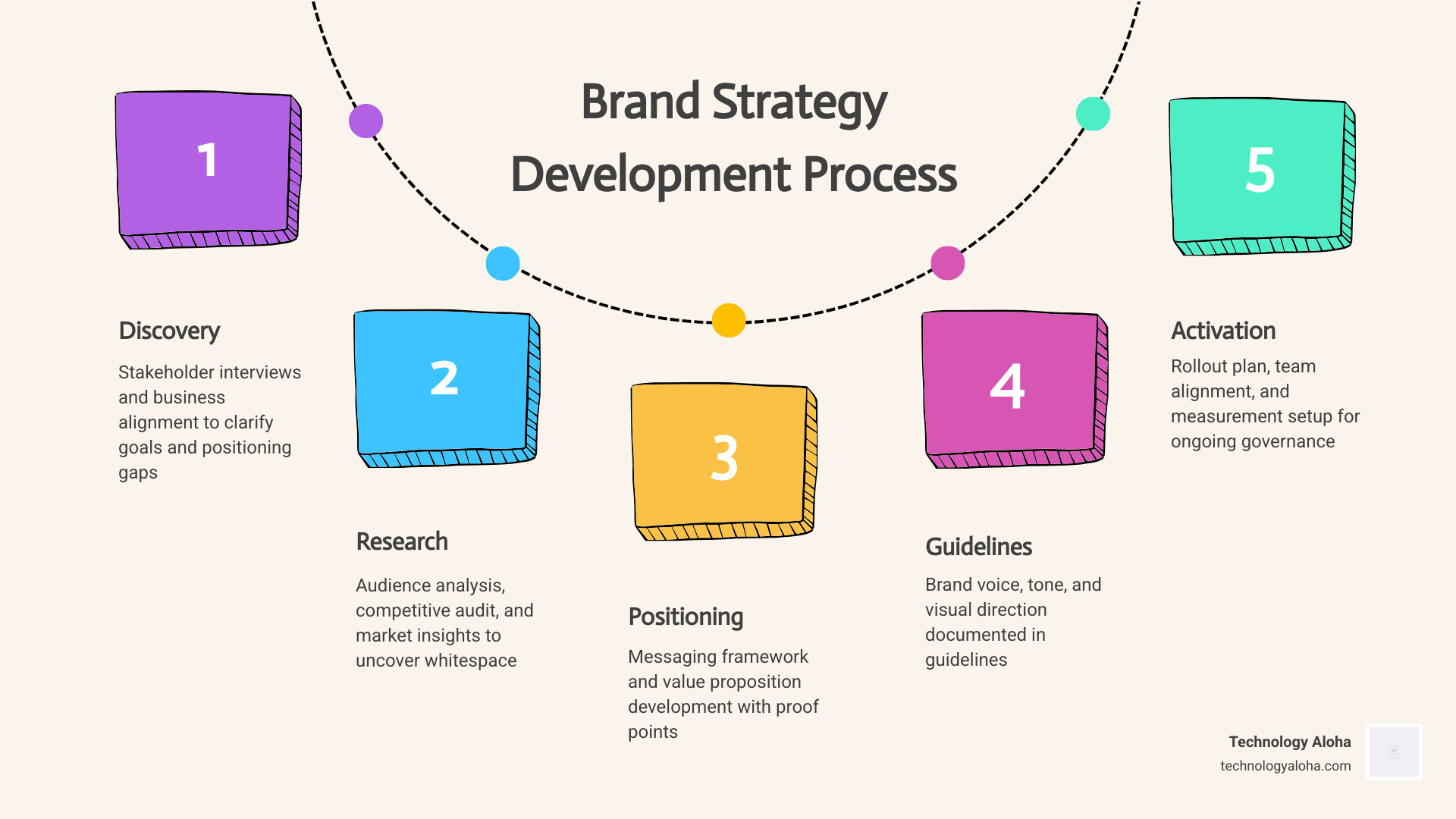
Most good projects follow a similar sequence. The labels may vary, but the logic does not.
How long brand strategy development services usually take
In 2026, most projects fall into a few common ranges:
- Focused work: about 2–8 weeks
- Standard strategic engagements: about 4–6 weeks
- Comprehensive strategy programs: about 6–10 weeks
- More complex brand architecture or multi-stakeholder work: longer
What affects timing?
- Scope of deliverables
- Depth of research
- Number of stakeholders
- How many audiences or service lines are involved
- Need for naming or architecture work
- Review and revision cycles
- Decision speed on the client side
A startup with one offer and a lean team moves faster. An established company with multiple services, legacy messaging, and many decision-makers usually needs more time.
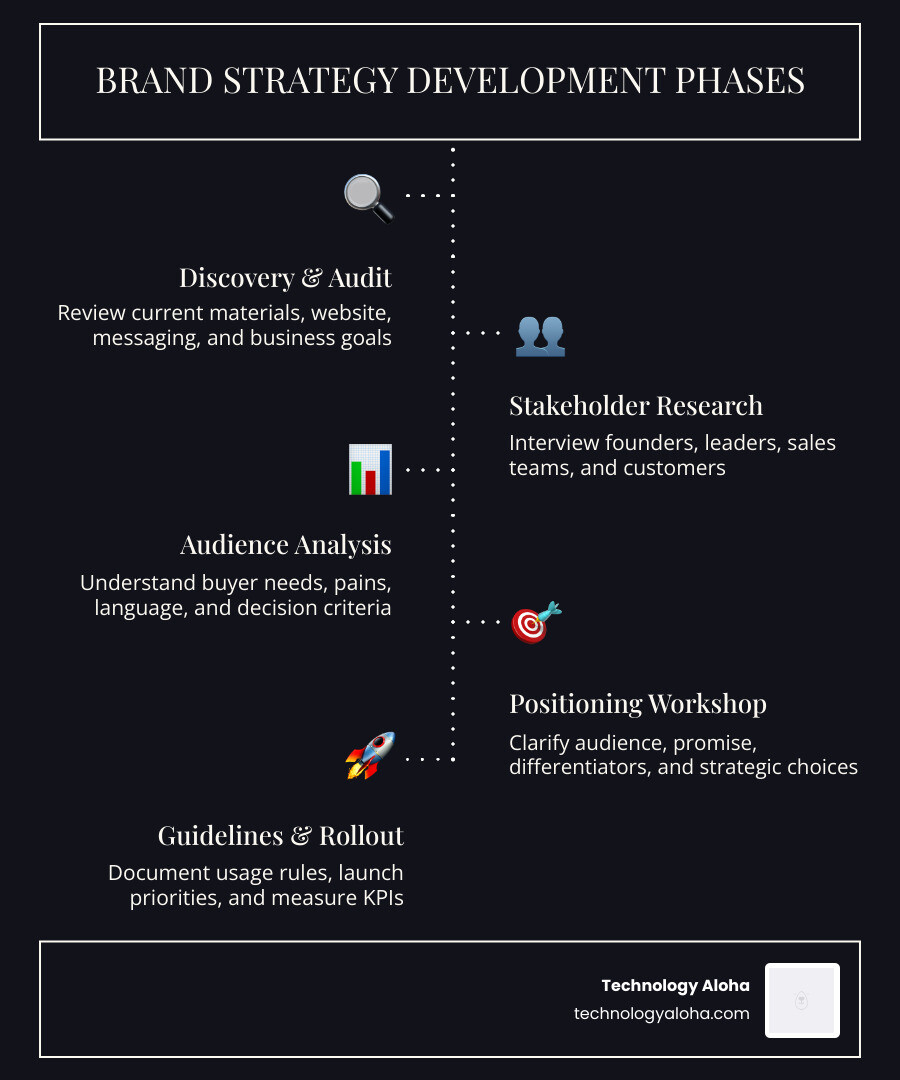
The main phases from audit to rollout
A typical process includes:
-
Discovery and audit
Review current brand materials, website, messaging, performance, and business goals. -
Stakeholder research
Interview founders, leaders, sales teams, customers, or community stakeholders. -
Audience analysis
Understand buyer needs, pains, language, expectations, and decision criteria. -
Competitive mapping
Analyze how similar businesses position themselves and where the gaps are. -
Positioning workshop
Clarify audience, category, promise, differentiators, and strategic choices. -
Messaging development
Create core messages, value propositions, proof points, and voice guidelines. -
Identity direction
Translate the strategy into a creative brief for brand identity and digital execution. -
Guidelines and governance
Document what the brand says, how it looks, and how teams should use it. -
Rollout and measurement
Launch with priorities, implementation support, and KPIs.
For a deeper foundation document, see Corporate Branding Strategy PDF: Building a Brand That Actually Sticks.
Research, Audience Insight, and Competitive Analysis: The Work That Makes Strategy Work
Strategy without research is a guess.
The point of strategy is not to express internal opinions more elegantly. The point is to make better decisions with evidence.
Why research is non-negotiable in brand strategy development services
Research does four jobs:
- It tells you what buyers actually care about
- It reveals the language they already use
- It exposes what competitors are overclaiming
- It helps you build a position you can prove
This matters because buyers are deciding whether you feel relevant, credible, and easy to understand.
In Hawaii, context matters too. Local brand strategy has to account for audience expectations, community trust, and place-based identity without collapsing into cliché.
What to look for in audience and market analysis
When evaluating brand strategy development services, ask what research is actually included.
You want a mix of:
- Qualitative interviews
- Survey or quantitative inputs where useful
- Audience segmentation
- Buyer journey analysis
- Competitor messaging review
- Brand perception assessment
- Category and trend context
- Message testing when stakes are high
Look for outputs such as:
- Persona summaries tied to buying behavior
- Key interview themes
- Decision drivers and objections
- Competitor claim maps
- Positioning gaps
- Message resonance insights
If the “research” is a quick glance at your Instagram and a few competitor homepages, that is not research.
For a practical identity starting point, read The DIY Guide to Creating a Brand Identity.
Costs, Timelines, and Service Fit for Startups vs. Established Brands
Cost depends on scope. That is the honest answer.
The useful answer is that pricing rises with complexity, research depth, stakeholder count, and deliverable breadth. Add visual identity, naming, website strategy, or architecture work and the project expands accordingly.
What brand strategy development services cost in 2026
Across the market in 2026, pricing often falls into broad tiers:
- Smaller foundational projects in the low thousands
- Mid-range strategy work in the mid-to-upper thousands
- More comprehensive programs in the tens of thousands
- Large, complex engagements at significantly higher levels
We are keeping this article non-specific on pricing because the right scope matters more than the headline number. A cheaper project that skips research and messaging is not a bargain. It is delayed spending.
The bigger pricing drivers are:
- Research intensity
- Number of audiences or markets
- Complexity of services or offers
- Brand architecture needs
- Naming requirements
- Whether visual identity is included
- Implementation support after strategy delivery
How startups and established companies should approach scope differently
Startups need enough strategy to create clarity fast. Established brands need enough strategy to create alignment without breaking what already works.
For startups, the priority is often:
- Clear positioning
- Go-to-market messaging
- Founder story refinement
- Investor and customer narrative alignment
- Website clarity
- Early brand guidelines
For established companies, the scope usually expands to include:
- Repositioning
- Market recalibration
- Service-line or portfolio architecture
- Internal alignment across teams
- Legacy equity preservation
- Rollout planning across channels
The mistake startups make is over-building. The mistake established brands make is under-scoping. One ends up with a glossy document no one needs. The other ends up trying to fix a strategic problem with a homepage headline.
For more context, see Top Branding Packages to Make Your Business Pop and Branding.
How to Choose the Right Partner and Measure ROI
Not every provider who offers branding can do strategy well. Some are excellent designers. Some are excellent marketers. Few are equally strong at research, positioning, messaging, and digital execution.
That combination matters.
Strategy should not stop at a slide deck. It should guide your website, content, campaigns, and conversion path.
Questions to ask before hiring brand strategy development services
Use these questions in every sales conversation:
- What is your methodology?
- What research methods do you use?
- How many stakeholders are typically involved?
- What deliverables will we receive?
- How do you define positioning?
- How do you validate messaging?
- Can you show sample strategy outputs?
- How do you connect strategy to website and marketing execution?
- What happens after final delivery?
- How do you handle revisions and decision-making?
- What metrics do you recommend tracking after launch?
- How do you ensure internal adoption?
Good answers should be specific. Vague answers are a red flag.
How to measure success after launch
Brand strategy ROI is measurable. Not perfectly, but clearly enough to matter.
Track a mix of brand and business metrics:
- Direct traffic and branded search growth
- Website engagement and conversion rate
- Lead quality
- Sales win rate
- Average deal value or pricing power
- Message consistency across touchpoints
- Content production efficiency
- Customer retention
- Referral rate
- NPS or satisfaction indicators
- Social engagement and sentiment
- Team alignment and sales enablement adoption
You should also compare before-and-after performance on key pages, especially your homepage, service pages, and lead forms. Better strategy should improve clarity. Better clarity should improve conversion.
That is where branding and digital execution meet. For more on that connection, read The Secret Sauce of Branding and Web Development.
Frequently Asked Questions about Brand Strategy Development Services
Is brand strategy development worth it if you already have a logo and website?
Yes – if your current brand is not clearly communicating your value.
A logo and website prove you launched. They do not prove you are positioned well. If visitors do not quickly understand who you help, what makes you different, and why they should trust you, strategy work is still worth doing.
This is especially true when:
- Leads are coming in but not converting
- Your sales cycle feels slower than it should
- You are competing on price
- Your messaging keeps changing
- Your team describes the business differently
Can brand strategy improve marketing and website performance?
Absolutely.
Clear strategy improves:
- SEO alignment around the right topics and intent
- Paid media efficiency through sharper message-market fit
- Landing page relevance
- Website UX because pages have a clearer purpose
- Conversion rates through stronger value communication
- Content strategy because themes and proof points are defined
Brand strategy is not separate from performance. It is often the reason performance improves.
What should you receive at the end of the project?
At minimum, you should receive:
- A documented positioning statement
- Audience profiles
- Messaging framework
- Value propositions and proof points
- Voice and tone guidance
- Competitive insights
- Strategic recommendations for rollout
- Brand guidelines or a clear brief for the next phase
If visual identity is included, you should also receive the visual system and usage guidance. If website work follows, the strategy should carry directly into sitemap, copy direction, UX priorities, and conversion goals.
What are the key takeaways from brand strategy development services?
The best brand strategy development services do one thing exceptionally well: they remove ambiguity.
They make it easier for customers to understand you, easier for teams to communicate consistently, and easier for your business to grow without reinventing itself every quarter.
If you are choosing a partner in 2026, evaluate them on strategic rigor, research quality, messaging depth, implementation readiness, and measurable outcomes – not just visual polish.
For a broader overview, explore Branding.