Why a High Performance Digital Strategy Separate Growing Businesses from Struggling Ones

High performance digital strategies are the systems, channels, and decisions that work together to grow your business online — faster and more sustainably than your competitors.
Here’s what they typically include:
- Clear goals tied to revenue, not just traffic or likes
- SEO and content that attracts the right people organically
- Paid advertising that converts without wasting budget
- Marketing automation and AI that scale your efforts
- First-party data collection to personalize and retain customers
- Technology infrastructure that connects your tools and teams
- Metrics and KPIs that tell you what’s actually working
Most small businesses have some of these pieces. Few have all of them working together.
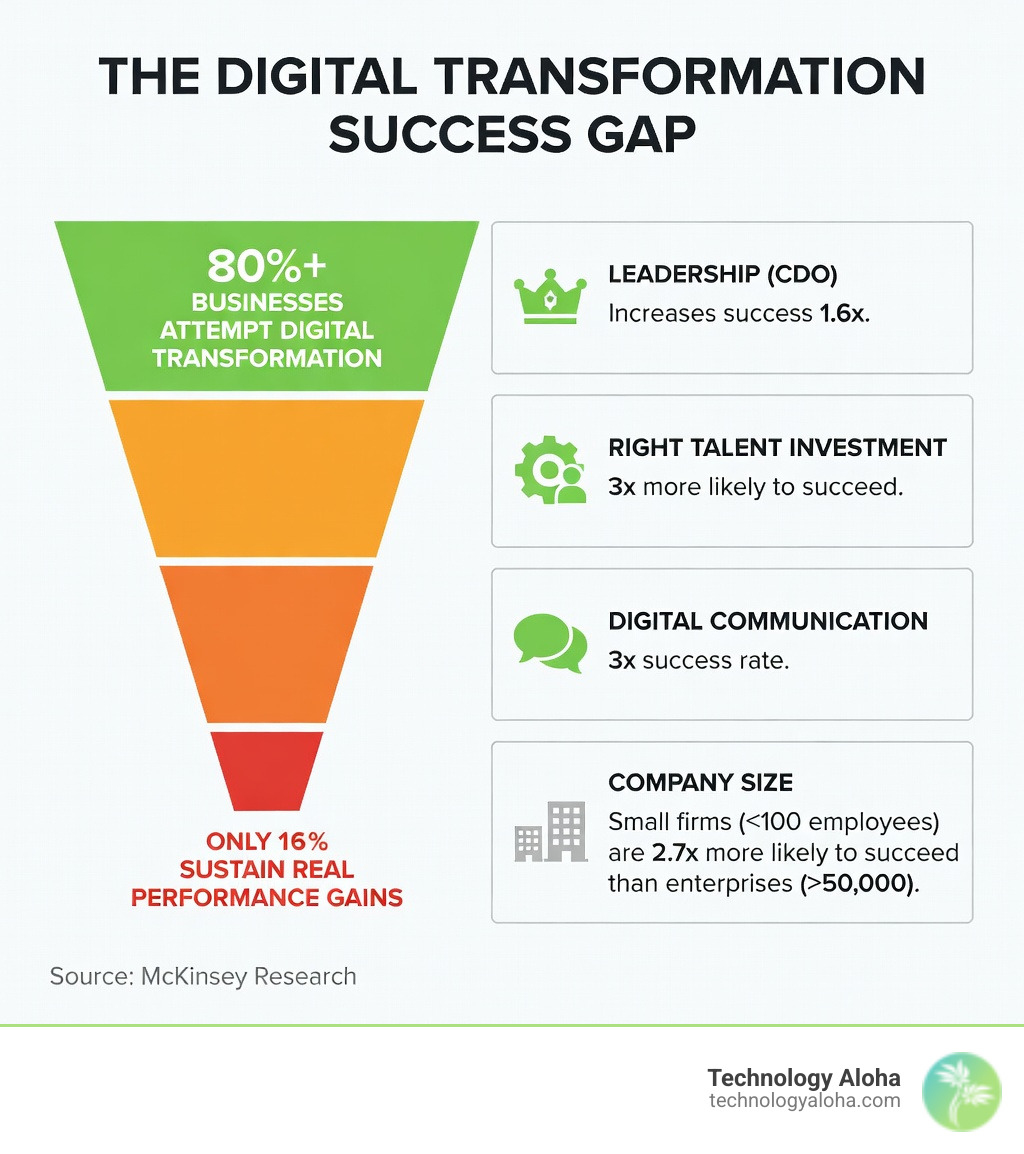
That gap is expensive. Research from McKinsey shows that only 16% of organizations report their digital transformations have actually improved performance and sustained those gains long-term. More than 80% of businesses have tried — most have fallen short.
The problem isn’t effort. It’s strategy.
Without a coherent plan, businesses end up with a website that doesn’t convert, ads that drain budget, and content that nobody reads. The digital landscape in 2026 is more competitive than ever — and the gap between companies that get this right and those that don’t keeps widening.
This guide breaks down exactly what separates high-performing digital businesses from the rest, and what you can do about it.
Technology Aloha brings an enterprise-grade, systems-thinking approach to high performance digital strategy without the enterprise bloat. Instead of chasing tactics, the focus is on building clear strategic frameworks, smart market positioning, and measurable growth loops that fit the realities of small businesses and nonprofits. The insights in this article reflect years of hands-on digital strategy work across the U.S., combining practical execution with disciplined analysis to help teams prioritize what actually drives revenue, retention, and long-term competitive advantage.
Defining High Performance Digital Strategy for 2026

In the past, a “digital strategy” might have just meant having a Facebook page and a website that didn’t look like it was from 1998. Today, high performance digital strategies are far more integrated. They are the engine of your business, not just a coat of paint on your marketing.
As we look toward 2026, several key technologies have moved from “nice-to-have” to “essential.” According to McKinsey, organizations that prioritize digital advancements see significantly higher profitability, revenue growth, and improved pricing strategies. But what does that look like in practice?
- AI and Automation: This isn’t just about chatbots. It’s about using AI to personalize customer journeys at scale and automating repetitive tasks so your team can focus on creative work.
- IoT (Internet of Things) Connectivity: Even traditional industries are getting “smart.” Think of how John Deere now differentiates itself through an IoT ecosystem that provides digital services to farmers, turning tractors into “computers on wheels.”
- Cloud Computing: The cloud isn’t just storage; it’s the agility to scale your systems instantly without buying new servers.
- Data Analytics: 57% of organizations say their marketing analytics still hasn’t had the expected impact on decision-making. High performers are the ones who bridge this gap by turning raw data into actionable insights.
- Cybersecurity: With high performance comes high risk. Protecting your customer data and financial systems with multi-factor authentication and encrypted gateways is now a core part of your brand’s trust.
At Technology Aloha, we believe that building a successful marketing process starts with understanding these tools. A strategy isn’t just a list of tools; it’s a roadmap for how those tools solve your customers’ problems.
The Anatomy of a Successful Digital Transformation
Digital transformation is a buzzword that gets thrown around a lot, but it’s actually quite difficult to pull off. In fact, success rates for digital transformations are lower than traditional business changes—less than 30% overall, and as low as 4% to 11% in traditional industries like oil and gas.
So, what makes the successful 16% different? It comes down to the “anatomy” of the organization.
| Feature | Traditional Transformation | Digital Transformation |
|---|---|---|
| Primary Focus | Cost-cutting and efficiency | Growth, agility, and customer experience |
| Leadership | Top-down hierarchy | Digital-savvy leaders (CDO, CIO) |
| Technology | Legacy systems / Silos | Integrated operational backbone |
| Pace | Annual planning cycles | Continuous “drumbeat” (Weekly/Monthly) |
One of the biggest indicators of success is having the right leadership. Organizations with a Chief Digital Officer (CDO) are 1.6 times more likely to report a successful transformation. Why? Because a CDO bridges the gap between the IT department and the boardroom.
Success also requires a “Two-Speed IT” model. This means your core systems (like your database) stay stable and secure, while your customer-facing applications (like your website or app) iterate rapidly through constant testing. This balance is a hallmark of strategy for a digital world.
We often remind our clients in Hawaii that the importance of a digital marketing strategy isn’t just about being “modern”—it’s about survival. Companies that ignore this anatomy often find themselves with “digital silos” where no one knows what the other department is doing.
Prioritizing High Performance Digital Strategy for ROI
One of the most common questions we get is: “Where do I start?” You can’t do everything at once. High-performing companies prioritize initiatives based on their potential for ROI and how quickly they can be implemented.
We recommend looking for “Quick Wins.” These are ten digital moves for a performance boost that can show results in months, not years. For example:
- Pricing Optimization: Using data to adjust prices can lead to an immediate margin increase.
- Digital Tracking: Implementing a “digital impact center” to see exactly where your leads are coming from.
- Agile Resource Reallocation: Moving talent and budget toward digital channels that are currently outperforming others.
Before you invest heavily, it’s vital to know where you stand. Performing a marketing audit allows you to see which of your current assets are working and which are just draining your bank account.
Building the Infrastructure for High Performance Digital Strategy
Your strategy is only as good as the technology it sits on. Think of your technology infrastructure as the foundation of a house. If the foundation is cracked, it doesn’t matter how nice the curtains are.
For a high performance digital strategy, you need a “Modular Architecture.” This means your different systems (your website, your CRM, your email marketing tool) can talk to each other through APIs. This prevents data from getting stuck in one place.
A key concept here is the “Data Trinity”:
- Use Cases: What specific business problems are we trying to solve? (e.g., reducing customer churn).
- Data Assets: What data do we have to help solve it? (e.g., purchase history).
- Architecture: How do we make that data accessible to the people who need it?
In 2026, your infrastructure must also prioritize First-Party Data. With privacy regulations tightening and third-party cookies disappearing, owning your own data (like your email list) is the only way to ensure long-term stability.
Finally, never underestimate the power of speed. Website speed optimization is no longer a technical “extra”—it’s a requirement. If your site takes longer than three seconds to load, your high-performance strategy will stall before it even starts.
Essential Components of Modern Digital Marketing
Once your infrastructure is set, you need to execute across the right channels. But rather than chasing every new trend, high performers focus on a few “powerhouse” components that drive results.
- Holistic SEO: Gone are the days of “keyword stuffing.” Modern SEO is about the user experience. It involves technical SEO, quality content, and building natural links. We call it “Holistic” because it looks at the whole picture—if your site is awesome for users, Google will eventually find it awesome, too.
- PPC Dayparting: If you’re running paid ads, don’t just “set it and forget it.” Use dayparting to schedule your ads for the times when your audience is most likely to engage and convert. This saves budget and increases your ROAS (Return on Ad Spend).
- Content Silos: Instead of random blog posts, organize your content into silos. This means creating a “pillar” page for a major topic and linking related sub-topics to it. This helps search engines understand your expertise.
- Video Marketing: Video remains the most engaging content format. Whether it’s a short “how-to” on social media or a deep-dive webinar, video builds trust faster than text alone.
- Voice Search: As more people use AI assistants, optimizing for “conversational” keywords (questions people actually say out loud) is becoming a competitive advantage.
Knowing how to develop a solid content marketing plan is the bridge between having ideas and having an audience. When you understand what SEO means for your company, you stop viewing it as a chore and start seeing it as a long-term asset.
Overcoming Cultural and Organizational Barriers
Here is a hard truth: the biggest obstacle to a high performance digital strategy isn’t technology—it’s people.
Success is more than three times likelier when organizations invest in the right digital talent. But it’s not just about hiring a “tech person.” It’s about creating a culture that embraces change.
- The Change Story: Communicating why you are changing makes a successful transformation more than three times more likely. If your team doesn’t understand the vision, they will resist the new tools.
- Agile Squads: Instead of massive, slow-moving departments, high performers use small, cross-functional “squads” that can test an idea, measure it, and pivot in two weeks.
- The Digital Drumbeat: Digital leaders move four times faster than their peers. For example, 44% of digital leaders analyze customer data weekly, while laggards might only look at it once a month or once a quarter.
We often see that social media management is a great place to start building this “test-and-learn” culture. It provides immediate feedback that can then be applied to larger, more complex digital initiatives.
McKinsey identifies six building blocks for a digital enterprise: Strategy, Customer Journey, Process Automation, Organization, Technology, and Data. If you miss even one of these blocks, the whole structure becomes unstable.
Frequently Asked Questions about Digital Strategy
What are the most common mistakes in digital transformation?
Many businesses fall into the “intuition trap.” They make decisions based on what they think will work rather than analyzing real performance data. Other common pitfalls include:
- Chasing Quick Wins Only: Focusing on short-term sales while neglecting your long-term organic growth (like SEO).
- Legacy Tech Dependence: Trying to build a 2026 strategy on 2010 software.
- Siloed Departments: When IT and Marketing don’t talk, you end up with systems that don’t work for the user.
- Mobile Neglect: If your strategy doesn’t prioritize the mobile user, you are ignoring more than half of your potential audience.
For small businesses, we’ve found that following these top 4 marketing tips for small businesses can help you avoid the most expensive errors.
How do you measure the performance of a digital strategy?
You can’t manage what you don’t measure. High performance is defined by data. The key metrics we track include:
- ROAS (Return on Ad Spend): Is your paid marketing actually making money?
- CAC (Customer Acquisition Cost): How much does it cost to get a new customer?
- LTV (Customer Lifetime Value): How much is a customer worth over the years?
- Conversion Rates: How well are you turning visitors into leads?
- Churn Rate: How many customers are you losing each month?
Understanding SEO basics for performance tracking is essential here. If you don’t know your baseline metrics, you won’t know if your new strategy is actually working.
Why is first-party data critical for 2026?
Privacy is the new frontier. With new regulations and the “death of the cookie,” you can no longer rely on Facebook or Google to tell you everything about your customers.
First-party data is data you collect directly from your audience with their consent. This includes:
- Email addresses from newsletter signups.
- Purchase history from your own shop.
- Customer feedback from surveys.
Focusing on building an email list for high ROI is one of the smartest moves you can make. It’s an asset you own, and it allows for the kind of personalization that drives 20% to 50% higher digital ROI.
Conclusion
At Technology Aloha, we’ve seen how high performance digital strategy can transform a business from a “struggling-to-keep-up” local shop into a market leader. Whether you are in Kahului, Maui, or serving clients across the mainland, the principles remain the same: you need data-driven insights, cohesive branding, and a website designed for conversion.
Success in the digital age isn’t about having the biggest budget; it’s about having the most disciplined strategy. By focusing on your technology infrastructure, your people, and your data, you can join that elite 16% of businesses that don’t just transform—they thrive.
Ready to take the next step? Explore our high performance marketing strategy services and let’s build a roadmap that actually delivers results.