Defining the Modern Marketing Ecosystem
Cohesive marketing ecosystems are unified systems where every marketing channel, tool, team, and message works together toward a single customer experience — rather than operating in disconnected silos.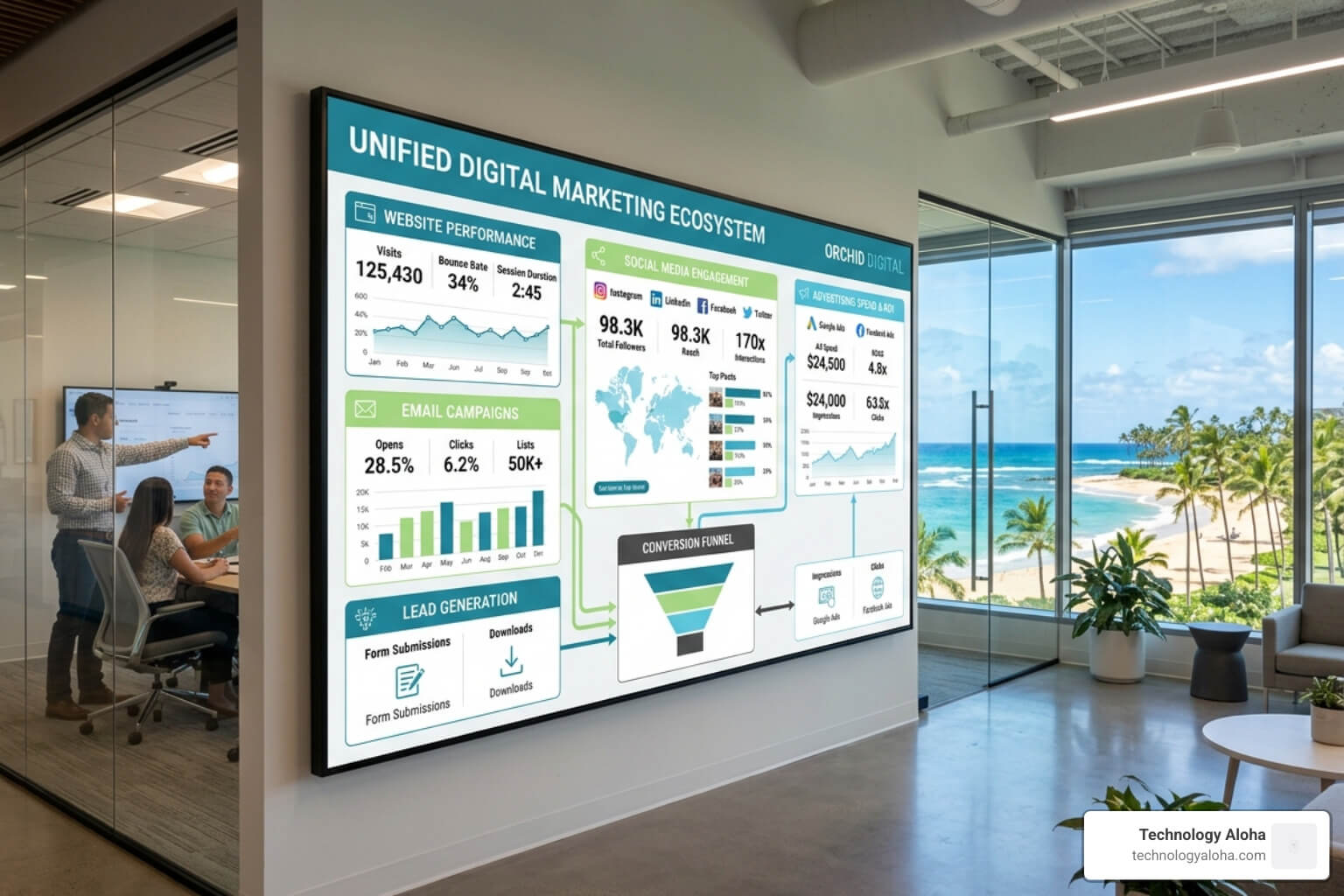
Here’s what that means in practice:
- Brand identity stays consistent across every touchpoint — website, email, social, ads
- Data flows freely between teams so everyone works from the same truth
- Technology is integrated so tools talk to each other instead of creating dead ends
- Customer journeys are mapped so the right message reaches the right person at the right stage
- Channels reinforce each other instead of competing or contradicting
If your website says one thing, your ads say another, and your sales team is working off a third script — you don’t have a marketing strategy. You have a collection of expensive guesses.
That’s the core problem cohesive marketing ecosystems solve.
Modern buyers don’t experience your brand one channel at a time. They Google you, see your ad, check your Instagram, read a review, and land on your homepage — all before making a single decision. Every one of those touchpoints either builds trust or erodes it.
The numbers make the stakes clear. By 2030, ecosystems are projected to account for nearly 30% of global revenue — more than $80 trillion. The organizations winning that share won’t be the ones running the most campaigns. They’ll be the ones running the most connected ones.
For small business owners especially, fragmented marketing isn’t just inefficient — it’s a competitive disadvantage. Larger competitors have the budget to survive waste. You don’t. Cohesion is how you level the playing field.
This guide walks you through exactly how to build one — from foundational pillars to technology integration to measuring what actually matters.
Know your cohesive marketing ecosystems terms:
- How to Achieve High Conversion E-commerce Success
- Why Your Business Needs a High-Performance Digital Strategy
- The Ultimate Blueprint for High-Performance Website Builds
In the 2026 market landscape, we no longer view marketing as a linear funnel. Instead, we see it as a networked economy. A marketing ecosystem is a living, breathing organism where every piece of content, every data point, and every team is an interconnected actor working toward a shared mission.
This shift from isolated campaigns to ecosystem orchestration is driven by economic transformation. Research suggests that ecosystems will represent a value pool of $70–100 trillion by 2030. To capture this, we must move beyond checking boxes on a list of tactics. We must embrace interdependence.
We use the PESO model—Paid, Earned, Shared, and Owned media—to build visibility. In a cohesive system, these aren’t separate buckets. A change in your “Owned” media (like a blog post) should immediately trigger a ripple effect through your “Shared” (social) and “Paid” (ads) channels. This creates a “solar system” effect where your core assets generate a gravitational pull, keeping customers engaged across the entire purchasing journey.
| Siloed Tactics | Cohesive Ecosystems |
|---|---|
| Fragmented messaging per channel | One unified brand story across all touchpoints |
| Data trapped in individual tools | Single source of truth via integrated CRM/CDP |
| Linear, one-way funnels | Non-linear, compounding growth loops |
| High waste and resource duplication | Resource sharing and automated workflows |
| Manual, slow adjustments | Real-time, data-informed pivots |
The Pillars of Cohesive Marketing Ecosystems
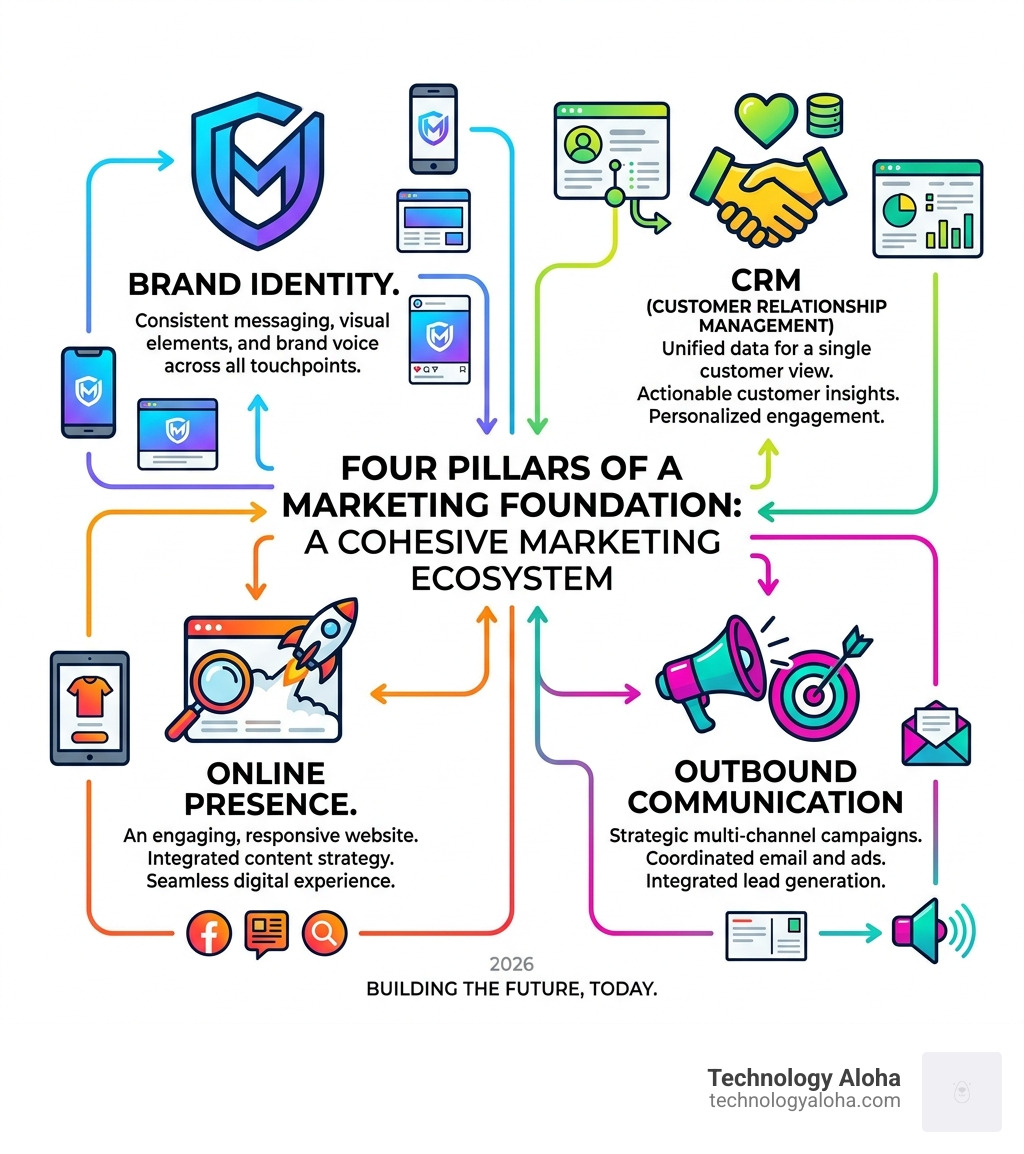
Building a cohesive marketing ecosystem is like building a home here in Hawaii. You need a foundation that can withstand the elements—in this case, market volatility and shifting consumer behavior. We focus on four foundational pillars:
- Brand Identity: This is your most valuable asset. It’s not just a logo; it’s your mission, promise, and purpose. Consistency here builds the trust necessary for long-term loyalty.
- CRM Integration: Your Customer Relationship Management (CRM) system is the heart of the ecosystem. It’s where your data lives and where your sales and marketing teams finally stop fighting and start collaborating.
- Online Presence: From your website to your mobile app, your digital footprint must feel like a single, continuous experience.
- Outbound Communication: Whether it’s email newsletters or targeted e-blasts, your communication must be personalized and timely, not generic and spammy.
A Brand Style Guide Your Key To A Consistent Brand Image is the rulebook that ensures these pillars stay aligned. Without it, your ecosystem quickly becomes a jungle of conflicting messages. Furthermore, Building A Cohesive Brand Presence From Web To Mobile ensures that as your customers move between devices, they never feel like they’ve stepped into a different company’s world.
The Role of Data in Cohesive Marketing Ecosystems

In 2026, data is the connective tissue of your ecosystem. However, having data isn’t enough; you need a single source of truth.
A cohesive data ecosystem allows us to layer information from multiple sources. For example, when we combine email open rates with actual purchase history and website behavior, we can move beyond basic segmentation into hyper-targeting. This level of personalization is what modern consumers expect.
Efficiency is the other major benefit. A well-oiled data system reduces the time spent cross-referencing metrics from hours to minutes. It also provides the resilience needed to survive platform disruptions. By prioritizing first-party data (the data you own), you reduce your reliance on third-party platforms that can change their algorithms or privacy rules overnight.
Maintaining a cohesive system also makes it significantly easier to stay compliant with privacy regulations like GDPR. When all your data is in one place, managing consent and data requests becomes a streamlined process rather than a manual nightmare.
Integrated Technology and Automation
Technology should unite your teams, not create silos. A truly cohesive marketing ecosystem relies on a modern tech stack that features:
- Digital Experience Platforms (DXP): A DXP serves as your foundation, usually with a CMS at its heart. It integrates your website, e-commerce, and social media into one manageable platform.
- Customer Data Platforms (CDP): This unifies your first- and third-party data into a single, real-time customer view.
- AI-Driven Demand Generation: We use AI to speed up research, content planning, and topic coverage. However, we always apply human expertise to ensure accuracy and brand voice. AI is the engine, but we are the drivers.
The goal is seamless data flow. When your tools talk to each other, you can automate repetitive tasks, allowing your team to focus on high-value strategic work. For instance, Crafting Cohesive Digital Experiences That Actually Convert requires that your landing pages, tracking pixels, and email sequences are all perfectly synchronized.
Building Your Unified Strategy: A Step-by-Step Framework

How do we actually build this? It requires a strategic roadmap and strong CMO leadership to drive cultural unity alongside technical integration.
- Audit Your Existing Landscape: Identify where your data is trapped and where your messaging is drifting. Look for gaps, redundancies, and missed opportunities for automation.
- Map the Customer Journey: Take a customer-centric view. Map every team, process, and tool to the ideal journey your buyer takes—from first discovery to becoming a loyal advocate.
- Define Your Topic Pillars: Instead of scattered blog posts, build topic clusters. This builds topical authority and helps search engines understand your expertise.
- Align Your Channels: Ensure your website, SEO, paid ads, and email all tell the same story. This prevents “buyer hesitation” caused by inconsistent proof points.
- Orchestrate and Automate: Use your DXP and CRM to ensure data flows between these channels in real-time.
For a deeper dive into foundational strategy, review our Branding Strategy 101 guide.
Managing Multi-Brand Complexity
For organizations with multiple sub-brands, maintaining cohesion is even more challenging but even more rewarding. The “secret sauce” here is the multi-brand design system.
By sharing costs and frameworks across brands, you can save thousands of design and development hours. This doesn’t mean every brand looks the same; it means they share a common DNA. We use reusable web components to ensure a consistent look and feel while allowing for local adaptability—a concept we call “glocalization.”
Regular external audits are essential. Even with strong internal processes, it’s easy for brands to drift apart over time. We recommend quarterly audits to check for brand consistency, cannibalization between brands, and new cross-promotional opportunities. If you’re looking for local expertise, Maui Branding Magic Where To Find Cohesive Design Solutions offers insights into how we handle these complex structures.
Measuring Success within Cohesive Marketing Ecosystems
We don’t just look at vanity metrics like “likes” or “clicks.” In a cohesive marketing ecosystem, we measure what actually drives business growth:
- Donor/Customer Lifetime Value (DLV/CLV): How much value does a customer bring over their entire relationship with you?
- Retention Rates: Are your systems successfully keeping people engaged after the first transaction?
- Cross-Platform Engagement: Are users moving seamlessly from your social media to your website to your email list?
- Attribution Modeling: Moving beyond “last-click” to understand how every touchpoint contributed to the final conversion.
This data allows for continuous evolution. We treat the ecosystem as a living thing—measuring, adjusting, and sustaining it over time. This approach is particularly vital for Positioning And Branding For Small Business, where every marketing dollar must work harder.
Frequently Asked Questions about Cohesive Marketing Ecosystems
What is the difference between a marketing ecosystem and a marketing strategy?
A marketing strategy is your plan of action—the “what” and “why” of your goals. A cohesive marketing ecosystem is the “how.” It is the actual infrastructure of people, tools, data, and processes that allows your strategy to function. You can have a great strategy, but without a healthy ecosystem, you won’t have the visibility or agility to execute it effectively.
How can small organizations build a cohesive ecosystem with limited budgets?
Start small and focus on the pillars. You don’t need a million-dollar tech stack to be cohesive. You need a unified brand voice, a single CRM (many are affordable for small businesses), and a commitment to “one message, every channel.” Prioritize a few key platforms deeply rather than spreading yourself thin across every new social media app. Automation tools like Canva for Nonprofits or basic email triggers can scale your efforts without a massive team.
Why is leadership essential for ecosystem cohesion?
Cohesion is as much about culture as it is about technology. Without leadership from the top—specifically the CMO—teams will naturally retreat into their silos. Leadership ensures that the social media team is talking to the sales team, and that everyone understands the overarching mission. Leadership also makes the hard calls on which tools to keep and which to cut to ensure the tech stack stays integrated.
How Can Technology Aloha Help You Build a Cohesive Marketing Ecosystem?
The era of fragmented, siloed marketing is over. In 2026, business resilience and compounding growth come from cohesive marketing ecosystems that treat every customer interaction as part of a larger, unified story.
By building on a solid foundation of brand identity and integrated data, you transform your marketing from an expense into a growth engine. Whether you are a small business in Kahului or a large organization across Hawaii, the principles of coordination, consistency, and customer-centricity remain the same.
Ready to stop guessing and start connecting? Build your cohesive marketing strategy today with Technology Aloha. We blend data-driven insights with cohesive branding to create high-conversion designs that help your business thrive in this networked economy.