Build an Integrated Digital Marketing Strategy That Works as One System
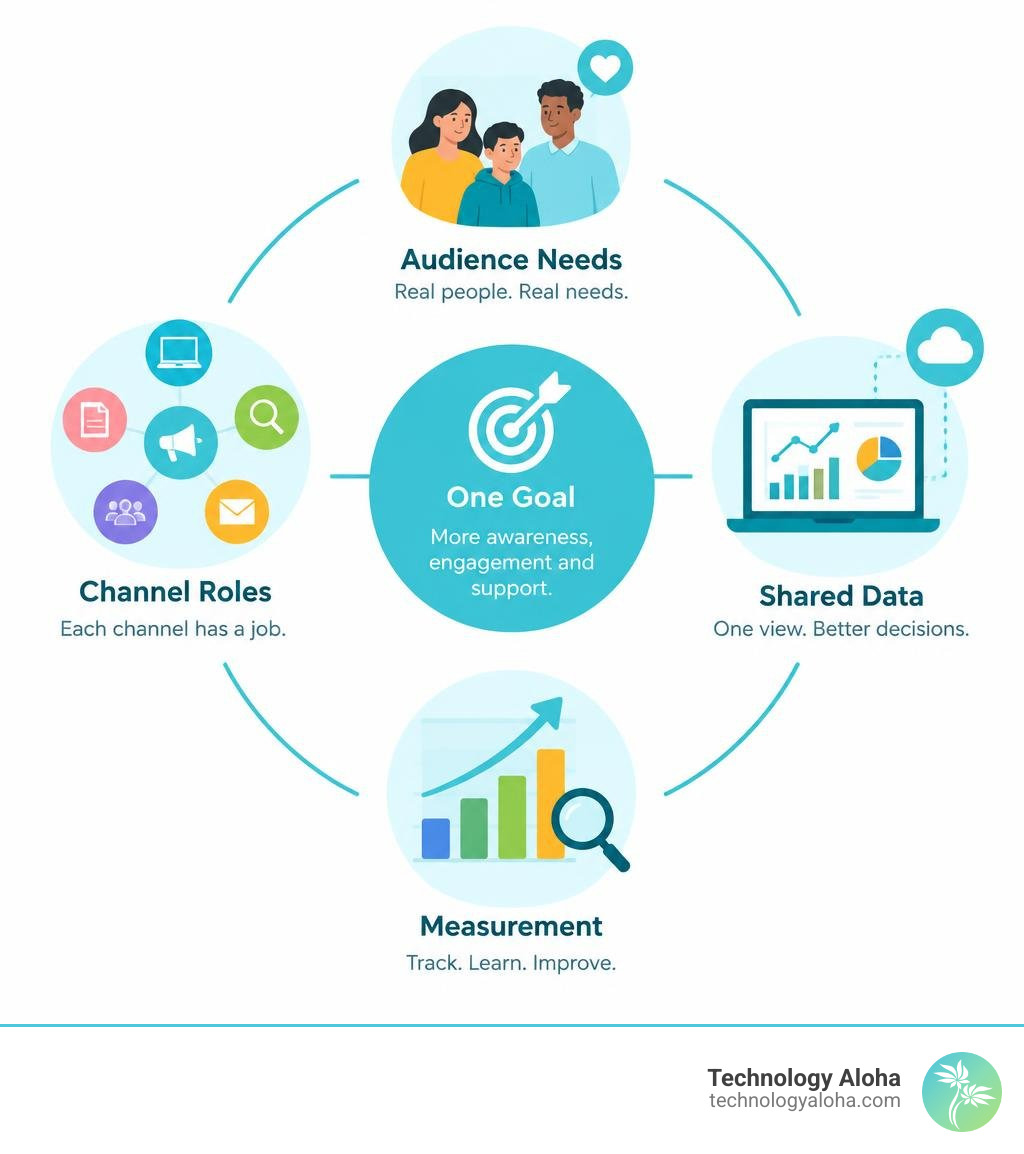
An integrated digital marketing strategy gives every channel a job in one shared plan. To build one, set a clear goal, map how people find and engage with your organization, and give your website, search, social media, email, and offline outreach distinct roles. Then use shared data to see where people get stuck and what to improve.
For a food bank, that might mean a community flyer and a social post lead to the same easy-to-use services page, while donor emails and search ads point to a clear donation path. The message stays consistent, but each touchpoint serves the person using it.
Integrated digital marketing strategy resources:
- The Ultimate Guide to a Marketing Plan
- Data-Driven Marketing Plans: A Practical Field Guide for Modern Teams
- Marketing Strategy Tips for 2026
Foundations of Strategic Cross-Channel Integration
Modern growth does not fail because organizations lack marketing channels. It fails because those channels operate as isolated fiefdoms. When your social media team chases viral impressions, your paid advertising runs standalone promotions, and your email marketing sends disconnected newsletters, your audience receives mixed signals.
A unified digital framework binds every customer touchpoint into an engine of compounding momentum. Integration turns disjointed digital noise into a coherent conversation, accelerating the velocity at which prospects move from initial discovery to long-term advocacy.
Why Your 2026 Growth Relies on an Integrated Digital Marketing Strategy
The digital landscape has fundamentally shifted. Zero-click discovery and conversational AI search interfaces now answer routine user queries directly on search engine results pages. Potential supporters and buyers evaluate your organization long before visiting your homepage. Reaching these fragmented audiences requires understanding Why Your Business Needs a High-Performance Digital Strategy to coordinate discovery with direct capture.
When prospects finally click through, they demand immediate relevance. Fragmented messaging erodes trust instantly. If a local food relief initiative promotes emergency pantry distribution on social media, but its landing page defaults to an outdated capital campaign form, conversion rates plummet. An integrated strategy guarantees that brand positioning, creative assets, and conversion paths reinforce one another across every touchpoint.
Deconstructing Multichannel, Omnichannel, and Integrated Frameworks
Marketers often use the terms multichannel, omnichannel, and integrated interchangeably. They represent distinctly different operating models:
- Single-Channel: The organization relies on one isolated platform (e.g., direct mail or local print).
- Multichannel: The organization maintains a presence across multiple platforms (e.g., website, Facebook, email), but each functions in an independent operational silo with disconnected metrics.
- Omnichannel: The customer journey spans desktop, mobile, and physical touchpoints with synchronized interfaces, focusing primarily on seamless user access.
- Integrated: Channels share unified customer data, coordinated messaging matrices, and shared business objectives. Every channel performs a distinct strategic role—either demand creation or demand capture—tied to full-funnel attribution.
| Marketing Model | Data Infrastructure | Message Coordination | Primary Strategic Focus |
|---|---|---|---|
| Single-Channel | Standalone database | Single format | Channel-specific reach |
| Multichannel | Disconnected data silos | Inconsistent per channel | Platform presence |
| Omnichannel | Synchronized interfaces | Unified brand identity | Experience continuity |
| Integrated | Unified customer data platform (CDP) | Dynamically tailored messaging matrix | Compounding revenue & conversion growth |
Core Pillars of an Integrated Digital Marketing Strategy
Executing an integrated strategy requires moving beyond tactical checklists to establish cross-functional marketing pillars.
Pillar 1: Unified Customer Data and Full-Funnel Attribution
Siloed analytics create blind spots. If your paid search team claims credit for a conversion that began with an educational blog post and was nurtured over three email newsletters, you will misallocate budget.
Integrating your tech stack around a centralized Customer Relationship Management (CRM) platform and adopting first-party data capture resolves attribution chaos. By reviewing Data-Driven Marketing Plans: A Practical Field Guide for Modern Teams, leadership can align pipeline metrics across paid, earned, shared, and owned channels.
Pillar 2: Cross-Channel Content Synchronization and Atomization
Creating net-new assets for every channel is inefficient and dilutes core messaging. High-performing teams rely on content atomization—taking a single, authoritative anchor asset and adapting it across distribution channels.
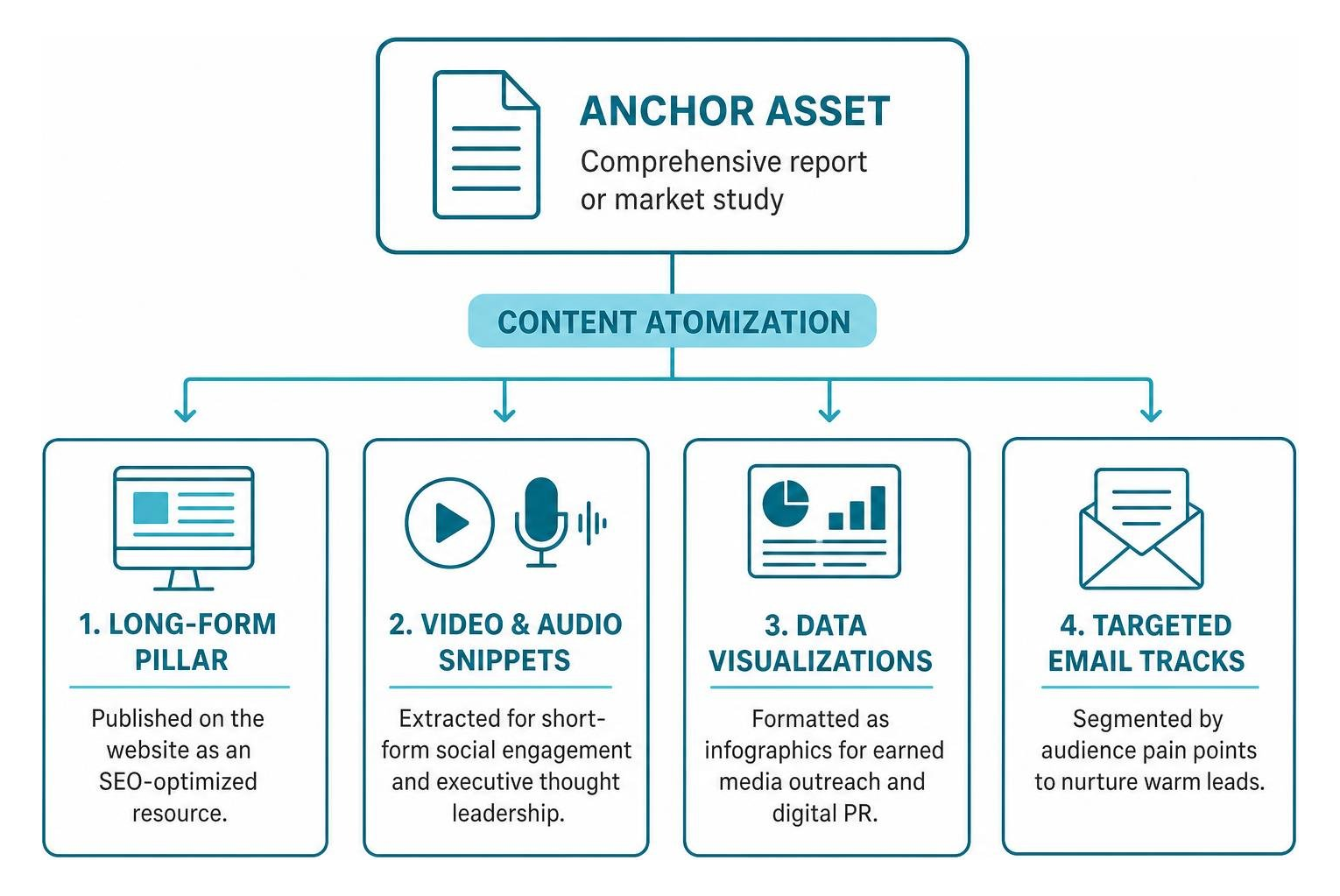
A comprehensive community impact report or market study can be atomized systematically:
- Long-Form Pillar: Published on the website as an SEO-optimized resource.
- Video & Audio Snippets: Extracted for short-form social engagement and executive thought leadership.
- Data Visualizations: Formatted as infographics for earned media outreach and digital PR.
- Targeted Email Tracks: Segmented by audience pain points to nurture warm leads.
- Direct Response Ads: Retargeting users who engaged with the pillar content.
This synchronization forms The Secret Sauce to Creating Cohesive Marketing Ecosystems, multiplying reach while reinforcing a singular value proposition.
Pillar 3: High-Performance Conversion Infrastructure
Traffic without frictionless conversion infrastructure wastes capital. An integrated campaign must direct traffic to user-centric, high-speed destinations tailored to user intent.

At Technology Aloha, we specialize in building scalable digital infrastructure for food banks and nonprofits, closing the survival gap through virtual donation platforms and high-conversion websites. Our focus centers on reducing donation friction to increase donor generosity while making it effortless for individuals in need to access community food resources.
Ensuring your web properties function smoothly requires Crafting Cohesive Digital Experiences That Actually Convert. When organizations implement Make Your Website Work Harder With Conversion-Focused Design, every touchpoint directs visitors to clear, intuitive actions without unnecessary form fields or confusing navigation.
Designing and Executing an Integrated Growth Blueprint
Bridging high-level strategy and daily execution requires a structured operational sequence.
Step-by-Step Implementation Framework
Building a sustainable cross-channel system follows four clear phases:
- Conduct an Ecosystem Audit: Inventory existing digital properties, historical channel performance, data tracking gaps, and messaging inconsistencies.
- Map the Channel Role Matrix: Assign every platform a dedicated objective. Distinguish between channels that drive demand creation (e.g., organic social, programmatic video, digital PR) and those that excel at demand capture (e.g., high-intent paid search, SEO landing pages, automated email workflows).
- Draft Unified Campaign Briefs: Establish a single source of truth for cross-functional teams, defining target personas, anchor assets, core value propositions, and stage-specific KPIs before launching assets.
- Iterate via Full-Funnel Scorecards: Evaluate macro-conversions, customer lifetime value, and cross-channel velocity rather than platform-specific vanity metrics.
For teams refining their planning cadences, The Complete Guide to Understanding the 4 Stages of Marketing Planning provides structural clarity. Professional frameworks like implementing an integrated digital marketing plan from eCornell also emphasize cross-departmental buy-in as a baseline requirement for sustainable growth.
Integrating Traditional and Digital Touchpoints Seamlessly
Physical touchpoints remain powerful drivers of digital action when connected intentionally. Print collateral, direct mail appeals, and community events should never function as dead ends.
- Dynamic QR Codes: Route direct mail recipients to personalized, mobile-optimized landing pages with pre-filled campaign identifiers.
- Physical Event Amplification: Leverage live events to capture digital newsletter subscriptions and trigger automated post-event follow-up sequences.
- Geotargeted Digital Support: Deploy localized search and social retargeting in zip codes receiving direct mail drops to compound brand recall.
Integrating offline and digital efforts is explored further in Designing Effective Distribution in Marketing Plan Frameworks for 2026.
Key Differences in Executing an Integrated Strategy for B2B vs. B2C
While integrated marketing principles apply universally, execution tactics diverge based on transaction complexity:
- B2C & Direct Donor Marketing: Characterized by shorter consideration cycles, emotional decision drivers, and broad audience segments. Integration emphasizes rapid retargeting, mobile-first conversion funnels, and real-time social proof.
- B2B & Institutional Philanthropy: Governed by multi-stakeholder buying committees, extended evaluation timelines, and rational risk-mitigation criteria. Integration centers on Account-Based Marketing (ABM), thought leadership, and custom sales enablement collateral. Reviewing B2B Buyer Persona Examples That Actually Close Deals helps teams map complex stakeholder motivations.
Technology, Automation, and ROI Measurement
Marketing technology should reduce friction, not introduce operational bloat.
Harnessing AI and Marketing Automation Across Channels
Modern marketing automation engines and AI tools allow lean teams to orchestrate complex multi-touch journeys without manual overhead:
- Dynamic Personalization: Adjust website hero banners and email messaging based on past engagement history.
- Predictive Lead & Donor Scoring: Automatically route high-intent prospects to direct outreach while enrolling early-stage contacts into educational nurture tracks.
- Cross-Channel Budget Fluidity: Reallocate ad spend dynamically to top-performing audience segments across search and social networks in real time.
Academic curricula like integrated digital marketing campaigns at U of M CCAPS emphasize leveraging automation for operational scale rather than simply generating generic copy.
Measuring True Impact: Beyond Last-Click Attribution
Single-touch and last-click attribution models skew performance data by assigning 100% of conversion credit to the final link clicked. This undervalues critical top-of-funnel discovery channels like SEO, organic social, and brand awareness campaigns.
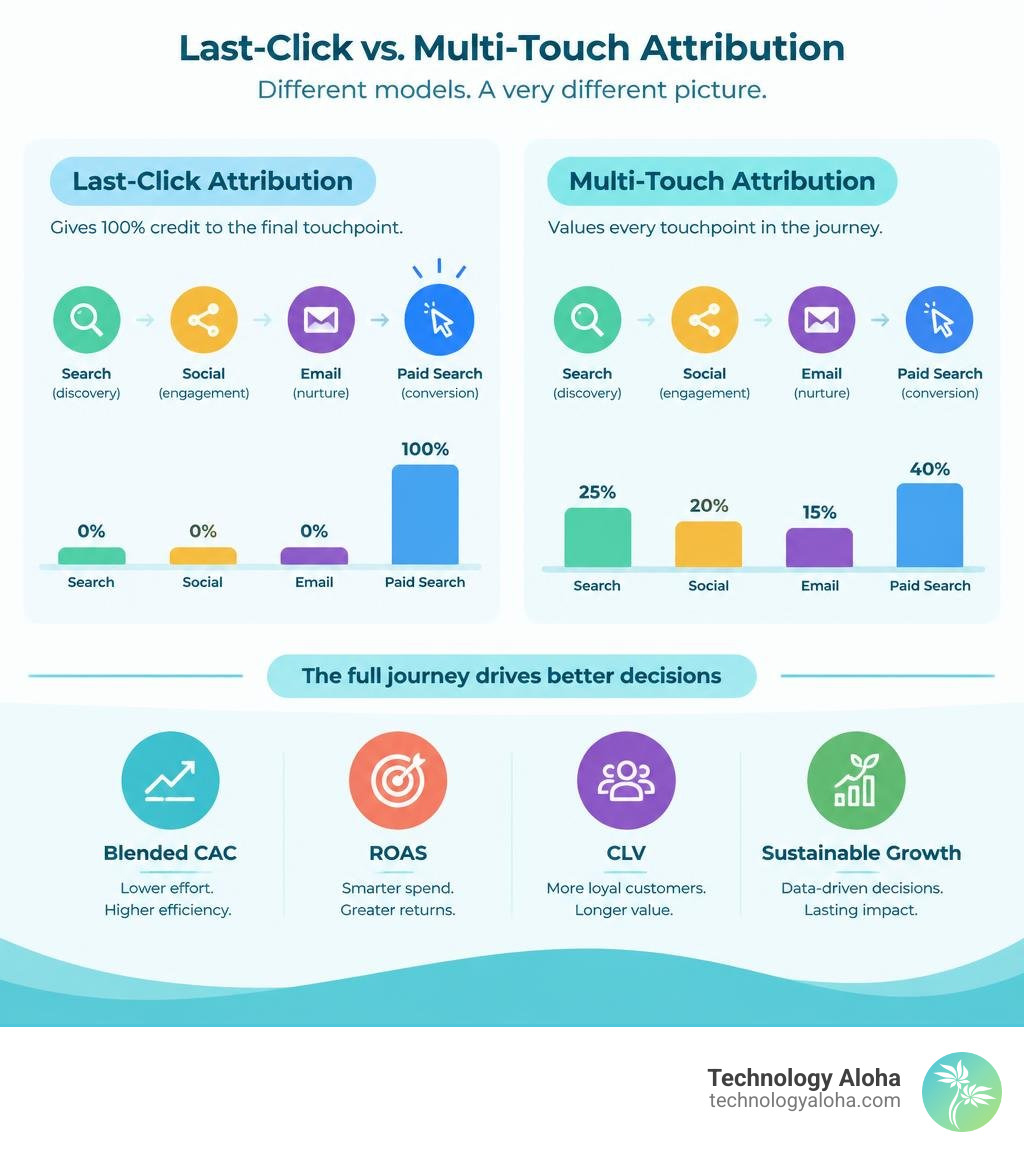
Implementing multi-touch attribution (linear, time-decay, or position-based) illuminates the entire path to conversion. Tracking blended Customer Acquisition Cost (CAC), Return on Ad Spend (ROAS), and Customer Lifetime Value (CLV) provides leadership with clear visibility into how marketing investments drive sustainable growth. Aligning metrics with overarching business goals is detailed in Customized Marketing Strategy: A Practical Framework for Tailored Growth.
Frequently Asked Questions About Integrated Marketing
How does an integrated strategy lower customer acquisition costs?
Integration prevents wasted spend across multiple fronts. Repurposing anchor assets eliminates redundant creative production costs, while synchronized cross-channel messaging reinforces brand recall. Furthermore, running multi-channel retargeting campaigns ensures that paid traffic is captured by targeted email sequences rather than leaking out of the funnel.
What tools are essential for managing an integrated digital strategy?
A functional integrated stack requires:
- Centralized CRM: A single system of record for all contact data and interactions.
- Marketing Automation Engine: To trigger synchronized email, SMS, and ad-audience updates.
- Cross-Channel Analytics Platform: To measure full-funnel multi-touch attribution.
- Shared Project Management Suite: To align content calendars, campaign briefs, and creative assets across departments.
How long does it take to see measurable results from marketing integration?
Initial operational efficiencies—such as unified tracking and resolved funnel friction—deliver measurable conversion rate improvements within 30 to 60 days. Broader revenue and pipeline compounding typically materialize over 3 to 6 months as cross-channel data accumulates and nurture sequences mature.
Conclusion
An integrated digital marketing strategy transforms fragmented promotional efforts into a predictable, scalable engine for organizational growth. When your data, content, and conversion infrastructure work in harmony, every marketing dollar works harder to build trust, engage audiences, and drive sustainable revenue.
Whether you operate a commercial enterprise or a mission-driven nonprofit, breaking down operational silos is the defining factor for long-term resilience. At Technology Aloha, based in Kahului, Hawaii, we build the robust digital foundations and frictionless conversion systems organizations need to thrive. To begin structuring your organizational roadmap, explore An Essential Guide to a Marketing Plan for Small Business and start unifying your digital ecosystem today.