A Practical Roadmap to Improve Marketing Strategy
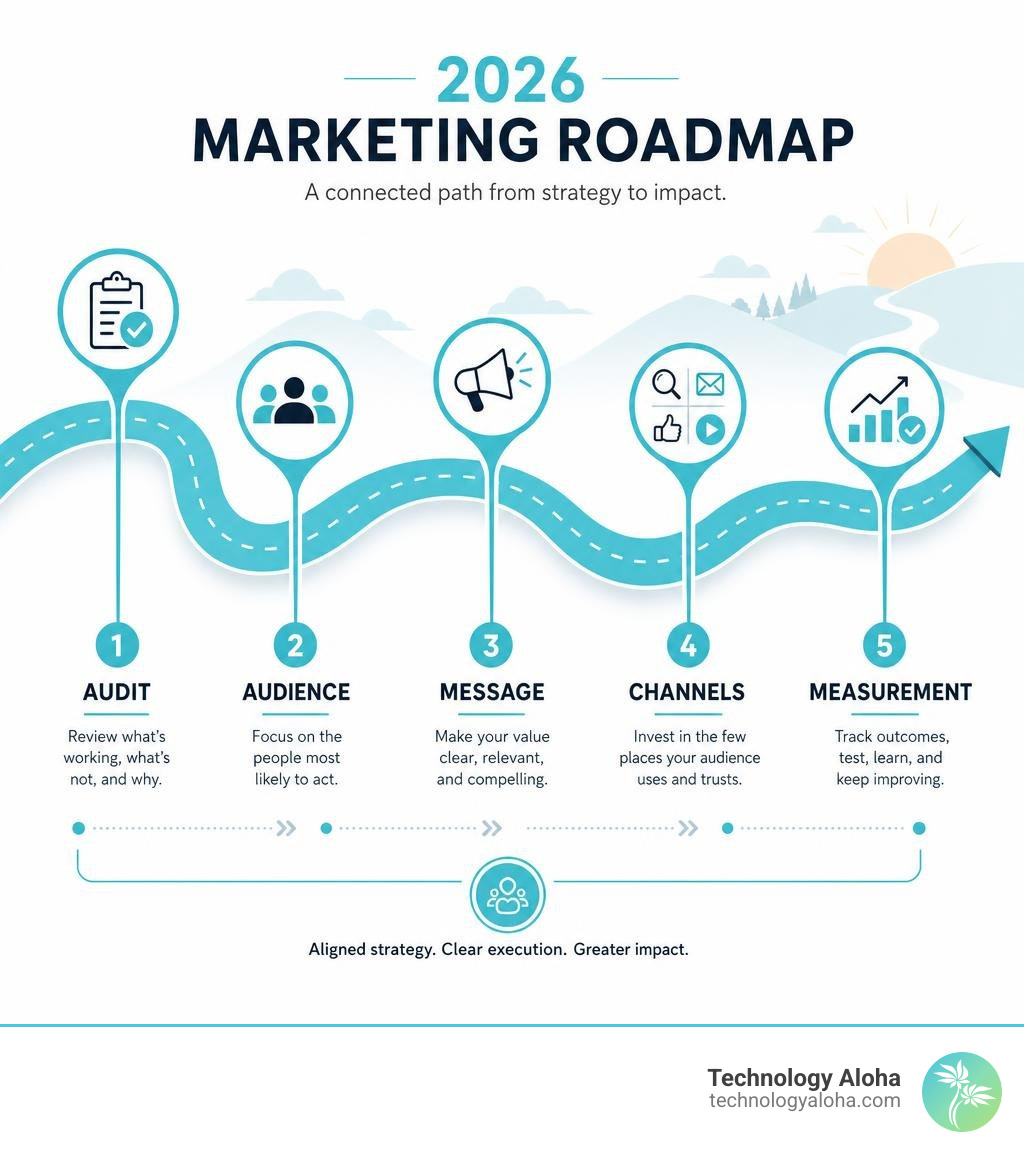
To improve marketing strategy, start by finding what is broken before adding new tactics. Audit your current results, connect goals to mission outcomes, focus on the audiences most likely to act, and shift time toward channels that produce measurable value.

- Audit performance: Review traffic, leads, donations, service inquiries, conversion rates, retention, and operational bottlenecks.
- Refine your message: Make the value clear: who you help, what problem you solve, and why your approach matters.
- Prioritize channels: Invest in the few places where your audience actually searches, learns, and takes action.
- Measure and adjust: Track meaningful outcomes, test one change at a time, then scale, refine, pause, or stop based on evidence.
For food banks and other nonprofits, this means treating marketing as a connected system — not a pile of social posts, email sends, and campaign reports. A clear strategy links awareness to a useful website experience, supporter follow-up, and easier access to services.
Your strategy is the long-term set of choices about audience, positioning, channels, and success measures. Your marketing plan is the schedule of work that puts those choices into action. Both need regular review as community needs, donor behavior, technology, and available resources change. The Salesforce marketing strategy guide recommends tying marketing activity to clear objectives, audience understanding, positioning, and measurable KPIs.
Improve marketing strategy resources:
- The Ultimate Guide to a Marketing Plan
- The Complete Guide to Understanding the 4 Stages of Marketing Planning
- A Quick Start Guide to Creating a Strategic Social Media Plan
How to Systematically Improve Marketing Strategy Performance
Marketing strategy is not a wishlist of campaigns or a collection of social media graphics. It is an operating system for making decisions under uncertainty. When organizations struggle to hit their growth or outreach targets, the breakdown rarely stems from a lack of creativity. Instead, it happens because teams confuse strategy with tactical execution.
Tactics tell you how to post a video, configure an email blast, or buy an ad. Strategy dictates where you compete, why your organization is uniquely qualified to solve a specific problem, and which trade-offs you must make to protect your budget. According to HubSpot’s complete marketing strategy research, marketers who document their strategy are 313% more likely to report success than those who do not. Many small and mid-sized organizations operate without confidence in their strategic direction when goals, audience definitions, and channel priorities are not documented, cycling through disconnected campaigns that drain staff hours and burn through capital.
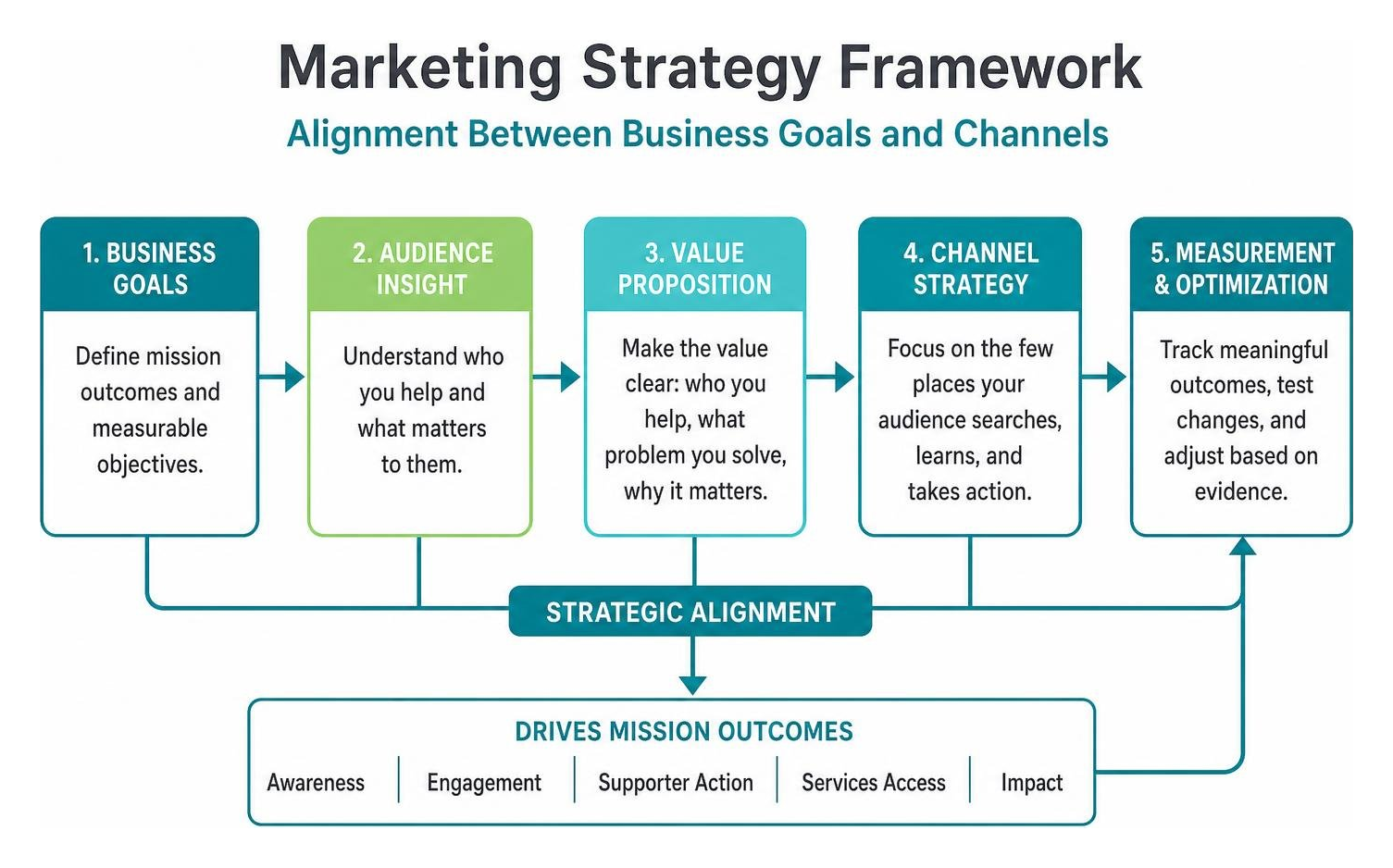
To build a reliable growth engine, every marketing dollar and work hour must connect directly to measurable commercial or mission outcomes. By structuring your approach around proven growth models—such as the classic Ansoff Matrix for market penetration and development, and the STP (Segmentation, Targeting, Positioning) model—you replace guesswork with strategic discipline.
Step 1: Conduct a Diagnostic Audit to Improve Marketing Strategy Alignment
Before updating a single landing page or shifting budget allocations, run an honest, diagnostic audit of your existing infrastructure. An effective audit operates across three distinct layers:
- Performance Metrics: Review hard data across the entire funnel—organic traffic trends, landing page conversion rates, email click-through numbers, customer acquisition cost (CAC), donor retention, and lifetime value (LTV).
- Operational Bottlenecks: Identify internal friction points that slow execution. Common culprits include convoluted approval hierarchies, poor CRM hygiene, lack of clear brand messaging guidelines, and delays in deploying technical website updates.
- Commercial and Mission Alignment: Verify whether your current marketing output matches executive priorities. If the organization needs to grow recurring monthly sustainers or expand high-margin service contracts, top-of-funnel vanity impressions on disconnected platforms do not move the needle.
Reviewing The Complete Guide to Understanding the 4 Stages of Marketing Planning helps identify where historical breakdowns occurred. Did your team fail at market research, goal setting, tactical execution, or ongoing measurement? Diagnosing the precise point of failure prevents you from repeating past mistakes.
Step 2: Clarify Target Audience and Refine Value Propositions
Generic messaging speaks to no one. If your audience definition is merely “people who need our service” or “community members who care about our cause,” your campaigns will fail to convert. Modern audience segmentation requires looking past broad demographics and identifying behavioral drivers, immediate need states, and real-world friction.
For example, consider three distinct organizations operating within the same regional food assistance and sustainability sector in Hawaii:
- Entity A (Emergency Food Relief): Focuses on working families facing sudden financial shocks who need immediate, dignified, mobile-first pantry access without administrative red tape.
- Entity B (Agricultural Food Hub): Connects local farmers with commercial kitchens and schools, targeting procurement directors who value supply-chain reliability and locally sourced produce.
- Entity C (Food Rescue Nonprofit): Partners with resort hotels and grocers to eliminate food waste, targeting corporate sustainability officers needing auditable environmental impact metrics.
Each entity serves the broader food ecosystem, yet their audiences have completely different pain points, trust thresholds, and motivations.
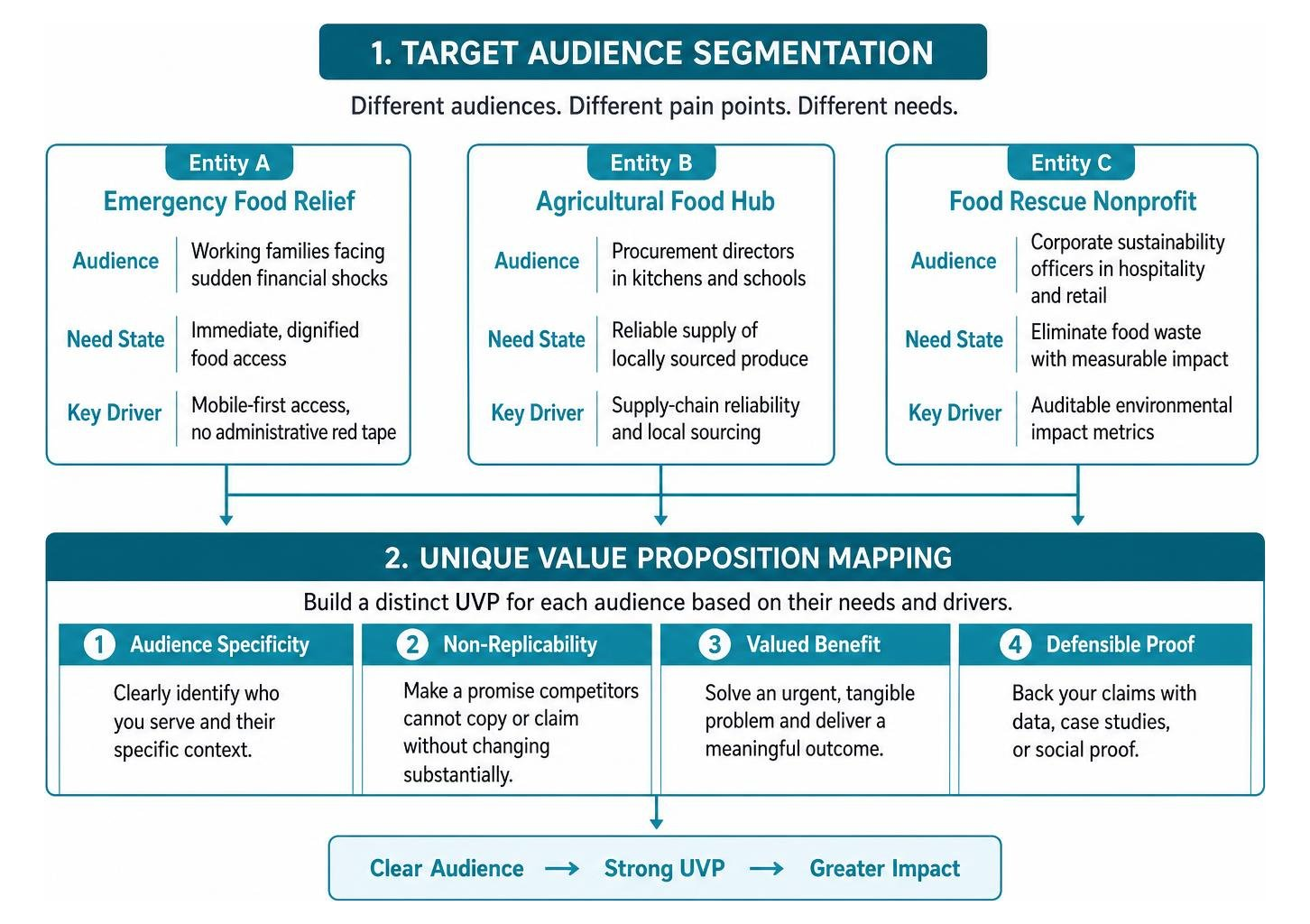
Within an actionable positioning framework, a strong statement must establish your target audience, frame of reference, primary outcome delivered, and verifiable proof. Test your Unique Value Proposition (UVP) against a simple four-part filter:
- Audience Specificity: Is it immediately obvious who this is for?
- Non-Replicability: Could a competitor copy-paste this statement onto their homepage without changing a word? If yes, it is too vague.
- Valued Benefit: Does it solve an urgent, tangible problem rather than offering generic platitudes?
- Defensible Proof: Can you substantiate your claims with data, case studies, or social proof?
Step 3: Optimize Channel Mix and Resource Allocation
Spreading your team thinly across eight different marketing channels guarantees mediocre performance on all eight. It is vastly more profitable to execute exceptionally well on two or three channels than to maintain a ghost-town presence everywhere.
When determining your channel architecture, evaluate where your target audience actively seeks solutions versus where they casually browse. Following The No-Nonsense Guide to Creating Your Small Business Market Strategy prioritizes channels based on audience intent, internal production capacity, and predictable returns.
| Channel Type | Primary Strengths | Strategic Role | Best-Fit Audiences |
|---|---|---|---|
| High-Intent Inbound Search (SEO & Paid Search) | Captures active demand at the precise moment of intent; compounding long-term traffic | Direct acquisition, immediate conversion, local discovery | Buyers and supporters actively searching for specific solutions, services, or local resources |
| Organic & Paid Social Media | Broad brand visibility, visual storytelling, micro-community building | Brand awareness, mid-funnel nurture, audience engagement | Demographics engaging with short-form video, lifestyle narratives, and peer recommendations |
| Lifecycle Email & SMS Automation | Zero platform risk, direct relationship management, high ROI conversion | Retention, recurring giving, automated customer onboarding | Existing leads, registered users, active donors, and repeat customers |
| Strategic Partnerships & PR | Borrows external trust, builds domain authority, expands reach fast | Brand equity, referral generation, high-tier credibility | Stakeholders, institutional partners, and community advocates |
Typical small-to-midsize organizations invest between 7% and 15% of overall revenue into their marketing budget. Allocate roughly 70% of those resources into proven, core direct-response and retention channels, 20% into scalable content and SEO infrastructure, and reserve 10% as a strategic testing budget for experimental channels.
Advanced Execution: Modernizing Channels and Technology
Optimizing a marketing strategy requires moving away from siloed tactics toward an integrated omnichannel architecture. If a prospect discovers your brand via search, reads an educational article on your website, sees a retargeted message on social media, and later signs up for an email newsletter, their data context must remain connected.

Modern digital infrastructure bridges the gap between marketing spend and bottom-line outcomes. For nonprofits and mission-driven organizations, this means ensuring that virtual donation platforms and service registration portals provide zero-friction experiences across every device.
How to Continually Improve Marketing Strategy with AI and Automation
Artificial intelligence is no longer an experimental luxury; it is a baseline operational requirement. However, successful organizations do not use generative AI to churn out generic, low-quality blog posts that clutter search engines. Instead, they leverage AI for predictive analytics, deep audience segmentation, and operational acceleration.
According to Backlinko’s 2026 marketing strategy roadmap, leading marketing teams use AI to automate routine data consolidation, identify buyer sentiment patterns, and personalize outreach at scale. Key strategic integrations include:
- Dynamic Lead Scoring: Automatically segmenting inbound inquiries based on engagement signals, allowing sales or donor relations teams to prioritize high-intent contacts immediately.
- Send-Time and Content Personalization: Delivering email communications at the exact hour an individual user historically engages, tailoring subject lines and featured stories to their demonstrated interests.
- Predictive Churn Modeling: Flagging lapsed donors or declining customer engagement before they disappear completely, triggering automated re-engagement workflows.
Treat privacy as a fundamental strategic constraint. With tightening data regulations and the deprecation of third-party cookies, build your automation around first-party data collected through direct opt-ins, member portals, and transparent value exchanges.
Strengthening Organic Reach Through SEO and Content Repurposing
Organic search remains one of the highest-ROI channels available. HubSpot’s content marketing research highlights that websites with active blogs generate 55% more visitors, with 77% of all internet users regularly reading blog content to inform their decisions.
To maximize reach without burning out your creative team, establish a repeatable framework by learning How to Build a Successful Marketing Process centered on modular content repurposing. A single well-researched pillar asset can be systematically deconstructed across multiple channels:
In addition to traditional on-page search engine optimization, optimize your content for Answer Engine Optimization (AEO). Modern search engines and AI discovery tools extract answers directly from clear, structured content. Format your key insights using direct answers, concise bulleted summaries, and schema-structured data so generative search platforms accurately reference your organization as the authoritative source.
Building Omnichannel Retention and Advocacy Engines
Acquiring a new customer or donor costs significantly more than retaining an existing one. Despite this economic reality, many marketing strategies over-index on top-of-funnel acquisition while neglecting post-conversion lifecycle marketing.
Word-of-mouth and peer recommendations remain exceptionally powerful: 88% of people trust recommendations from people they know more than any other channel. Social proof also affects conversion behavior: Northwestern University’s Spiegel Research Center found that displaying reviews can increase conversion rates by up to 270%.
To turn past buyers and supporters into an active advocacy engine, integrate clear social proof across every conversion touchpoint:
- Verified Case Studies and Reviews: Place authentic quotes and star ratings directly beside conversion forms and donation checkout pages.
- Transparent Impact Metrics: Show exactly what a purchase or donation achieves (e.g., meals distributed, hours of service funded, or dollars saved).
- Automated Referral Loops: Give satisfied clients and donors simple, shareable links to introduce colleagues and friends immediately after a positive experience.
Measuring Performance and Running Iterative Reviews
A marketing strategy is not a static document locked in a drawer; it is an iterative operating framework that requires structured governance. Without reliable performance measurement, marketing quickly devolves into expensive performance theater.

To maintain clarity, avoid drowning in vanity metrics like raw impressions, page views, or social media likes. Anchor your reporting to actionable business indicators that directly reflect economic and mission health, as outlined in the Marketing Strategy Guide: Small Business 2026.
Structuring High-Velocity Growth Experiments
Do not overhaul your entire marketing engine overnight based on gut feelings. Improve your strategy by running disciplined, single-variable growth experiments with predefined success metrics and strict stop criteria.
Maintaining a centralized experimentation backlog ensures your team continually tests value propositions, headline clarity, call-to-action buttons, and email subject lines without introducing operational chaos.
Establishing Review Loops: Scale, Refine, Pause, or Stop
Establish a disciplined monthly and quarterly governance rhythm. During each review, evaluate channel performance against your baseline CAC payback horizon and gross margin contribution, concluding with one of four explicit operational choices:
- Scale: Channel is outperforming CAC payback thresholds and driving sustainable growth—increase budget allocation and expand reach.
- Refine: Channel shows promising engagement or high lead volume but suffers from lower downstream conversion—optimize messaging, onboarding speed, or landing page friction.
- Pause: Channel performance is hindered by temporary operational bottlenecks or seasonal dips—hold spend while fixing technical constraints.
- Stop: Channel has failed to meet core profitability or acquisition benchmarks for two consecutive quarters—eliminate the initiative and redeploy resources into proven channels.
Frequently Asked Questions About Marketing Strategy Optimization
How often should a business revisit and update its marketing strategy?
Review tactical performance monthly and run a formal strategic evaluation quarterly. Comprehensive overhauls should take place annually to align with new business goals, emerging technology, and broader industry shifts. However, if a major market disruption occurs—such as sudden economic changes or major shifts in consumer search habits—adjust your strategic assumptions immediately.
What is the difference between a marketing strategy and a marketing plan?
A marketing strategy defines the overarching long-term vision, value proposition, target customer segmentation, and competitive positioning (the what and why). A marketing plan is an operational roadmap that details the specific campaigns, timelines, asset deliverables, and channel budgets needed to execute that strategy (the how, where, and when).
How long does it take to see measurable results after improving a strategy?
Immediate tactical optimizations—such as removing friction from donation pages or running targeted paid search ads—can produce measurable conversion lifts within 30 to 60 days. Compounding organic channels like search engine optimization, content marketing, and brand authority engines typically require 3 to 9 months to demonstrate clear revenue traction and 12 to 18 months to reach full maturity.
What are the key takeaways for improving marketing strategy?
Improving a marketing strategy is not a one-time project with a fixed finish line. It is an ongoing cycle of diagnosing friction, clarifying value, focusing resources on what works, and cutting what does not. Organizations that thrive do so because they treat their marketing as an interconnected system designed to serve real people with clarity and precision.
When you align your messaging with genuine audience needs, build high-performing digital infrastructure, and measure results with disciplined financial rigor, growth shifts from an unpredictable gamble into a dependable, compounding outcome. For small businesses and mission-driven organizations ready to turn high-level strategy into a sustainable operational roadmap, explore An Essential Guide to Marketing Plan for Small Business to take your next strategic step.