In Depth Guide to Branding for Accounting Firms
Why Branding for Accounting Firms Decides Who Wins the Client
Branding for accounting firms is the strategic process of defining how your firm is perceived — by clients, prospects, and future employees — and then making that perception consistent across every touchpoint.
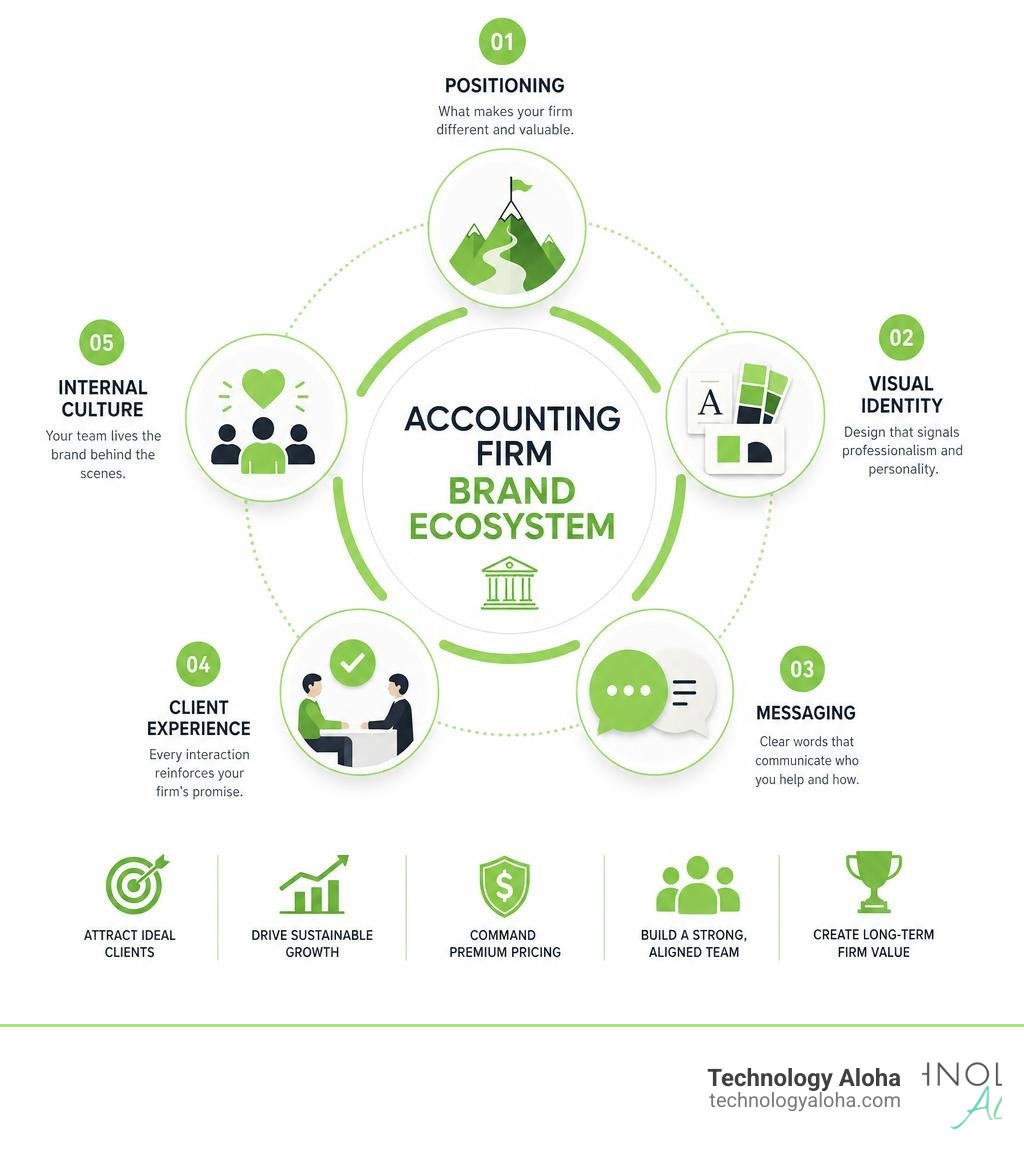
Here is what strong accounting firm branding covers:
- Positioning — what makes your firm different from the other 85,000+ CPA firms in the US
- Visual identity — logo, colors, typography, and imagery that signal professionalism and personality
- Messaging — the words you use to describe who you help and how
- Client experience — how every interaction reinforces your firm’s promise
- Internal culture — how your team embodies the brand behind the scenes
Most accounting firms offer nearly identical services — tax prep, bookkeeping, payroll, advisory. When services look the same, perception becomes the deciding factor.
And yet, branding is still treated as an afterthought in most firms. A logo gets designed. A website gets launched. Nothing is connected. Clients can’t tell you apart from your competitors, so they choose on price.
That is a problem you can fix.
The data backs this up. High-growth accounting firms spend more than twice as much on marketing — 2.1% of revenue versus the industry average of 1%. Meanwhile, 98% of accountants now use AI automation to serve clients, which means the technical work is increasingly commoditized. What you do is no longer enough. How you show up matters just as much.
A real-world example makes this concrete. One six-person accounting firm completed a full rebrand and secured a new $17,000-per-year client within four months of launch. By the end of that year, they had exceeded revenue goals with 4% growth and a 5% increase in their client base.
That is not a coincidence. That is what a clear, consistent, differentiated brand does.
This guide walks you through every step — from defining your firm’s positioning and visual identity to executing a brand strategy that attracts better clients and grows revenue.
The Strategic Value of Branding for Accounting Firms
Many partners view branding as an expense — a superficial layer of paint applied to business cards and websites. This perspective is a costly mistake. In professional services, your brand is your reputation scaled. It is the emotional shortcut a prospect takes to trust you with their financial survival.
When you build a strategic brand, you build enterprise value. A well-positioned firm does not compete on price because its clients do not view its services as a commodity. This structural advantage gives you pricing power. It allows you to transition from billing by the hour to value-based pricing, significantly increasing your margins.
Furthermore, a strong brand directly impacts client retention. When clients feel an emotional connection to your firm—aligned with your values and confident in your specialized expertise—they become highly resistant to competitor pitches. To understand how this works across different business sizes, read our insights on Small Business Branding and Positioning: Why Your Logo Is Not Your Brand.
Why Traditional Branding for Accounting Firms No Longer Works
The traditional playbook for accounting firm marketing is dead. Historically, firms relied entirely on quiet, backroom trust, local word-of-mouth, and conservative visual identities. Today, that approach guarantees invisibility.
With 98% of accountants leveraging AI automation to streamline client workflows, the baseline execution of tax preparation and bookkeeping has been automated. If your brand positioning is built entirely on “accuracy,” “timeliness,” or “painless tax prep,” you are marketing a commodity that software can replicate.
Modern clients expect proactive, strategic advisors, not historians who merely record what has already happened. They research firms online long before making contact, comparing digital presences and evaluating brand authority. If your firm remains hidden behind an outdated, stoic identity, you lose the client before the first phone call. Explore how modern market shifts require a new approach in our guide on Branding.
Logo vs. Brand: Defining Your Firm’s True Identity
A logo is a graphic mark. A brand is the sum of every experience, perception, and emotional connection a client has with your business.
Your visual assets — your logo, color palette, and website — are merely the containers that hold your brand promise. The actual brand is the promise itself. It is how you answer the phone, how clearly you explain complex tax structures, how reliably you deliver on deadlines, and the specific problems you solve for your niche.
Confusing your logo with your brand leads to fragmented marketing and weak market positioning. To build a firm that commands premium fees, you must design both the visual container and the emotional substance inside it. For a deeper dive into this distinction, see our analysis of Positioning and Branding for Small Business.
Designing a Scalable Brand Strategy and Positioning Framework
A scalable brand strategy acts as your firm’s operational DNA. It guides how you hire, how you price your services, and how you communicate value. Without this strategic foundation, your marketing channels will produce inconsistent, low-converting messages.
Your brand strategy must define four core elements:
- Mission: Why your firm exists beyond making a profit (e.g., “To give business owners financial clarity so they can scale with confidence”).
- Vision: Where your firm is heading over the next five to ten years.
- Core Values: The non-negotiable principles that dictate how your team behaves and makes decisions.
- Positioning Statement: A clear formula defining who you serve, what unique problem you solve, and why you are the only logical choice.
To align these strategic elements for long-term growth, review our foundational guide on Branding Strategy 101.
Step-by-Step Guide to Building Scalable Branding for Accounting Firms
Building a brand that scales requires a systematic process. You cannot rely on guesswork or personal design preferences. Follow these steps to build a firm identity that supports long-term expansion:
- Define Your Ideal Target Audience: Move beyond broad demographics. Build detailed buyer personas that outline your target clients’ industry, annual revenue, specific financial pain points, values, and common objections.
- Conduct a Competitive Audit: Analyze your local and regional competitors. Look at their websites, messaging, and visual identities. Identify the gaps they leave behind — such as overly formal language or a lack of transparent pricing — and position your firm to fill those gaps.
- Draft Your Mission, Vision, and Values: Keep these statements practical. Avoid generic corporate jargon like “synergy” or “world-class.” Use plain, direct language that your team can actually live by every day.
- Create Your Messaging Pillars: Establish three to four core themes that run through all your marketing. For example, your pillars might be Proactive Advisory, Industry-Specific Expertise, and Clarity Over Complexity.
- Develop Your Brand Style Guide: Document your visual rules, including logo usage, color codes, typography, and imagery guidelines, to ensure consistency across every digital and print asset.
For a comprehensive blueprint on executing this process, read our article on Mastering Brand Strategy and Development for Modern Marketing.
The Power of Specialization and Niching
The fastest way to differentiate your accounting firm is to narrow your focus. Generalist firms are forced to compete on price because they appear interchangeable to prospects. Specialized firms, however, build instant authority.
Consider the difference in positioning. A business owner in the hospitality industry looking for tax help has two choices:
- Firm A: A generalist CPA firm offering “tax and bookkeeping services for all businesses.”
- Firm B: A specialized firm positioned as “the financial growth partners for independent restaurants and boutique hotels.”
Firm B can charge a premium because they understand the specific tax codes, payroll complexities, and operational challenges of the hospitality industry.
In Hawaii, successful local firms prove this model. For instance, Khalsa CPA Services, LLC serves its local community with clear, targeted positioning. Similarly, HiAccounting establishes strong regional authority by focusing on Hawaii-specific business needs.
If you want to join the ranks of the Top Accounting Firms in Hawaii | 2026 – DesignRush or stand out on the Top Accounting Firms in Hawaii – Jun 2026 Rankings | Clutch.co, you must abandon generalist messaging and own a distinct niche. To learn how to narrow your focus effectively, read our guide on Brand Positioning and Differentiation.
Developing Your Visual Identity and Messaging Architecture

Your visual identity is the first thing a prospect notices about your firm. It must immediately communicate your level of professionalism, modern capability, and brand personality.
A modern visual identity system includes:
- Logo Design: Clean, versatile, and simple. Your logo must work as well on a smartphone screen as it does on a physical office sign. Avoid overused accounting cliches like calculators, columns, or generic bar graphs.
- Color Palette: Colors trigger immediate psychological responses. While traditional blue conveys trust and stability, pairing it with energetic secondary colors like teal (#208a9d) or light green (#abe080) can make your firm look modern and approachable.
- Typography: Limit your brand to two or three typefaces. Use a clean, bold sans-serif for headlines to look modern, and a highly readable font for body text.
- Imagery: Avoid generic, staged stock photos of people shaking hands in glass boardrooms. Instead, use authentic photography of your actual team and local clients, or high-quality, atmospheric imagery that reflects your brand’s style.
For a real-world look at how clean typography and modern visual systems transform accounting brands, look at leading industry case studies. To build your own visual rules, read our guide on Brand Style Guide: Your Key to a Consistent Brand Image.
Balancing Professionalism with Approachability
Accounting is a high-trust industry. Your branding must convey absolute accuracy and security, but it should not feel cold, formal, or intimidating. The most successful modern firms balance professional credibility with warm approachability.
To achieve this balance, write your website copy and client communications in a clear, conversational tone. Avoid dense financial jargon that alienates readers. Instead, write the way you actually speak to clients in real life. Use clear headlines that challenge industry stereotypes, and back them up with transparent process guides like “How We Work” to demystify your services.
A great example of this balanced approach is detailed in the Clayton McKervey branding campaign, which shows how a firm can look energetic and worldly while maintaining deep professional credibility. For more on web design strategies that strike this balance, read The Definitive Guide to Brand Identity Web Design.
Aligning Personal Branding with Firm Identity
In professional services, people buy from people. While your firm’s brand provides a scalable corporate identity, the personal brands of your partners and leadership team build human connection.
Encourage your leadership team to build active, professional presences on platforms like LinkedIn. Sharing educational content, commenting on industry trends, and explaining complex tax changes in simple terms positions your partners as accessible experts. This thought leadership complements your corporate brand, making your firm feel human and approachable.
To learn how to balance these personal and corporate brand assets, read our guide on How to Build a Big Brand for Your Small Business. For practical tips on using personal branding to support firm growth, refer to the step-by-step insights in Branding for accounting firms: build a scalable identity that grows ….
Executing and Measuring Your Brand Strategy
A brilliant brand strategy is useless without consistent execution across your primary marketing channels. Your website is the center of this digital ecosystem. It must be designed for conversions, guiding visitors from initial curiosity to scheduling a consultation.
To turn your brand into a client acquisition engine, focus on these three channels:
- Search Engine Optimization (SEO): Optimize your website for local search queries (e.g., “CPA in Kahului” or “Maui business tax planning”). This ensures that when local businesses search for help, your brand is the first one they see.
- Email Marketing: Email remains one of the highest-ROI marketing channels available, generating $36 of value for every $1 spent. Use regular, educational newsletters to share valuable tax tips, regulatory updates, and business advice, keeping your brand top-of-mind.
- Content Marketing: Create helpful, downloadable resources—like tax checklists or cash-flow templates—to capture leads and demonstrate your expertise before a prospect ever books a call.
| Marketing Channel | ROI Potential | Effort Required | Primary Brand Benefit |
|---|---|---|---|
| SEO & Local Search | Exceptionally High | High (Ongoing) | Long-term visibility and high-intent organic leads |
| Email Marketing | High ($36 per $1 spent) | Medium | Client retention and nurturing warm prospects |
| Content Marketing | High | High (Creation) | Authority building and lead generation |
| LinkedIn Organic | Medium-High | Medium (Consistent) | Personal brand building and referral networking |
Managing a Brand Refresh or Rebrand
As your firm grows, your brand must evolve. If you have recently expanded your advisory services, target larger clients, or acquired other firms, your original branding may no longer fit who you are.
A brand refresh does not mean throwing away your history. It means modernizing your visual identity and messaging to reflect your current capabilities while preserving the trust you have built over the years.
Major national and regional firms manage this transition carefully. For example, the Top 25 CPA firm Eide Bailly, which reports $705 million in revenue, updated its visual identity to emphasize connection and collaboration. You can read about their approach in the official press release: Eide Bailly Unveils New Brand Identity to Reflect Firm’s Growth and Continued Commitment to Connection.
Similarly, the case study Froehling Anderson | Brand Refresh for a Growing CPA Firm shows how an established firm can update its look to support recruiting and expansion without losing its core identity.
Internal Alignment and Brand Culture
Your brand is only as strong as your team’s ability to deliver on its promise. If your marketing promises a “proactive, modern advisory experience” but your staff communicates with slow, jargon-filled emails, the brand breaks down.
To prevent this disconnect, make brand training a core part of your employee onboarding. Provide your team with clear brand guidelines that explain your mission, values, and tone of voice. Reward team members who live your brand values, and ensure your internal culture matches the energetic, professional identity you present to the world.
Key Performance Indicators for Brand Success
Branding is a long-term strategic investment, but its success can and should be measured. Track these key performance indicators (KPIs) to evaluate your brand’s performance:
- Client Retention Rate: A rising retention rate proves your brand is building deep, long-term loyalty.
- Organic Search Traffic: Growth in organic traffic shows that your SEO and brand awareness efforts are working.
- Inbound Consultation Bookings: An increase in qualified, inbound leads indicates that your messaging is successfully reaching your target audience.
- Average Client Value: As your brand positioning grows stronger, you should see an increase in average fees per client, reflecting your growing pricing power.
Frequently Asked Questions about Accounting Branding
How much should an accounting firm budget for branding and marketing?
Most average accounting firms spend about 1% of their annual revenue on marketing. However, high-growth firms—those actively expanding their client base and raising their fees—spend an average of 2.1% of their revenue. If you are launching a full rebrand or a major website redesign, plan for a dedicated upfront investment, and then set aside a consistent monthly budget to maintain and promote your new brand.
How can our firm differentiate if we offer the same compliance services as competitors?
You differentiate through how you deliver those services, who you deliver them to, and the conversations you have around them.
- Niche Specialization: Focus on a specific industry, such as real estate, medical practices, or hospitality.
- Client Experience: Replace slow, traditional accounting processes with modern, transparent client portals and rapid response times.
- Advisory Shift: Position your services around forward-looking strategic advisory rather than historical bookkeeping.
How long does it take to see a return on investment from a rebrand?
While a full rebrand is a long-term strategy, many firms see measurable results quickly. It is common to secure high-value clients who were previously out of reach within three to six months of launching a polished, professional brand. Over twelve to twenty-four months, a strong brand pays off through higher client retention, increased pricing power, and more efficient recruiting.
What are the Key Takeaways for Branding Your Accounting Firm?
In a highly competitive financial market, standing out takes more than just doing great work. It requires a clear, consistent, and strategically positioned brand. By defining your target niche, building a modern visual identity, and aligning your team’s culture with your brand promise, you can transform your firm from an interchangeable service provider into a highly trusted partner.
At Technology Aloha, we combine data-driven insights with strategic positioning and high-conversion web designs to help accounting firms stand out and grow. If you are ready to build a brand that attracts better clients and commands premium fees, we are here to help.