Distribution in a Marketing Plan: Getting Value to the Right People
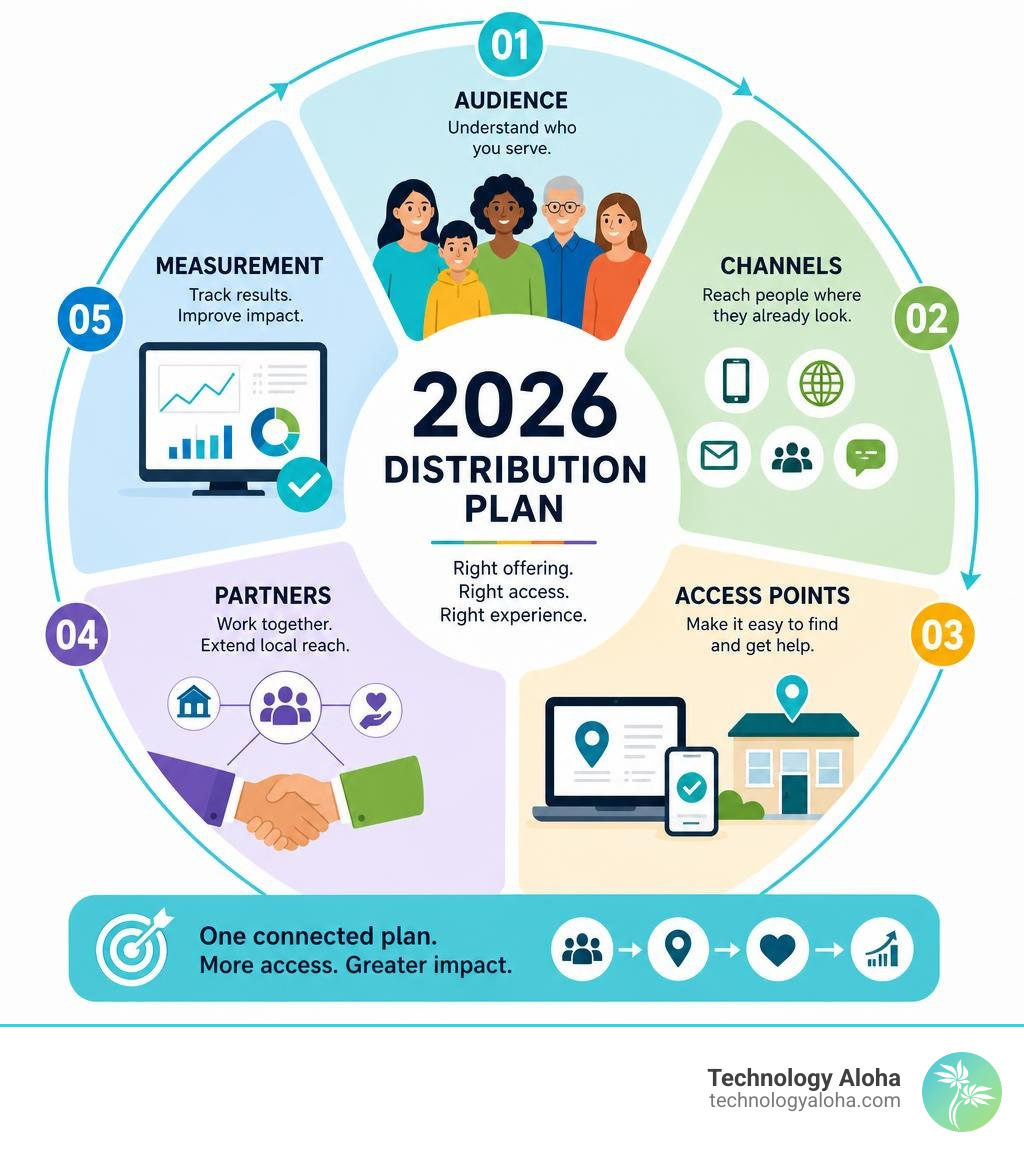
Distribution in a marketing plan defines how people can find, access, receive, and use your product or service. It is the “place” part of the marketing mix, but it is more than shipping or shelf space. It connects your audience, channels, partners, inventory, communications, and customer experience.

For a food bank or nonprofit, distribution may include a service-location finder, online intake forms, mobile distribution sites, partner agencies, email updates, and referral networks. The right plan answers four practical questions:
- Who needs access to the service or offering?
- Where do they already look for help or information?
- Which direct and partner channels can reach them reliably?
- How will every channel deliver a consistent, accessible experience?
A strong distribution plan prevents a common problem: investing in outreach that sends people to confusing, outdated, or hard-to-use access points. It also helps leaders balance reach with control. Direct channels provide clearer data and brand control; partners can extend local reach; a hybrid approach can do both when roles are clear.
Distribution decisions matter more as expectations for fast, easy access rise. Research cited by Walker Sands found that 50% of consumers expect two-hour shipping availability, a useful signal that convenience and speed now shape customer expectations well beyond retail.
Relevant articles related to distribution in marketing plan:
- The Ultimate Guide to Marketing Plan
- The Complete Guide to Understanding the 4 Stages of Marketing Planning
- Marketing Strategy Tips 2026
Understanding the Strategic Role of Distribution in Marketing Plan Development
Developing a remarkable product or vital community service solves only half the equation. The remaining challenge lies in physical and digital delivery: ensuring end users can find and obtain what they need without unnecessary friction. Within traditional marketing theory, distribution represents the “Place” in the 4Ps model. In modern execution, place marketing operates as an interconnected value network that coordinates logistics, data exchange, communication, and partner economics.
A well-structured distribution strategy aligns every customer touchpoint with organizational capacity. According to insights highlighted by Forbes, 91% of companies consider their distribution strategy a key factor impacting overall organizational performance. Furthermore, global spend on distribution services reached over $2 trillion, reflecting the massive operational investment required to move goods and services across modern economies.
When integrating distribution into foundational marketing planning, organizations must move beyond viewing delivery as simple transport. Instead, leaders must evaluate intermediary economics, partner capabilities, and access friction. A structured distribution path framework emphasizes that customer access points directly dictate conversion rates, cash flow stability, and community trust.
Why Distribution in Marketing Plan Architectures Dictates Growth
A distribution strategy functions as the operational engine behind sales and service growth. When access pathways are fragmented, marketing campaigns generate interest that evaporates before reaching a point of sale or intake portal. Conversely, an optimized distribution infrastructure accelerates revenue velocity and mission delivery by placing services directly along existing user pathways.
Integrating distribution with systematic marketing process optimization allows teams to manage three critical business variables:
- Margin preservation: Controlling intermediary layers prevents excess revenue sharing and unnecessary processing fees.
- Customer retention: Reliable, transparent fulfillment builds sustained loyalty across recurring user touchpoints.
- Operational overhead: Coordinated inventory and delivery protocols minimize waste, prevent backorders, and lower service delivery costs.
Overcoming Channel Trade-Offs: Brand Control vs. Market Reach
Every distribution design forces a foundational trade-off between brand control and marketplace reach. Direct routes preserve total governance over messaging, pricing integrity, and user data, yet they demand substantial marketing capital to generate baseline visibility. Indirect routes leverage existing wholesale networks or community hubs for rapid volume, but they sacrifice direct customer intimacy and risk message dilution.
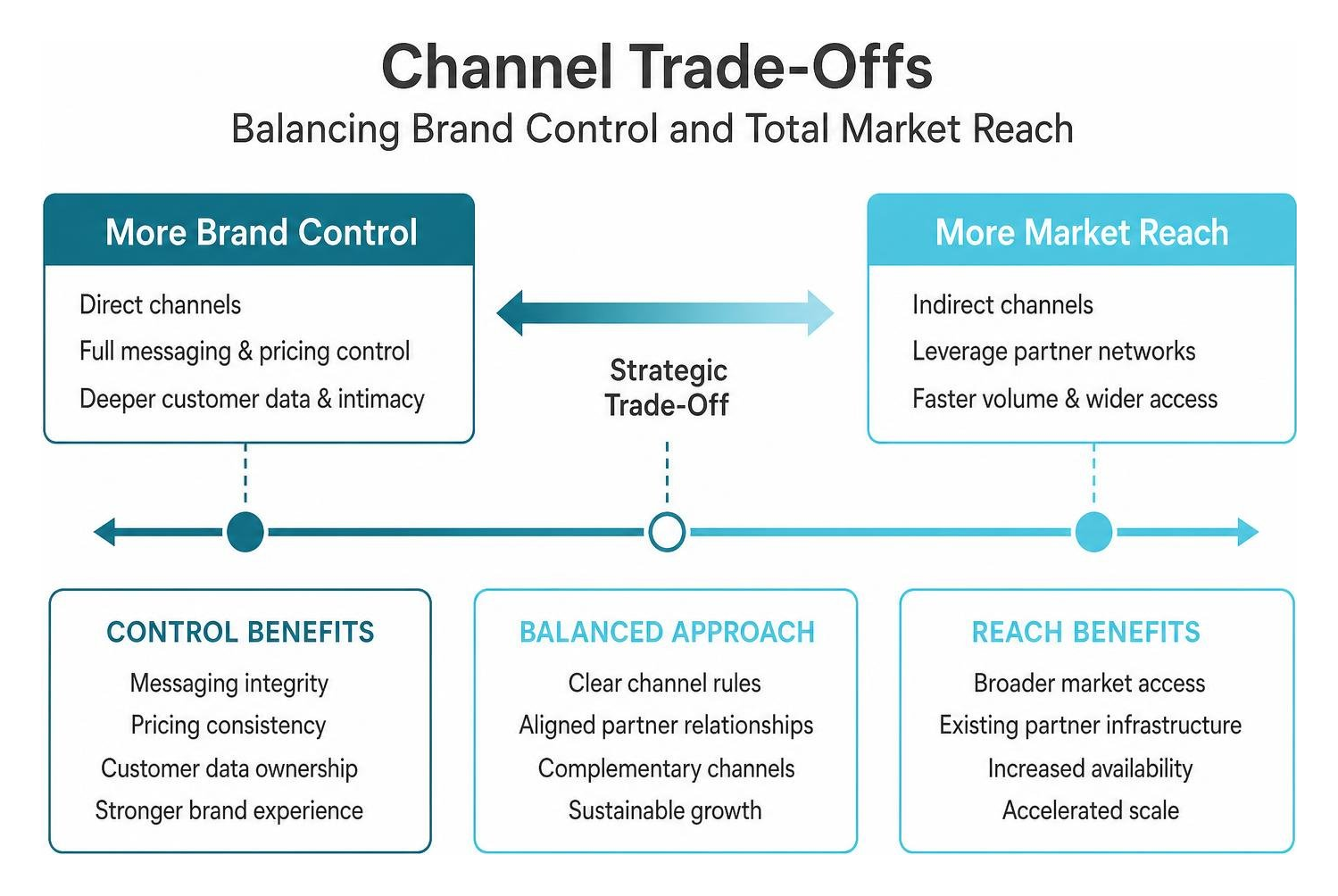
Navigating this trade-off requires setting clear channel rules of engagement. When organizations sell or deliver across multiple avenues, unmanaged channel conflict can cause internal competition, erratic pricing, and frustrated partners. Strategic alignment ensures that intermediary networks complement internal channels rather than cannibalizing them.
Evaluating Primary Distribution Channel Models and Structures
Channel architecture dictates the operational tiers between an organization and its end user. In marketing distribution analysis, these pathways range from direct zero-tier structures to complex, multi-tiered networks.
The table below outlines how core distribution models compare across operational dimensions:
| Channel Model | Intermediaries Involved | Brand & Data Control | Gross Margin Retention | Setup & Operational Complexity |
|---|---|---|---|---|
| Direct Distribution | Zero (Direct to Consumer/User) | High (Complete ownership) | High (100% margin retained) | High operational maintenance |
| Indirect Distribution | Wholesalers, Retailers, Brokers | Low to Moderate | Lower (Shared with intermediaries) | Low internal logistics overhead |
| Hybrid Distribution | Both Direct & Partner Networks | Balanced across segments | Blended margins | Requires robust partner orchestration |
Direct Distribution Channels
Direct distribution—often referred to as a Level 0 channel—connects the producer straight to the consumer without external middlemen. By establishing proprietary web properties, intake portals, or company-owned facilities, organizations maintain complete custody over brand governance, pricing models, and first-party customer data.
Operating a direct channel allows organizations to capture immediate behavioral feedback. Applying core digital marketing principles to direct portals enables real-time testing of onboarding flows, messaging clarity, and conversion bottlenecks. While building and maintaining direct fulfillment requires dedicated infrastructure, the payoff appears in 100% margin retention and authentic customer relationships.
Indirect Distribution Networks
Indirect channels utilize third-party intermediaries—such as wholesalers, retail chains, brokers, or community partner agencies—to accelerate distribution volume. Leveraging established distribution methods allows an organization to tap into established geographic footprints and customer foot traffic without building proprietary physical logistics in every market.
In indirect distribution economics, volume offsets margin compression. While intermediaries require wholesale discounts or administration fees, their specialized infrastructure reduces the primary producer’s customer acquisition and local storage costs.
Hybrid and Dual-Channel Strategies
Modern organizations rarely rely on a single channel. Hybrid distribution strategies blend direct touchpoints with indirect partner ecosystems to maximize reach while preserving customer ownership.
A dual-channel strategy might deploy direct digital portals for self-service requests while partnering with regional networks to handle specialized fulfillment. Balancing direct and indirect efforts requires clear channel segmentation, transparent communication, and strict price parity to prevent partner friction.
Selecting and Structuring Channel Coverage Strategies
Channel coverage defines the breadth and intensity of product availability across a target market. Structuring this coverage requires assessing user purchasing behavior, handling requirements, and unit economics. Aligning your distribution model with strategic market positioning ensures that availability matches brand expectations.
Intensive, Selective, and Exclusive Distribution Methods
Selecting the correct coverage model depends on target audience expectations and product characteristics:
- Intensive distribution: Aims for maximum market saturation by placing products or services in as many outlets as possible. This approach suits everyday consumer goods, standard utility tools, and emergency aid where accessibility and convenience override brand selectivity.
- Selective distribution: Filters distribution through a curated network of authorized partners based on service capability, location, or technical expertise. This method balances healthy market penetration with rigorous brand control.
- Exclusive distribution: Grants exclusive territorial or category rights to a single intermediary or proprietary channel. Primarily used for luxury goods, specialized enterprise software, or niche services, this model protects premium brand equity and ensures white-glove customer care.
Aligning Product Attributes with Distribution in Marketing Plan Execution
Physical and functional product attributes dictate viable distribution pathways. For example, cold-chain perishables and urgent community food resources require tight, hyperlocal logistics, whereas digital products can scale globally overnight.
During the marketing planning stages, teams must evaluate:
- Handling complexity: Highly fragile or perishable items require direct routing or specialized local hubs.
- Transaction value and frequency: High-frequency, low-cost items thrive on intensive indirect networks; high-value offerings justify dedicated direct support teams.
- User assistance requirements: Complex services demand trained intermediaries capable of providing setup guidance and support.
Operationalizing Distribution: Technology, KPIs, and Emerging 2026 Trends
Supply chain visibility and real-time data integration define the current distribution landscape. Marketers can no longer design distribution plans in isolation from operations. Today’s execution relies on distributed marketing platforms, unified Customer Relationship Management (CRM) databases, and integrated inventory management.
Marketers must also track channel performance using content and performance analytics to evaluate customer paths, conversion efficiency, and drop-off rates across both direct and partner access points.

Distributed Marketing Platforms and CRM Integrations
A distributed marketing platform centralizes core digital assets, intake forms, and campaign collateral, allowing local branches or partner agencies to customize messaging while preserving brand compliance.
Integrating these platforms with modern CRM systems bridges the gap between field distribution and marketing intelligence. Centralized systems provide real-time visibility into inventory levels, localized demand trends, and partner responsiveness. This connectivity enables marketing teams to launch targeted campaigns only when local fulfillment capacity is confirmed.
Essential Channel Performance Metrics and Ongoing Optimization
Evaluating distribution efficacy requires continuous monitoring of operational and customer satisfaction metrics. Key indicators include:
- Order fill rate: The percentage of customer or client requests fulfilled accurately on the first attempt.
- Inventory turnover: The rate at which stock or resources are distributed and replenished, minimizing holding costs.
- Cost-to-serve: The comprehensive operational and marketing cost required to deliver value through a specific channel.
- Channel profitability: The net margin generated per channel after accounting for intermediary discounts and management fees.
- Customer Satisfaction (CSAT): User sentiment scores tied specifically to access convenience and delivery speed.
Frequently Asked Questions About Distribution Strategy
What is the primary difference between direct and indirect distribution?
Direct distribution moves goods or services straight from the creator to the end user without third parties, offering maximum control and full margin retention. Indirect distribution relies on intermediaries like wholesalers, retailers, or partner agencies to achieve rapid geographic reach and volume at the cost of shared margins.
How often should an organization review its distribution strategy?
Organizations should conduct a comprehensive review of their distribution strategy annually. However, quarterly operational audits are recommended to evaluate channel fill rates, partner compliance, and changing market conditions.
How does distribution strategy impact overall brand consistency?
Distribution channels serve as the physical or digital manifestation of your brand. If a partner provides poor service, displays outdated messaging, or causes fulfillment delays, the end user associates that negative experience directly with your organization. Centralized governance and strict partner standards protect brand integrity across all touchpoints.
What are the key takeaways for an effective distribution strategy?
A well-architected distribution strategy bridges the gap between marketing interest and reliable delivery. By balancing direct control with partner reach, aligning channel selection with user habits, and leveraging modern CRM platforms, organizations build resilient access systems that withstand operational disruptions.
Executing an effective channel strategy requires ongoing measurement, clear partner governance, and seamless integration between messaging and fulfillment. For further guidance on coordinating these operational components, review our guide on strategic marketing planning for small businesses to align organizational operations, messaging, and distribution channels for measurable results.