A–Z Guide to Brand Reinforcement Strategies
Why Brand Reinforcement Strategies Determine Long-Term Market Position
Brand reinforcement strategies are the ongoing actions a company takes to protect and grow its brand equity over time — before decline forces a more costly recovery.
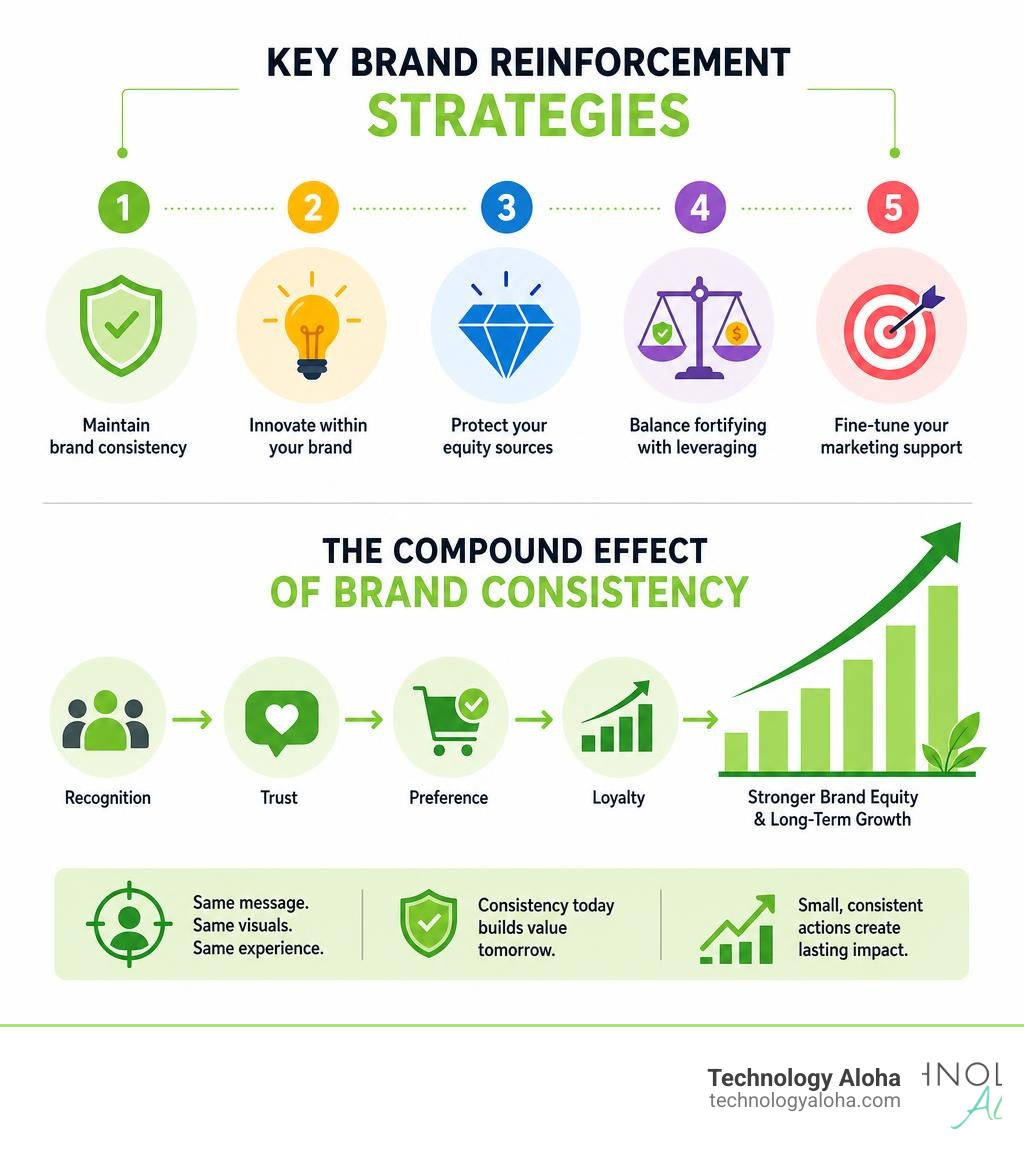
Here is a quick answer to what they involve:
- Maintain brand consistency — same message, visuals, and tone across every touchpoint
- Innovate within your brand — update products, services, and marketing without abandoning core identity
- Protect your equity sources — keep the associations consumers already trust and recognize
- Balance fortifying with leveraging — strengthen brand perception while also monetizing it
- Fine-tune your marketing support — adjust campaigns when current efforts stop delivering results
Most small businesses focus on acquisition and ignore what happens after. That is where brand equity quietly erodes.
Consistent brand presentation across all channels can increase revenue by up to 23%. Brands that maintain consistent messaging see 3–5x higher recall among consumers. And 90% of consumers expect consistent interactions at every touchpoint.
The brands people buy are rarely the ones with the biggest budgets — they are the ones that show up the same way, every time.
This guide covers the full picture: what brand reinforcement actually means, how it differs from revitalization, and exactly how to apply it whether you are building from scratch or shoring up a brand that has started to drift.
Handy brand reinforcement strategies terms:
- Brand Building Strategies Demystified
- Brand Positioning and Differentiation
- Mastering Brand Strategy and Development for Modern Marketing
Brand Reinforcement vs. Brand Revitalization: The Long-Term Play
Long-term brand management is not a single creative campaign; it is a continuous operational discipline. To manage a brand successfully over time, we must understand the distinct roles of brand reinforcement and brand revitalization. While both strategies aim to secure desired brand knowledge structures in consumers’ minds, they address entirely different stages of the brand lifecycle.
Brand reinforcement is a proactive strategy. It focuses on maintaining and strengthening existing brand equity. This involves consistently communicating what the brand stands for, what core benefits it delivers, and how it satisfies consumer needs. By reinforcing the brand, we protect its positive reputation, maintain customer satisfaction, and drive shareholder value by preventing competitor encroachment.
Brand revitalization, on the other hand, is reactive. It is required when brand equity has already diminished, or when market dynamics—such as shifting consumer behaviors, technological changes, or aggressive competitor moves—have rendered the existing positioning ineffective. Revitalization is a “back to basics” approach to recapture lost equity or establish entirely new sources of brand equity.
| Strategic Dimension | Brand Reinforcement | Brand Revitalization |
|---|---|---|
| Primary Goal | Maintain and fortify existing brand equity | Recapture lost equity or build new equity sources |
| Market Condition | Healthy brand with strong, positive associations | Faded, declining, or outdated brand perception |
| Core Focus | Consistency of message and continuous innovation | Repositioning, expanding awareness, and rebuilding associations |
| Tactical Execution | Minor tactical adjustments; keeping core promise intact | Major strategic shifts; updating brand assets and target segments |
| Risk Profile | Low risk; protects current market share | Moderate to high risk; requires changing consumer minds |
Understanding where your brand sits on this spectrum is critical for effective Mastering Brand Strategy and Development for Modern Marketing. If we attempt to revitalize a healthy brand prematurely, we risk alienating loyal customers. Conversely, if we merely try to reinforce a brand that has fundamentally lost its market relevance, we waste valuable resources on an outdated message.
Why Long-Term Brand Management Dictates Market Survival
Brands are potentially immortal, but products are not. A product is a physical or functional offering that can easily be copied, replaced, or rendered obsolete by new technology. A brand is the accumulated trust, memory, and emotional connection that lives in the consumer’s mind. When we ignore long-term brand management, we invite brand decay.
Brand decay does not happen overnight. It is a slow, quiet process driven by cognitive friction. If a business changes its messaging, visual identity, or core values too frequently, consumers must expend mental energy to understand what the brand stands for. In a crowded marketplace, consumers naturally gravitate toward brands that offer cognitive simplicity—those that are instantly recognizable and consistently deliver on their promises.
Without active reinforcement, a brand loses its mental availability. When a consumer faces a buying decision, the brand is simply no longer part of their consideration set. According to Kotler’s framework on brand reinforcement, brands that fail to move forward and reinforce themselves inevitably lose recall, visibility, and market share. Continuous, disciplined management is the only way to insulate a business from aggressive competitor discounting and shifting market dynamics.
Balancing Fortifying Activities with Equity Leveraging
One of the most complex challenges in brand management is balancing fortifying activities with equity leveraging.
- Fortifying activities are investments made directly into the brand’s health. These activities do not always yield immediate revenue, but they build and protect brand awareness, improve brand associations, and deepen customer loyalty.
- Leveraging activities exploit existing brand equity to drive financial gain. This includes tactics like brand extensions, licensing, or price increases.
If we focus entirely on leveraging the brand without fortifying it, we commit brand exploitation. Over time, the brand’s core meaning becomes diluted, its distinctiveness fades, and its equity decays.
To maintain long-term brand health, we must design a balanced resource allocation model. Every time we leverage the brand to launch a new product or enter a new market, we must simultaneously invest in fortifying the core brand. This ensures that the parent brand remains strong enough to support its extensions. Effective Brand Positioning and Differentiation requires us to constantly feed the source of our equity, ensuring the brand’s core values remain vibrant and relevant.
Implementing Proven Brand Reinforcement Strategies
To reinforce a brand effectively, we must maintain consistency across all customer-facing touchpoints. Consistency builds familiarity, and familiarity breeds trust. However, consistency does not mean standing completely still. The goal is to maintain a uniform brand meaning while adapting our tactical execution to keep pace with changing consumer expectations.

This balance requires a clear system of governance, starting with a comprehensive Brand Style Guide: Your Key to a Consistent Brand Image. A style guide is not just a document for designers; it is a strategic business tool that ensures every piece of content, every customer interaction, and every product package reflects the same visual and verbal identity.
Product-Led Brand Reinforcement Strategies
For brands built on product-related core associations, brand reinforcement must start with the product itself. If the product’s quality, design, or functionality slips, no amount of creative marketing can save the brand’s reputation.
Product-led reinforcement relies on three pillars:
- Product Innovation: We must continuously improve product design, manufacturing processes, and merchandising to deliver superior value. This does not mean changing the core product benefit, but rather enhancing how that benefit is delivered.
- Design Systems: Implementing robust design systems ensures that product updates feel like a natural evolution rather than a jarring departure. This maintains visual familiarity across product lines.
- Quality Assurance: Consistent quality is the foundation of brand trust. Every product delivered must meet or exceed the brand promise.
For organizations starting this journey, using The DIY Guide to Creating a Brand Identity can help establish the foundational guidelines needed to keep product design and brand presentation aligned.
Marketing-Led Brand Reinforcement Strategies
For brands built on non-product-related associations—such as user imagery, usage imagery, or brand personality—marketing-led reinforcement is the primary driver of brand equity. The objective is to keep the brand’s emotional and symbolic associations relevant and top-of-mind.
This is achieved through a coordinated, multi-channel presence that emphasizes consistent brand messaging and visual identity. Rather than launching disconnected ad campaigns, successful brands focus on smart repetition. According to research on building memorable brands, we must focus on Small Moves, Strong Signals: Building a Brand People Remember. This means optimizing everyday touchpoints—such as email signatures, invoices, social media channels, and packaging inserts—to reinforce the brand’s core values.
Repetition should feel like a steady rhythm, not a repetitive loop. By using creative variation, we can deliver the same core message in different formats, preventing consumer fatigue while steadily building deep memory structures.
The Strategic Pivot: Revitalizing Faded Brand Equity
When a brand has suffered from long-term neglect, competitor disruption, or major shifts in consumer preferences, reinforcement is no longer enough. The brand requires a strategic pivot to revitalize its faded equity.

Revitalization begins with a deep, objective analysis of the brand’s current state. We must understand what elements of the brand’s heritage are still valuable and what needs to be retired. When planning a brand refresh, it is essential to understand What You Need to Know When Rebranding to avoid deleting “accidental equities”—those unique brand codes that consumers unconsciously use to identify your business.
Expanding Awareness and Rebuilding Brand Associations
To revitalize a brand, we must focus on two primary fronts: expanding brand awareness and rebuilding brand associations.
Expanding brand awareness requires looking at both depth and breadth:
- Depth of awareness refers to how easily consumers recall or recognize the brand.
- Breadth of awareness refers to the range of purchase and consumption situations in which the brand comes to mind.
Often, a faded brand has adequate depth but very narrow breadth; consumers know the brand, but they only think of it in limited, traditional scenarios. To fix this, we must identify and establish new usage situations or target entirely new customer segments.
Simultaneously, we must rebuild the brand’s associations. This involves defining clear points-of-difference (PODs) that distinguish the brand from modern competitors. We must strengthen the favorability, strength, and uniqueness of these new associations through targeted marketing.
For a complete framework on aligning your post-purchase experience with your brand promise to drive repeat revenue, consult a comprehensive brand playbook to boost customer lifetime value.
Real-World Case Studies of Reinforcement and Revitalization
Analyzing historical brand management decisions reveals clear patterns of success and failure. Long-term studies published by institutions like the Marketing Media Alliance highlight how iconic brands navigate these transitions.
Consider the contrast between Boroline and Cadbury:
- Boroline: An antiseptic cream brand in India that has maintained virtually unchanged packaging, core formulation, and messaging for over 80 years. By refusing to chase short-term design trends or execute unnecessary product extensions, Boroline reinforced its core promise of safety, reliability, and heritage, retaining deep consumer loyalty across generations.
- Cadbury Dairy Milk: Rather than standing completely still, Cadbury successfully shifted its positioning in the Indian market from a children’s pre-event treat to a post-dinner dessert suitable for all ages. This repositioning expanded the brand’s breadth of awareness, tapping into new consumption scenarios and dramatically increasing its market share.
Both examples demonstrate that whether you choose strict reinforcement or strategic revitalization, success depends on a deep understanding of consumer behavior and a disciplined commitment to your brand’s core truth.
Frequently Asked Questions About Brand Reinforcement
What are the primary risks of failing to reinforce a brand?
Failing to actively reinforce a brand leads to brand decay, brand dilution, and a significant loss of market share. When messaging and visual presentation become inconsistent, cognitive friction increases, making it harder for consumers to recognize and recall the brand. Over time, this erosion of mental availability leads to customer churn, as buyers drift toward competitors that offer a simpler, more consistent experience.
How do customer satisfaction and shareholder value connect to brand equity?
Brand equity acts as a financial accelerator. High brand equity drives customer satisfaction and increases customer lifetime value, as loyal buyers are less price-sensitive and more likely to make repeat purchases. This predictable, recurring revenue reduces the cost of customer acquisition, improves overall financial performance, and directly increases brand valuation—thereby maximizing long-term shareholder value.
How often should a company audit its brand reinforcement strategies?
A company should conduct a comprehensive brand audit at least once a year, supplemented by ongoing market tracking and performance metrics. This audit should evaluate every customer-facing asset for visual and verbal consistency, measure brand recall and recognition, and analyze consumer feedback to ensure that the brand’s core associations remain strong, favorable, and unique.
Conclusion
Managing a brand for the long run is not about chasing fleeting trends or executing flashy, disconnected campaigns. It is about the disciplined, consistent application of strategic principles that protect and grow your brand equity. Whether through product-led innovation or coordinated marketing-led messaging, brand reinforcement strategies ensure your business remains top-of-mind when consumers are ready to buy.
At Technology Aloha, we understand that your brand is your most valuable asset. Located in Kahului, HI, we bring data-driven insights to businesses across Hawaii and beyond, blending cohesive branding with high-conversion web designs. We help you build a practical brand system that reduces cognitive friction, improves customer retention, and drives measurable business growth.
Ready to secure your brand’s market position for 2026 and beyond? Let us help you design a brand strategy that actually sticks. Explore our Technology Aloha Branding Services and let’s build something memorable together.