A Comprehensive Guide to Rebrand Implementation Plan Steps
Why a Rebrand Implementation Plan Determines Whether Your Rebrand Succeeds or Fails
A rebrand implementation plan is a structured, phase-by-phase roadmap that organizes every task, owner, timeline, and touchpoint required to transition your organization from its old brand to its new one—without confusion, inconsistency, or lost trust.

If you need the short version:
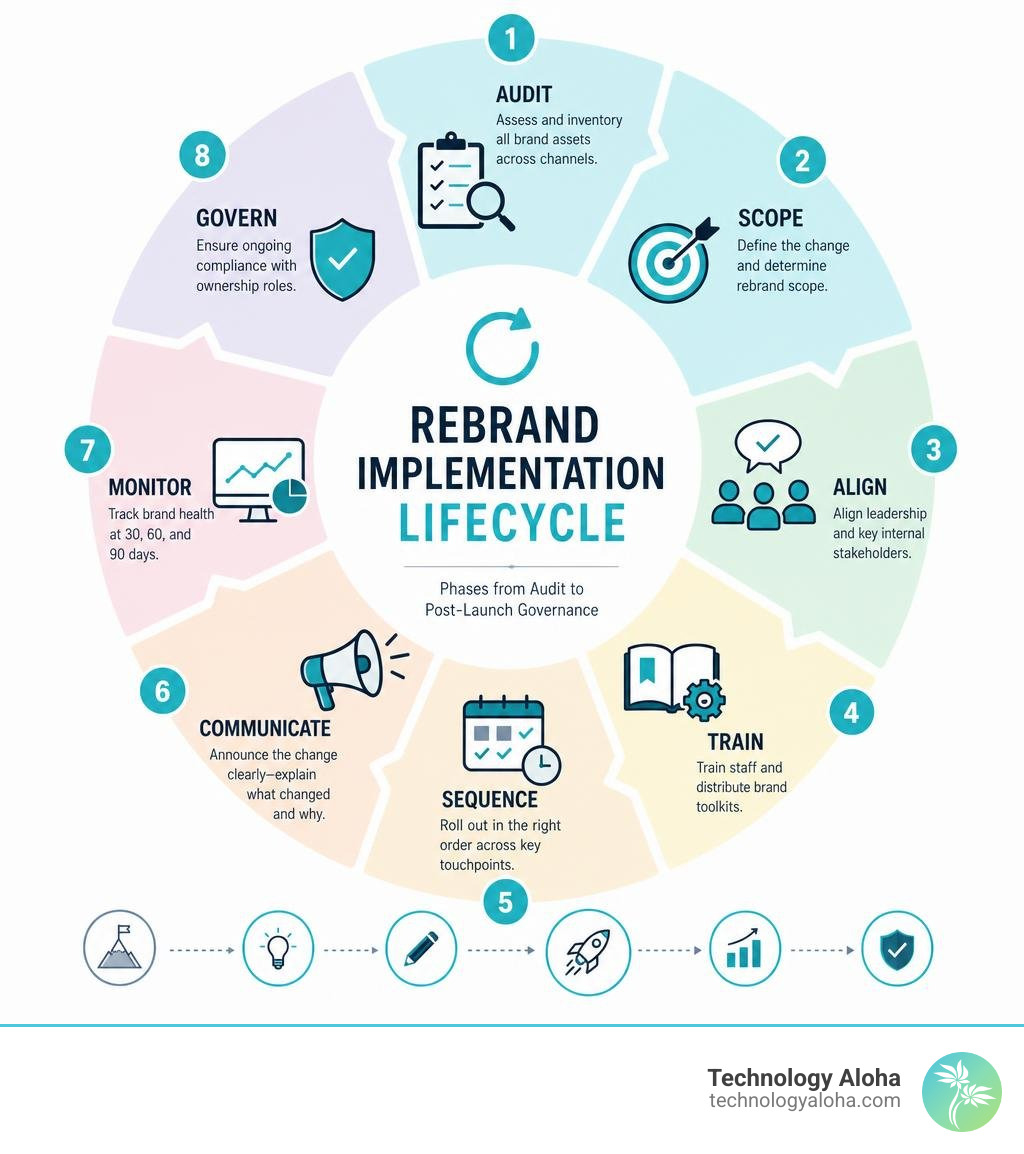
- Audit all existing brand assets across every channel and department
- Scope the change—brand refresh or full rebrand
- Align leadership and key internal stakeholders before anything goes public
- Train staff and distribute brand toolkits so employees communicate consistently
- Sequence the rollout—website first, then email, CRM, social, sales collateral
- Communicate the change to customers with clear messaging about what changed and why
- Monitor brand health at 30, 60, and 90 days post-launch
- Govern ongoing compliance with assigned ownership roles
Most rebrands don’t fail at the strategy stage. They fail at execution—when a polished new identity gets applied inconsistently across touchpoints until the organization looks like it has two brands instead of one.
The stakes are real. Brand consistency protects recognition, reduces donor hesitation, and keeps teams from wasting weeks explaining whether the old logo, old name, or old language still applies. Rebrands also move inside tight leadership, campaign, and budget cycles. There is little room for a slow or chaotic rollout.
For nonprofit leaders especially—already stretched thin across donor management, service delivery, and staff coordination—a fragmented rebrand doesn’t just create confusion. It erodes the donor trust and community credibility you’ve spent years building.
This guide walks you through every phase of a rebrand implementation plan: from the initial asset audit to post-launch governance, with practical frameworks you can apply regardless of your organization’s size or budget.
Rebrand implementation plan terms to know:
- Step-by-Step Guide to Brand Strategy Plan
- All About Creating a Brand Management Plan
- Building a Cohesive Brand Presence From Web to Mobile
Essential Scoping Steps for a Rebrand Implementation Plan
Before you launch into design files and launch schedules, you must define the precise boundaries of your rollout. Skipping the scoping phase leads directly to missed touchpoints, unbudgeted expenses, and timeline creep. A structured rebrand implementation plan begins with a clear understanding of what you are changing, why you are changing it, and every asset that change will touch.
To build an actionable foundation, start with a comprehensive brand audit. Catalog every surface where your visual and verbal identity lives—from high-visibility digital properties down to internal document templates, invoice headers, and email footers. For guidance on evaluating your current state, review our guide on What You Need to Know When Rebranding.
Brand Refresh vs. Full Rebrand
Not all brand changes require the same operational lift. Confusing a subtle visual evolution with a structural corporate overhaul causes friction across every department.
A brand refresh updates your visual execution without altering your underlying core positioning. You might modernize your color palette, select clean typography, or streamline logo clear-space rules. The core audience, mission, and value proposition remain intact. Rollouts for a refresh are manageable within 4–8 weeks, carrying lower risk and requiring minimal customer-facing explanation.
A full rebrand fundamentally alters how your business is understood. It is driven by strategic repositioning, business model pivots, strategic expansion, or major organizational shifts. A full rebrand changes your visual identity, core messaging, value proposition, and occasionally your name. Implementation for a full rebrand typically requires 12–16 weeks of execution work followed by ongoing stabilization.
To evaluate strategic market positioning before committing to a scope, see our resource on Brand Positioning and Differentiation.
| Dimension | Brand Refresh | Full Rebrand |
|---|---|---|
| Primary Trigger | Visual modernization, aesthetic updates | Strategic pivot, name change, repositioning |
| Core Messaging | Unchanged | Overhauled |
| Typical Timeline | 4–8 weeks | 12–16+ weeks |
| Operational Impact | Low to moderate | High across all departments |
| Rollout Model | Soft launch or phased rollout | Big Bang or structured 30–60–90 framework |
Building a Master Asset Inventory and Tracking System
A successful rollout relies on a centralized system of record. Every uninventoried touchpoint creates customer confusion and forces internal rework. We recommend setting up a master asset database in Airtable or Asana to catalog every single item.
Group your inventory by channel surface area:
- Digital Channels: Primary domain, subdomains, web landing pages, favicon files, transactional emails, portal login screens, mobile app icons, software UI, third-party directory listings, Google Business Profiles, social media banners, and digital advertising templates.
- Internal Operations & Sales Collateral: Pitch decks, proposal templates, contract agreements, invoice headers, email signatures, employee badges, corporate intranet pages, and onboarding documentation.
- Physical Touchpoints: Building signage, vehicle fleet graphics, event booths, branded merchandise, donor wall displays, printed collateral, and packaging materials.
For organizations navigating complex enterprise transitions, mapping asset dependencies across legacy systems prevents operational friction and unexpected delays.
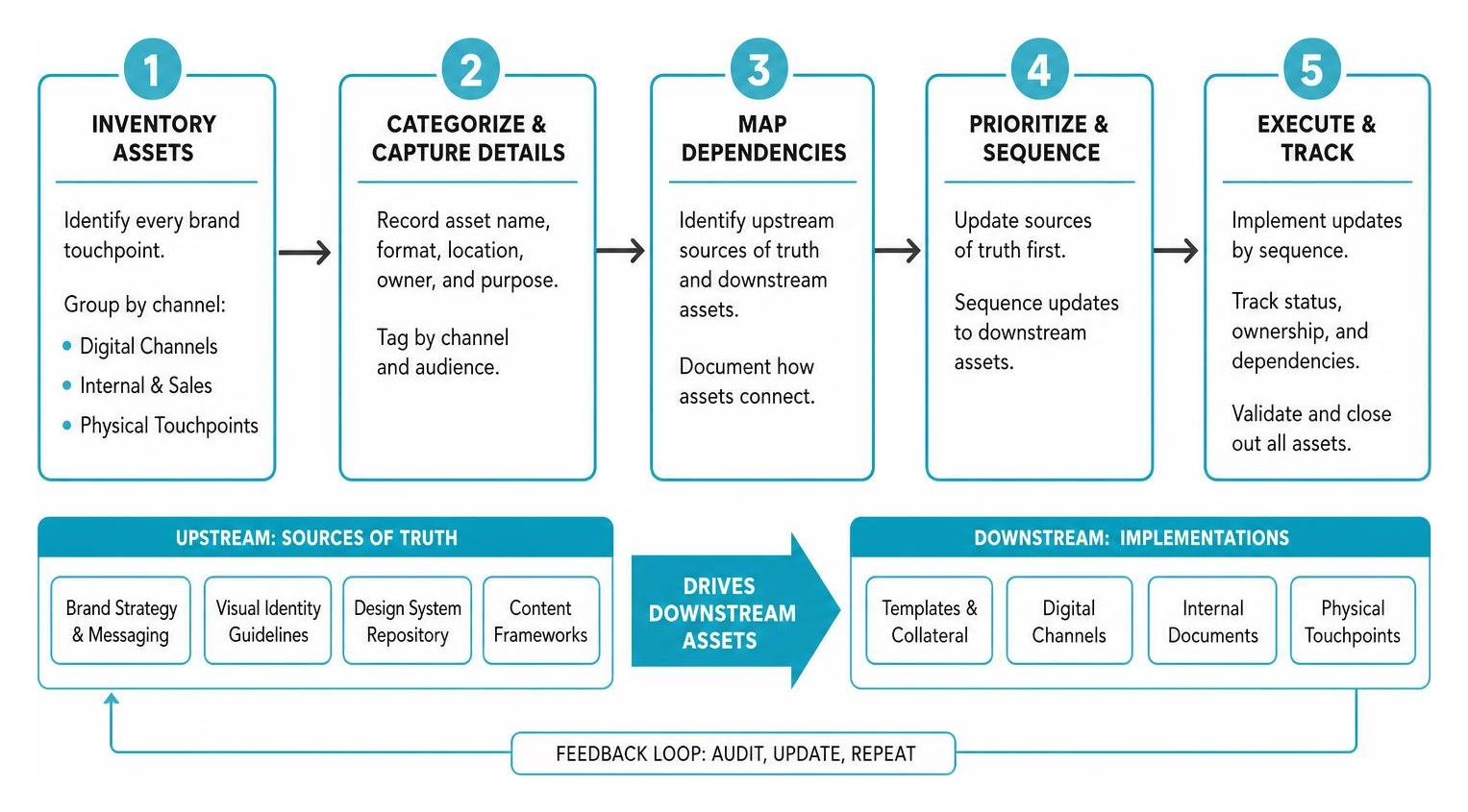
Map dependencies directly into your tracker. Determine which assets serve as upstream sources of truth (such as centralized design system repositories) and which are downstream implementations (such as sales pitch templates). Sequence updates so that source repositories change before template distribution begins.
The 30–60–90 Day Timeline for Rebrand Execution
Executing a rebrand requires strict operational sequencing. Trying to change every asset simultaneously without phased governance leads to mixed brand states, where external audiences see old and new branding side-by-side. A structured 30–60–90 day framework provides clear milestones and assigns operational accountability across functional teams.
Executing Phase 1 of a Rebrand Implementation Plan
Phase 1 (Days 1–30) focuses entirely on internal stabilization, leadership alignment, and operational preparation. Public audiences should see zero changes during this window.
Begin by establishing project governance. Assign clear decision rights using a RACI framework:
- Responsible: Project Lead / Rebrand Coordinator (executes the daily rollout checklist)
- Accountable: Executive Sponsor / CMO / Executive Director (holds final approval authority)
- Consulted: Department Heads in Sales, IT, HR, and Legal (provides operational inputs)
- Informed: All staff and key external partners (receives timely updates)
Finalize all core identity files, web design systems, and legal compliance filings. Build your master asset tracking sheet, run internal quality assurance, and prepare employee enablement toolkits.
Phase 2: Controlled External Transition and Website Launch
Phase 2 (Days 30–60) shifts focus to external execution. Your digital anchor channel—your website—serves as the centerpiece of this phase.
Execute the digital cutover in strict logical order:
- Website Cutover: Deploy updated visual styling, copy, and technical 301 redirects to preserve SEO authority.
- Core Direct Channels: Roll out updated email signature systems, sales proposal software templates, and automated transactional emails.
- Public Announcement: Publish your launch landing page, release official press releases, and deploy direct email notifications to customers, donors, and strategic partners.
- Social & Paid Media: Update social media avatars, cover banners, pinned posts, and active ad campaign graphics simultaneously.
When executing marketing shifts across service-driven organizations, align your outreach using principles from A Comprehensive Guide to Branding Strategies for Services.
Phase 3: Post-Launch Stabilization and Governance
Phase 3 (Days 60–90) handles long-tail updates, feedback monitoring, and brand compliance enforcement.
Scan digital properties weekly using automated site crawlers to catch legacy logo images, outdated copyright strings, and broken link paths. Review customer support tickets and social media comments daily during the first two weeks post-launch to address customer confusion immediately. Conduct a formal 30-day post-launch review to confirm all physical signage, business cards, and secondary partner listings align with your new brand guidelines.
Internal Alignment, Stakeholder Buy-In, and Employee Enablement
Employees are your primary brand ambassadors. If your internal team feels confused, unequipped, or excluded during a rebrand, your external launch will stall. Internal alignment must precede external launch dates by 2 to 4 weeks.
Securing Executive Buy-In and Cross-Department Alignment
Executive alignment requires more than passive approval; it requires active commitment to cross-departmental coordination. Position the rebrand not as a superficial graphic design project, but as a strategic business enabler designed to capture market share, unify messaging, or improve customer retention.
Involve departmental leaders early during the discovery phase. Sales leads understand where pitch decks fail; customer service teams know which collateral causes customer confusion; HR leads know how prospective hires view company culture. Establishing a cross-functional Brand Command Center with weekly 30-minute operational standups prevents cross-department friction.
For strategic frameworks on aligning company leadership during brand evolution, read The Ultimate Guide to New Brand Development.
Preparing and Training Staff as Brand Ambassadors
Never let employees discover your new brand through social media or press coverage. Host an exclusive internal reveal event two to four weeks prior to the public launch date.
Structure the internal enablement rollout with practical tools:
- The Insider Unveil: Present the executive vision, market research data, and creative rationale behind the rebrand. Show staff how the change benefits their daily workflows and advances organizational goals.
- Brand Champion Toolkits: Equip team members with a centralized digital folder containing logo variations, slide deck templates, document headers, email signature generators, and social media announcement badges.
- Practical Style Guides: Provide a clean, usable brand identity kit rather than an overwhelming 100-page PDF document. Highlight typography specs, primary color codes, clear space rules, and direct rules on how not to use the logo. Read more about developing accessible identity rules in our guide to Brand Style Guide: Your Key to a Consistent Brand Image.
- Internal FAQ Sheets: Supply customer-facing staff with explicit scripts and talking points. Provide direct answers for questions like, “Why did you change your name?” or “How does this affect my existing service contract?”
External Communication and Channel Migration Tactics
When introducing an updated brand to the public, clarity prevents skepticism. External communications must articulate three distinct points: what changed, why it changed, and what remains unchanged for your customers.
Managing Digital Assets in a Rebrand Implementation Plan
Digital migration carries real technical risks—specifically search engine traffic loss and broken conversion funnels. Managing digital cutovers requires precise technical execution across your martech stack.
- Website & Technical SEO Migration: Map every old URL to its exact new equivalent path using permanent 301 redirects. Follow Google Search Central’s Site Moves and URL Changes guidance, update page title tags, meta descriptions, open graph tags, and image alt text. Submit updated XML sitemaps to Google Search Console on launch day and monitor crawl errors daily.
- Email Signature Automation: Use centralized signature management platforms like Templafy or Exclaimer to update signatures across all employee mail accounts simultaneously on launch day. Manual employee updates create avoidable compliance gaps, especially in large or distributed teams.
- CRM & Marketing Automation Stack: Update email newsletter templates, workflow triggers, landing page footers, transactional email notifications, and customer portal stylesheets prior to firing public launch emails.
Customer Communication and Public Perception Management
Use a concentric circles approach to sequence customer communications. Notify your closest stakeholders first, building trust before launching public outreach campaigns.
- Tier 1 (Inner Circle): Provide personal calls, direct emails, or advance previews to key partners, enterprise clients, and major donors 1–2 weeks before public unveiling.
- Tier 2 (Existing Customers): Send a direct email announcement on launch day from the CEO or Executive Director. Explain the strategic rationale, highlight improved user experience features, and reassure them that core services, pricing, and point-of-contact details remain unchanged.
- Tier 3 (Public & Media): Distribute press releases, launch a dedicated website landing page explaining the brand narrative, and publish across social channels.
Publishing 9–12 cohesive posts on visual platforms like Instagram immediately establishes your new aesthetic for profile visitors.
Measuring Success and Maintaining Brand Equity
An operational launch day is a milestone, not the finish line. Post-launch measurement and long-term brand governance ensure your investment generates measurable ROI while protecting brand equity.

Monitor quantitative and qualitative performance indicators across 30-, 60-, and 90-day intervals:
- Technical & Digital Signals: Track organic search impressions, branded search volumes, domain authority retention, direct website traffic, bounce rates, and conversion rate stability.
- Brand Health & Sentiment: Conduct brand perception surveys among customers and internal employees at 90 days post-launch. Track social media sentiment scores and monitor customer support ticket tags related to rebrand inquiries.
- Operational Compliance: Perform a 30-day post-launch audit across sales decks, partner portals, and physical collateral to calculate your brand consistency index score.
Assign ongoing brand governance responsibilities. Establish a Brand Review Committee that meets monthly to review custom asset requests, inspect digital compliance, and update design system components as your organization evolves.
Frequently Asked Questions About Rebrand Rollouts
How long does a typical rebrand implementation take to complete?
A standard rebrand implementation takes 12–16 weeks from audit completion to public launch, followed by a 30–90 day post-launch stabilization phase. Minor brand refreshes can complete within 4–8 weeks, while enterprise multi-entity organizational shifts may require multi-year phased transitions.
How do you protect website SEO rankings during a rebrand?
Protect SEO performance by creating a comprehensive 1-to-1 URL redirect map using 301 permanent redirects prior to deployment. Maintain existing content architecture where possible, update internal links, update XML sitemaps, verify domain address changes in Google Search Console, and monitor crawl errors and indexed pages daily post-launch.
What is the biggest mistake companies make during a rebrand launch?
The single biggest mistake is neglecting internal alignment—spending 90% of budget and energy on creative design while treating the launch rollout as an afterthought. Launching externally before employees are fully trained leads to off-brand sales messaging, mixed visual signals, customer confusion, and eroded trust.
What are the key takeaways for a successful rebrand implementation?
Executing a rebrand requires operational discipline, clear decision-making rights, and strategic sequencing. By conducting a thorough asset audit, choosing the right scope, aligning your internal team, and following a structured 30–60–90 day execution framework, you protect your brand equity and build lasting trust with your audience.
Whether you need strategic brand positioning, a modern website architecture, or technical launch support, Technology Aloha helps mission-driven organizations and businesses navigate brand transitions without friction or lost momentum. Explore our specialized Expert Branding Services to build a cohesive visual and strategic presence that drives growth.