Positioning and branding for a small business is the strategic process of defining what you stand for, who you serve, and why customers should choose you — then communicating that consistently across every touchpoint.
Positioning and branding for a small business is the strategic process of defining what a business stands for, who it serves, and why customers should choose it, consistently communicated across every touchpoint. While a logo is merely a symbol, a brand encompasses the feeling people get when interacting with a business, and positioning explains why they remember it over competitors. This strategic approach is crucial because it helps small businesses differentiate themselves, build trust, and avoid being commoditized, leading to benefits like increased recognition and improved employee pride. Research indicates customers typically need 5 to 7 impressions before recognizing a brand, underscoring the importance of consistent branding efforts.

Here is the short version:
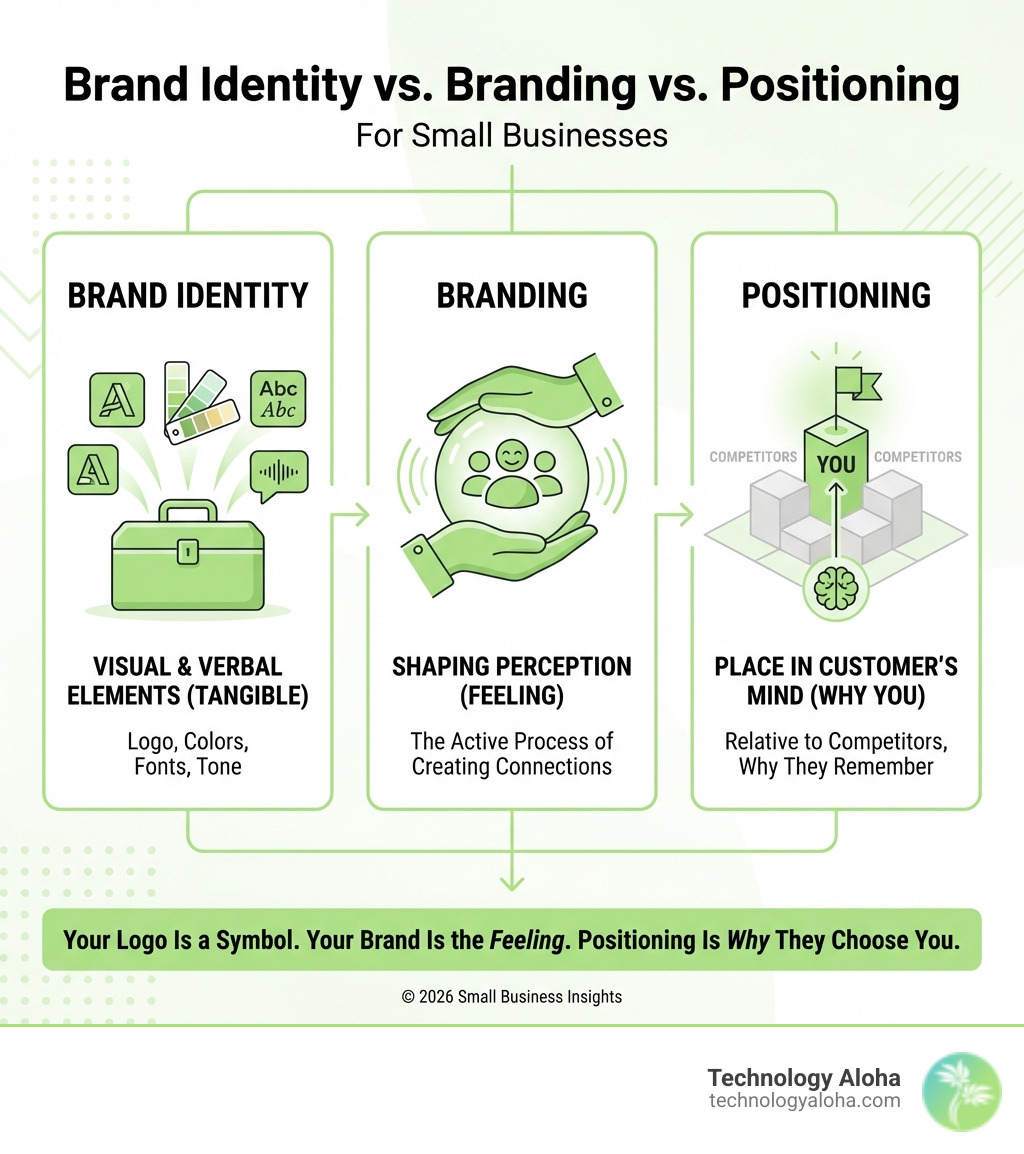
- Brand identity — the visual and verbal elements you create (logo, colors, fonts, tone)
- Branding — the active process of shaping how people perceive your business
- Positioning — the specific place your business occupies in a customer’s mind relative to competitors
If you only have time for one insight: your logo is a symbol. Your brand is the feeling people get when they interact with your business. Positioning is why they remember you instead of someone else.
Most small business owners start with a logo. That is understandable — it is tangible, it feels like progress. But a logo without strategy is decoration. It does not tell customers why you are different. It does not build trust. And it does not win business in a crowded market.
Research is clear that customers need 5 to 7 impressions before they recognize a brand. That means every interaction — your website, your social posts, how your staff answers the phone — either builds recognition or erodes it.
The businesses that win are not always the ones with the biggest budgets. They are the ones with the clearest message and the most consistent presence.
This guide walks you through exactly how to build that — from defining your audience to creating a visual identity to measuring whether your positioning is actually working.
The Strategic Value of Positioning and Branding for a Small Business
For many entrepreneurs, the term “branding” feels like a luxury reserved for companies with billion-dollar marketing departments. In reality, your brand is your promise to your customer. It tells them what they can expect from your products and services, and it differentiates your offering from your competitors’.
When we talk about positioning and branding for a small business, we are talking about mental real estate. If you don’t define your position, the market will define it for you—usually based on price alone. Strategy allows you to move away from being a commodity and toward being a preferred choice. There are 4 hidden benefits of having a strong branding strategy that directly impact your bottom line: increased recognition, improved employee pride, a stronger sense of trust within your community, and higher advertising effectiveness.
Why Small Businesses Can Outmaneuver Global Corporations
Large corporations have massive budgets, but they also have massive inertia. A global brand often requires years and a 150-page brand book to make even a minor shift in perception. As a small business, your greatest assets are agility and personal connection.
Oberlo statistics show that consistent presentation of a brand can increase revenue by as much as 33%. While a large corporation struggles to maintain consistency across 50,000 employees, a small team can ensure that every single customer feels like an individual, not a number. Currently, 61% of customers feel treated like numbers. By leveraging a niche focus and genuine storytelling, you can occupy a space in the customer’s mind that a faceless corporation never could.
The High Cost of Skipping Strategy
Skipping the strategy phase to jump straight into social media posts or ad spend is a common mistake. Without a clear position, your marketing becomes “white noise.” You end up in a “price war” where the only way to win is to be the cheapest—a race to the bottom that most small businesses cannot survive.
According to the CMO Survey, businesses spend an average of 11.72% of their total budget on marketing. If that investment isn’t backed by a cohesive strategy, a significant portion of it is wasted on inconsistent messaging that confuses the market. Confusion leads to customer churn; clarity leads to loyalty.
Defining Your Audience for Effective Positioning and Branding for a Small Business
You cannot be everything to everyone. Effective positioning and branding for a small business requires “exclusionary” thinking—deciding who you are not for is just as important as deciding who you are for.
To start, you must define your target audience by looking at demographics like age and location, but more importantly, psychographics: their values, pain points, and desires. When choosing the right branding for your small business, you must align your visual and verbal identity with what your specific audience values most. If your audience values sustainability, your branding must reflect that through more than just a green logo; it must be woven into your narrative and business practices.
Competitor Analysis and the Unique Value Proposition
To stand out, you must know what you are standing against. We recommend “ethical stalking”—analyzing your competitors’ social media, customer reviews, and website messaging to identify gaps. Are they all focusing on price? Then perhaps you can focus on quality or convenience.
The Small Business Development Center is an excellent resource for market data that can help you identify these differentiators. Your Unique Value Proposition (UVP) is the intersection of what your customers need, what you do exceptionally well, and what your competitors lack.
What are the different types of positioning strategies for small businesses?
| Strategy Type | Definition | Best For | Example |
|---|---|---|---|
| Attribute-based | Focuses on a specific feature or characteristic. | Technical or innovative products. | “The only 24-hour bakery in the area.” |
| Benefit-based | Focuses on the outcome or “job” the product does. | Service-based businesses. | “We give you back 10 hours of your week.” |
| User-based | Focuses on a specific type of person or lifestyle. | Lifestyle and community brands. | “The gym for busy parents.” |
Building a Visual and Verbal Identity Without a Corporate Budget
Once your strategy is set, it is time to build the “face” of your brand. This is your visual identity. You don’t need a Madison Avenue agency to look professional. You do need consistency.
Your logo should be simple enough to work in black and white and small enough to fit a social media profile picture. When selecting colors, your brand colors matter because they evoke specific emotions. Blue suggests trust and stability; orange suggests energy and friendliness. For typography, sites like dafont.com offer a wide range of fonts, but we suggest sticking to two: one for headings and one for body text to maintain a clean look.
The Power of Brand Voice and Storytelling
If your visual identity is the “face,” your brand voice is the “personality.” How does your business speak? Is it authoritative and expert, or casual and witty? This voice must be consistent whether you are writing an email, a caption, or building your brand on your site.
Storytelling is the bridge to emotional connection. People do not buy what you do; they buy why you do it. Share your origin story. Why did you start this business? What problem were you desperate to solve? Authentic stories outperform massive marketing budgets because they build a “gut feeling” of trust.
Budget-Friendly Tactics for Positioning and Branding for a Small Business
You can implement branding on a budget by focusing on high-impact, low-cost activities:
- Content Marketing: Write one helpful blog post a week that solves a customer problem. This positions you as an expert.
- Social Media: Use consistent filters and templates (like those found in Canva) to ensure your grid looks cohesive.
- Local Partnerships: Partner with complementary businesses for cross-promotions.
- Google My Business: Ensure your profile is complete with high-quality photos and consistent contact information.
Ensuring Consistency Across Every Touchpoint
A brand is only as strong as its weakest link. If your website looks professional but your automated confirmation emails are written in a completely different tone, you create “brand friction.”
To prevent this, you need a style guide for your brand. This doesn’t have to be a 100-page document. A simple two-page brand style guide that outlines your logo usage, color hex codes, font choices, and “voice” examples will suffice. This ensures that whether a customer sees a Facebook ad or receives a business card, the experience feels unified.
Measuring Impact and the Role of External Expertise
How do you know if your positioning and branding for a small business is working? Look at three key areas:
- Revenue: Are you able to maintain your margins without constant discounting?
- Referrals: Are customers becoming advocates for your brand?
- Recognition: Are people mentioning your brand name in local community groups or online?
Sometimes, an outside perspective is necessary to see the gaps in your own strategy. This is where branding strategy 101 meets professional execution. A fractional CMO or a specialized agency can provide the data-driven insights needed to blend cohesive branding with high-conversion designs, ensuring your marketing spend actually moves the needle.
Frequently Asked Questions about Small Business Branding
Do small businesses really need branding if they have good products?
Yes. A good product is the baseline, but branding is what helps people discover that product and choose it over a competitor’s. Without branding, you are invisible to everyone except those who stumble upon you by accident.
What is the most common branding mistake small business owners make?
Starting with tactics instead of strategy. Many owners design a logo and start running ads before they have defined their target audience or their unique position. This leads to inconsistent messaging and wasted budget.
How often should a small business refresh its positioning?
Positioning should be reviewed annually but only “refreshed” if there is a significant shift in the market, a new major competitor, or a change in your core business offerings. Consistency over time is what builds brand equity.
Conclusion: Taking the First Step Toward a Standout Brand
Building a brand is not a one-time event; it is a discipline. It requires the courage to be specific and the commitment to be consistent. Start today by writing down your positioning statement: We are the [Type of Business] for [Target Audience] who want [Key Benefit] without [Major Pain Point].
Once you have that foundation, ensure your visual identity and digital presence reflect that promise. Strategic positioning, branding, and user-centric websites help businesses find clarity and achieve growth.
Ready to stop being “just another business” and start being a brand? Elevate your brand with professional positioning and branding services to ensure your message gets the attention it deserves.