Nonprofits spend a lot of energy communicating trust: mission statements, impact statistics, testimonials, financial transparency, stories from the people they serve.
Nonprofit donation flow is a critical trust signal where donors assess an organization's competence and reliability, extending beyond mission statements and impact statistics. Inconsistencies in branding, immediate confirmation, and accurate data flow during the checkout process can erode donor trust, causing organizations to lose potential and recurring donors. A donation system designed for trust ensures a consistent visual experience from appeal through confirmation and automatically integrates donor information into backend systems, preventing issues like generic thank-yous or incorrect receipts.

Far less attention goes to the nonprofit donation flow — the moment when that trust is actually tested. It’s the few minutes between clicking “Donate” and receiving confirmation that the gift went through.
That’s a mistake.
Because once a donor decides to give, trust stops being something you say. It becomes something your systems have to prove.
How do nonprofit systems prove trust during the donation process?
A donor is forming an opinion about your organization from signals most nonprofits don’t think of as trust signals at all.
Does the donation page look and feel like the organization they intended to support, or does it suddenly resemble a third-party checkout they’ve never seen before?
Does the transaction confirm immediately, or are they left wondering whether the payment went through?
Does the receipt arrive promptly with the correct amount, organization name, designation, and tax information?
Does the follow-up acknowledge what they actually gave?
None of those details are about your mission.
But together, they tell a donor something important: whether your organization appears competent, organized, and capable of handling their money responsibly.
Where the trust leak usually happens
The problem is rarely one catastrophic failure.
It’s usually a series of small inconsistencies.
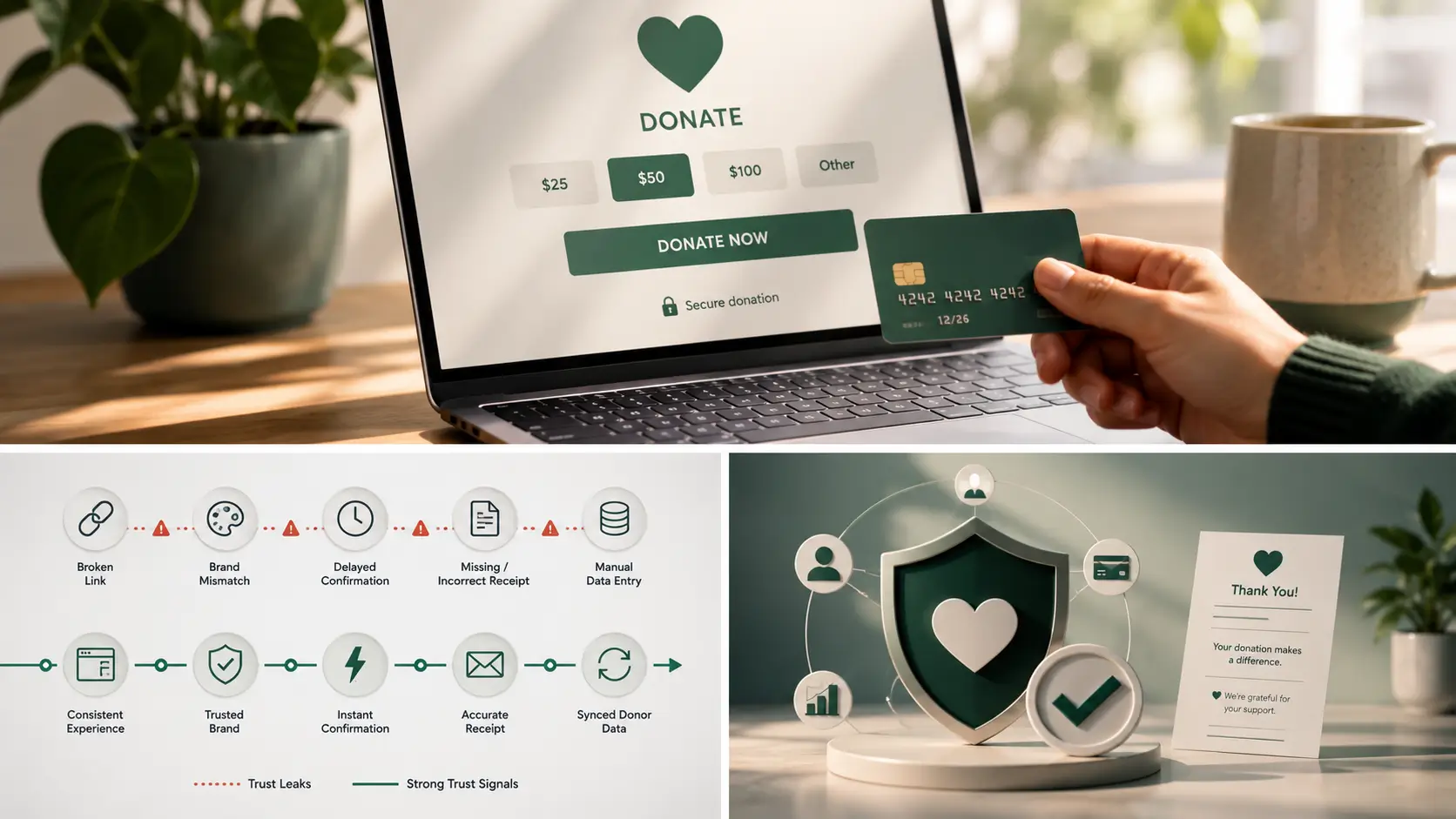
A campaign page gets built quickly for a specific fundraising push and sits outside the organization’s normal donation system. The branding is close, but not quite the same. The confirmation message is whatever the platform provides by default. Donor information lands in a spreadsheet someone eventually has to reconcile with the CRM.
Then the consequences start showing up downstream.
A recurring donor gets a generic thank-you. A designation doesn’t carry through correctly. A receipt comes from an unfamiliar processor. A later email references the wrong gift amount or treats an existing donor like a new prospect.
Internally, each issue may seem minor.
To a donor, they accumulate.
This is also why a beautifully designed campaign page can still create a weak giving experience. A polished front end bolted onto disconnected systems may look convincing until the donor moves through the transaction.
They can’t see the backend architecture.
They can see its consequences.
What trust-by-design actually looks like
A donation system designed for trust does several unglamorous things extremely well.
The visual experience remains consistent from the original appeal through checkout and confirmation, so the donor never has to wonder whether they’ve been sent somewhere unexpected.
Confirmation is immediate and specific: the gift amount, designation, organization name, and next step are clear.
Donor information flows into the systems that need it automatically, so future communications — thank-yous, recurring gift messages, tax receipts, campaign updates, and year-end summaries — are based on accurate information rather than manual reconciliation.
And when a campaign needs something different — a matching-gift initiative, emergency appeal, special designation, or new program — the organization can adapt the experience without rebuilding the underlying infrastructure from scratch.
That matters because consistency is hardest to maintain when teams are moving quickly.
A good system makes consistency the default.

Why does specialized digital expertise matter for nonprofit donation infrastructure?
Donation infrastructure touches more than web design.
It can involve payment processing, donor management systems, email automation, accounting workflows, analytics, tax receipts, recurring gifts, campaign attribution, data privacy, and the experience a donor sees at every step.
A page can look flawless while those systems are poorly connected underneath it.
That’s why evaluating a donation experience requires more than reviewing the design. It means understanding what happens to the donor and the data from the moment someone clicks “Donate” through every system that follows.
A specialized digital partner should be looking for those connections — and the places where they break — before the donor discovers them first.
What does trust-by-design look like in practice for nonprofit donation infrastructure?
This is the case for treating your donation infrastructure, not simply your donation page, as a trust asset.
It’s why we build campaign and donation systems around a connected donor and reporting foundation rather than creating disconnected one-off experiences for every fundraising push.
The consistency isn’t merely a design preference.
It’s part of how an organization demonstrates that it can be trusted with the gift a donor just made — and with the next one.
Rather than ask:
“Does our donation page look good?”
The better question is:
“If a first-time donor gave to us right now, would every step reinforce that they made a good decision — or would something in the experience quietly introduce doubt?”
If you’re not sure what your own donation flow is communicating to first-time donors, that’s worth examining. Book an Initial Strategy Consultation and we’ll identify where the experience — or the systems behind it — may be creating unnecessary friction.