This week, Fundraise Up made every organization on its platform eligible to become discoverable through AI-assisted giving. Its new Agentic Giving for nonprofits feature lets AI assistants read participating nonprofits’ live campaigns, recommend them to prospective donors, and pass the donor into a pre-populated Fundraise Up checkout. That may sound like one more platform feature to turn on. It isn’t. It’s an early mainstream signal of a much larger shift in how donors will discover, evaluate, and eventually transact with nonprofits. And the important part is that there probably won’t be one agentic giving model. There will be at least two.
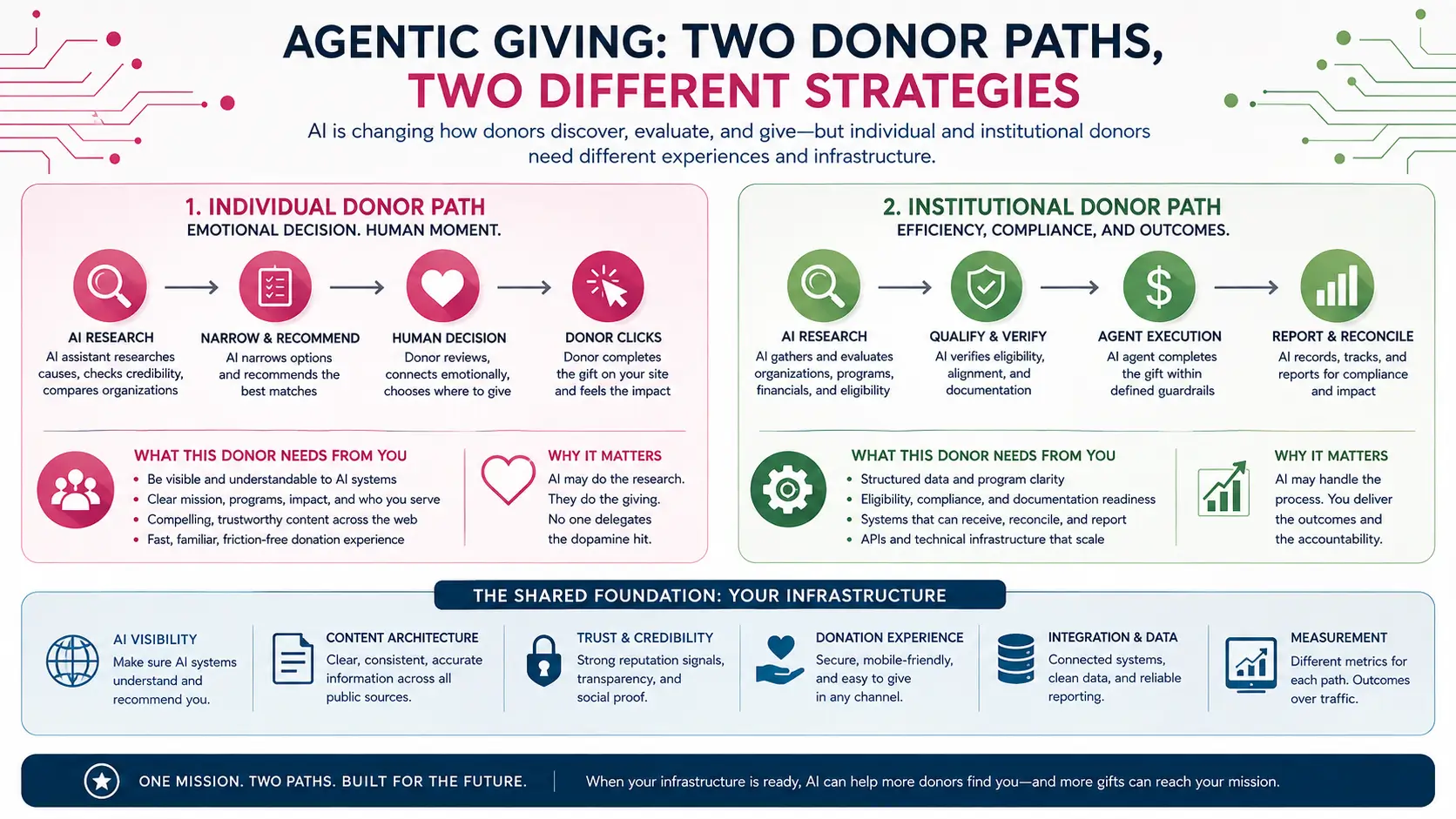
Agentic giving for nonprofits involves using AI assistants to manage parts of the donation process, from researching causes to potentially completing transactions, as exemplified by Fundraise Up's new feature. Nonprofits need two distinct strategies because individual donors, often driven by emotion, will likely retain the final decision, requiring nonprofits to optimize for AI recommendation and a smooth click-through experience. In contrast, corporate and institutional donors, prioritizing efficiency and compliance, are more likely to delegate full transaction execution to AI, necessitating a focus on eligibility and automated reporting.

What agentic giving actually is
Agentic giving is the use of AI assistants to perform some portion of the giving process on a donor’s behalf. That can mean researching causes, comparing organizations, checking credibility, identifying relevant campaigns, or eventually executing a gift with limited or no additional human input. The important word is some. Agentic AI isn’t all-or-nothing. GiveCampus, for example, already frames agentic fundraising as a spectrum. Its tools range from Collaborative Mode, where AI performs work with human review, to Independent Mode, where an agent can manage a sequence within predefined guardrails and escalate when human judgment is required.
That spectrum is a useful way to think about donor-side agentic giving too. The question is not simply, “Will donors use AI to give?” It’s, “Which parts of the giving decision will different donors want AI to handle?” That distinction matters because individual donors and institutional donors are solving very different problems.
The split: emotional givers and efficiency givers
For many individual donors, I expect the emotional decision to remain human even as the research becomes increasingly agentic. An AI assistant can do the unglamorous work extremely well. It can vet financials, compare the impact claims of three food banks, check whether an organization is legitimate, identify which nonprofits serve a specific community, and summarize programs, ratings, financial information, and recent news. That dramatically compresses the research phase.
But giving is different from buying toner.
For many individual donors, clicking “Donate” is part of the experience. They want to make the decision, feel the moment, and know that they acted.
No one delegates the dopamine hit.
That suggests an emerging model in which AI does more of the discovery and evaluation while the donor retains the final decision. For this donor, your immediate priority is not necessarily enabling an autonomous agent to complete the transaction. It is becoming the nonprofit the AI recommends in the first place.
Your organization needs to be visible enough, credible enough, and specific enough that an AI assistant can accurately explain who you are, what you do, who you serve, and why you are relevant to the donor’s request. Then, when the donor clicks through, the giving experience needs to be fast, trustworthy, and friction-free.
Corporate and institutional giving may be where full agentic execution takes hold first. Consider a corporate social responsibility team managing a quarterly community-giving allocation, a matching-gift program, or disaster-relief funding.
The staff member administering that process may have very little emotional investment in manually clicking the final donation button. Their priorities are more likely to be eligibility, compliance, accuracy, documentation, reporting, and getting the allocation completed correctly and on time.
Delegating research, qualification, and eventually execution to an AI agent may not feel like surrendering control. It may be exactly why the organization adopts the technology.
That creates a very different technical requirement. The organizations best positioned for this kind of giving will need to be both visible and understandable to AI systems and technically capable of receiving, processing, reconciling, and reporting a transaction initiated through an agentic workflow.
Same underlying technology. Two donor types. Two very different jobs for your digital infrastructure to do. Building one strategy for both risks becoming invisible to the efficiency-driven donor while stripping too much humanity from the individual donor experience.
Why this matters now
The visibility side of this shift is already happening. AI search is changing how people research organizations, products, services, and causes before they ever visit a website. Recent research has found that charities have been somewhat more resistant to AI-driven traffic declines than many commercial sectors, likely because charitable searches tend to carry strong intent.
But nonprofit visibility has still been affected. At the same time, zero-click search continues to grow, meaning more people are getting at least part of their answer without visiting the underlying website.
For nonprofits, that changes the role of search visibility.
It is no longer enough to ask, “Do we rank?”
You also need to ask, “When an AI system answers a question about our cause, geography, programs, or impact, does it understand us well enough to include us?”
The donors who do arrive on your site may also be further along in the decision process. They may already know what you do, may already have compared you with several alternatives, and may already be leaning toward giving.
That raises the stakes on what happens when they arrive. A confusing donation page, inconsistent message, or high-friction checkout has less room to recover from the mistake when the donor has already done most of the evaluation somewhere else.
Donor behavior is beginning to point in the same direction
AI-assisted nonprofit research is still early. Only a small percentage of donors currently report using chatbots to research causes. But those donors appear to behave differently.
Available data suggests they tend to make larger gifts when they do convert and are less likely to donate immediately, which is consistent with a longer research-then-decide journey.
At the same time, donor resistance to nonprofits using AI appears substantially lower than many organizations assume. A majority of online donors report being comfortable with nonprofits using AI to assist with marketing, fundraising, and administrative work.
The larger problem may therefore not be donor acceptance. It may be organizational readiness.
The 2026 Nonprofit AI Adoption Report found that roughly 92% of nonprofits are already using AI in some form, while only about 7% report major improvements in organizational capability. Nearly half still have no AI governance policy.
That is a substantial gap between using AI tools and actually being prepared for AI to become part of the organization’s external donor ecosystem.
And that is why an “Enable Agentic Giving” setting can create a false sense of completion.
Turning on the capability is not the strategy.
What to do before giving season ramps up
There are three things I would do now.
1. Audit how AI systems currently understand your organization
If your fundraising platform offers an AI visibility assessment, use it. But don’t stop there.
Ask ChatGPT, Claude, Perplexity, and Google questions a prospective donor might actually ask, then ask how your own organization is described and compare that answer with two peer organizations.
Look for missing programs, incorrect geography, outdated leadership or organizational information, weak descriptions of impact, confusion about who you serve, or cases where your organization simply doesn’t appear.
The important question is not whether an AI system can technically access your information. It is whether it understands your organization well enough to recommend you accurately.
If the answer is wrong, thin, or absent, turning on an agentic checkout capability will not solve the underlying visibility problem.
2. Design the individual and institutional donor paths separately
For individual donors, your public digital presence needs to provide enough clear, credible, structured information for AI systems to understand and recommend you.
That includes your website, but it can also include media coverage, nonprofit profiles, community platforms, reviews, authoritative third-party mentions, and other public sources.
Then, once the donor chooses to visit your site, the human giving experience needs to be excellent. Effective nonprofit websites are fast, familiar, trustworthy, mobile-friendly, and low friction.
The institutional path is different. That path increasingly needs technical and compliance infrastructure capable of supporting research, eligibility verification, transaction processing, reconciliation, and reporting with progressively less manual intervention.
That is not the same thing as adding a Donate button.
3. Measure the two paths differently
Traffic volume is becoming a weaker measure of digital visibility on its own.
If AI answers more questions before someone visits your site, declining or flat traffic does not necessarily mean declining influence.
For the individual donor path, measure outcomes: completed gifts, conversion rate, new donor acquisition, recurring-gift conversion, and donor quality.
Then separately monitor how AI systems describe and recommend your organization.
For institutional and eventually fully agentic giving, measurement will need to include whether those transactions can be received, attributed, reconciled, and reported correctly without adding administrative burden.
Agentic giving is an infrastructure decision
The easiest response to Fundraise Up’s announcement is to turn on the feature and consider the organization ready.
But the feature itself is only one piece.
Agentic giving sits at the intersection of AI visibility, content architecture, fundraising technology, donation experience, data integration, analytics, compliance, and donor strategy.
The organizations that benefit most will not necessarily be the first ones to enable a setting.
They will be the ones whose digital infrastructure is ready for both sides of the change: AI systems that increasingly influence which nonprofits donors discover, and giving systems capable of supporting increasingly automated transactions when the donor actually wants them.
Those are two different challenges.
They need two different strategies.
And they are arriving on two different timelines — for two different kinds of donors who happen to be giving to the same cause.
Sources:
- Agentic Giving — Fundraise Up
- Agentic AI Fundraising Doesn’t Mean All-or-Nothing Control — GiveCampus
- Charity Site Traffic Growth Slows by 2.5% as AI Search Rolls Out — NonProfit PRO
- 2026 AI Marketing & Fundraising Statistics for Nonprofits — Nonprofit Tech for Good
- What the 2026 Nonprofit AI Adoption Report Reveals — Virtuous
- How AI Search Is Changing Donor Discovery for Nonprofits — NonProfit PRO