Master Advertising Media Planning Basics: Your Detailed Guide
Advertising and media planning is the strategic process of determining where, when, and how to deliver marketing messages to reach the right audience at the optimal moment for the lowest possible cost. This crucial planning prevents budgets from being wasted on channels an organization's target audience doesn't use. The stakes are high, as television alone accounts for over 38% of total advertising spending in the U.S., and fewer than 20 companies control more than 50% of all media advertising revenue. For organizations like nonprofits, effective media planning ensures every dollar spent on advertising directly supports their mission by connecting with donor attention.
Why Advertising and Media Planning Determines Whether Your Campaign Succeeds or Fails
Advertising and media planning is the strategic process of deciding where, when, and how to deliver your marketing messages — so they reach the right people, at the right moment, for the lowest possible cost.

If you’re running any kind of campaign — digital, print, social, or broadcast — here’s what you need to know upfront:
- What it is: A structured blueprint that guides every ad placement decision before you spend a single dollar
- Why it matters: Without it, budgets get wasted on channels your audience doesn’t use
- Who does it: Media planners, advertising agencies, or in-house marketing teams
- What it produces: A media plan — a document covering your target audience, budget, channel mix, schedule, and KPIs
- How it differs from media buying: Planning sets the strategy; buying executes it by purchasing actual ad space
Every successful advertising campaign begins with a media plan. That’s not an opinion — it’s how the industry works. The planning phase is what separates campaigns that convert from campaigns that just spend money.
The stakes are high. Television alone accounts for just over 38% of total advertising spending in the U.S., and fewer than 20 companies control more than 50% of all media advertising revenue. The media landscape is concentrated, competitive, and expensive. Going in without a plan isn’t bold — it’s costly.
For nonprofit leaders and executive directors, this matters just as much as it does for consumer brands. Donor attention is finite. Every dollar spent on the wrong channel is a dollar that didn’t fund your mission.
This guide walks you through everything — from core definitions to the full planning process — in plain language.
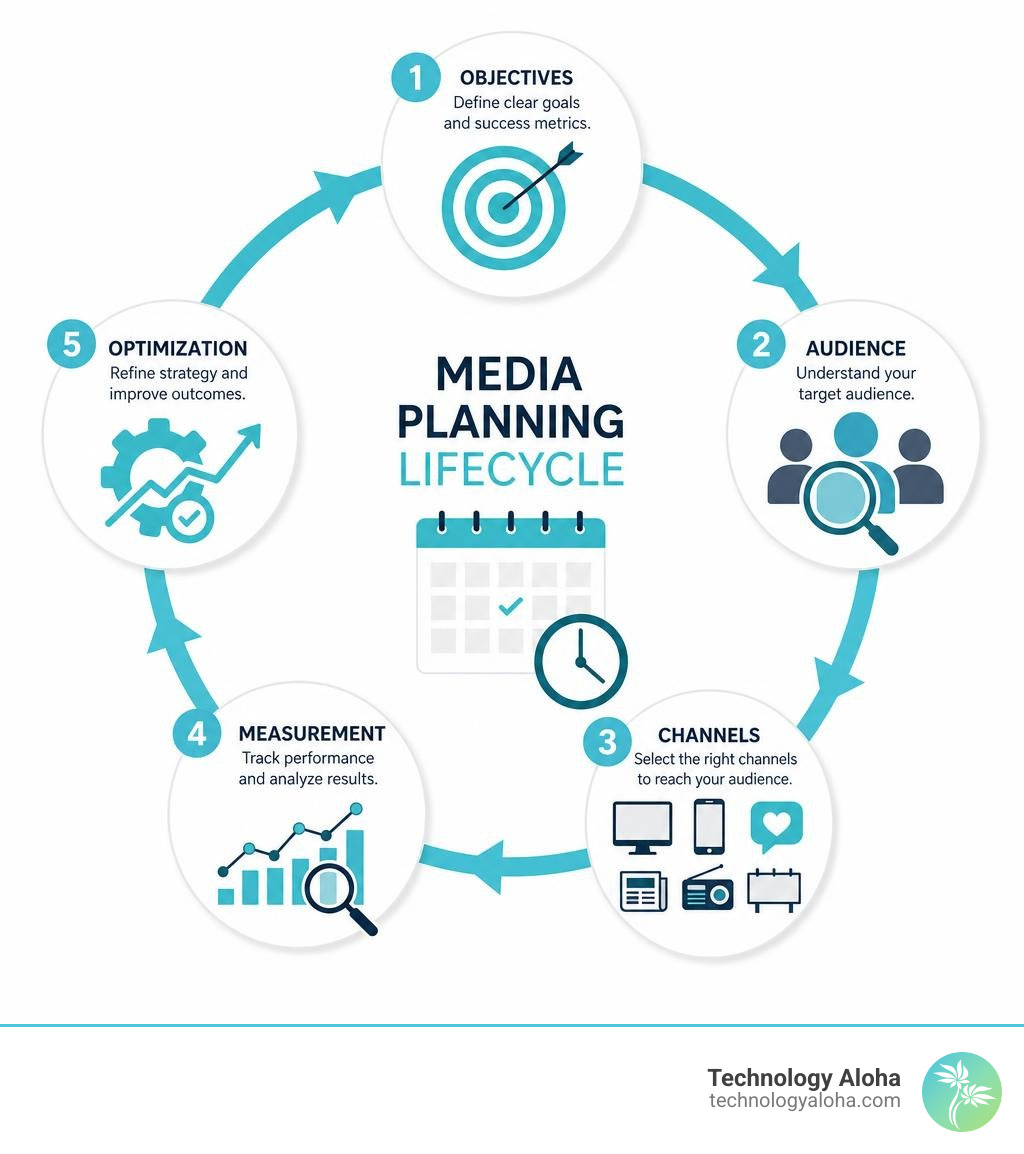
Essential advertising and media planning terms:
What is Advertising and Media Planning?
Brand communication relies on two fundamental pillars. The first is content—what your brand says. The second is contact—how that message connects to your target audience. Advertising and media planning is the art and science of making that connection happen.
At its core, this planning process involves researching, analyzing, and selecting the optimal combination of media channels to share your message. It is a strategic exercise that transforms a creative concept into a structured campaign. According to academic frameworks found in Advertising Media Planning – DocsLib, media planning is a systematic effort to maximize exposure while maintaining absolute control over your budget.
For any organization, a media plan functions as the connective tissue between high-level business goals and ground-level marketing execution. If you have built a comprehensive marketing blueprint using The Ultimate Guide to Marketing Plan, your media plan is the vehicle that drives those strategies into the real world.
Without this structured approach, organizations risk falling victim to media fragmentation. In 2026, consumers multitask across multiple screens and devices, often consuming more hours of media per day than they are awake. A professional media planner’s job is to analyze these complex consumption habits, identify when consumers are most susceptible to a message, and place ads where they will generate genuine consumer engagement rather than empty impressions.

Media Planning vs. Media Buying: Key Differences
While often grouped together, media planning and media buying are distinct phases of an advertising campaign.
- Media planning is strategic. It is the analytical phase where we define the target audience, establish the budget, select the channels, and set the timing parameters. The planner asks: Who needs to see this, where are they looking, and what action do we want them to take?
- Media buying is tactical. It is the execution phase where the buyer negotiates rates, purchases actual ad space, and monitors live campaign delivery. The buyer asks: How can we get the best placement for the lowest cost, and is the ad running exactly where we agreed?
Planners rely on market research and consumer behavior data. Buyers rely on negotiation skills, agency relationships, and real-time bidding software.
To build a high-performing campaign, these two disciplines must work in close coordination. You can learn more about aligning these operational steps by reading our guide on How to Build a Successful Marketing Process.
| Feature | Media Planning | Media Buying |
|---|---|---|
| Primary Focus | Strategy, audience research, and channel selection | Negotiation, purchasing, and execution |
| Key Output | Media plan, budget allocation, and schedules | Purchased ad space, optimized campaign delivery |
| Core Skills | Data analysis, audience profiling, strategic thinking | Negotiation, relationship building, budget management |
The Core Components of a Modern Media Plan
A successful media plan requires structure. If you leave any of the core components to guesswork, your campaign will lose efficiency. When we design digital strategies, we ensure every plan includes these four pillars:
- Target Audience Profile: You must know exactly who you are trying to reach. This goes beyond simple demographics like age and location. It includes psychographics, online behaviors, and media consumption habits.
- Budget Allocation: This outlines exactly how much money is assigned to each channel. A disciplined budget prevents overspending and ensures that high-performing channels receive the resources they need.
- Media Mix: The specific combination of channels you will use to deliver your message. This could include search engine marketing, social media, programmatic display, email, or legacy print and out-of-home advertising.
- Scheduling and Frequency: This defines when your ads will run and how often your audience will see them. Planners must balance reach (how many people see the ad) with frequency (how many times they see it) to avoid ad fatigue.
Understanding these components is essential to mastering The Most Important Aspects of Digital Marketing.
The Paid, Owned, and Earned Media Framework in Advertising and Media Planning
To build a balanced media mix, modern planners organize their campaigns using the Paid, Owned, and Earned (POE) media framework. This strategic model ensures that your brand supports its message across all possible consumer touchpoints.
- Paid Media: Any placement that requires a direct financial investment. This includes social media ads, search engine marketing (SEM), sponsored content, and traditional television or print ads. Paid media is highly controllable and scaleable, making it excellent for driving immediate traffic.
- Owned Media: The media channels that your organization completely controls. Your website, blog, email newsletter, and organic social media profiles are all owned media. These channels cost less to maintain and are essential for nurturing long-term relationships and converting leads.
- Earned Media: The organic attention your brand receives from external sources. This includes word-of-mouth recommendations, press coverage, social media shares, and online reviews. While earned media is difficult to control, it carries the highest level of trust and credibility with consumers.
An effective plan does not rely on paid ads alone. It uses paid media to drive traffic to owned media channels, which in turn inspires earned media through high-quality content and user experiences.
The Step-by-Step Media Planning Process
Executing a campaign without a step-by-step process is a recipe for wasted ad spend. Based on professional standards, such as those taught in the ADV4300-Spring 2026-MediaPlanning_Moon curriculum, a rigorous planning process follows a logical path from research to execution.
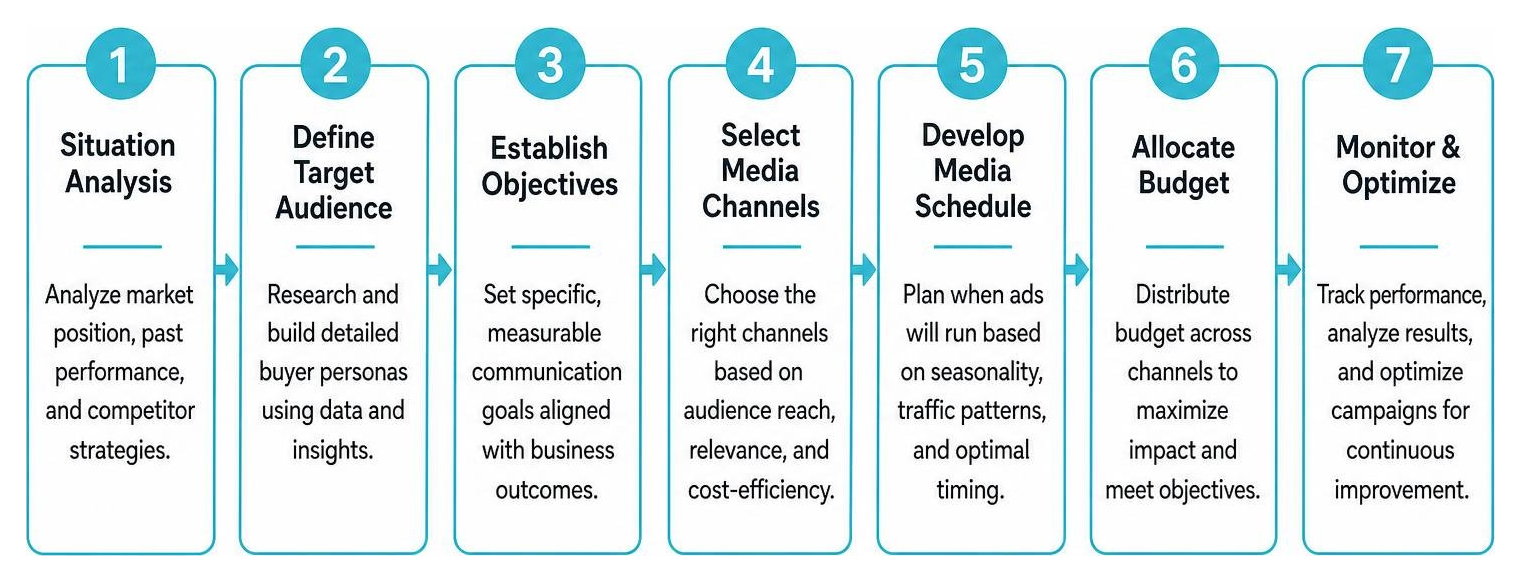
- Conduct a Situation Analysis: Analyze your current market position, review past campaign performance, and evaluate your competitors’ advertising strategies.
- Define Your Target Audience: Use database research, customer surveys, and digital analytics to build detailed buyer personas.
- Establish Clear Objectives: Set specific, measurable communication goals (e.g., increase website traffic by 25% or secure 100 new monthly recurring donors).
- Select Your Media Channels: Match your target audience’s media habits with the channels that offer the best reach, cost-efficiency, and trust.
- Develop the Media Schedule: Create a calendar that outlines when ads will run, taking into account seasonality, weekly traffic patterns, and optimal times of day.
- Allocate the Budget: Assign financial resources to each channel based on expected ROI and cost-per-thousand (CPM) estimates.
- Execute, Measure, and Optimize: Launch the campaign, monitor performance metrics in real-time, and shift budget away from underperforming channels to maximize results.
Aligning Marketing Objectives with Advertising and Media Planning
Your media plan should never exist in a vacuum. It must directly support your broader business and marketing objectives. If your primary business goal is to build brand awareness, your media plan should prioritize high-reach channels like social video or display networks. If your goal is direct conversions, your plan should focus on high-intent channels like search engine marketing.
To make this alignment work, you must establish clear Key Performance Indicators (KPIs) and conversion tracking systems before launching. This ensures that every dollar spent can be traced back to a tangible result. For a deeper look at setting up these foundational strategies, review our guide on How to Create a Marketing Strategy for Your New Business.
Frequently Asked Questions About Media Planning
What is the difference between Above the Line (ATL) and Below the Line (BTL) media?
These terms originate from traditional accounting practices but remain highly relevant for categorizing media spend:
- Above the Line (ATL) media refers to mass media channels designed to reach a broad, non-targeted audience. This includes national television, radio, and major newspapers. ATL is highly effective for building brand awareness but carries high upfront costs and makes precise targeting difficult.
- Below the Line (BTL) media refers to highly targeted, direct marketing activities. This includes email marketing, direct mail, local event sponsorships, and targeted social media ads. BTL allows for precise audience segmentation, lower entry costs, and highly accurate conversion tracking.
Modern integrated campaigns often combine both approaches—sometimes referred to as “Through the Line” (TTL) strategies—to build broad awareness while simultaneously driving direct conversions.
How do you measure the success of a media plan?
We measure success by comparing real-world campaign data against our initial KPIs. The primary metrics we track include:
- Reach: The total number of unique individuals exposed to your message.
- Frequency: The average number of times each person sees your ad.
- Impressions: The total number of times your ad was displayed, regardless of whether it was clicked.
- Return on Investment (ROI): The revenue or value generated by the campaign relative to the total ad spend.
In the commercial sector, strategic media planning yields massive efficiency gains. For instance, tech partners utilizing advanced media planning APIs have improved database call success rates from 30% to 98%, saving dozens of development hours each week. On the consumer side, brands like Beekeeper’s Naturals optimized their top-of-funnel streaming TV investments to achieve an 18% growth in assisted sales and a 70% increase in middle-of-funnel new-to-brand purchasers.
Whether your goal is selling wellness products or increasing donor retention for a food bank, rigorous tracking is the only way to prove and improve your ROI.
What tools do professional media planners use?
Professional planners rely on specialized tools and databases to remove the guesswork from channel selection:
- Nielsen: The industry standard for measuring television and digital audience viewing habits.
- MRI-Simmons: A comprehensive consumer database that links demographic data with media usage and product purchasing behavior.
- SRDS (Standard Rate and Data Service): A directory used to find ad rates, circulation sizes, and contact information for print, digital, and out-of-home media vehicles.
- Talkwalker: A computational data and social listening tool used to track real-time online conversations, brand sentiment, and digital trends.
If you are ready to explore digital ad placements yourself, start by reading our introductory guide: Considering Advertising on Social Media Learn the Basics Today.
What are the key takeaways from this guide on advertising and media planning?
The key takeaways from this guide on advertising and media planning are that strategic planning is essential for campaign success, ensuring messages reach the right audience efficiently. Technology Aloha emphasizes that a brilliant message only works if the right people actually see it, highlighting the critical role of media planning for businesses and nonprofits, especially food banks. They specialize in building scalable digital infrastructure and high-conversion virtual donation platforms that turn attention into action. By reducing donation friction and designing user-centered websites, they help organizations close the survival gap and maximize their community impact. If you are ready to stop guessing where to spend your marketing dollars, Technology Aloha can help you build a data-driven strategy that delivers real results. Explore their specialized Marketing Strategy Services and read An Essential Guide to Marketing Plan for Small Business to start optimizing your outreach today.
For food banks and nonprofits, this efficiency is critical. We specialize in building scalable digital infrastructure and high-conversion virtual donation platforms that turn attention into action. By reducing donation friction and designing user-centered websites, we help organizations close the survival gap and maximize their community impact.
If you are ready to stop guessing where to spend your marketing dollars, let us help you build a data-driven strategy that delivers real results. Explore our specialized Marketing Strategy Services and read An Essential Guide to Marketing Plan for Small Business to start optimizing your outreach today.