Why a Buyer Persona Template Example Saves You Time and Guesswork

A buyer persona template example gives you a ready-made structure to document who your ideal customer is—so you stop marketing to everyone and start connecting with the right people.
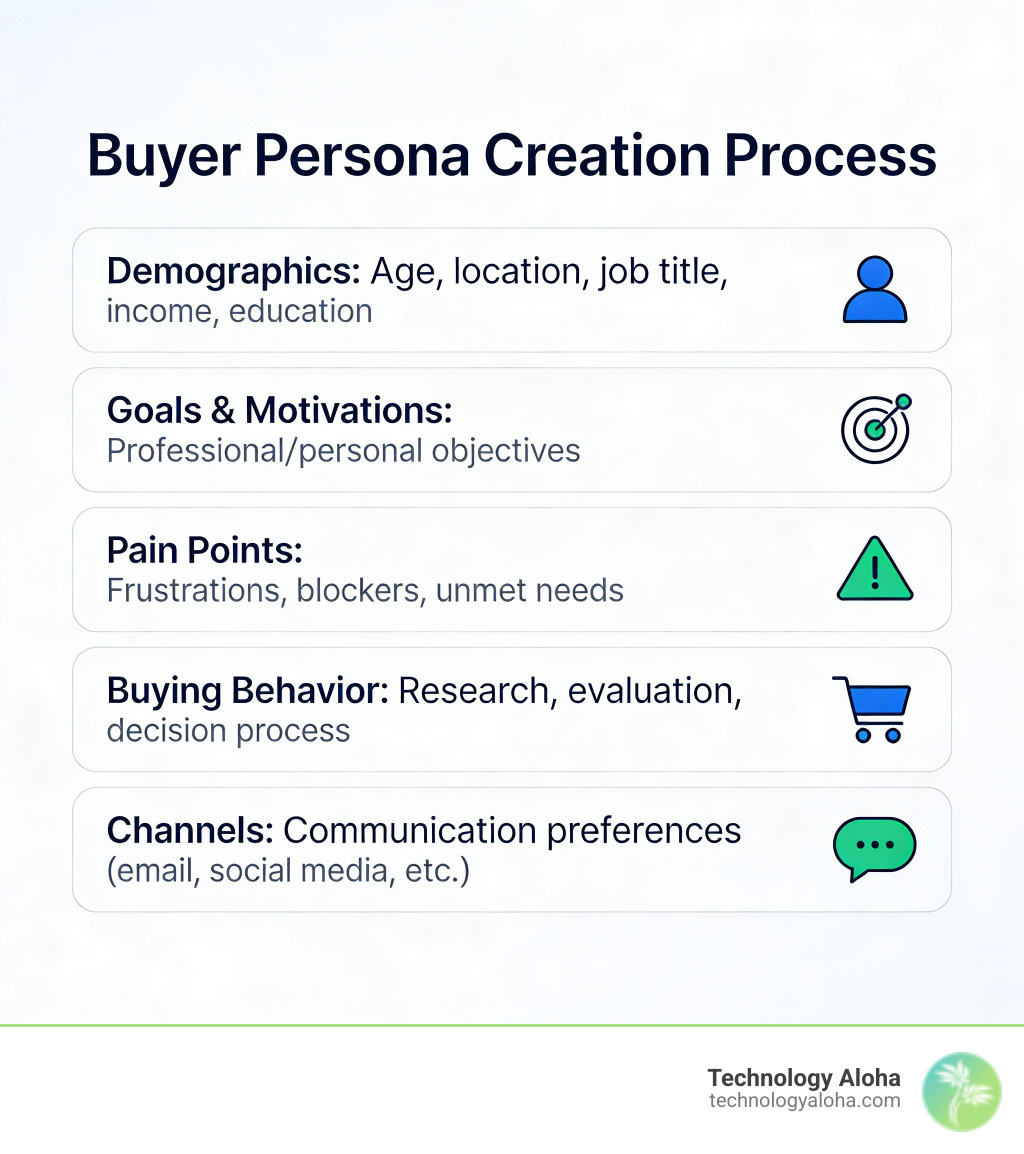
Here are the core elements a buyer persona template should include:
| Section | What to Document |
|---|---|
| Demographics | Age, location, job title, income, education |
| Goals & Motivations | What they’re trying to achieve professionally or personally |
| Pain Points | Frustrations, blockers, unmet needs |
| Buying Behavior | How they research, evaluate, and decide |
| Communication Preferences | Email, social media, video, peer recommendations |
| Brand Affinities | Trusted sources, preferred content formats |
| Decision-Making Authority | Do they approve the purchase or just influence it? |
Most small businesses skip this step—or rush it. The result is generic campaigns that don’t convert.
The data backs this up. Persona-driven campaigns achieve a 32% email open rate compared to 12% for generic campaigns—and an 8% conversion rate versus 1.5%. That’s not a marginal difference. That’s a completely different business outcome.
The core issue isn’t effort. It’s precision. A solid buyer persona template forces you to get specific about who you’re talking to, what they need, and how they make decisions—before you spend a dollar on marketing.
The Essential Components of a Buyer Persona Template Example
An effective buyer persona template example is more than a list of demographics. While knowing a customer’s age or location is a starting point, it doesn’t explain why they buy. To build a strategy that actually works, you must dig into the psychographics—the values, attitudes, and lifestyles that drive behavior.
When we develop these for our clients, we focus on the “Before and After” framework. What is their life like now (the pain), and what does it look like after using your solution (the transformation)? Content that people can relate to simply sells more because it demonstrates a solution to a real-world problem.
Key components to include in your template:
- Pain Points: What keeps them up at night? Is it a lack of time, inefficient software, or high costs?
- Professional Goals: If they are B2B, what does success look like for their boss? If B2C, what personal milestone are they trying to reach?
- Buying Triggers: What specific event makes them realize they need a change today?
- Communication Preferences: Do they scroll TikTok for advice, or do they only trust peer-reviewed case studies?
- Decision-Making Authority: Are they the one signing the check, or the one who has to convince the person signing the check?
For a deeper look at how these elements come together, you can browse the ultimate target persona example gallery to see various ways to visualize this data.
5 Industry-Specific Persona Examples to Guide Your Strategy
Not all personas are created equal. A B2B persona focuses heavily on professional ROI and stakeholder alignment, while a B2C persona often centers on emotional triggers and personal convenience. Understanding how persona examples can help your marketing strategy is the first step toward better targeting.
Comparison: B2B vs. B2C Persona Dimensions
| Dimension | B2B Persona Focus | B2C Persona Focus |
|---|---|---|
| Primary Motivation | Efficiency, ROI, Risk Mitigation | Status, Ease, Emotional Reward |
| Decision Cycle | Long (Months/Years) | Short (Minutes/Days) |
| Influencers | Department Heads, IT, Finance | Family, Friends, Social Media |
| Content Needs | Whitepapers, Case Studies | Reviews, Video Demos, Discounts |
The SaaS Efficiency Seeker: A B2B Buyer Persona Template Example
Meet “Marcus,” an IT Director at a mid-sized firm. He is overwhelmed by “tool sprawl”—too many subscriptions that don’t talk to each other.
- Pain Points: Cybersecurity vulnerabilities and outdated systems.
- Buying Behavior: He relies on peer recommendations and technical specs.
- Goal: To consolidate workflows without breaking the budget.
- Strategy: For Marcus, skip the flashy ads. He needs a detailed whitepaper or a technical demo that proves your software is secure and compatible.
The Eco-Conscious Retail Shopper
“Suzanne” is a 30-year-old retail shopper who prioritizes sustainability over price.
- Pain Points: “Greenwashing” and lack of brand transparency.
- Buying Behavior: She researches brands on social media and looks for ethical certifications.
- Goal: To feel that her purchases align with her environmental values.
- Strategy: Use video content that shows your supply chain. Suzanne values transparency and will pay a premium for it.
The Busy Fitness Professional
“Jake” is a time-poor professional who wants to stay healthy but struggles to find an hour for the gym.
- Pain Points: Overwhelming options and lack of time.
- Buying Behavior: Mobile-first browsing; he buys via apps that offer a one-click checkout.
- Goal: A frictionless, 20-minute workout solution.
- Strategy: Your marketing should emphasize “quick,” “convenient,” and “mobile-integrated.”
The Cautious Insurance Customer
“Sarah” is looking for life insurance but is terrified of being “sold” something she doesn’t need.
- Pain Points: Industry jargon and high-pressure sales tactics.
- Buying Behavior: She seeks warm, educational guidance.
- Goal: Long-term security for her family.
- Strategy: Use plain language. Educational blog posts that demystify insurance will build the trust she needs to convert.
The Negative Persona: Filtering Low-Value Leads
Sometimes, knowing who not to market to is just as important. A “Negative Persona” (like “Beth the Chronic Returner”) helps you optimize resources.
- Characteristics: High maintenance, low revenue, or a mismatched budget.
- Why it matters: By identifying these profiles, you can stop spending ad dollars on leads that will only drain your customer service team’s time without providing a return.
A Step-by-Step Guide to Data-Driven Persona Creation
Creating a persona shouldn’t be a creative writing exercise. It should be a data-mining expedition. If you guess, you fail. Research shows that customers value a tailored experience, but you can’t tailor what you don’t understand.
To get started, check out everything you need to get started with marketing personas for a foundational overview.
Gathering Insights via Surveys and Interviews
The best data comes directly from the source. Don’t just look at your CRM; talk to your customers.
- Surveys: Use tools like SurveyMonkey (rated 4.5/5 on G2) to ask open-ended questions.
- The Right Questions: “What is your biggest daily frustration?” “How do you typically research a new solution?” “What was the last thing that almost stopped you from buying from us?”
- Interviews: Aim for 15–20 minute calls. Record them (with permission) so your entire team can hear the customer’s actual voice and vocabulary. This helps identify qualitative patterns that numbers alone might miss.
Refining Your Buyer Persona Template Example with AI and CRM Tools
Modern tools can turn months of research into days of insight.
- Sentiment Analysis: AI can scan your call logs and emails to identify if customers are frustrated or happy, helping you refine the “Pain Points” section of your buyer persona template example.
- Technographic & Intent Data: Use CRM data to see what other tools your customers use and what they are searching for online right now.
- Data Decay Prevention: B2B data decays at a rate of about 30% per year. People change jobs, companies merge, and priorities shift. Real-time validation through your CRM ensures your personas don’t become “zombies”—static documents that no longer represent reality.
Maximizing ROI Through Persona-Driven Personalization
The ultimate goal of a buyer persona template example is to increase your bottom line. When your marketing feels human and personal, it works.
Consider the statistics:
- Email Performance: Persona-driven campaigns see an 18% Click-Through Rate (CTR) compared to just 5% for generic blasts.
- Conversion Efficiency: An 8% conversion rate for targeted campaigns versus 1.5% for “spray and pray” methods.
- Sales Alignment: When Sales and Marketing use the same persona, the “hand-off” of leads is seamless. Sales knows exactly which pain points to mention in their first outreach call.
By aligning your product roadmap with persona needs, you ensure you aren’t building features nobody wants. You are building solutions for “Marcus” or “Suzanne,” which makes your product indispensable.
Frequently Asked Questions about Buyer Personas
What is the difference between a buyer persona, target audience, and user persona?
These terms are often used interchangeably, but they serve different purposes:
- Target Audience: A broad group (e.g., “Women aged 25–40 in Hawaii”).
- Buyer Persona: A deep, psychological profile of the decision-maker (e.g., “Leilani, a small business owner in Maui who values community and needs time-saving marketing”).
- User Persona: Focused on how someone interacts with a specific product or website.
- Customer Persona: Often refers to the profile of someone who has already purchased, focusing on post-purchase behavior and loyalty.
How often should I update my buyer persona templates?
We recommend a quarterly review. Markets shift, and as we’ve seen, data decay is real. If your bounce rates are climbing or your CTR is dropping, your persona is likely outdated. Significant organizational changes or new product launches should also trigger an immediate update.
What are the most common mistakes when building personas?
- Guesswork: Basing a persona on what you think customers want rather than real interview data.
- Ignoring Negative Personas: Wasting budget on leads that will never convert or will be too expensive to service.
- Static Documentation: Creating a beautiful PDF and then never looking at it again. A persona should be a “living” part of every strategy meeting.
- Over-complication: If your persona is 20 pages long, nobody will read it. Keep it punchy and actionable.
Conclusion
Building a strategy without a buyer persona template example is like trying to navigate the road to Hana without a map—you might get somewhere, but it will be a lot more stressful and take twice as long.
At Technology Aloha, we specialize in turning these data-driven insights into high-conversion designs and cohesive branding. Whether you are in Kahului or anywhere else in Hawaii, our focus is on helping your business grow through strategic positioning and user-centric websites.
Ready to stop guessing and start growing? Learn more about our marketing strategy services and let’s build a persona that actually drives results.