B2B Buyer Persona vs. ICP: Understanding the Difference
In B2B marketing, we often hear the terms “Ideal Customer Profile” (ICP) and “Buyer Persona” used interchangeably. However, they serve two distinct but complementary purposes. If you want your b2b buyer persona template to be effective, you must understand where one ends and the other begins
 .
Think of the ICP as the “Company Profile.” it focuses on firmographics—the characteristics of the organization that is the best fit for your services. This includes company size, industry, geographic location (like businesses here in Kahului or across Hawaii), annual revenue, and their current technology stack. We use ICPs primarily for account targeting and high-level market segmentation.
On the other hand, the Buyer Persona is the “Individual Profile.” It focuses on the human beings working within those companies. These are the decision-makers, the influencers, and the evaluators who actually interact with your brand. While the ICP tells you which building to knock on, the buyer persona tells you what to say when someone opens the door.
| Feature | Ideal Customer Profile (ICP) | B2B Buyer Persona |
|---|---|---|
| Focus | The Organization (Account-level) | The Individual (Role-level) |
| Data Points | Industry, Revenue, Employee Count, Location | Goals, Pain Points, Buying Triggers, Fears |
| Primary Use | Lead Qualification & Outbound Targeting | Messaging, Content Creation, Sales Scripts |
| Goal | Finding the right “fit” company | Connecting with the human decision-maker |
To dive deeper into the basics of creating these profiles, you can check out our guide on everything you need to get started with marketing personas. By combining a strong ICP with detailed personas, you ensure that your marketing isn’t just reaching the right office—it’s reaching the right mind.
Why Your Business Needs a Detailed b2b buyer persona template
Creating a b2b buyer persona template isn’t just a “nice-to-have” administrative task; it is a fundamental driver of ROI. In the B2B space, sales cycles are often long, and decisions are high-consideration. Buyers aren’t just picking a product; they are often risking their professional reputation or their department’s budget on a solution.
When we use data-driven personas, we move away from “spray and pray” marketing and toward surgical precision. Here is why this matters for your bottom line:
- Increased Sales Efficiency: When your sales team knows exactly what an “IT Director Ian” cares about versus an “Operations Olivia,” they don’t waste time on irrelevant talking points. They can handle objections before they are even raised.
- Messaging Consistency: Have you ever had a prospect hear one thing from an ad and something completely different from a sales rep? Personas act as a “shared language” for your entire company, ensuring a cohesive brand experience.
- Higher Lead Quality: By identifying “Negative Personas”—the types of people who are not a good fit—you can stop spending money on leads that will never close or will churn quickly.
- Personalization at Scale: As noted in our research, 56% of consumers are more likely to repeat buy after a personalized experience. In B2B, this personalization happens by addressing role-specific challenges.
Industry research shows that 82% of top-performing B2B marketers credit their success to understanding their audience at this role-specific level. Without a template to organize these insights, that knowledge stays locked in the heads of a few veteran employees instead of empowering your whole team.
Essential Components and Research Methods
A “pretty” persona document is useless if it’s based on guesswork. At Technology Aloha, we advocate for a data-first approach. To build a b2b buyer persona template that actually works, you need to look at what truly drives a purchase.
One of the most effective frameworks for this is the “5 Rings of Buying Insight.” Instead of just asking “How old is the buyer?” we ask:
- Priority Initiatives: What three to five problems is this buyer dedicated to solving right now?
- Success Factors: What tangible results do they expect from a solution?
- Perceived Barriers: Why would they not buy from us (or anyone else)?
- Buyer’s Journey: Who else is involved, and what resources do they trust?
- Decision Criteria: What specific features or capabilities are non-negotiable?
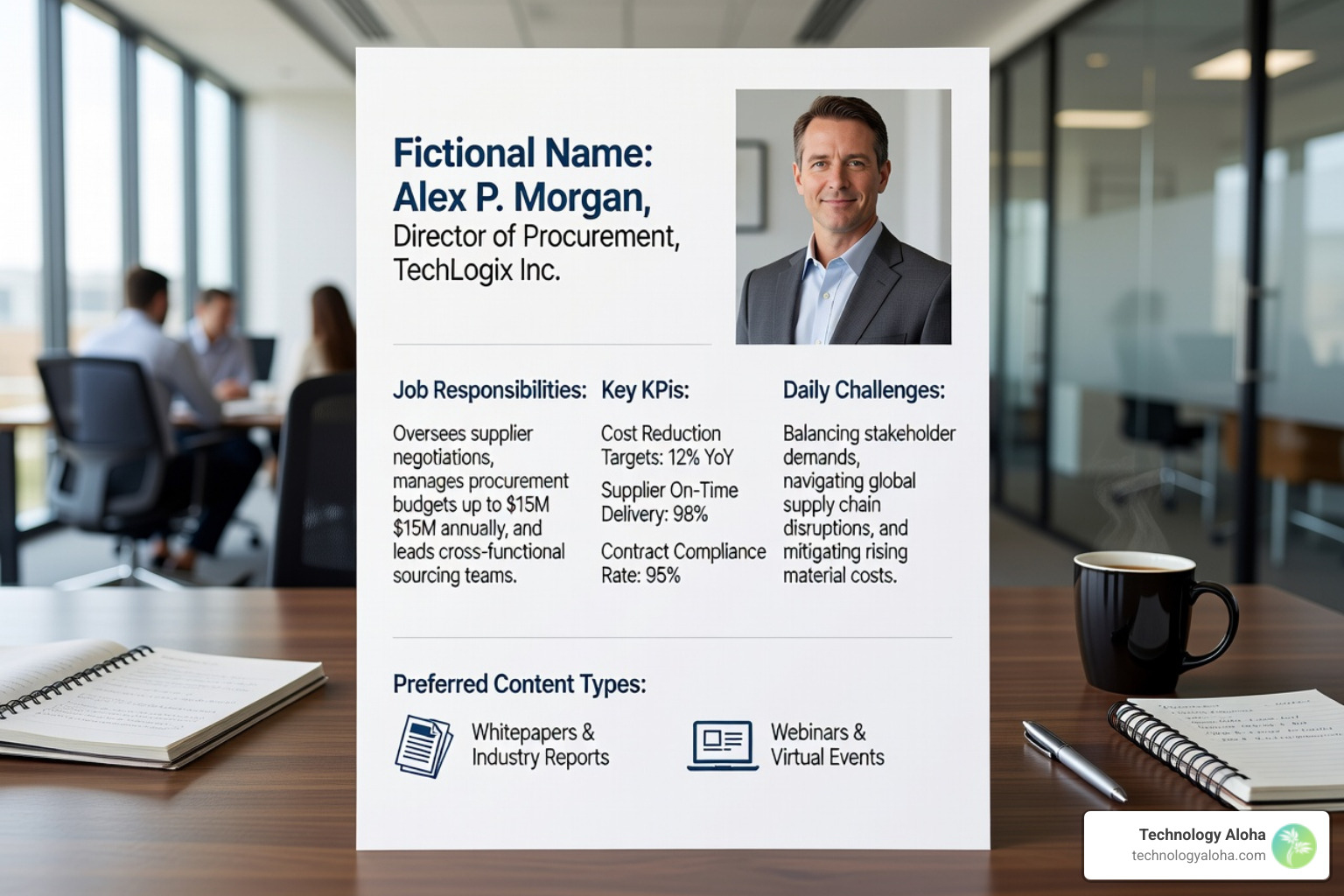
Essential Sections of a b2b buyer persona template
When you are filling out your template, ensure you include these role-specific fields:
- Job Title & Seniority: Does this person have the authority to sign the check, or are they an “influencer” who recommends the tool to their boss?
- Technical Expertise: Are you talking to a CTO who wants to know about API integrations, or a CEO who only cares about the bottom-line ROI?
- Communication Preferences: Do they prefer a 30-page whitepaper, or a simple one-page summary they can forward to the CFO?
- Validators: Who do they trust? This might be Gartner reports, peer case studies, or specific LinkedIn thought leaders.
- Negative Traits: List the “red flags”—such as a lack of budget authority or a history of switching vendors every six months—that help your team disqualify leads early.
Step-by-Step Creation and Common Mistakes
How do you actually get this information? You go straight to the source.
- Interview Recent Buyers: This is the gold standard. Speak to people who have purchased a solution like yours (even if they didn’t buy it from you) in the last 6 to 12 months. Their memory of the “pain” is still fresh. Aim for at least 10 interviews to find recurring patterns.
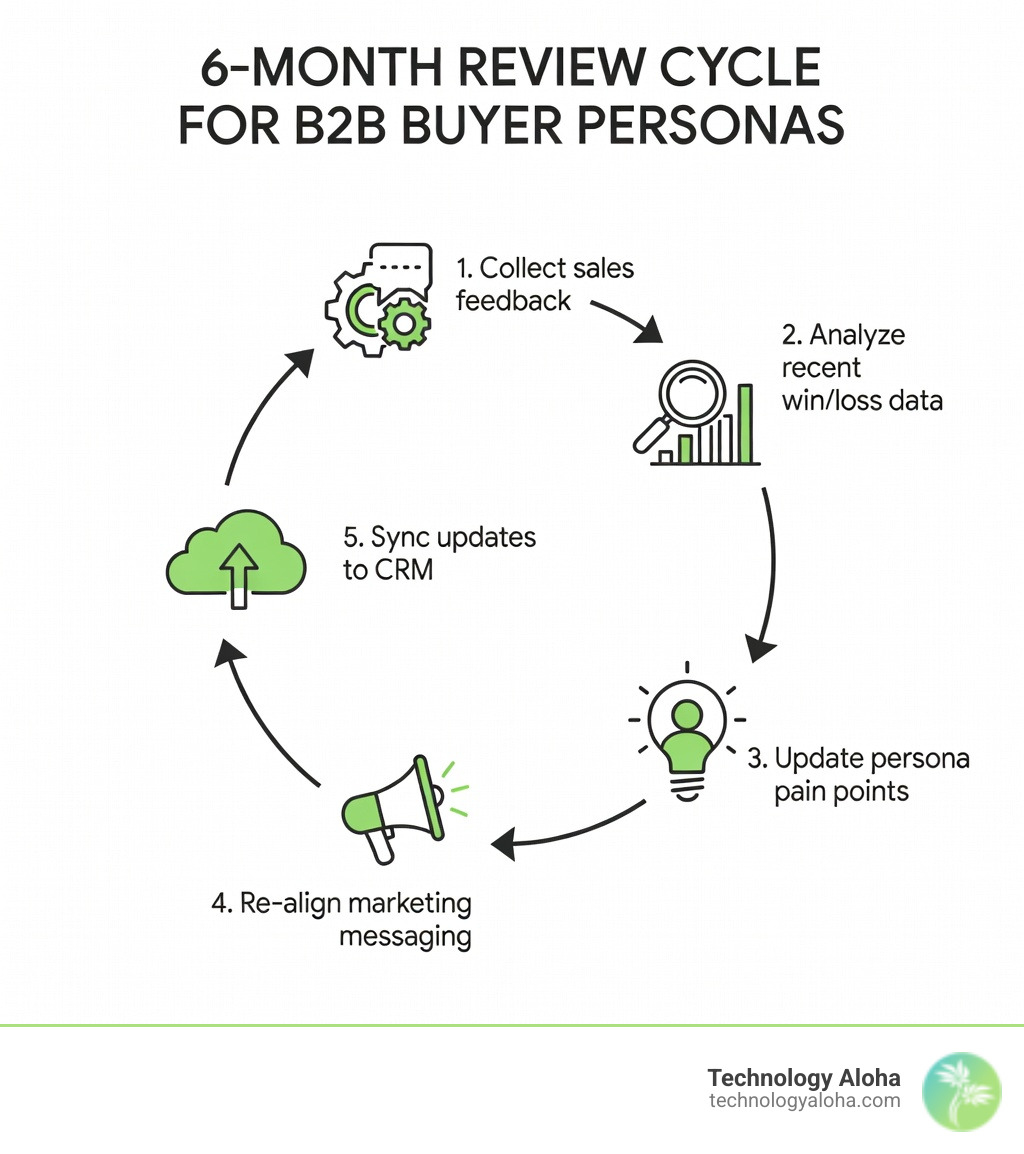
- Mine Your CRM: Look at your “Closed-Won” vs. “Closed-Lost” data. Are there specific job titles that consistently move through the funnel faster?
- Talk to Your Sales Team: Your sales reps are on the front lines. They know the common objections and the “buying triggers” that indicate a prospect is ready to move.
- Analyze Support Tickets: What are your current customers struggling with? These challenges often mirror the pain points of your future buyers.
- Use Real Quotes: Don’t just summarize. Use the actual language your buyers use. If they say they are “drowning in manual data entry,” put that exact phrase in your b2b buyer persona template.
You can start with a B2B buyer persona template as a foundation and customize it based on these real-world findings.
Avoiding Common Persona Pitfalls
Even with the best intentions, many teams fall into these traps:
- Making Assumptions: Never sit in a conference room and “invent” what you think a buyer cares about. If it isn’t backed by an interview or data, it’s a fairy tale.
- Over-Segmentation: You don’t need 20 personas. Most B2B companies only need 2 to 5. Start with your primary decision-maker and one or two key influencers.
- Focusing on Irrelevant Demographics: In B2C, knowing a buyer likes hiking might matter. In B2B, knowing they use HubSpot and report to the Board of Directors is much more important.
- The “One and Done” Mentality: Markets shift. Competitors launch new features. If you haven’t updated your personas in over a year, they are likely obsolete.
Real-World Examples and Strategic Application
To see how this looks in practice, let’s look at three common B2B roles. Each of these people might work at the same company, but they require entirely different messaging.
- Operations Olivia (The Decision-Maker): Olivia is a VP of Operations. Her goal is efficiency and scalability. Her pain point is “siloed data.” To win her over, you need to prove a 20-30% efficiency gain and show how your tool integrates with her existing workflow.
- IT Director Ian (The Evaluator): Ian doesn’t care about the marketing fluff. He cares about security, uptime, and ease of implementation. If your product doesn’t meet his technical requirements, he will veto the deal, even if Olivia loves it.
- HR Manager Helena (The User/Influencer): Helena is the one who will actually use the software every day. Her “trigger” is high employee turnover or manual tasks taking up too much time. She needs to see that the tool is easy to use and will make her daily life better.
For more details on how these personas impact your overall plan, read our post on persona examples and marketing strategy.
Where to Download a Free b2b buyer persona template
You don’t have to start from scratch. There are several excellent resources available depending on your preferred workflow:
- Interactive Tools: Use the free buyer persona generator from HubSpot to build a polished, digital profile that you can easily share with your team.
- Collaborative Documents: Google Docs templates are great for teams that need to leave comments and iterate together.
- Design-Forward Options: If you want a persona that looks great in a presentation, Canva offers thousands of user persona templates that you can customize with your brand colors.
- Project Management: Notion frameworks allow you to link your personas directly to your content calendar or product roadmap.
Integration, Tools, and Maintenance
A b2b buyer persona template is only useful if it lives where your team works.
CRM Synchronization: Most modern CRMs allow you to tag leads with a specific persona. This allows you to automate email sequences. For example, if a lead is tagged as “IT Director,” they automatically receive technical documentation rather than a generic sales brochure.
Content Mapping: Every piece of content you create should be assigned to a persona and a stage of the buyer’s journey. If you realize you have ten blog posts for “Helena” but nothing for “Olivia,” you know exactly where your content gap is.
Review Frequency: We recommend reviewing your personas every 6 to 12 months. A major market shift (like a new technology or a change in the economy) should trigger an immediate update. Validate your personas by looking at your latest “Win/Loss” reports—are the reasons people are buying still the same ones listed in your template?
Frequently Asked Questions about B2B Buyer Personas
How many buyer personas does a B2B business actually need?
Most B2B businesses find success with two to five personas. This usually includes one primary decision-maker (the person who signs the contract), one or two influencers (the people who will use the product), and one “negative” persona (someone who looks like a lead but isn’t a good fit).
What is the best way to recruit buyers for persona interviews?
The best way is to offer an incentive, such as a gift card, for 20 minutes of their time. Reach out to recent customers, but also try to reach out to “lost” prospects. They often provide the most honest feedback about perceived barriers or why they chose a competitor.
How do marketing and sales teams use personas differently?
Marketing uses personas to create targeted ad copy, blog posts, and lead magnets that “hook” the right audience. Sales teams use them to personalize their outreach, prepare for discovery calls, and quickly identify which objections a specific role is likely to have.
Conclusion
Building a b2b buyer persona template is the first step toward a more mature, data-driven marketing strategy. It moves your business away from guesswork and toward a deep, empathetic understanding of the people you serve.
At Technology Aloha, we believe that the best marketing blends cohesive branding with high-conversion designs backed by real-world insights. Whether you are based here in Hawaii or serving a global market, your success depends on your ability to speak to your customers’ true needs.
Ready to sharpen your approach? Explore our strategic marketing strategy services to see how we can help you turn these insights into growth.