A Practical Campaign Development Process for 2026
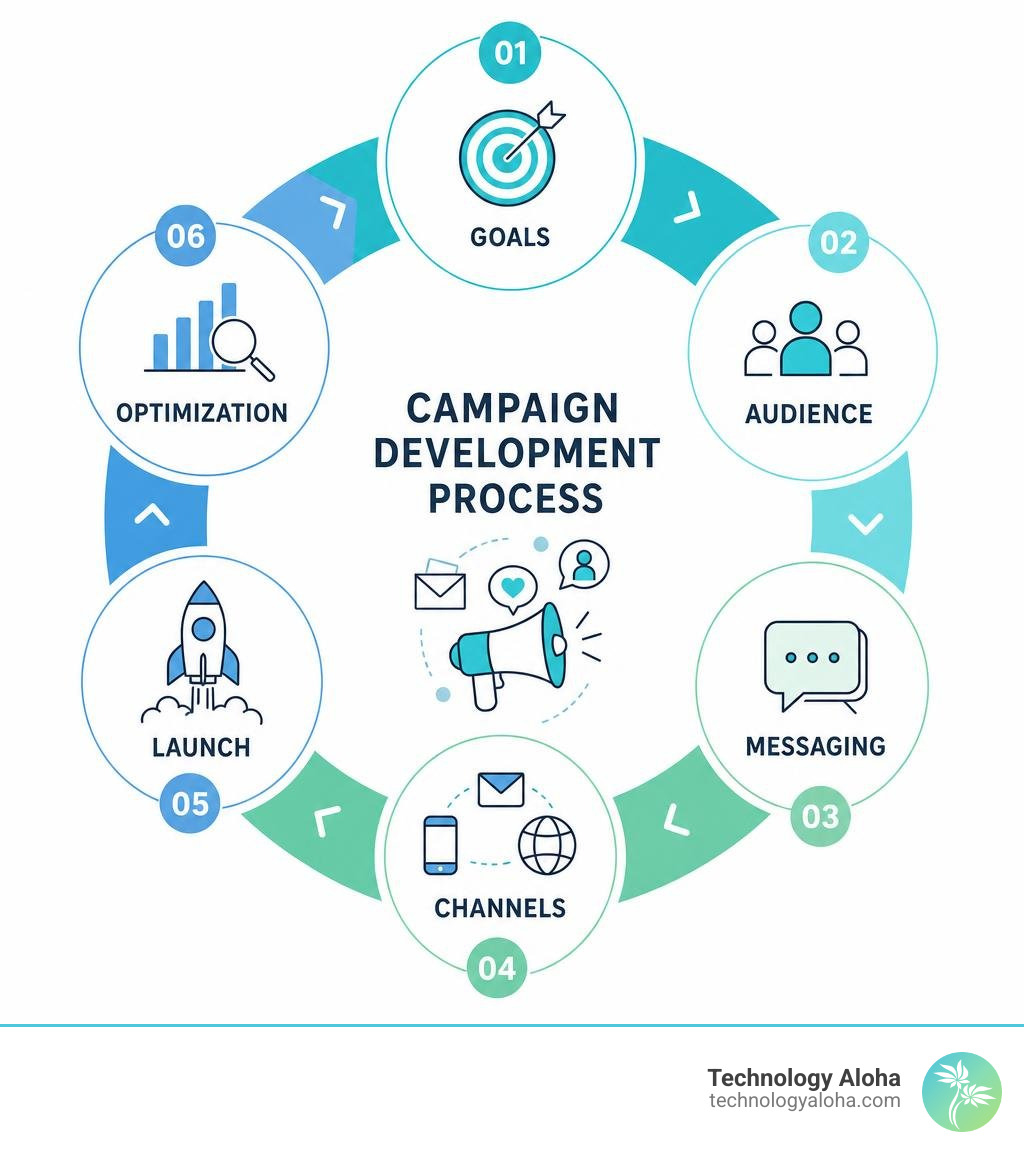
A strong campaign development process follows a clear sequence:

- Align one measurable campaign goal with a wider organizational outcome.
- Research and segment the people most likely to act.
- Build one core message, then adapt it for each channel.
- Assign budget, owners, deadlines, tracking, and approval steps before launch.
- Monitor results, test improvements, and document what to repeat or change.
For food banks and nonprofits, this structure helps turn scattered activity into a coordinated effort. Instead of publishing posts, sending emails, and buying ads as separate tasks, every touchpoint can support one outcome – such as more recurring donors, more volunteer sign-ups, or fewer barriers to accessing services.
The work is operational as much as creative. APQC research reports a median campaign development and launch cycle time of five weeks across industries. A written plan, clear ownership, and pre-launch tracking help teams use that time well—especially when staff, data, and approval processes are already stretched thin.
Similar topics to campaign development process:
- The Ultimate Guide to Marketing Plan
- Detailed Guide to Advertising Media Planning Basics
- Marketing Strategy Tips 2026
Core Foundations of the Campaign Development Process
Every successful campaign rests on a solid architectural foundation. When campaigns fail, they rarely falter due to poor visual design or uninspired copywriting; they break because the underlying structure lacks strategic intent. Without structural integrity, marketing activities become random acts of promotion that consume resources without driving sustainable growth.

Understanding how a campaign fits into broader organizational planning requires viewing it through the lens of The Complete Guide to Understanding the 4 Stages of Marketing Planning. A marketing strategy sets the multi-year direction, whereas a campaign is an orchestrated, time-bound initiative designed to achieve a specific milestone within that overarching vision.
A classic misstep is confusing marketing campaigns with standalone advertising pushes. The Campaign Development Process an outline method emphasizes that comprehensive campaigns must encompass the entire constituent journey across multiple touchpoints, rather than merely purchasing short-term attention.
| Dimension | Marketing Campaign | Advertising Campaign |
|---|---|---|
| Scope | End-to-end customer or donor journey across owned, earned, shared, and paid media | Focused primarily on paid media placements (search, social ads, display, print) |
| Objective | Full-funnel outcomes (e.g., donor retention, volunteer onboarding, community education) | Upper-funnel reach, immediate clicks, or direct-response actions |
| Touchpoints | Website landing pages, email sequences, CRM workflows, events, PR, and ads | Ad platforms, sponsored content, paid broadcast, and print spaces |
| Lifecycle | Typically 4–12 weeks of phased engagement and nurturing | Runs strictly as long as media spend is actively allocated |
| Success Metric | Net revenue, donor lifetime value, cost per acquisition, systemic engagement | Impressions, click-through rate (CTR), cost per click (CPC), return on ad spend (ROAS) |
Managing resource constraints and securing stakeholder buy-in early protects the campaign from mid-flight disruption. By anchoring the campaign architecture in verifiable organizational priorities, teams mitigate operational risks and ensure that every dollar spent directly moves the needle.
Six Essential Phases to Build and Launch a High-Impact Campaign
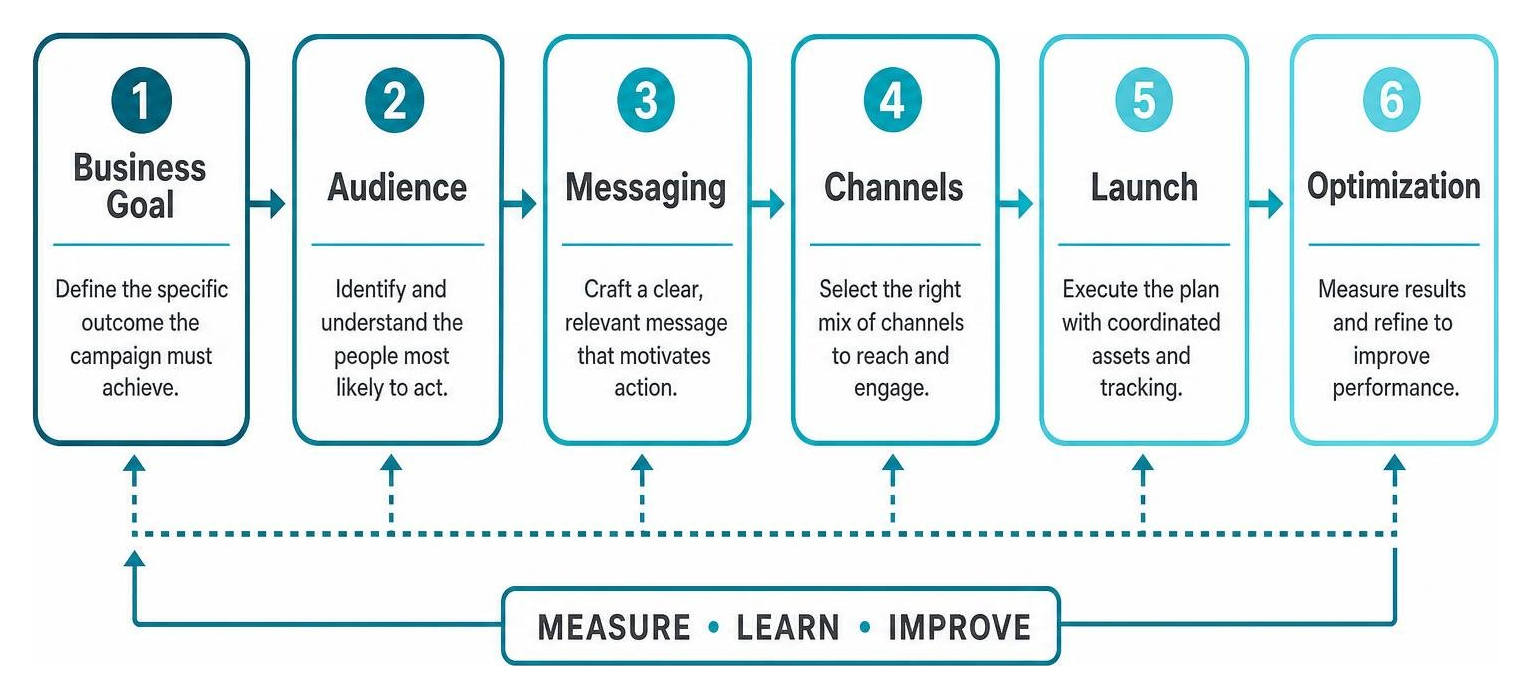
Executing a sophisticated campaign requires disciplined governance and clear operational pacing. Rather than treating development as an ad-hoc checklist, high-performing teams guide their initiatives through six distinct, interdependent phases.

Phase 1: Setting SMART Goals and Concrete KPIs
A campaign must begin with unambiguous mathematical targets. Applying the SMART framework—Specific, Measurable, Achievable, Relevant, and Time-bound—ensures that internal teams and external stakeholders evaluate success against the exact same criteria. Setting deliberate milestones provides the focus needed to increase brand awareness by 15% in 6 months while keeping operational spend contained.
When establishing objectives, align them directly with your organization’s financial realities and programmatic needs as outlined in The Ultimate Guide to Marketing Plan.
- Primary Outcome Goals: Specific, top-line deliverables such as securing 450 new monthly recurring donors, generating $120,000 in unrestricted capital, or enrolling 300 active community volunteers within an eight-week window.
- Secondary Efficiency KPIs: Diagnostic health indicators, including maintaining a Customer Acquisition Cost (CAC) under $35, sustaining an email click-to-donate rate above 4.2%, and keeping landing page bounce rates below 40%.
Phase 2: Audience Research and Strategic Segmentation
Relevance drives conversion. Blasting generic messaging to a broad audience creates fatigue and inflates acquisition costs. Effective campaign planning starts with mining first-party data from your CRM, email management systems, and website analytics.
Segment your audience across three essential layers:
- Behavioral Data: Recency, frequency, and monetary value of past interactions (e.g., one-time donors versus recurring sustainers; event attendees versus passive newsletter subscribers).
- Psychographic Drivers: Underlying motivations, community values, and specific programmatic interests (e.g., childhood hunger alleviation, rural food distribution, or emergency disaster relief).
- Friction Points: Identifying and eliminating physical, technological, or psychological barriers that prevent action, applying proven principles of How to Win Friends and Influence Markets with Brand Positioning and Differentiation.
Phase 3: Omnichannel Strategy and Messaging Architecture
A robust narrative hierarchy ensures your core message remains resonant regardless of where a prospect encounters it. The central theme must speak directly to the audience’s primary motivation, supported by clear proof points and an unambiguous call to action (CTA).
Integrating channels effectively requires balancing your media mix across four pillars:
- Owned Media: High-conversion landing pages, automated email nurturing sequences, and dedicated website resource hubs.
- Paid Acquisition: Targeted search ads, geotargeted social media campaigns, and local digital sponsorships designed using fundamentals from our Detailed Guide to Advertising Media Planning Basics.
- Earned Reach: Regional press releases, local news features, and community partner endorsements.
- Shared Channels: Co-branded initiatives with regional corporate partners and peer-to-peer advocate toolkits.
Phase 4: Creative Production and Asset Development
Creative assets must serve the overarching strategic objective rather than visual novelty alone. Ineffective briefings remain a primary source of friction when strategic direction and creative execution diverge.
To ensure creative fidelity, build a modular asset suite around a primary “hero” concept:
- Hero Assets: Long-form impact videos, deep-dive case studies, or interactive community impact calculators.
- Derivative Assets: Snappy 15-second social cuts, static visual quotes, custom email header graphics, and digital display banners.
- Design Systems: Strict adherence to color systems, accessibility standards, typography, and layout rules rooted in The Definitive Guide to Brand Identity Web Design to maintain instant brand recognition.
Phase 5: Technical Infrastructure and Tracking Configuration
Technical breakdowns at launch destroy ad spend and skew analytics. Before any public-facing channel goes live, technical teams must validate the end-to-end user flow across all digital infrastructure.
- Standardized UTM Taxonomy: Maintain rigid naming conventions across source, medium, campaign, term, and content parameters to ensure clean attribution reporting.
- Event Tracking & Pixel Verification: Verify that Google Analytics 4 (GA4) conversion events, Google Tag Manager containers, and platform tracking pixels trigger accurately across form submissions and payment gateways.
- Donation Platform & Checkout Testing: Perform live end-to-end test transactions across mobile and desktop devices to identify latency, unexpected form fields, or checkout friction that might deter donors.
Phase 6: Live Execution and Real-Time Optimization
A launch is not a static event; it is the beginning of active tactical calibration. Staggering channel activation allows teams to spot and resolve unforeseen user friction before committing the bulk of paid media budgets.
- Daily In-Flight Monitoring: Monitor traffic volume, bounce rates, ad frequency, and initial conversion velocities during the first 72 hours.
- A/B Performance Testing: Run iterative split tests on landing page headlines, hero imagery, and button CTA copy, systematically retiring underperforming variations.
- Bid & Budget Rebalancing: Shift daily spend dynamically away from saturated channels and toward ad sets demonstrating the highest conversion velocity and lowest cost per acquired supporter.
Managing Operations: Budget, Cross-Functional Alignment, and AI Tools
Operational excellence separates high-performing organizations from chaotic ones. Keeping complex initiatives on schedule requires robust budget modeling, cross-functional synchronization, and the intelligent application of modern automation tools.
When establishing operational budgets, high-performing organizations allocate capital across distinct operational buckets:
- Core Media Spend (55–65%): Direct paid acquisition across search, social, and display channels.
- Asset Production & Creative (20–25%): Copywriting, videography, graphic design, and landing page engineering.
- Tooling & Infrastructure (5–10%): Specialized software licenses, CRM data hygiene, and testing tools.
- Contingency Reserve (10%): Unallocated capital reserved to capitalize on unexpected high-performing opportunities or mitigate sudden performance drops.
Streamlining the Campaign Development Process with AI and Automation
Artificial intelligence and marketing automation have transformed campaign orchestration from a manual grind into an agile discipline. By 2026 standards, forward-thinking teams leverage AI not to replace human strategic insight, but to remove operational friction.
- Predictive Audience Segmentation: Machine learning models analyze historical CRM transaction data to identify high-propensity donor clusters and forecast lifetime value before a campaign launches.
- Dynamic Content Personalization: Automated systems tailor landing page messaging and email subject lines in real time based on referral sources, geographic locations, and past giving histories.
- Operational Workflow Automation: Natural language processing tools transcribe planning sessions, extract key action items, automatically populate task tickets, and draft initial creative briefs, accelerating internal production cycles.
Governance, RACI Frameworks, and Cross-Team Alignment
Cross-functional friction between marketing, development, and executive leadership creates costly approval bottlenecks. Establishing a formal RACI (Responsible, Accountable, Consulted, Informed) matrix before creative production begins guarantees clear decision-making authority.
- Responsible (The Doers): Content creators, graphic designers, and media buyers executing individual assets and channel configurations.
- Accountable (The Decision-Maker): The Campaign Lead or Marketing Director who holds singular sign-off authority and owns overall performance outcomes.
- Consulted (Subject Matter Experts): Program directors, volunteer coordinators, and IT specialists who provide vital operational facts and technical validation.
- Informed (Executive Leadership): Executive Directors and Board Members who receive structured, high-level milestone updates without introducing mid-campaign scope creep.
Measuring Real Business Impact Beyond Vanity Metrics
Surface-level metrics like impressions, post likes, and page views provide momentary validation but offer little insight into actual organizational health. Measuring true impact demands connecting digital engagement directly to revenue, pipeline expansion, and long-term retention.
To establish an actionable measurement framework, categorize your metrics into primary business outcomes and diagnostic health indicators:
- Primary Business Metrics:
- Net Revenue Generated (Total income minus total campaign expenditure)
- Cost Per Acquisition (CPA / CAC)
- Return on Marketing Investment (ROMI / ROAS)
- New Recurring Donor / Customer Lifetime Value (LTV)
- Volunteer Capacity Hours Secured
- Diagnostic Metrics:
- Landing Page Conversion Rate (%)
- Email Open and Click-Through Velocity
- Cost Per Click (CPC) and Cost Per Mille (CPM)
- Funnel Drop-Off Rate at Payment Steps
- Ad Creative Engagement and Retention Duration
Attribution Modeling and Calculating Campaign ROI
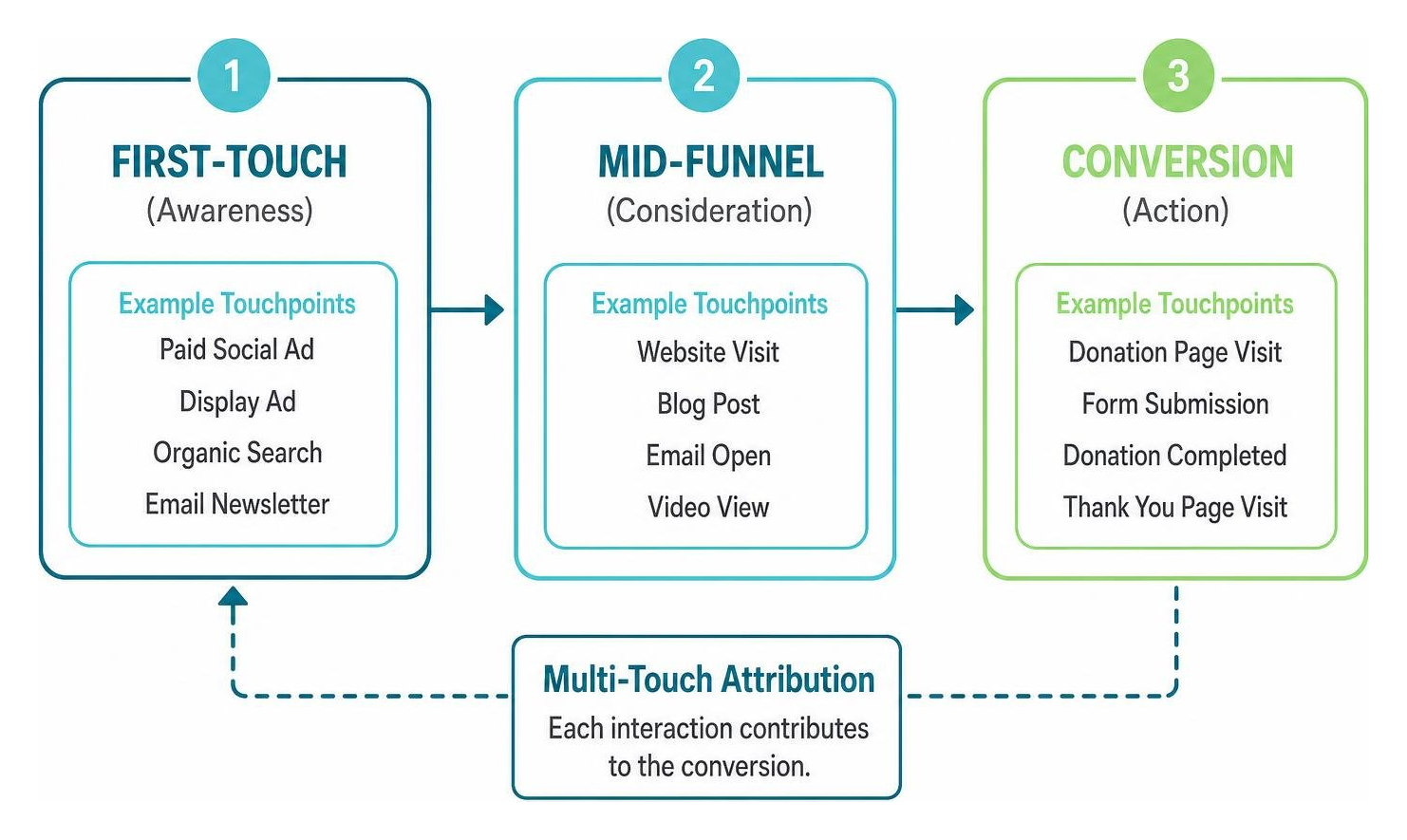
Relying solely on single-touch attribution—such as first-touch or last-touch models—presents a distorted view of performance. A first-touch model overvalues top-of-funnel social awareness, while a last-touch model attributes all success to a final branded search ad, ignoring weeks of educational nurturing.
Implementing a multi-touch attribution model (such as linear, time-decay, or data-driven attribution in GA4) distributes credit proportionally across every touchpoint.
$$text{Campaign ROI (%)} = left( frac{text{Net Attributed Revenue} – text{Total Campaign Cost}}{text{Total Campaign Cost}} right) times 100$$
Example Calculation: If a seasonal fundraising drive generates $180,000 in attributed donations against a total expenditure of $45,000 (including staff hours, media spend, and creative production), the return is:
$$text{ROI} = left( frac{$180,000 – $45,000}{$45,000} right) times 100 = 300%$$
Optimizing the Campaign Development Process Through Post-Mortem Analysis
The lifecycle does not end when the final ad concludes. A structured post-mortem debrief transforms temporary execution into institutional wisdom. Within two weeks of campaign close, bring key cross-functional team members together to evaluate the entire project lifecycle.
Review the original SMART benchmarks against actual results, pinpoint where production bottlenecks occurred, analyze creative asset fatigue points, and document technical tracking anomalies. Archiving these findings ensures that future marketing iterations launch faster, convert at higher rates, and continually lower organizational acquisition costs.
Frequently Asked Questions About Campaign Development
How long does the campaign development process typically take?
While timelines vary based on organizational complexity, cross-industry benchmark data reveals a median development and launch cycle of 5.0 weeks. Straightforward digital initiatives can often be deployed in 3–4 weeks, whereas complex omnichannel campaigns requiring custom video production, extensive landing page development, and multiple stakeholder sign-offs typically require 6–8 weeks of preparation.
What is the primary difference between a marketing campaign and an ongoing strategy?
An ongoing marketing strategy serves as a continuous, permanent operational framework that defines brand positioning, value propositions, and overarching growth goals over years. A campaign is an intensive, time-bound execution (typically 4–8 weeks) with a defined beginning, middle, and end, created to accomplish a singular, measurable objective that accelerates the broader strategy.
How should teams manage budget contingencies during execution?
Organizations should ring-fence a 10% contingency reserve within the primary campaign budget. This capital remains unassigned during initial media allocation. If a specific channel significantly outperforms baseline projections, contingency funds can be unlocked instantly to capitalize on momentum without pulling capital from active ad sets or requiring executive board approval cycles.
Conclusion
Building a sustainable, high-impact campaign requires moving beyond fragmented digital marketing tactics. By structuring initiatives around rigorous architecture—from foundational SMART goals and data-backed audience segmentation to disciplined multi-touch attribution—organizations establish a predictable engine for community growth and sustained engagement.
Successful campaigns combine sound operational discipline with user-centered design, systematically eliminating friction across every stage of the constituent journey.
For more frameworks on structuring long-term organizational outreach, consult the Marketing Strategy Guide Small Business 2026 to continue refining systematic, conversion-focused campaigns that drive measurable results.